


Book Review of How to Draw the World: Harold and the Purple Crayon and the Making of a Children’s Classic
The Children’s Book Review
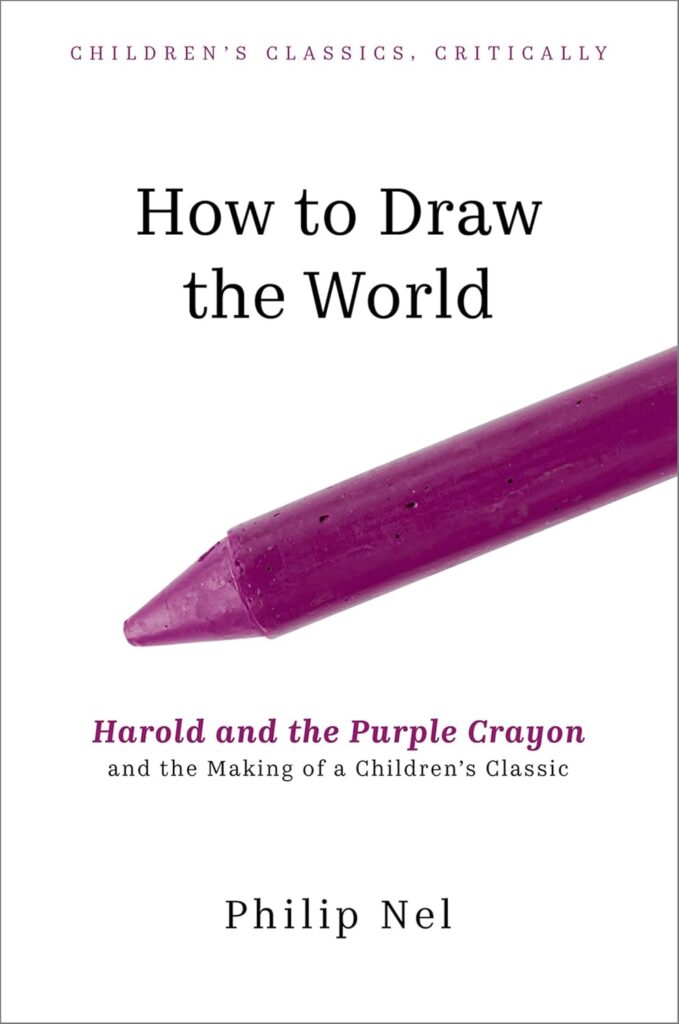
How to Draw the World: Harold and the Purple Crayon and the Making of a Children’s Classic
Written by Philip Nel
Ages: 15+ | 184 Pages
Publisher: Oxford University Press (2024) | ISBN: 9780197777619
What to Expect: Art criticism, design analysis, biography, cultural history, creative process, picture book scholarship.
A scholarly deep dive into one of children’s literature’s most enduring classics reveals the genius behind simplicity.
What can be said about a boy, a crayon, and the moon? According to Philip Nel, quite a lot—thirty chapters’ worth, to be exact. How to Draw the World is a scholarly examination of Crockett Johnson’s 1955 masterpiece, Harold and the Purple Crayon, that explores how a deceptively simple picture book became a cultural phenomenon that inspired everyone from Prince to Pulitzer Prize-winning authors.
Nel, who previously wrote Johnson’s biography, brings decades of expertise to this “biography of a book” revealing the hidden complexities of creating Harold and the Purple Crayon: deliberate design choices, the printing process behind the three-color palette, typeface selection (even Garamond matters), and even how Harold’s tan hue sparked conversations about race and representation in children’s literature.
The book excels as both a primer on picture book art and design and a meditation on creative process. Nel demonstrates how words and images work together in sophisticated ways, exploring the “complex interdependency of visuals, words, and sequence” that makes picture books far more than simple stories with pictures. His analysis reveals how Johnson distilled the boundary between imagination and reality into its most profound form—using only a child, a crayon, and a blank page to show readers that they can improvise, invent, and draw new paths when faced with obstacles.
Nel’s writing strikes a balance between scholarly rigor and accessibility, making complex ideas about modernism, Cold War creativity, and abstract art engaging for general readers through its concise chapters that extend outward into art history, biography, and politics. It models the pleasures of sustained attention while demonstrating that looking closely at familiar things can reveal extraordinary depths—proving that sometimes the simplest crayon drawings contain entire universes. This multidisciplinary approach rewards readers fascinated by the creative process and design theory.
How to Draw the World is an essential and inspiring read for educators, artists, designers, and anyone who believes that children’s books are not a lesser art form.
Buy the Book
About the Author
Philip Nel is University Distinguished Professor of English at Kansas State University and the author or co-editor of 15 books, including: a double-biography of the children’s writers Crockett Johnson and Ruth Krauss, Keywords for Children’s Literature, and Was the Cat in the Hat Black?: The Hidden Racism of Children’s Literature and the Need for Diverse Books. This book was one of the catalysts for Dr. Seuss Enterprises’ March 2021 decision to stop publishing six Dr. Seuss books that contain racist imagery.
