

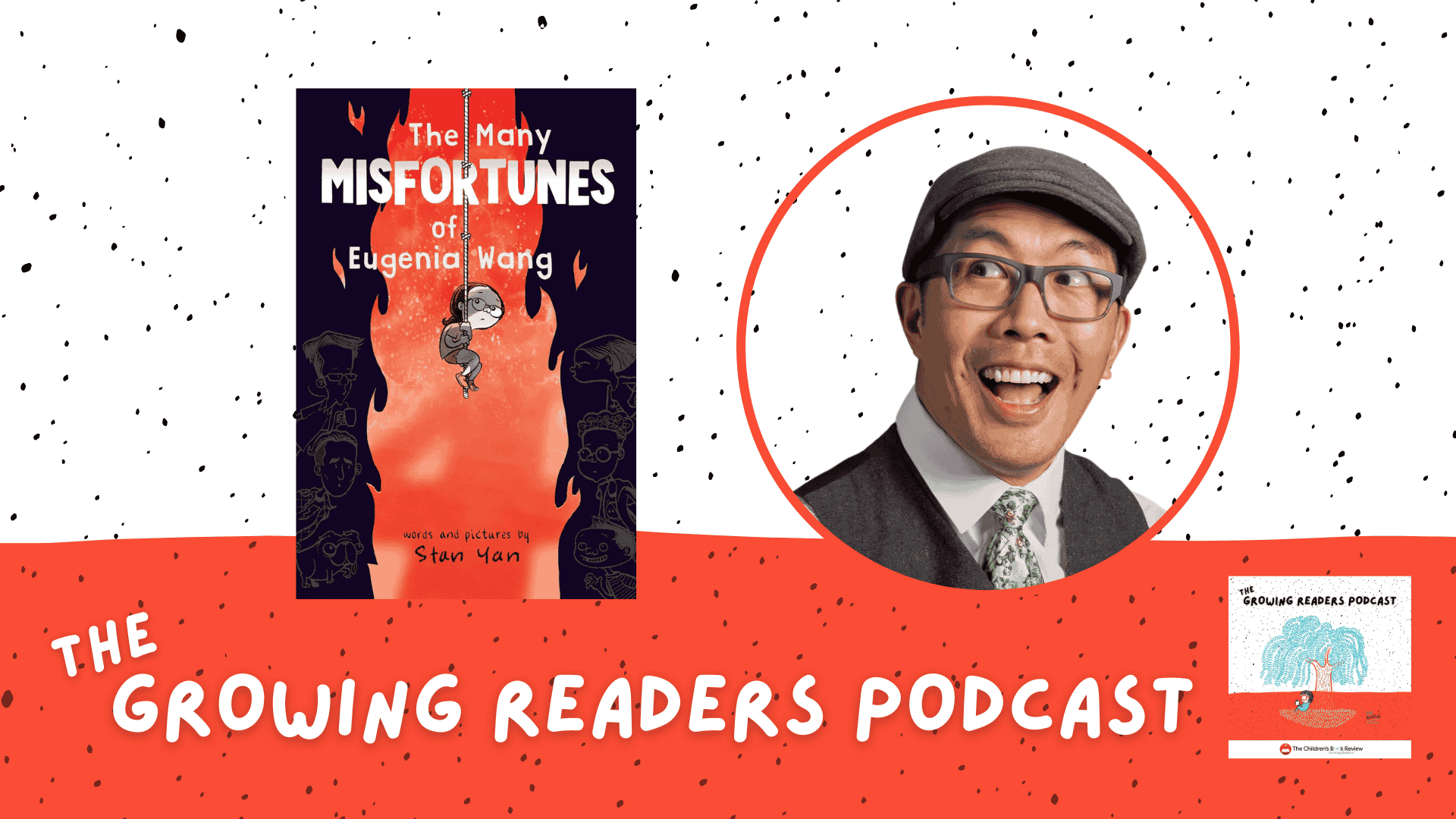
A podcast interview with Stan Yan about The Many Misfortunes of Eugenia Wang. Listen on The Growing Readers Podcast, a production of The Children’s Book Review.
In this candid conversation, award-winning creator Stan Yan shares the transformative moment that changed his approach to storytelling forever.
At age 50, the first-generation American-born Chinese artist realized he had never drawn characters that looked like himself—despite creating stories inspired by his own experiences.
Stan discusses his debut middle-grade graphic novel, The Many Misfortunes of Eugenia Wang, a spooky tale that weaves Chinese superstitions with the challenges of middle school. From his unexpected journey as a stockbroker to children’s book creator, and the six major rewrites that shaped Eugenia’s story, Stan reveals how reading diverse authors like Andrea Wang, Grace Lin, and Kelly Yang gave him permission to create authentic characters.
The conversation delves into the cultural significance of the unlucky number four, the creative challenges of making comics scary for children, and why Stan believes that making stories more specific makes them truly universal. Stan’s graphic novel has already earned recognition as a Junior Library Guild Gold Standard selection—a remarkable achievement for a debut work.
This episode offers valuable insights for creators, educators, and anyone interested in the power of representation in children’s literature.
Subscribe to The Growing Readers Podcast to ensure you never miss an episode celebrating the creators shaping young readers’ lives.
Listen to the Episode
Show Notes
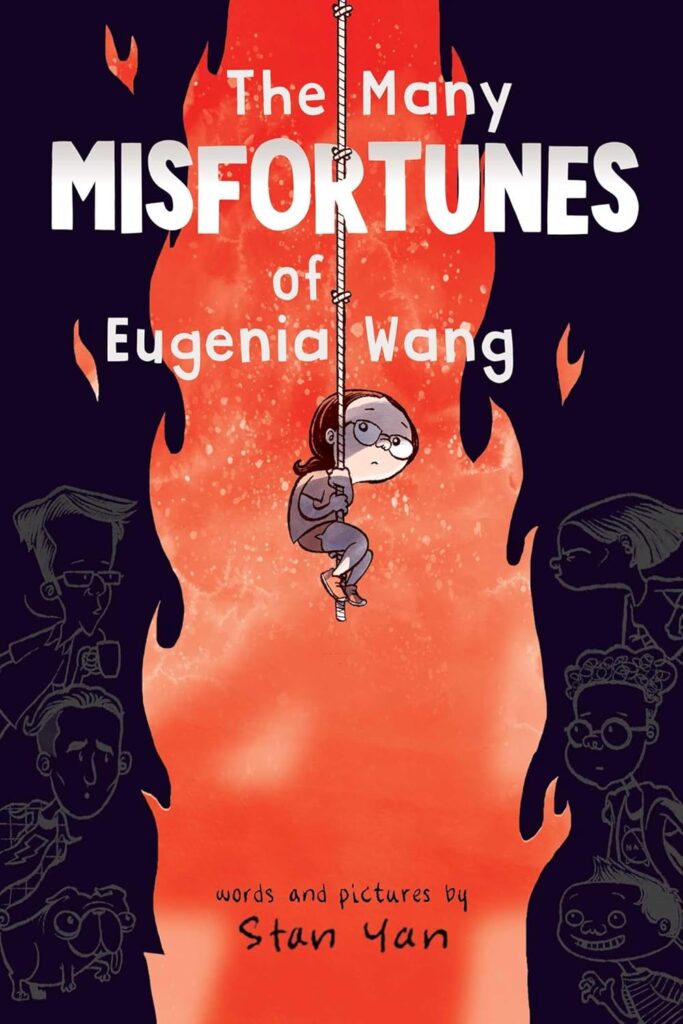
The Many Misfortunes of Eugenia Wang
Written and Illustrated by Stan Yan
Ages 8+ | 264 Pages
Publisher: Atheneum Books for Young Readers | ISBN-13: 978-1665943321
Publisher’s Book Summary: In this hilarious and heartfelt debut graphic novel, a girl born on a day considered unlucky in Chinese superstition starts to wonder if she really is cursed when she’s troubled by visions of doom set to occur on her thirteenth birthday.
Twelve-year-old Eugenia Wang has never celebrated her birthday on her actual birthday, April 4th, because of her mom’s belief in the Chinese superstition that four is an unlucky number. And that’s not the only thing Mom’s strict about; she won’t let Eugenia go to a summer comic art camp because she thinks art is a waste of time. This year, Eugenia is determined to defy her mom by applying for the camp, having her party on her actual birthday, and inviting her super cute crush while she’s at it, too!
But when Eugenia gets hit in the head with a sneaker during PE, she starts getting unnerving visions of impending doom about her upcoming birthday. It might be the aftereffects of her head injury, or maybe she’s just anxious about turning thirteen. As the visions get worse, even affecting her artwork, Eugenia suspects an unseen force may be sending her messages. If she’s haunted after all, Eugenia will have to figure out why before it’s too late. Even more horrifying, she may have to do the unthinkable: admit her mom was right.
Buy the Book
Other Books Mentioned:
- There’s a Zombie in the Basement by Stan Yan: Amazon or Bookshop.org
- Ghost Book by Remy Lai: Amazon or Bookshop.org
- Calvin and Hobbes by Bill Watterson: Amazon or Bookshop.org
About the Author-Illustrator
Stan Yan is an award-winning, first-generation American-born Chinese writer, illustrator, and educator based in Denver. He co-founded the Squid Works comic creator cooperative, serves as co-Regional Advisor for the Rocky Mountain Chapter of SCBWI, and teaches illustration at Rocky Mountain College of Art & Design. His work spans comics, children’s books, and educational materials, with his graphic novel debut earning Junior Library Guild Gold Standard recognition.
Learn more about Stan Yan: https://www.stanyan.me/

Episode Credits:
- Host: Bianca Schulze
- Guest: Stan Yan
- Producer: Bianca Schulze
Read the Transcript
Growing Readers Podcast: Interview with Stan Yan
Bianca Schulze: Welcome to the show, Stan. I’m so excited to have you today.
Stan Yan: Well, thank you for having me. This is my first for this book.
Bianca Schulze: Amazing. Oh my gosh. Well, I feel very privileged. I’m sure there’s many more to come. Since you’re a newbie on the show, which I love a first-time guest, I’m wanting to just hit you up with some rapid-fire questions just so we can get a little sense of who is Stan Yan. Are you ready? This is whatever comes to mind. You can reserve the right to change your mind in another podcast.
Stan Yan: I guess so.
Stan Yan: Okay.
Bianca Schulze: All right, the first one is introvert, extrovert, or somewhere in between.
Stan Yan: I’m probably somewhere in between. I think in my own head, I’m an introvert, but I don’t know that other people see me that way.
Bianca Schulze: Yeah, relatable. Favorite comic book character when you were growing up?
Stan Yan: I’d say comic book character. That’s tough because actually I was more into comic strips growing up and I didn’t get into comic books until I was much older. So I would probably say Calvin from Calvin and Hobbes.
Bianca Schulze: Yeah. Do you still have the collection of books for your own son?
Stan Yan: I have one of them and, I mean, I find that sometimes it’s futile trying to push my own book interests on him.
Bianca Schulze: Yeah, yeah, yeah, I know that. Well, I loved watching cartoons as a kid and I have to imagine that you watched cartoons too. So what cartoon character would you want to hang out with for the day?
Stan Yan: Oh gosh, probably Scooby-Doo. I don’t know, like all the dog characters are always the best. So like in Inspector Gadget, Brain was the best. And then, you know, Wallace and Gromit, you know, Gromit’s so awesome.
Bianca Schulze: Yeah, I love Gromit.
Bianca Schulze: Yes, yeah, yeah, I love it. I love it. Well, if you could have any superpower, what would it be?
Stan Yan: Oh gosh, I think I already have superpowers. And I don’t know, because I always like see the cautionary tales about having a superpower, especially things like time travel or whatever, and then how it just makes things way worse. So for me,
Well, I mean, the existing superpower I have according to my wife is if she’s watching Outlander and I walk into the room, a steamy scene always comes on without, you know, without a doubt. Which one do I want? I don’t know. I mean, I suppose probably I feel like singing is a superpower and I’d love to be able to sing a little bit better, but I’d like to be able to actually
Maybe a photographic memory so that when I read something I remember it all because I have got horrible reading comprehension. I’d love to have my son’s reading comprehension.
Bianca Schulze: That’s funny.
Bianca Schulze: I love that. You know, I always say, and it’s funny because like I spend my days reviewing children’s books and interviewing authors. And I always say like, it’s hard for me to remember exactly what a book was about, but I always remember how I felt when I was reading it. And I say that that counts.
Stan Yan: Guilty. I think the problem with me is whether I’m reading a book or whether I’m listening to an audiobook, my mind tends to wander because I’ll hear something that really connects with me or that I like. And then I’ll start thinking about how it applies to my life or how it gives me an idea for a story I’m writing or a character or whatever. And then before I know it, I’ve been just sitting,
Bianca Schulze: Alright.
Stan Yan: thinking about that for 10 minutes and then I don’t know what I’ve been listening to or whatever.
Bianca Schulze: Yeah, yeah, yeah. Again, totally relatable. All right, well, let’s have a, I’m going to do a creator type rapid fire here. Early bird creator or night owl artist.
Stan Yan: Hahaha
Stan Yan: Okay.
Stan Yan: Oh gosh, that’s a good question because I used to be very much a morning person or a night person. And then I was a stockbroker for about 13 years. So I had to wake up with the East Coast. And because of both of those things and then becoming a parent, I am neither a morning. I’m just tired all the time. So, my creativity is whenever I’m awake, definitely not after lunch.
because that’s when I need a nap.
Bianca Schulze: Yeah.
Stan Yan: Yeah.
Bianca Schulze: That’s a fun answer. All right. Okay. So favorite place to draw or write.
Stan Yan: My favorite place to draw or write is at home. There’s a lot of like distractions, especially the couch after lunch, as I had mentioned. But, and I used to love going to coffee shops and things like that, but I feel like, you know, because of deadlines and I mean, working in isolation is, is kind of nice because it gives my imagination a room to breathe.
without having to overhear someone else’s conversation. I always get a lot of ideas. So if I’m out somewhere, I’ll end up overhearing something or seeing something that ends up distracting me and giving me more ideas, which isn’t a bad thing. But when I’m trying to be focused on an accomplishment, then that’s not necessarily always good.
Bianca Schulze: Yeah, yeah. All right, well, music, silence or background noise when you work.
Stan Yan: Depends on what stage of the process I’m in. If I’m doing any sort of writing at all, I need silence. If I’m doing rough layouts, silence, or just background noise, nothing too engaging. And if I’m coloring my comic, then anything goes.
Bianca Schulze: Pen, pencil, or digital stylus?
Stan Yan: Mostly digital at this point, mostly because of revision aspects and the undo thing. And I find that when I try to draw traditionally and then I do this to enlarge it, it doesn’t work. iPad.
Bianca Schulze: Yeah, and anyone listening, Stan is using his pointer finger and his thumb, you know, when you’re trying to like tap the screen and like make something get bigger. Yeah. But if your artistic style had a flavor, what would it be?
Stan Yan: Right.
Stan Yan: My artistic style had a flavor. I mean, my mind immediately went to ice cream for some reason. So I’m thinking mint chocolate chip just because it’s my favorite. But man, that’s a good question. It would have to be something kind of creepy because like there’s always something a little unsettling about the things that I’m interested in, even if they’re cute things, you know, some
Bianca Schulze: Ha!
Bianca Schulze: So what about like cinnamon? Cinnamon, because it’s kind of like spicy, but then it ends up like smooth or something. Yeah.
Stan Yan: Yeah. Or maybe pumpkin spice. There you go. Because that is tied to holidays that I’m kind of obsessed with.
Bianca Schulze: Yeah, there you go. I like that. See, we got there. We got there. All right. What’s the strangest thing you’ve had to research for a story?
Stan Yan: I don’t know if it’s the strangest and I actually did a video about this, but for this book, I was trying to like figure out something like something divination-wise. Like a Ouija board or, but I wanted something specifically Chinese. So I started looking up, you know, Chinese divination and, you know, kind of did a dive into a bunch of YouTube videos where
I was watching them, it was like a, almost like a divining rod that two people would hold that go into like a sandbox. And then they’re supposed to, you know, like spirits would be writing words through them. And that would be sending messages from the other side.
Bianca Schulze: I love that. I, having read the book, I know that there’s a scene with that. So let’s see, what is the most unexpected reaction you’ve gotten from a young reader or a recipient of a piece of art you’ve created?
Stan Yan: Hahaha
Stan Yan: I think the most unexpected was from my picture book that I came out with in 2016. There’s a Zombie in the Basement. And the unexpected thing was I was contacted by Make-A-Wish. And one of their Make-A-Wish recipients had that as their favorite book. And that just touched me in the deepest way.
and kind of reinforced why I’m doing what I’m doing. What am I doing it for? Yes, it just gave me goosebumps. I was the one saying it.
Bianca Schulze: That just gave me goosebumps, I love that.
Bianca Schulze: Yeah, yeah. So that’s amazing. All right, well, what’s a favorite middle grade book that isn’t yours?
Stan Yan: A favorite middle grade book that isn’t mine.
Probably Ghost Book by Remy Lai.
Bianca Schulze: I knew you were going to say that. Oh my gosh, when I wrote this rapid-fire book, I knew you were going to say that. I freaking love Remy Lai and Ghost Book. I mean, it’s so incredible. I love that you said that.
Stan Yan: Because that’s your superpower.
Stan Yan: Did you get a chance to meet her when she was in town? She was doing a signing at Second Star and she’d been on this probably worldwide tour doing school visits and everything. Unfortunately by the time she got here she was sick. She had a mask on and everything.
Bianca Schulze: I didn’t, I didn’t.
Bianca Schulze: Yeah. Oh, bummer. Well, we did have her on the podcast. So anyone listening, go back and listen to Remy Lai. She was on here. Yeah, yeah, yeah. Yeah, she was on. I love her. I’ve never read a Remy Lai book that I don’t love. All right. Well, what’s the best piece of advice another author has ever given you?
Stan Yan: Oh, I didn’t know that. I have to go back through your archives. So, nice.
Stan Yan: The best piece of advice another author has given me actually might be from Kaz. Kaz Windness is just be ready to wait. Like once you get into publishing, just be prepared to wait. And so for me, it’s been nice because like, I think, the first time I had to wait for anything,
Bianca Schulze: Ready to wait.
Stan Yan: I was just unproductive because I didn’t want to do anything or start anything and then all of a sudden get my marching orders from my editor. And now I know better where I’m like, okay, this is going to be a little while, so feel free to have fun and do the things that you want to do or work on things that you need to do your taxes. That kind of thing.
I’ve been waiting for some editorial notes from my editor recently, and I found myself doing a lot of artwork for myself. I’ve been working, I don’t know if you’ve been watching social media, but I’ve been doing some fan art for some books that I’ve been reading. And that’s been a lot of fun too. And trying to build my cover art portfolio because I want to make myself available during these big breaks where I’m waiting for my editor to maybe get
Bianca Schulze: I did see.
Stan Yan: you know, brought on to do some cover art for a middle grade book or novel or something.
Bianca Schulze: Yeah. Yeah. Awesome. Well, two really quick tangents is since I just raved about Remy Lai and then you mentioned Kaz Windness. Hi Kaz. We love you and everyone Kaz has been on the podcast too. Yes. Blowing kisses to Kaz. Go back and listen to Kaz’s episode. And then also if you don’t follow Stan on TikTok, I love Stan’s TikTok feed. It’s humorous and you see him sketching and he’ll
Stan Yan: Yes.
Stan Yan: Aww.
Bianca Schulze: do critiques of other people’s art and I just, I do like your feed a lot. So if you’re not already following Stan on TikTok, please go and do that. All right, so last rapid fire. If you could collaborate with any artist or author, living or dead, who would it be?
Stan Yan: Just because of the topic matter and because I had a thing in mind, probably Kaz actually. And plus, you know, we can easily keep each other accountable because we probably get together for donuts every one or two weeks.
Bianca Schulze: And then a small test.
Bianca Schulze: Okay, I said no more rapid fire questions. Okay, so what kind of donut? Are you like the cake style donut or the traditional kind of yeast donut?
Stan Yan: It depends on from where. I grew up really loving the Dunkin’ Donuts donuts, but then they stopped making them at the donut shop and they’re not great anymore. And then when I went to high school, Daylight Donuts used to provide my school donuts and I really, really loved their glazed, raised donuts.
but the restaurant that we go to, which used to be a Daylight Donuts, but they keep the same donut recipes. I think they just, you know, license them off of them or something. I don’t know. Their cake donuts are incredible. So yeah, yesterday Kaz and I went and I had a cake donut with chocolate icing and blue sprinkles. Fantastic.
Bianca Schulze: There you go. Now I need to go out for donuts out there. All right, well, I guess we kind of like cheated on the rapid fire because, we… No, it’s fine. And then I was elaborating. So when I say we’re going to go on to longer answers here, I mean, we’re not… Now you’re probably going to get shorter on me. So…
Stan Yan: Yeah, I went really long. I didn’t like give you one word answers.
Stan Yan: Yeah, just wait, you know? I hope… No, we’re gonna be on here for like two hours, I think.
Bianca Schulze: So here’s my question no longer in the rapid fire. What’s one thing that you do in your day-to-day practices that you think would be the most surprising or just even something really relatable?
Stan Yan: Most surprising? I don’t know. I think I already gave that away. Probably the nap. I don’t think there’s anything I do in particular that’s very notable or surprising. I don’t know.
Bianca Schulze: Yeah, I’m kind of jealous that you can nap. I am completely unable to nap despite however, like being tired. I cannot nap during the day.
Stan Yan: I think I can’t sleep in and that’s why I need the nap. So like as I’ve gotten older, I find myself waking up really early in the morning. You know, I told you I’m not a morning person. I’m still not. So that just like leads to sleep deprivation. And then when I get food in my stomach, then all the blood rushes from my head to my stomach. I need a nap.
Bianca Schulze: Hmm.
Bianca Schulze: Love it. What would you say it is that motivates you, what drives you and guides you to create books specifically for children?
Stan Yan: I think because I’m inspired by children’s literature. I mean, originally it was my son. So like before my son was born, I had like absolutely no interest in doing children’s books just because you know, what I do and my muse is comics. So it’s a little time consuming because I’m not only writing, I’m drawing, I’m doing the whole, you know, ball of wax there.
But then my son came along and he became kind of the focus of my inspirations because I think originally is because I wanted to entertain him. But even before that, I’ve I kind of got addicted to entertaining people, but I can’t remember things, so I can’t be a stand-up comedian and I’m kind of good at drawing. So.
Bianca Schulze: Yeah.
Stan Yan: that seemed to always be like the way I needed to tell stories. And in my own head, I always see stories in comic panels for as long as I can remember. So that ended up being the media that I, the format that I used to, you know, originally just to tell jokes mostly. Like I said, I was really inspired by comic strips.
but, I think like the first time I sold like a photocopied saddle stitched, comic book, self published comic book at a comic book convention to a stranger. And they told me how much they loved it. That that was the, the juice, man. That’s what, keeps me going is, is being able to have an effect on people.
Bianca Schulze: Yeah.
Stan Yan: but specifically children because as I started writing for children, I started reading a lot more children’s books. And I feel like I love them a lot better because of the, like the pure motivations of a child protagonist, as opposed to like a lot of the adult stuff that I’ve been reading was, you know.
zombie apocalypse stuff and everyone is just like so damaged beyond belief that the protagonists, you know, have very selfish motivations at times, or they do things because they’re damaged. Whereas I feel like most children, protagonists, even YA, you know, they’re still hope, you know, and that’s what I love about it. And I like to
normalize that we don’t have to be evil people. Whereas I think a lot of times in adult literature, it’s like, it’s inevitable, we’re all evil. I don’t know. I don’t like to think that way, you know. And I do feel like, you know, reading is a gateway to connecting with other people. And I think that
Bianca Schulze: Yeah. There might be some truth to that, but I know I love that. Yeah. I love that. I know I feel.
Stan Yan: A lot of the adult literature that normalizes that we’re all evil or movies or TV is based on the people that we see around us that probably don’t read.
Bianca Schulze: Yeah.
Bianca Schulze: Truth to that too, probably. All right. Well, to be a writer, they say that you need to be a reader first. So was there a pivotal moment in which you considered yourself a reader?
Stan Yan: I feel bad because I’ve been horrendous as a reader because I, like I said, I have bad reading comprehension and I always have. I was a slow reader growing up and, but the things that appealed to me were heavily illustrated. So growing up, I was, I really loved Where the Wild Things Are.
because of the imagery. I love Dr. Seuss because of the rhyming sing-song nature of the text. And those were like two major influence books that are authors that influenced me, authors and illustrators that influenced me at that time. And then, you know, get into school and pretty much most of what I was reading was what was assigned to me.
I had to read for English class. And then in college that continued. And I still had my moments where I got into spurts of reading Stephen King or Anne Rice or all the spooky stuff that I love. But when I got out of school, unless it was like a comic book or a graphic novel,
Bianca Schulze: Yeah. Yeah.
Stan Yan: I would say there were times where there were probably gaps where I didn’t read for entertainment for like 10 years, a long time. So I think it, it, like I started reading more probably around the time I started doing children’s books. And now, I’m mostly reading novels and, thanks to
my discovery of audiobooks, I’m voracious. It’s unusual if I don’t get through 75-100 books a year. Yeah.
Bianca Schulze: I love audiobooks. But I’m so curious then if audiobooks is maybe the medium that you frequent most in terms of reading, have you noticed if that audio storytelling has impacted your visual storytelling? So when you’re listening and taking in the audio, like, and maybe this is a bit of an abstract question, but like, you know, do you like?
Do you get sort of more visual inspiration when you’re listening?
Stan Yan: Um, I don’t know. I mean, I’m always visual no matter what, whether I’m like reading a book, um, or if I’m listening to a book. So I really couldn’t say one way or another. Um, yeah, so that’s, that’s my long answer for you.
Bianca Schulze: Yeah. Yeah. Yeah.
Bianca Schulze: All right. Yeah, I love it. It’s definitely not gonna be the shortest one yet. I love it. All right, well, let’s get into your graphic novel. So it’s your debut graphic novel and it’s The Many Misfortunes of Eugenia Wang and it combines Chinese superstitions, middle school challenges, supernatural elements. So I would love it if you can walk us through how this story came to life.
Stan Yan: Yes.
Bianca Schulze: Because I want listeners to hear the backstory of the various iterations that began with a completely different main protagonist. So, Eugenia is an amazing protagonist. I love Eugenia. But she wasn’t actually how the story started. So, walk us through it.
Stan Yan: Yes.
Stan Yan: Now, she wasn’t originally female and she wasn’t originally Chinese. So for me, this was actually kind of a bucket list thing that I wanted to do because I wanted to write and illustrate a comic that actually scared me because even though comics has a rich history of horror,
It just never scared me, you know, the same way that like a movie would or a novel would. Because with a novel, like I said, I’m always visual. And so my brain does all the heavy lifting about how scary the thing I’m reading is, you know. And then on the movie side, you you have the benefit of sound effects, an editor that paces things and edits things the way that they…
the speed that they want you to watch things. And so the jump scares work. But, you know, the closest thing to that in a comic is the page turn, you know? I mean, there’s like only so much if someone’s going to jump after a page turn, I would think. So I was like, there’s got to be a way of, you know, creating a comic that would scare me. And so as I started thinking about the things that I really
loved and that spooked me. There was like a common thread through a lot of it, which was I was relating to a child character. And so I’m like, okay, well, I need to make the protagonist a child of some sort, because I felt like, well, like children are a little more innocent and they also
maybe haven’t discounted the possibility of what can or can’t be because of science or because of, whatever, you know, and, so, you know, I could do some supernatural stuff there. So what I almost by accident became a children’s book. You know, I’d already started, I’d already written, you know, There’s a Zombie in the Basement by then, but, but then I, so I started writing it and it was originally a story called, Olfactory Memory.
Stan Yan: where the main character gets hit in the head and starts having these visions triggered by certain smells of what he later connects to being past lives that he’s had. So he’s been reincarnated, but always at the moment that he dies in those past lives and it’s always on his 13th birthday.
Bianca Schulze: Hmm.
Stan Yan: Um, but then, you know, I was like, Oh, so then I started reading, um, books by like Andrea Wang and Kelly Yang and, uh, Grace Lin. And it made me do a little bit of soul searching because I was like, why, you know, first of all, in my picture book, why did I not make my protagonist who’s named after my son?
look like me because he looks like me, you know? I didn’t ever even considered it. This is why, you when I do school visits, I always talk about how, you know, representation matters because I don’t want you to grow up thinking that you can’t draw a main character that looks like yourself, like me.
you know, as a 50 year old, still thought, you know, it never even crossed my mind because in my mind I’m rationalizing that, you know, I want to make this as appealing to as many people as possible and make it more universal, but universal to who, you know? And then there was a quote, I forget who delivered the quote, but I remember Jason Reynolds repeated it about how you make something so specific, it becomes universal. I’m like, that makes sense because I think
Like there’s certain authenticity that needs to be in things that become universal. And if you’re not really writing based on your own experiences in history and who you are, then, you know, it’s not going to be quite as authentic. So, so anyway, then I was like, I should make him Chinese. And then I should, and just to make it even more authentic, I was like, why don’t, why don’t we like set it
in the early 1980s when I was a child too. And so he could have, it could be kind of like a love story to my own childhood and things that I had to deal with, with Chinese parents and Chinese older sister and everything. But then I took it to get a manuscript review at the summer.
Stan Yan: SCBWI virtual conference with Melissa Manlove, who at that time was with Chronicle Books. And she’s like, I love it, but I think there’s like too many things going on. So she, she encouraged me to make it contemporary and take out the whole smell sensory thing. Cause she thought that was like a separate superpower and it could be a separate story. So I’m like, all right.
And then in the interim, as I’d been doing all these school visits for There’s a Zombie in the Basement, I’d been talking to a lot of librarians who, you know, of course, our conversations always went to scary books because I have There’s a Zombie in the Basement. And a lot of them would tell me that there needs to be more scary books for girls. I’m like, well, maybe I should, you know, when I’m rewriting this, I’ll make the protagonist female instead.
And plus when I was writing Olfactory Memory, it quickly became clear it wasn’t scary to me anymore. I love the story, but it wasn’t scary to me. So I rewrote it and I kind of simplified things, but I’m like, there’s still gotta be a way of getting her into these visions of her impending doom. And like, well, why don’t I make her a comic artist?
And so the comic kind of becomes the portal to these visions, whether they’re just dreams based on her head injury or are they actually a premonition? You never know. And so things started happening in the story, like panels got changed or drawn and she doesn’t remember doing any of it.
Bianca Schulze: Yeah. Yeah. Yeah. Yeah.
Stan Yan: And then like, she’s trying to change things and the changes get torn up. And there’s like automatic drawing going on. And these were all like things that I already thought were creepy. And so I’m like, oh my gosh, in the process of taking Melissa’s advice and rewriting it, it became scary again. And it is my bucket list story once again.
Bianca Schulze: Yes. Well, I’m so glad that you shared that because I think, you know, I know we have a lot of writers that listen, you know, but we also have kids and we also have families and teachers and all sorts of people. And so sometimes when you see these polished, beautiful stories, you know, whatever the theme is, whether it’s spooky or, you know, drama or, you know, just something beautiful and hopeful, you know, it can look like it was so easy to arrive at this.
polished story, but I love that you shared that because it just shows like the different iterations and the process and the time that it takes to create something and being open to feedback and listening and being open to ideas and playing with your story. And so I love that you shared it.
Stan Yan: Yeah, I mean, it was something I started, I think it was in 2015 or 2016 is when I started writing it. And it’s gone through six major plot revisions. A couple of revisions were like full manuscripts, like the whole book.
Bianca Schulze: Yeah. All right. Well, let’s go into Eugenia a little bit. So she wants to attend a comic art camp, but her mom believes that art is a complete waste of time, or so it seems. And as a first generation American-born Chinese creator, that’s you, Stan, how much have your own cultural experiences influenced Eugenia’s story and her relationship with her mom?
Stan Yan: Yes.
Stan Yan: Quite a bit. I think like her relationship with her mom isn’t my relationship with my mom. It’s my older sister’s relationship with my mom. Now, granted, I was the one that wanted to be an artist, not my sister. But like a lot of what I wrote into the book was based on kind of their hot tempered relationship, especially, you know, in those adolescent years where
She’s really trying to become her own person. And my mom just wants her to follow the rules and do what’s smart and prudent. Certainly like a lot of the talk about doing something more practical with your life than art, we were immersed in that. We have an opportunity.
But I think like the problem is that a lot of times our parents have a different idea of what makes for a, what would make for a good life for you as a child, you know. And I think like immigrants, a lot of immigrants just struggle to survive because they’re just trying to put food on the table, a roof above their head. So money.
is kind of the center of all of that. But once you have all of those lower parts of your Maslow’s hierarchy of needs taken care of, there’s also some things that help with your health, mental and physical. Well, I think those two things are tied together. I think pursuing your passions
helps with your mental health. And as I always tell students at schools, it doesn’t have to be something that you do for a living either. Because I’ve seen a lot of artists who as soon as they start worrying about the money aspect of their art, then they start kind of despising it and it becomes stressful. And I like to use this analogy. I ask the students, so how many of your parents are passionate about golf?
Stan Yan: And of course a lot of people’s hands, the kids hands go up. I’m like, all right, how many of you, those of you that have your hands up have a parent that’s on the PGA tour and then everyone’s hands go down. I’m like, but they made time in their lives to do what they’re passionate about. And that probably helps a lot with their mental health.
Bianca Schulze: Yeah, yeah. Well, in the story, Eugenia is turning 13, which is a really significant milestone for kids and also parents that are parenting them. So what made this age, 13, particularly interesting for you to explore in the story based on superstition, family dynamics, and self-discovery? Like, what made it interesting for you to explore 13?
Stan Yan: I think like 13 is just, it’s, it’s uncomfortable. And I think like as writers, I always tell people your job is to torture your protagonist and what better time of your life to torture your protagonist than when they’re probably at their most vulnerable.
Bianca Schulze: Yeah.
Stan Yan: And I think you’re also kind of in between. Like for me, there was a lot of conflict in my own household between my mom and my dad’s, her in-laws, you know, because they wanted to drag me to church. And she was really against any sort of like religious or nationalistic indoctrination at all because she had some…
pretty bad experiences when her whole family were trying to immigrate out of communist China and somehow, you know, probably, you know, whatever deal they were able to turn, her whole family was able to leave except for the oldest child, which was her, and her grandmother. And so she had to stay an extra year in China. And over the course of that year,
when she was going to school, they made the kids go out to the playgrounds and watch people get executed. So I think that kind of tied into her whole not wanting any of her kids to be indoctrinated into anything because she saw what the result of it could be. And so
Bianca Schulze: Oh my god.
Bianca Schulze: Yeah.
Stan Yan: You know, that was, I don’t know. I kind of lost my train of thought. What was the question?
Bianca Schulze: I was exploring the number 13. Oh my gosh, where do we go from there?
Stan Yan: The number yes. So in my own life, that was kind of where I was trying to figure out what I believed, you know? And so I had a little bit of exposure to church and the people at church. And then on the other side, you know, things that are going on at home and, you know, the conflict between my mom and dad and his parents.
revolving around this. And that’s kind of what Eugenia is going through because she’s trying to figure out what she believes in, what’s important and what she wants to prioritize in her life. And that was the same thing I was going through at that age.
Bianca Schulze: Yeah, yeah. I mean, a whole nother podcast episode, but I just feel as though, I feel as though almost what you’re exploring is an inherited trauma. And there’s so much of that that just exists in the world. I think so many of us are carrying this inherited trauma that we don’t even fully understand. And I think that’s why it’s so important.
for there to be so many different stories available to explore all the different views and angles and
Stan Yan: Right, just so people know that they’re not alone, you know. Because when you don’t have books that have representation, you end up being an adult like me that doesn’t even consider drawing my protagonist anything but a white person.
Bianca Schulze: Yeah. I mean, that just blows my mind, right? As a white woman, you know, I would never imagine that somebody wouldn’t know that they can draw themselves. And so, yeah, we need to hear more stories. And I’m so glad that you shared that, Stan. And I’m so glad that you know that you can draw yourself. And I’m sad that you had to wait till you were 50 to know that, you know? All right. Well, let’s go on to this question, which is…
Stan Yan: Yeah, yep.
Bianca Schulze: Another number question. So the number four is considered unlucky in Chinese culture and it plays
Stan Yan: Uh-huh.
Stan Yan: Yes, I’ve since found out in a lot of Asian cultures, apparently. And I don’t know if it has to do with the language and it wouldn’t surprise me, but yeah. So again, this is something I didn’t know about. I mean, I grew up with a Chinese family in, you know, suburban Denver, you know, since the 1970s. And so there was not a lot of Chinese culture around me. So if my parents didn’t tell me about it,
Bianca Schulze: Interesting.
Stan Yan: I didn’t know about it, you know? And so in 2004, you know, at the end of the summer Olympics, when they look forward to the next summer Olympics, they were talking about the 2008 Olympics in Beijing and how they actually won the 2004 Olympics, but they rejected it. They turned it down because four was an unlucky number. And so that was the first I’d heard of that. And I’m like,
And, and I learned that four was an unlucky number because the word sounds just like the word for death. I mean, just with a little, you know, different inflection to it. And so it’s always been considered an unlucky number. I’ve since also learned that a lot of, buildings in the far East don’t have a fourth floor. Like you look at the row of elevator buttons and there’s no number four button. So.
Bianca Schulze: Oh my gosh. Why don’t you share about like, well, you just sort of described that maybe superstitious feeling and understandably if it sounds a little bit like the word death, but why don’t you talk about it in the sense of how it shapes Eugenia’s character and journey, because it’s like, I mean, we kick off the story learning about number four. So why don’t you share a little bit about it?
Stan Yan: Right. So Eugenia Wang was born on April 4th. And because of her mom’s belief in this bad luck number, she’s never let Eugenia celebrate her birthday on her actual birthday because, you know, April 4th is four four, right? And so that, and, you know, I think in my mind through Eugenia’s life, she’s been cool with it, but
Bianca Schulze: Yep. That’s double unlucky.
Stan Yan: This year, she’s finally had it. She sees it as a personal slight to her as a person. And so she’s gonna push back. So together with her best friend, Keisha, they’re planning a secret birthday party on the upcoming Friday, which is April 4th. Whereas the official party is on Saturday, April 5th at her parents’ house.
So they’re going to kind of have a sneaky birthday, you know, spend the night at Keisha’s house, invite the people that they want to invite and, you know, basically be rebellious, which is not in Eugenia’s character normally, but you know, she’s turning 13, so she’s getting a little antsy.
Bianca Schulze: Yeah. Yeah. All right. Well, there’s like a moment that Eugenia might have to, let’s put quotes here, do the unthinkable and admit that her mom, look at the balloons coming out. We’re having a party all of a sudden. So there’s a powerful moment when Eugenia might have to do the unthinkable and admit that her mom was right.
Stan Yan: What did you do?
Bianca Schulze: So do you want to talk about that moment? And if you feel like it’s a spoiler moment, we can pause.
Stan Yan: Yes. Well, so I think the.
Stan Yan: Yeah, no, no, no, that’s fine. So as I’d mentioned earlier, she has a head injury. So one day in P.E. Keisha actually falls on Eugenia and she gets a concussion, ends up in the hospital. And ever since she’s had this dream about her death on her 13th birthday,
on April 4th. And it’s recurring. And it’s one of these things that every time she has it, there’s a few more facts that are revealed. Or maybe, you know, sometimes the facts change a little bit. So she starts to believe that this is actually not a dream, it’s a premonition. So that would vindicate mom in that
you know, four is an unlucky number if she actually celebrates her birthday on the fourth. So, and so a lot of the story is her trying to kind of audit the differences in what she thinks is gonna happen and what is happening in these visions and how they line up and maybe how she can change what might be her future fate.
Bianca Schulze: Yeah. All right. Well, let’s talk about creating your, what I’m going to call is delightfully quirky supporting characters. And I know one of your favorite quotes from the book is when Keisha describes Jordan as not just a scientist, marathoner and viral accordion YouTube star. He’s a paranormal research nut. So why don’t you pick two side characters?
Stan Yan: Okay?
Bianca Schulze: and tell us why you gave them the traits you did and how much fun you had creating them. And I just want to say that again, because I think it’s such a funny description, not just the scientist, marathoner and viral accordion YouTube star. He’s a paranormal research nut. I like even without the graphic panel, like you can visualize. So tell us about two characters and how much fun you had creating them.
Stan Yan: Well, okay. Well, let’s talk about Jordan since you brought him up. So he’s actually one of Keisha’s dads and both of her dads are scientists. And so that actual quote came about because they’re trying to really figure out what’s happening and figure out whether these visions are being spurred on by something paranormal or whatever.
And so, Keisha really kind of gets excited about the prospect of exploring those things. But what Eugenia knows of Keisha is that, you know, she’s all about science stuff. She’s like a science nut. She’s in robotics club and, you know, both of her dads are scientists, like I said. But this was like some new information that, you know,
Like everyone else, Jordan has multiple interests and his happened to be extremely divergent. And so it was kind of like a funny thing. I’m like, let’s make him kind of like a conduit for information that kind of helps to guide the reader to learn a little bit more about what may or may not, these visions may or may not be.
And I had a lot of fun just kind of with the dynamic within Keisha’s household as a, like a contrarian contrast from how Eugenia’s household is and how they live. You know, everything is very serious because mom, whereas everything is very lighthearted and they have a very sarcastic and fun loving relationship with one another. And there are a few outtakes that kind of crushed me, you know.
Kill Your Darlings that my editor had me take out where I explored the relationship between Keisha’s family members at that time. But that was basically what Jordan was, you know. And then the other character I’d like to talk about is the dog, Peanut. So let’s talk a little bit about Peanut. So Peanut really is kind of,
Stan Yan: He is like the side of Eugenia that is.
Like if she doesn’t feel like she can like yell at mom, then, then peanut will bark at her for him for her. And so, so peanut is really Keisha’s right-hand man throughout this whole story. And there, there is like a little plot line that plays into Keisha’s character development that involves peanut as well. So, you know,
Bianca Schulze: Yeah, yeah.
Stan Yan: Overall, Peanut is just really cute and you get, hopefully, I don’t know if you’ve got attached to Peanut while reading this, but Peanut is an important part of the plot that helps Keisha be a little bit less selfish as her personality grows and she grows as a person because, you know.
being older isn’t all about just independence. It’s also about, I think, growing as a compassionate human being. Which way are you gonna go, you know?
Bianca Schulze: Yeah, yeah. I don’t sometimes I don’t want to talk about a specific character because I don’t want to be the one to let out a spoiler. But I did love Peanut and I find Peanut’s little plot line very connective and very poignant. And that’s all I’m going to say. Go read the book, everybody.
Stan Yan: Okay.
Bianca Schulze: At the time that we’re recording this conversation, which is a little bit ahead of when your book releases, it was just, yeah, yeah, yeah. Yeah. Well, it was just selected as a junior library gold standard selection. Sorry, I’m going to say it again. Junior library guild gold standard selection for your debut. That’s so cool.
Stan Yan: It’s a lot ahead. I don’t even have an advanced reader copy yet.
Stan Yan: I know that was unexpected. Yeah. I’m surprised, extremely, extremely flattered. Cause I know that that’s not an easy thing. That’s a very, very select group. And then, you know, narrowing it down to just like graphic novels as well, because, you know,
Bianca Schulze: Yes, but like beyond unexpected, like how does it make you feel?
Stan Yan: maybe only a couple of graphic novels get selected for these boxes, you know. So I am extremely flattered.
Bianca Schulze: Yeah, yeah. Well, I think it’s so cool. And I know that just before you mentioned that stories from authors like Andrea Wang, Grace Lin, Kelly Yang, and Lisa Yee gave you personal permission to create characters that look like you. So from reading their stories, you felt like, I can do this.
So I’m curious, is there anything that you want to say to them and what would that be?
Stan Yan: Well, I just like to say thank you for kind of paving the way for me and opening my eyes as well. You know, like I said, there was that, you know, decade period where I wasn’t reading a lot. So I, you know, probably wasn’t aware of as many books by Chinese American authors as I should have been. But, you know, I also grew up at a time where like
The one book I can remember that had some Chinese representation in it was the Five Chinese Brothers. And that book wasn’t necessarily one that made me feel great about myself as a Chinese person. So, you know, for me, I was just inundated with media and entertainment that was, you know, the Asian.
characters were side characters, you know, comic relief, martial artists.
Bianca Schulze: Well, if you could share any inspiration for maybe young creators that look like you, Stan, what would you want to say to them?
Stan Yan: Be well read, you know, I would say, there’s nothing wrong with doing like I did and doing a deep dive into a lot of Asian American authors books, you know, and finding out commonalities and differences as well. You know, what are, what are some things in your own life that were different than what they’re representing in their literature? I mean, for me, the, one of the more interesting things that
seemed like common through a lot of these books is just the propensity for Asian American immigrant parents to not want to rock the boat. So even when you recognize that there’s something wrong about how you’re treated or microaggressions or whatever, you know, our families have a history of not wanting to say anything about it or speak up. And so
You know, it was kind of cool to read some of these stories where now the next generation of character down is not okay with it. It wants to do something about it. But I was like, yeah, you know, that is totally true. You know, why, why is it that my family wasn’t more activist? Like some of my friends’ families were and things like that, because we definitely had to endure a lot of different things. And, you know,
continued to, you know, every once in a while, you know, I guess more recent recently a lot more often, but like at times where we thought, you know, everything is cool. And we’ve completely become immigrate integrated into the society is Chinese Americans. You know, someone would lean out their car window and yell ching chong at me and I’m like, Whoa, where was that from? Because this is, you know,
You know, that hadn’t happened to me in 20 years.
Bianca Schulze: Oh man. So if I was to paraphrase, like, do you think read wide, be proud of who you are, and don’t be afraid to speak up.
Stan Yan: Yes.
Stan Yan: Yeah, don’t be afraid to, and this is something that my teachers always said to my son is to advocate for yourself. So, you know, I think that if you aren’t willing to advocate for yourself, then it’s hard to advocate for other people as well. And as a writer, I mean, you know, we are,
Bianca Schulze: Yes, yeah, for sure, for sure.
Stan Yan: advocate, I mean, whether it’s overtly or not, you know, the things that we are writing about our characters, you know, either advocate or normalize certain things in our readers’ minds and in movies and whatever Broadway musicals. Okay.
Bianca Schulze: Well, how do you say Broadway musicals? I have a question for you. So looking forward, if the many misfortunes of Eugenia Wang were to become a Broadway musical, what scene would you be most excited to see brought to life on stage?
Stan Yan: Okay. This is kind of cool because like, you know, from the shows that I’ve seen, some of the more amazing things that like I saw Beauty and the Beast on Broadway many, many years. And when they change the beast into the prince, it was like, it was like magic. I didn’t know how they did it. And so I feel like there could, you know, how
you transition from Eugenia’s, into her visions and back and forth would be interesting to see on stage and how they would pull that off.
Bianca Schulze: Yeah, yeah, so cool. Well, finally, last question. How do you hope that the many misfortunes of Eugenia Wang contributes to a child’s reading journey?
Stan Yan: I hope it makes them, love reading more. Cause I, my, my main goal is just to entertain. So, you know, if it’s entertaining because I get them all spooked or because they thought it was just so funny. I want, I would love for that to lead to a deeper appreciation of reading and graphic novels and,
My writing especially.
Bianca Schulze: Yeah, yes, yes. And just let’s just do a quick shout out and a high five across screens here. But everybody, graphic novels is real reading. It’s real reading.
Stan Yan: It is real reading, yes. And for any of your parents that say, you know, don’t read a graphic novel, that’s not a real book, but in the same breath, when they’re trying to read a graphic novel, they’re like, well, how do I read this and where do I start? Ha, in your face. So easy, is it?
Bianca Schulze: In your face. Oh my gosh. Well, Stan, I can’t thank you enough for hanging out with me and the listeners today. And it’s been a real treat to dive into the many misfortunes of Eugenia Wang, which is the perfect blend of spooky and funny. I absolutely loved it. It definitely deserved that.
Junior Library Guild Award or selection. So just so proud of you for that. And I’ve loved hearing the stories behind the story. And I think what’s really stuck with me today is your journey with representation in your work and that moment when you realize that your characters didn’t actually look like you and then finding your way through reading other books. I think that’s really going to stick with me and I bet with a lot of listeners.
Stan Yan: Thank you.
Bianca Schulze: they’re going to connect with that too. So I also think that Stan will all be first in line for tickets when that Broadway musical happens. But until then, thanks for making kids laugh and helping them feel seen in such a normalized way. I loved it. And just a big thanks for being on the show.
Stan Yan: Yeah.
Stan Yan: Well, thank you so much for having me.
