

The Children’s Book Review | November 8, 2013
A Discussion with Toni Runkle & Stephen Webb – Authors of Glitter Girl
 It’s funny. People ask us [about the process of co-writing a novel] all the time because it’s hard for them to conceive of two people writing a book together and making it sound like one cohesive voice.
We’ve written together as screenwriters for years. So we already had a long established rapport. Still, dialogue is different from prose. In a screenplay you can split up characters and give them each distinctive voices. In a book the dialogue is minimal. So going in, the challenge was to make what we wrote individually seem like a seamless part of a whole.
The process all started with the idea, which was based on a news story we came across about how these big companies secretly track girls’ online activities and blogs and would identify these “Alpha Girls” in various schools. That’s the word the marketers use for the girls who are the most popular in their schools – the trend-setters, the girls other girls looked to for advice on everything from clothing to electronic devices. They approach these girls and have them host these “exclusive” slumber parties where they’d give out free products. The idea being, you get the popular Alpha Girls to use your product and the rest of the “pack” will follow.
We are both parents to young daughters and this was troubling to us, these big companies labeling these girls as a pack of animals and creating what was essentially a big popularity contest. So we decided to explore it in Glitter Girl. But we knew that the idea of how companies were using kids would be of more interest to parents than kids and Glitter Girl was going to be a book for kids.
So that part was secondary to the main story, which was about two best friends whose friendship is tested when they get to middle school and begin developing different interests. New friends come into the mix, as well as the “mean girl” mentality which seems to take root around grade 6 and blossom from there. Then the marketing company gets involved and the friendship is really tested. We’d seen our own daughters go through similar things, and at that age it’s very painful.
So that’s how we came up with the idea. The actual writing process begins with the outline. We flesh out our characters fully before we put fingers to keyboard.
During the course of a summer, we sat down in a room together every day and pounded out the chapter outline. We both have daughters who are friends, and they would hang out together while we worked. This was ideal because the girls kept each other occupied and also because they were available whenever we had a question that had to do with authenticity. They weren’t shy about saying that a girl “wouldn’t talk that way” or that something was “lame”. I guess you could say they were our technical advisors. Even though we’re both parents and have seen the emotional rollercoaster that is adolescence, it’s been a long time since we’ve been there ourselves. And above all, we wanted our book to ring true to our intended audience.
Once the chapter outline was finished, we went off to our separate writing caves – we live about 40 minutes from each other – and we started writing our first draft.
To expedite the process we each took a chapter, starting with Chapter One, and wrote simultaneously. Because we outlined it so carefully, we knew exactly what we each had to cover in writing our respective chapters.
That doesn’t mean it was a seamless process. After all, the outline is really a skeleton. In the actual writing process – which is organic- you flesh the story out, make it a living, breathing thing. As you write, you come up with some ideas that aren’t necessarily part of the original outline. As your character comes to life, she takes on a mind of her own and even directs you where to go. It’s not unlike watching your child grow into their own individual person.
We’d do a few chapters, then do a read-through of what we had. We’d eliminate any overlap or redundancies and smooth out any rough spots. We’d look at new ideas the other came up with and would say, “yes, this works, let’s use this” or “no it doesn’t, it has to go.”
Believe it or not, we were pretty much in agreement on everything. Because we had done such a specific job of fleshing out the characters, we instinctively knew what felt true for Kat and Jules and what felt false. When there was any question of authenticity, mostly about dialogue or the latest technology, we’d ask our own Kat and Jules – our daughters. For instance, our girls informed us that under no circumstances would a tween girl be caught dead on Facebook. Instagram is THE place to post your photos and innermost thoughts. We got the very eye-rolls from them that some characters do in the book. It’s a teen girl thing – thinking your parents are so out of touch!
The most amazing thing for us writing our first novel was the discovery that our writing “voices” were so in sync. It was almost impossible to distinguish who wrote what. Usually the only way to tell was because we’d use something from our own experience in the story. But there was a specific instance when Stephen said, “I want to talk about this stuff you wrote in this chapter…” and Toni said, “Uh, Steve, YOU wrote that.” Then he laughed and said, “I did? Oh, yeah, I did.” That happened a few times to both of us. We thought it was very funny. But also great because if WE couldn’t tell the difference we knew the reader wouldn’t be able to either. Still we each have specific strengths that we bring to the table as writers as well. Although, we both took an active part in the writing of the book, Toni is much more of a “big picture” person, always with her eye fixed on how a certain moment in the book would affect the story as a whole, whereas Stephen is much more of a tinkerer, enjoying playing around with a line of dialogue or a description until it read just right. Perhaps precisely because we have complementary skills, we found the writing process to be fairly conflict-free.
Once we had the first draft finished, we had several read-throughs. We’d take our own individual notes and get together and go through it page by page, until we were satisfied that we had written the story we wanted to tell. Our girls read it through also. We knew the story worked when they couldn’t put it down. As a writer, that’s your goal, to get your audience engaged. As a parent, it’s a thrill to connect with your kids through your art. There’s nothing more satisfying.
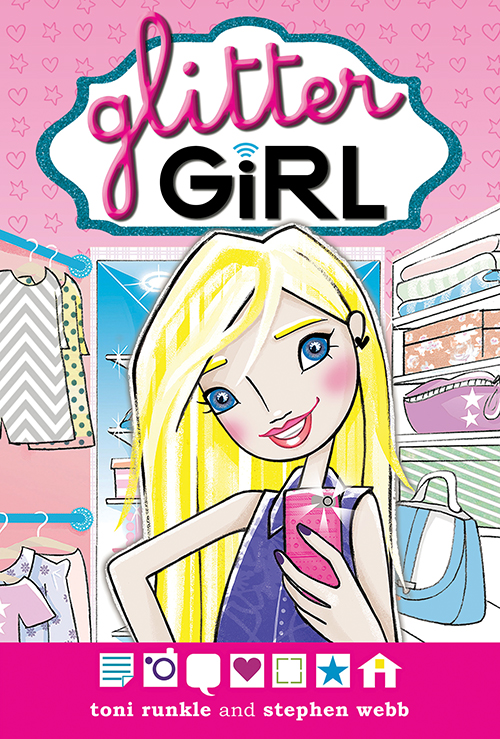
Add this book to your collection: Glitter Girl
For more information, visit: http://runklewebb.com/
About the Authors
Toni Runkle began her writing career at age 4 when she scrawled on a lampshade in crayon. Despite getting in BIG trouble, she continued writing (books, blogs, screenplays). She lives in Valencia, California with her husband and daughter who are understandably grateful that she now writes on computers instead of furniture. – See more at: https://www.sourcebooks.com/index.php?option=com_egdauthors&view=author&aid=A2572#sthash.pTQq163j.dpuf
Hailing from a small town in South Dakota, Stephen Webb now makes his home in the small town of Los Angeles, where he enjoys annoying his wife and daughter by singing show tunes at the top of his lungs. He loves softball, cheeseburgers, and his family, although not necessarily in that order.
