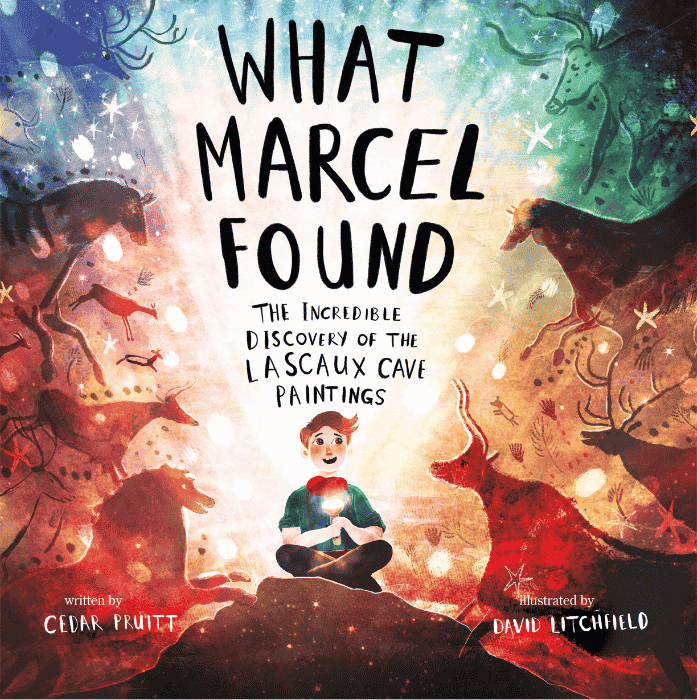
Cover Reveal of What Marcel Found by Cedar Pruitt and David Litchfield, presented by The Children’s Book Review.
Get a first look at a luminous picture book inspired by one of the greatest discoveries in history!
We’re excited to share the cover of What Marcel Found, written by Cedar Pruitt and illustrated by David Litchfield. This powerful true story introduces readers to Marcel Ravidat, a young boy whose curiosity led to one of the most important archaeological discoveries in history: the Lascaux Cave Paintings.
Balancing the weight of World War II with the wonder of prehistoric art, this luminous picture book shows how imagination, bravery, and creativity can offer light in dark moments. With art that seems to glow from the page, What Marcel Found connects children to the past—and reminds us how deeply art binds us across time.
Don’t miss the cover reveal below, plus hear from Cedar Pruitt and David Litchfield on bringing a world-changing discovery to life for young readers.
Cover Reveal
Author and Illustrator Interview
Cedar, in just five words, how would you describe what David’s illustrations do for this book?
Cedar Pruitt (CP): Illuminate humanity, art and heart.
David, in just five words, how would you describe what Cedar’s story means to you?
David Litchfield (DL): Art. Power. Discovery. Hope. Friendship.
Marcel was searching for hidden treasure when he stumbled upon something far more extraordinary. What drew you to his story, Cedar?
CP: This real-life kid, in a forest with his dog on that fall day, had to think in an almost “upside-down way” to make this discovery. He had to think beyond the ground under his feet.
He had to be willing to imagine an entirely unknown world down there.
What if we can all be as innovative as Marcel? And persistent enough to dig deep and follow our curiosity?
And brave enough, for that matter, to go back to a mysterious place simply to keep exploring? It wasn’t easy for Marcel, or Jacques, or Simon, or Georges to get down there, and no way to predict what they would find or what would happen.
These are the qualities it took for them to guide us all to a new understanding about being human. I’m inspired, captivated, and grateful.
The backdrop of World War II adds such emotional weight to this story of wonder and discovery. How did you balance the joy of what the boys found with the very real darkness unfolding around them?
CP: Daily life must have felt, in some ways, like the world was ending.
As I was writing this story, I could feel a heaviness in my chest when I imagined trying to be a kid in Nazi-occupied France.
Like all kids, these boys just wanted to be free, playful, and imaginative. I really wish that they had more chances to just be kids – in fact, one of the four boys was taken with his family by the Nazis just two days after their discovery, while it was still a secret among the children. Real horrors were unfolding, and yet, for just a little while, they could be free, playful, and imaginative in their own safe place.
These four kids uncovered an ancient truth: our ancestors felt joy, wonder and awe when they watched animals, just like children do today.
And the exquisite way they expressed that truth? It was all through art. Art is such an important part of being human!
It makes deep sense to me that two of the four boys eventually dedicated their lives to protecting the art at Lascaux. And my heart is filled with gratitude that all four survived the war and reunited later at the cave. I worked with the Ministry of France to print an original picture of three of them in the Author’s Note, because I want the children of today to feel their connection to these kids and the role they played as a bridge through history.
I’m also curious how much of Marcel’s bravery, innovation and persistence was spurred by the fact that the world above ground was not safe. The worst of humanity was on display and everything familiar was altered by evil. Maybe a dark, hidden cave felt more like home in comparison.
But even before the war, Marcel gave his dog an unusual name (check out the Author’s Note for more on that!), so it’s clear that he was long willing to think in an experimental way – and that he was open to unusual possibilities.
David, you’re bringing to life both the world of 1940 France and art that is 17,000 years old in a single picture book. How did you approach the visual challenge of bridging such vastly different moments in human history?
DL: I think that our book shows the power of art and how it resonates through time. For me the narrative that the Lascaux artists communicated with their paintings was one of survival and how community and working together is important for that survival. I would imagine that this resonated with Marcel and his friends growing up in World War II, and I think that it still very much resonates with us now.
Art created in the past very much captures a moment in time, but it also communicates and reassures us in the present. It tells us that we have been through hard times and faced great danger before and we survived. I think it’s a very hopeful thing.
What excites you most about this book landing in the hands of children?
CP: I find David’s art incredibly exciting to share – this story is partly set underground, and yet his work beams like light radiating off every page. The forest and the children seem to glow. The colors are sublime. He’s essentially created a whole new universe between these covers, full of ancient animals that feel like old friends. Every time I turn a new page, my breath is taken away.
In addition to that exhilarating aspect of the book, I am excited to connect readers to the people of 17,000 years ago. This is where we come from.
Our shared ancestors were people who thought that animals were unspeakably beautiful and knew just how to use rock surfaces to paint them in motion, with paints made from materials found in nature. Their paintings and engravings reverberate with perception, skill, and heart.
My dream is that we all dig deep like Marcel—but deep within ourselves, until we surface that enduring need to truly see, to be seen, and to create from a place of awe and wonder.
DL: I really hope that it appeals to their sense of adventure and exploration. The world is there to be explored and it is full of incredible things that are just waiting to be discovered.
I also hope that they feel as inspired by the amazing cave paintings as I was. The flowing paint strokes, the detail and the urgency of the scenes that they created just made me want to instantly paint and create my own. It’s really incredible art.
About the Book
What Marcel Found: The Incredible Discovery of the Lascaux Cave Paintings
Written by Cedar Pruitt
Illustrated by David Litchfield
Ages 4-8 | 40 Pages
Publisher: Beach Lane Books (2026) | ISBN-13: 978-1665941419
Publisher’s Book Summary: It is 1940, and his country, France, is in a great battle.
But in the quiet of the woods, Marcel explores…
When Marcel Ravidat finds a secret underground tunnel in the woods, he doesn’t hesitate to explore. While World War II rages outside, this prehistoric cave is calm, still, and quiet. And then, Marcel discovers a treasure for the ages: hundreds and hundreds of extraordinary animal paintings made by humans more than 17,000 years ago. When he tells others of this discovery, the whole world shares in his curiosity and wonder.
This book shines a light on a boy’s awe-inspiring archaeological find during a dark time in the world. And it shows what the Lascaux Cave Paintings can teach us about what it means to make art, what it means to be human, and how creativity connects us all.
Pre-Order the Book
About the Author
Cedar Pruitt is an author and presenter with a love for art and discovery. Her debut picture book, Fire Flight: A Wildfire Escape (illustrated by Chiara Fedele; Capstone, 2024) was named a Best Children’s Book of the Year by Bank Street College of Education. Her forthcoming book, What Marcel Found: The Incredible Discovery of the Lascaux Cave Paintings (illustrated by David Litchfield; Beach Lane Books/Simon & Schuster) will be available everywhere that books are sold on October 13, 2026. Cedar has also published humor, memoir, and poetry; holds an M.Ed. from Harvard University; and lives in New England with her family.
Find her on her website at CedarPruitt.com.

About the Illustrator
David Litchfield is a multi-award-winning illustrator and author represented by The Bright Agency.
David’s author/illustrator picture books, The Bear & The Piano; Grandad’s Secret Giant; The Bear, The Piano, The Dog & The Fiddle; Lights On Cotton Rock, and The Bear, The Piano & Little Bear’s Concert and Kid Christmas: Of The Claus Brothers Toyshop are all out now.
David has also illustrated a number of picture books and novels for authors such as Ross Montgomery, Gregory Maguire, David Almond, and Smriti Halls, as well as book covers for Kate DiCamillo, Neil Patrick Harris, Chloe Daykin, and many more. David lives with his family in Bedford, England.
Find him on her website at davidlitchfieldillustration.com.