

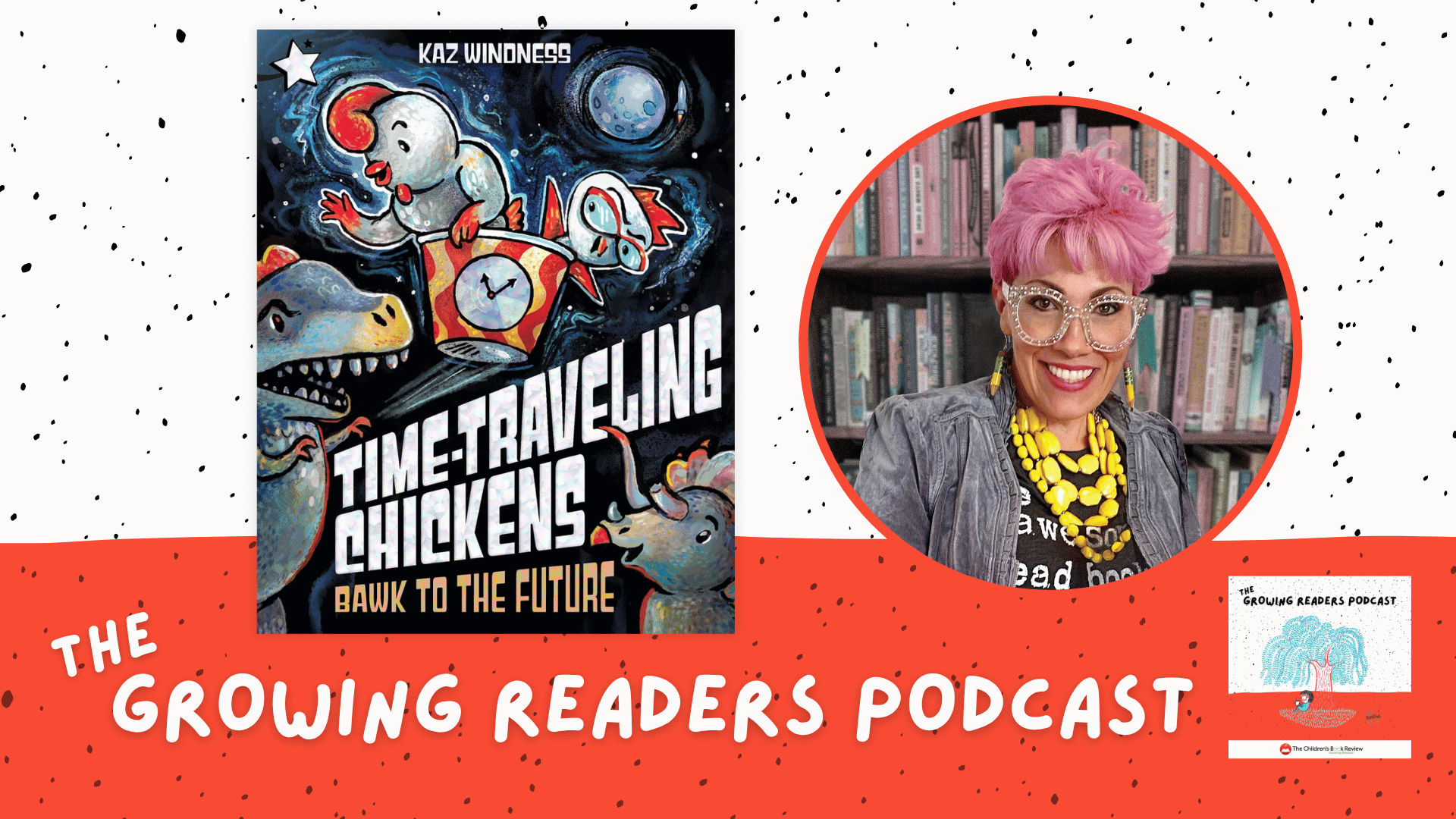
A podcast interview with Kaz Windness on The Growing Readers Podcast, a production of The Children’s Book Review.
Kaz Windness is back on the podcast, and this time she’s bringing two very determined chickens, Nugget and Tenders, along for the ride.
Windness, an award-winning author and illustrator, joins us to discuss her latest work, Bawk to the Future, the first book in her Time Traveling Chickens series. This delightful early chapter book features two adventurous chickens, Nugget and Tenders, who accidentally find themselves in the age of dinosaurs, thanks to a time machine and some not-so-friendly scientists. As Kaz puts it, “Can they change the past and get back to their future? Or are they doomed to be a dinosaur’s dinner?” Their quest to change the past and return to their future is filled with humor and heart, making it a perfect read for kids eager for adventure.
“Star chapter books are the perfect bridge for kids moving beyond beginning readers, but not yet ready for longer chapter books.”
— Kaz Winness
Throughout the conversation, Kaz opens up about her creative journey and the ongoing process of self-discovery as an artist. She reflects on the challenges and triumphs she has faced, sharing that even years into her career, there are still new aspects of her creativity to explore. She also shares a peek at her latest Bitsy Bat book, Snow Star.
If you’re curious about Kaz Winness’s journey and her inspiring work, dive into the full episode to hear more about her creative process and the stories she brings to life.
Subscribe to The Growing Readers Podcast to ensure you never miss an episode celebrating the creators shaping young readers’ lives.
Listen to the Episode
The Show Notes
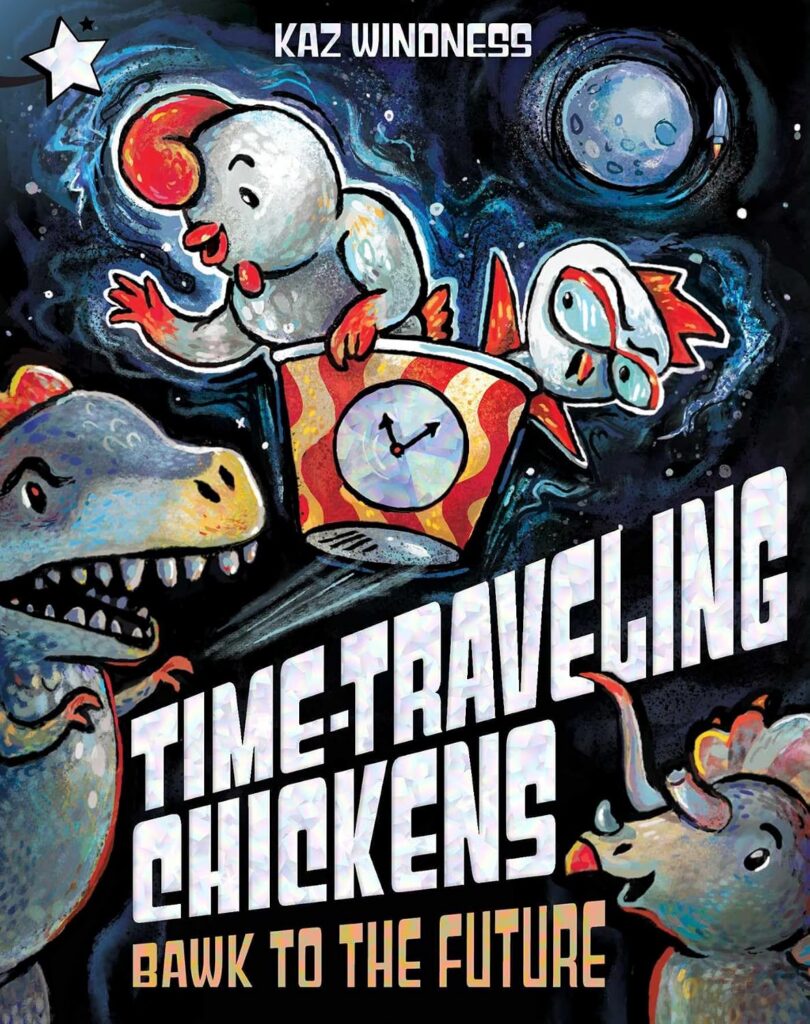
Bawk to the Future: A Star Chapter Book (Time-Traveling Chickens)
Written and Illustrated by Kaz Windness
Ages: 5-9 | 112 Pages
Publisher’s Book Summary: Two chicken friends accidentally time travel back to the age of the dinosaurs in this first tale in the rollicking Time-Traveling Chickens series from Theodor Seuss Geisel Honor–winning author-illustrator Kaz Windness!
Nugget and Tenders are super-big, super-smart, talking chickens. When evil scientists trap them in a time machine, they land in the age of the dinosaurs. Not ones to be easily discouraged, these adventurous avians see their chance to change the course of chicken-kind. Can they change the past and get back to their future—or is the duo doomed to be a dinosaur’s dinner?
Each Star Chapter Book is 112 pages long, divided into six to eight short chapters with illustrated panels on every page to keep kids engaged from start to finish. This highly visual early chapter book format supports the transition from leveled readers to chapter books, making Star Chapter Books a perfect fit for independent reading, classroom libraries, or shared story time.
Look for more Star Chapter Books adventures to help kids grow confident and develop a love of reading, including the chickens’ next adventure, Nugget and Tenders’s Eggcellent Adventure!
Buy the Book
Borrow the Book
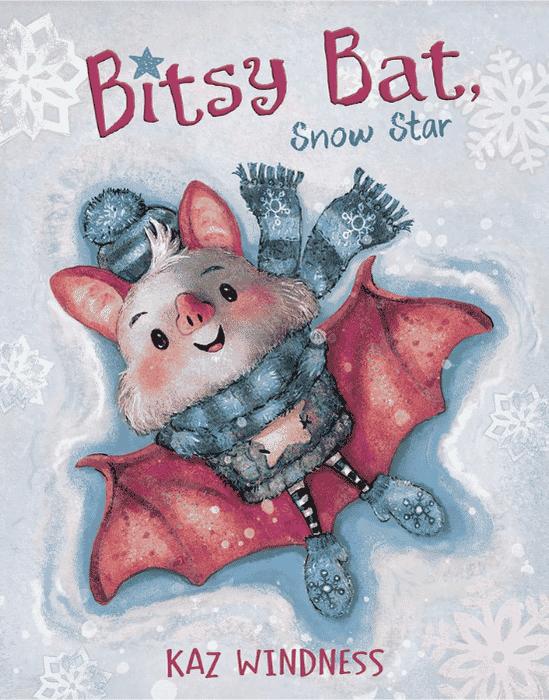
Bitsy Bat, Snow Star
Written and Illustrated by Kaz Windness
Ages 4-8 | 48 Pages
Publisher: Beach Lane Books (2026) | ISBN-13: 978-1665963664
Publisher’s Book Summary: Bitsy Bat experiences her first snow and discovers it’s okay for friends to not always like the same things in another charming follow-up to Bitsy Bat, School Star from Theodor Seuss Geisel Honor–winning author-illustrator Kaz Windness.
When Bitsy wakes up to see her first-ever snowfall, she’s excited to try out wintry activities with her friends at school. But sledding turns out to be harder than she thought, and making snow angels and snowmen leaves her feeling cold and wet. Bitsy tries to pretend she’s having fun…until a friendly snowball fight pushes her over the edge.
She retreats inside the school, worried her friends won’t like her anymore once they find out she doesn’t love the snow like they do. But a surprise is waiting for her—Enzo Owl and Mo are inside too! They don’t like snow either and would rather read in the cozy nook. Bitsy comes up with an indoor activity for a snowy day—making paper snowflakes—that just might give her the courage to be honest with her friends.
Buy the Book
Borrow the Book
About the Author
Kaz Windness is the author-illustrator of picture books Swim, Jim! and Bitsy Bat, School Star, which received starred reviews from Kirkus Reviews, School Library Journal, and BookPage. She created the Theodor Seuss Geisel Honor Level 1 Ready-to-Read Graphics book Worm and Caterpillar Are Friends, which received a starred review and is a Junior Library Guild selection, and the Level 1 Ready-to-Reads Cat vs. Vac and Go! Go! Dino!. Kaz is also the illustrator of Ollie, the Acorn, and the Mighty Idea by Andrew Hacket and the author of When You Love a Book, illustrated by Heather Brockman Lee.
When she’s not writing or illustrating books, Kaz teaches illustration at the Rocky Mountain College of Art + Design and enjoys making deep-dish pizza. Kaz lives in Denver, Colorado, with her husband, two children, and a Boston terrier.
Visit her at WindnessBooks.com.

Credits:
Host: Bianca Schulze
Guest: Kaz Windness
Editor: Kelly Rink
Producer: Bianca Schulze
Read the Transcript
Bianca Schulze: Hi Kaz, welcome back to the show.
Kaz Windness: Hey Bianca, I’m so glad to be here. Thank you for having me back.
Bianca Schulze: Yeah, for anybody that missed our first conversation, you have to go back and listen to Kaz talk about Bitsy Bat. So we did a lot of our typical questions that I do on the show in that episode. So this one we’re gonna jump right into some fun, rapid fire questions. All right, well, so I whatever comes to your mind first on these, and you can say pass.
Kaz Windness: Yay, we’re gonna go deep fast. You know I love that.
Kaz Windness: Okay.
Bianca Schulze: But just quick answers. Regular shaped chicken nuggets or dino nuggets?
Kaz Windness: Dino nuggets, obviously, yes.
Bianca Schulze: Nugget or Tenders, which character is more like you? If you could time travel to any era, prehistoric or otherwise, where would you go?
Kaz Windness: I hate to admit it, but it’s Nugget.
Kaz Windness: Gosh, that’s a that’s a very good question. I might have to pass on that one to come back.
Bianca Schulze: Okay. If I if you If you get an answer later on, anytime you can you can blurt it out. Two color illustrations or full color, which is harder?
Kaz Windness: Okay, Cool. Thank you.
Kaz Windness: Full color is definitely harder.
Bianca Schulze: Favorite word that’s fun to draw as a sound effect, like bawk, crunch, or screech.
Kaz Windness: I do tend to use screech a lot and misspell it, change the spelling on it all the time. You know, so it keeps it creative. So I’m gonna have to go with screech on that.
Bianca Schulze: All right, let’s go deep now. So last time we talked all about Bitsy Bat, and this time we’re talking about your early chapter book series that’s in a graphic novel format, and you’ve gone from bats to chickens. There’s chickens, evil scientists, a time machine, dinosaurs. So this is a big silly high-stakes premise for a chapter book. So what made now the right moment to build a whole series around these two characters, Nugget and Tenders
Kaz Windness: Yes, it is.
Kaz Windness: Opportunity. My publisher came to me. So they also published Worm and Caterpillar Are Friends, Worm and Butterfly Are Friends, Always, and some of our other early readers, like Cat vs. Vac and Go! Go! Dino! and others that I’m forgetting at the moment because I’m forgetting so many things. But they came to me and said that they were starting a star chapter book graphic novel level that is meant to help capture those readers that, you know, we always talk about this literacy crisis.
But we’re coming into that upper elementary where these kids are just falling off and don’t have the skills in order to access the books that are meant, you know, quote unquote meant for the reading level. So we really wanted to give those those kiddos books that had a lot of fun stories, a lot of illustrations to support the text, high you know, high stakes, but also
high adventure things that were meant for the reading, the for the reading, their age level, but with you know, shorter sentences and you know, just one really it’s just one sentence per panel and only four panels per spread, those kind of things. So they could actually access those stories in a way that would recapture them so they would fall in love with books again. So my publisher came to me and said, do you have any ideas for a graphic novel?
And I thought back to, we all as writers and creators have a whole stash of ideas that haven’t made it into books yet. And I just thought back to Nugget and Tenders, which were characters my kids and I had come up with at the dinner table and we had talk about talked about a time-traveling bucket, you know, just like a chicken bucket.
And I was thinking back to that and I’m like, I actually do have an idea on that. So it was the perfect opportunity to flesh out that idea. And I just love that this publisher takes risks on me. They trust me to do things that are audacious and a little subversive, and and it was very fast timelines too. So, producing
Kaz Windness: those those stories and getting them approved and then moving right into the illustrations and just moving very, very quickly to have these happen. So it’s i in some ways miraculous that it happened as quickly as it did, but they’re being well received. The whole series, the Star Chapter series is being well received. So I’m just really glad to have these books out in the world that are supporting those readers.
Bianca Schulze: Yeah, amazing. So then the moment that Nugget and Tenders were born, it sounds like was with your kids at the dinner table. So tell me a little bit more about that moment and maybe what it feels like to them to sort of see these characters that they were you know, there from the origin moment that your kids got to experience and now they see it in your books.
Kaz Windness: Yes.
Kaz Windness: Yeah, I mean, I’ve been pursuing this for a long time and part of me felt sad that it took so long. Like my kids are teenagers now, and you always are developing these these books and stories that you hope that you can read to your own kids, and that’s not always possible just because you’re busy raising those kids and it does take a lot of work and time in order to get books published. So in the case of these books,
it’s it’s always hard to gauge how my kids really feel about the books I’m putting out in the world, but you can just kind of see it like at at our book launch and just see the little spark in their eyes, or, you know, like just the smile that that comes to them or the way they’re engaging with what I said during the presentation. like my My kiddo Max was like, I actually think we were at
a Mexican restaurant when we came up with that. So they really do remember us coming up with that idea. And I did you know, add them to the dedication. So they are getting that acknowledgement. But I think just being an example of someone who does pursue their dreams that you know, can work through resistance and rejection and all the things that come with that to see things you know, become reality. I always think of books as this amazing alchemy.
We are just taking ideas out of the ether and even bizarre things like like time-traveling chickens and transmuting them into something that’s physical and tangible out in the world, out in the world in a big way. I mean, these books do reach a lot of readers. So that for me feels great. And I know that it is you know, showing kids that example and plus you know, championing their own creativity. My oldest is now going to college for graphic
design and seeing the drawings that they’re doing and the interest they have in that. And my oldest has been like it’s really cool to see that you that your published books. I’m it’s really cool to see that your ideas become books. So So yeah, that that feels very good.
Bianca Schulze: Yeah, yeah. Well, Nugget and Tenders don’t just want to survive the age of dinosaurs. They want to change the course of chicken kind. And that’s a surprisingly ambition ambitious goal for two chickens. So what does it say about who those characters are?
Kaz Windness: Uh-huh.
Kaz Windness: Well, Tender’s motivation is always like their name, for the for for protecting and helping others. So they want to go back and save the other chicks that are in the lab. Whereas Nugget wants revenge. Nugget wants to get not only get chicken off the menu, Nugget wants to destroy human history in the process, as you know, the way that they are gonna save chicken kind. So
their motivations are different, but I think they also listen to each other and temper each other and Tenders being the more realistic or kind of the two of them. and and I do like It’s not a full complete character arc, but you do see that Nugget kind of comes around to being more understanding and considering others. And I think we need each other as a community to say, hey, you’re kind of being a jerk right now.
I have friends that are willing to call me out on that or call out my insensitive insensitivities, which I do have. So they kind of have that relationship too. I think every book, even time-traveling chickens books, I’m exploring my own psyche and sort of working things out and also like you know, growing to be a more empathetic person myself by putting myself in these other you know, characters or imagining what they’re like. And I I hope that readers have that experience as well.
Bianca Schulze: Yeah. Well, humor is doing a lot of work in this book. So for a reader who might be intimidated by quotation marks, a real chapter book, like a thick one with no pictures in it, If funny is often the thing that hooks them and helps them become a reader and realize that they enjoy it. So how do you go about writing jokes that land for you know, a six or seven year old without feeling like you’re writing down to them, but also making sure that
Kaz Windness: Right.
Bianca Schulze: your jokes aren’t too grown up.
Kaz Windness: Well, I’m about ready to make a six-seven joke. So that just tells you about my maturity. I think part of it is that I never really grow grew up. my humor is stuck at that second grade or sometimes middle school boy era age. But you know, I I think humor, I was the class clown, and that was a way that I made friends or like dis dis you know, dispelled like this feeling of anxiety or being awkward,
Bianca Schulze: Ha ha ha.
Kaz Windness: was to use humor to to soften that. So that’s, you know, I’m always, you know, making a joke about something, even if I shouldn’t be making a joke about something. So the it’s kind of the joke side comes to it a little more easy. But I think if you set up premises that have a lot of opportunity for for puns or humor, it just makes it easier to, to, you know, like I could insert this might be a really serious
moment, but I could insert a fart or something. I don’t actually know that there’s any farts in Time-Traveling Chickens, but there are some hidden in my other books. Yeah, but I just think that pacing and growing up on comics too, where it’s like the, you know, the setup, the raising the stakes, and then the surprise. So I’m always thinking about like how can a page turn or or a panel move into something that’s going to surprise the reader a little bit or land a joke
while still holding the the storyline together and still being serious about that. And I think part of it is taking something like time-traveling chickens very seriously. for me, they are real characters. The stakes are real. The friendships are real. You know, even Dr. Dipping Sauce and her struggles with her kind of evil, well, you know, very evil boss, and her coming around to have her own
realizing that she doesn’t want to be a part of that system anymore and how she takes back her own power and builds a time tr t time toilet. So, you know, just baking in things that are naturally funny, but taking them very seriously, I think you know, sets you up for some good humor. But it that’s just more natural to me. Like I’ll go for a joke probably before I’ll go for for serious. So, yeah, but yeah, set yourself up with a great premise and the jokes are gonna come.
Bianca Schulze: Yeah. Well, I I think something fun about these books are you know, I the the little Easter eggs that are hidden in there. Like I love Dr. Dipping Sauce’s moment when she is, I don’t I want I don’t want to give too much of a spoiler away, but she’s making something of her own and there’s a a flush capacitor in it. And I mean anyone that’s read or watched Back to the Future, it’s like that that reference is is great. So I love that you sort of
Kaz Windness: Mm-hmm.
Kaz Windness: Right.
Bianca Schulze: hide those things in there. Is that Does that bring you joy when you get to do that?
Kaz Windness: Working on things that are, they they’re hard. This is stressful. But I think if you’re entertaining yourself in some ways, as long as you haven’t lost sight of the audience, then that joy is gonna come through in the book. So sometimes it really is a little bit selfish. I’m Gen X, I was raised on you know, Back to the Future and Bill and Ted’s Excellent Adventure and all those sci-fi kind of
films that are just baked into my psyche and who I am. So it was really fun to riff on them without making it necessary for you to know those references in order to enjoy the books. Because I also know that you know, maybe they’re the grandparents of the kids that are reading them now. But I know that I you got it. Like you You understood the joke. So there’s just, you know, it doesn’t hurt to add in those little things that just tickle tickle me as I’m
creating it and still contribute to the story. So yeah, the the references are definitely there.
Bianca Schulze: Yeah. Well, you touched on this up front, but I just want to go a little bit deeper in here. So the Star Chapter Books are built for a very specific reader because they’re the perfect bridge for kids moving beyond beginning readers, but not yet ready for longer chapter books. And so the Time-Traveling Chicken series is part of the Star Chapter Books. So when you take off your picture book writing hat, what do you have to unlearn
Kaz Windness: Exactly.
Kaz Windness: Exactly.
Bianca Schulze: or relearn to write for that in-between reader?
Kaz Windness: I think creativity thrives in limitation. So when you get asked or you submit something for an early reader, they have parameters on it. So they told me there’s no more than four panels per page. Less is better. There’s only one sentence
per panel. And I did cheat a little bit on that and they let me cheat a little bit on that. But you know, I was always keeping those parameters in line and how many words per per speech bubble and how many chapters there were. So because I have those limitations, it helps me to, you know, I I tend to go off the rails with everything. Like my picture books would probably be sixty four pages if someone didn’t stop me and say, no, it’s way too long.
So it’s always about editing and limitation. I try not to edit as I write, even though I’m keeping those parameters in line. with a picture book, my pitch picture books do tend to be longer. So usually around 40 or 48 pages. But I really am keeping that word count in mind. But I’m just writing the story that needs to be written. And there’s always so much you can do, and you know this, in the editing process to to reel it back in. But with something that’s longer, like the a chapter book or a graphic novel,
you know, breaking it down into to how many chapters I’m allowed to have. And, you know, I I’m a planner, a plotter. So I’m gonna figure out, you know, what’s what’s the premise. And then I’m gonna break that premise down into the scenes that need to happen in the book in order to make that premise happen. And then I’m, you know, building that out into a synopsis. And then I’m just building that synopsis out into those chapters.
And then I go back and and and edit. But I always think it’s those limitations that are really helpful. And I think a storyteller is a storyteller. I think the same thing about doing the illustrations, those go in hand in hand to me. At the end of the day, maybe you call me a writer, maybe you call me an illustrator, but I’m really a storyteller and I’m always keeping that with the audience in mind, which also means that I’m consuming, I’m reading a lot of books.
Kaz Windness: I’m reading books that are at the level that I’m trying to write to. I’m seeing what other people are doing. I’m never copying what they’re doing, but it gives me a really good feel for the pacing that’s necessary in order to get the right kind of book to the right kind of reader in the way it needs to happen. And I also have a great editing team. Like Simon Spotlight is incredible. I love working with them. So they’re always I’m, they’re checking in with me. I’m giving them that synopsis and they’re saying, that’s great.
Could you consider removing this political joke? And I’m like, okay, fine, whatever. So yeah, they’re always giving me that feedback. My my whole thing is like, how am I supposed to know where the line is if I don’t cross it? So I let myself cross it because I don’t want to pre-edit, and I let them come back and say, you went too far here. Can you pull that back? And I always, always can. But yeah, it really just comes down to ster storytelling,
Bianca Schulze: Ha ha ha
Kaz Windness: remembering who you were as a reader at that age, as a a kid at that age. And I’m also going into classrooms. I’m meeting these kids. I’m not negligent to who that reader is and what they need. So yeah, I guess I’m holding a lot of things as as I’m doing this, but I’m not doing it alone either, thank goodness.
Bianca Schulze: Yeah, yeah. Well the the two color illustration style is such a signature of this format. So how how did you think about what a chicken and dinosaur look like when you’ve only got the two colors to work with?
Kaz Windness: That’s a great question. So color was the last thing that I really started to understand as an illustrator was very hard for me. Value, just contrast, grayscale, all that kind of stuff came much, much earlier to me. And I actually think it’s a better foundation to have if you’re thinking about the contrast and where you want the eye to go. Then you’re putting color on top of that. So actually going back to monochromatic, which which
primarily what kind of work I was doing early and in college, wasn’t that complex for me. Like I was glad to have again restraints, and I chose red just because I was thinking about red being a color. Red and yellow are what our human eyes are geared to look at first. So I knew wherever I put the red, the eyes would go to. And then I was thinking about chickens, like, you know, that’s it’s a pretty good choice for them.
The other thing I should mention is that this was the first time I’ve worked with an inker and colorist. And so I hired David Deen, who’s also in our local Colorado area. He’s in my critique group. He’s so so talented, and I’ve watched him all these years. I think we’ve been in the same critique group for seven years. And I just thought if I ever had the opportunity to work with him, I would love that opportunity. And because these deadlines were so fast that it was the perfect time to say, hey, I
I need help and you would be amazing at this. And of course he was. You can see that. So I did the full color illustrations for the covers, but I turned over sketches to him. And I do work in value with my sketches, but poor David Deen, he got so he got very rough sketches in some cases. And he is also a master of of value and was able to to flesh these out in ways that I just I couldn’t even imagine how good
it would be. like I I had a a feeling that he would do a great job, but he did a spectacular job. So I have to give him a lot of credit for for how you know, he imagined the the coloration of the differences in the late Cretaceous and the dinosaurs and where to put those colors. Cause I gave him loose instructions. I gave him character designs, but then it was really I wanted to trust his creativity and wow, he just he blew it out of the water.
Bianca Schulze: That’s so great. I I wonder like, was it hard for you to you know, you’re so used to creating all your own artwork? Was it hard to let go to start with?
Kaz Windness: No. If if he wants to like paint all my books like now.
Kaz Windness: No, for it was part of what I there was a lot of it was It was stressful just because the deadlines were so fast. but sometimes I would just get myself through by saying like, all I have to do is get a sketch down here. All I have to do is put something on the paper and David Deen’s gonna rescue, poor David Deen, he’s gonna rescue me. He’s gonna be able to figure this out. And also, like just getting something down on the paper and being able to revise something, like you can’t fix something that doesn’t exist.
But no, I had no problem surrendering that part to him. In fact, like it was even better than I could have imagined it. I would love to do more teamwork things and like for bigger projects, it’s very, very normal to have inkers and colorists and you know, developmental people and people that do backgrounds and you know, you think about film and animation and all that. Like you could never do that as a as individual person. So you know, I I I loved it. And
I the illustration is is a lot of labor. It is a lot of time in the chair, alone, working on something. It can be very, very lonely, and very hard. So like to take on t a team,
I it’s it’s been a dream. I’ve I’ve loved it. I didn’t have a problem with that. And he’s very great to work with. So if there was things that we’d had a miscommunication on or something needed to change, both of us were very willing to have a conversation that says there needs to be an adjustment here, or this is not what I intended, or if you’re busy working on the next book, which he was, I’m very happy to take on the edits for this part. So it was a very collaborative situation. So I think having somebody that you have good communication with
that you can have tough conversations with because you both love each other and you really care about the end product. No, like we had a couple tiny bumps getting up to speed with things, just big, audacious, he’s never done this before. So but once we got over that hump, like smooth sailing and I’m really glad to, technically it hasn’t been announced yet, but there is a third book coming. So, I’m very glad to be working with him on a third book, Planet of the Chickens. So yeah.
Kaz Windness: Yeah, there are more there are more chickens coming.
Bianca Schulze: Yes.
That’s That’s awesome. So I think where I want to go next is, you know, you just described about when you’re in the thick of one of these big projects, that it’s such a lot of work. But when you get to the other side, the reward for doing all of that hard work is incredible.
But there’s a lot of people right now who maybe write stories, but they’re not illustrators. And instead of hiring an illustrator to really come with another piece, they’re jumping straight to AI for the artwork of their books. So you’ve exactly. So you’ve been vocal about where you stand on AI and h and your
You know, we we’ve said this together, go make art with your little human hands, right? We want human-made art. So for listeners who haven’t heard you talk about this, what’s at stake for writers and illustrators? And why is it a hill worth standing on to say no AI?
Kaz Windness: For multiple reasons and thank you for bringing that up. I th I think it’s bizarre to me that it’s like we silo ourselves instead of seeing ourselves as a collective human creative body of of people. So why would you say that it’s not okay to use generative AI on the writing, but it’s totally okay to use generative AI on the art? Like I I just,
I don’t compartmentalize like that, maybe because I’m an author and illustrator, or maybe because I actually talk to other human beings and I understand what it’s like to be in the trenches with this. I One, it’s not necessary. you know, there are If you’re self-publishing, there are throngs of hungry, talented artists ready to to be hired and do a spectacular job for you.
Two, if you’re traditionally publishing, it is unnecessary for you to submit with art. Just write the best story you can. The publishers are very good at pairing you with spectacular illustrators. They’re gonna do an amazing job. And three, generative AI is made from the stolen property of us, of artists. So if you’re an ethical person,
and you’ve certainly by now have heard that there is no ethical way of using generative AI. It was all made out of stolen copyright works. You don’t do that. And also I think maybe kids deserve good art made by people that have experienced life. So then you know, and there’s there’s a million other reasons why AI is not the solution here.
But yeah, that’s always bizarre to me. And if you if you put AI, if you put a AI generated cover on your book, there is no reason for me to believe that you didn’t generate the whole book or didn’t you generate parts of the book. Like how am I supposed to believe in your authenticity if you have inauthentic, you’re you’re willing to package your book with with you know, copyright infringed slop.
Kaz Windness: I I don’t tr I don’t trust you. You’ve already lost my trust. So yeah, So I’ll keep on being vocal about that. Not because sometimes I get criticism in the comments, you’re just, struggling and so, you’re just mad at us, you taking advantage of this. And I’m like, I’m not struggling. I’m doing just fine. I just care very much about artists and the next generation of artists to have the same opportunities that we’ve had. So, yeah, I’m
I’m I’m gonna keep on fighting. I’m gonna keep being a a pain about that.
Bianca Schulze: Yeah, please do. I think for me, I the part that I don’t understand as well is I guess some people maybe just want to have a a published book. But for anybody that is doing the work, that that is the point of it, is doing the work, is writing the story, is getting in touch with yourself, getting in touch with humanity.
Kaz Windness: Yeah.
Kaz Windness: Yeah. The process.
Mm-hmm. Mm-hmm.
Bianca Schulze: Discovering things about nature and putting it into words and putting it into pictures and like y y if you’re just having generative AI either create the words or create the the the the art, then just go to the bookstore and buy a book and read that. Like why do you have to have
Kaz Windness: Reach. Yes.
Kaz Windness: Yeah. Yeah, you’re you’re you’re robbing your yourself. Yeah, I agree.
Bianca Schulze: Yeah. why have something created and then put your own name on it? I just, I don’t understand. Yeah. All right. Well let’s yeah.
Kaz Windness: Yeah, yeah, yeah, I don’t understand it either. I yeah, I don’t understand it. Well, and and art is hard. Art art is hard. So, I’m glad that it came later because I was talking about really struggling with color. There were so many parts that were so hard to figure out. it’s a lot of scaffolding and it’s a lot of building on you know, you okay, you become an expert, this little thing.
And then there’s a whole nother thing that you gotta figure out. And it’s really hard. And when you’re up against that hard, there’s so many times that I would have loved to smash a button and have it do it for me. But I think on the other side of that, I wouldn’t have learned the skills, I wouldn’t be able to to have overcome that and yeah, I’m really glad that I didn’t have that because I might have been tempted to sell out on it. So I just you know, encourage people that are emerging, like it is worth it to push through that
hard. to To grow those muscles, those creative muscles, so you can be able to express yourself in ways that maybe you couldn’t have imagined before. So yeah, it’s it’s worth it. Like why would you let somebody else lift weights for you if you wanted to be a bodybuilder? Like Don’t do that. Like Yes, it’s painful and you might throw up sometimes because it’s painful. But keep on doing it because you’re gonna get strong, right?
Bianca Schulze: Yes, yes. And we need more voices and more styles, not just some sort of you know, collective voice. you know. All right, let’s bring it back to the kids. So, Kaz, you’ve got a Giselle honor or gu is it Geisel or Giselle? Geisel, okay, let me rephrase it. Giselle. You’ve got a Geisel honor to your name for creating beginner reader books.
Kaz Windness: Yes.
Kaz Windness: Yeah, yeah.
Okay. Yes.
Kaz Windness: Geisel, yeah. I l do like Giselle though. I do. Yes.
Kaz Windness: Mm-hmm.
Bianca Schulze: And you know, now you’re stretching into this next stage of reading, like it it’s a little bit leveling up with this graphic graphic novel format. Do you think about the whole arc of a kid’s reading life when you’re building a series like this?
Kaz Windness: Mm-hmm.
Kaz Windness: Yeah.
I’m always thinking about building readers, and and it’s been pretty cool to, like the Geisel was for Worm and Caterpillar Are Friends, which is a level one reader. And this is technically, like Time-Traveling Chickens is technically, even though it isn’t a level, it’s technically a level five. So I know that I’m growing with those readers. The readers that fell in love with Worm and Caterpillar or Worm and Butterfly
are now able to pick up a new Kaz Windness book and grow into more reading and eventually be launched into you know full full chapter books and novels and you know I I am always thinking about that. But n not necessarily building like I I don’t imagine that Worm and Caterpillar would build into
a middle grade. Although, I’m I you know, some some people have teased me about you know, Bitsy being a middle grade character or what l what does she look like when she goes to her teen teen years. I’m not really thinking about building the characters that way, but I am thinking about growing readers al always. Growing readers, yes.
Bianca Schulze: Yep, yep, yep. Well, Nugget and Tenders’s Eggcellent Adventure, at the time that everybody’s listening to this conversation is already out in the world. So when you are building a series like this, how far ahead do you plot and how much do you leave open for the chickens to surprise you as you’re creating?
Kaz Windness: y I am thinking about what, like initially we didn’t we just had one book. But these do tend, you know, what what Simon Spotlight does does often turn into a series. So I am thinking about the potential of a series and I don’t wanna like end things so completely that I couldn’t build into another story, but I also don’t like the idea of a cliffhanger. Like you know, that left that final page, there’s a little bit of hint that something
bigger might happen after they’ve left something somewhere that could create more issues that need to be be solved, so I am thinking a little bit about that, I’m and when I’m building out the synopsis that I’m getting approved, I’m also like at the end of it, I’ll usually say, you know, potentially they could go from here to there if there is a next book. Just so it’s you know, on my mind. And especially since these are fast timelines,
if they come back to me and say, hey, actually we do want a third book. What do you have for the third book? I can be like, well, know at the end of this second book where there was this thing that was maybe suggesting you know, so planet Planet of the Chickens, and so building out that whole synopsis from Planet of the Chickens where we’re going to space and we’re going to the future. Yeah, so I I, you know, I’m not fully plotting, but I also like to leave something
on the the table that I can dive into to later. Yeah, that’s a great question.
Bianca Schulze: Yeah. Well you’ve also got a new Bitsy Bat book, Snow Star. So we did go deep on Bitsy in our last conversation, but what was different about writing Bitsy’s first encounter with snow for you versus some of the other books you’ve done?
Kaz Windness: I do.
Kaz Windness: So my editor, Catherine Ledone, came to me and she said, I had sent her a a watercolor painting of Bitsy in snow gear for for a holiday gift for her. And she had kept that up in her office and she had kept on thinking about it. So she came to me and she said, I would really like a winter book for Bitsy. w What do you think about that? And I said, well, I don’t like the snow.
And she said, that’s great. Can you write about that? So that’s really where it came from. And I think out of the whole series, that one flowed a more easily, I think, because we really understood the world and also just the sensory issues of snow and winter and her being a bat, which isn’t an animal that’s really a snow animal. So there was just, you know, the entry into that story was
Bianca Schulze: Yeah.
Kaz Windness: a little smoother for us than in those previous books. And also was really fun to paint all those characters and just cozy, fun winter outfits and also just dreaming of snow here in Colorado where we’ve been in a terrible drought. So I would love I would actually I I take it all back. I love snow. I want snow. Please more snow. But yeah, it was you know and and really nice to live in the world of Bitsy’s world
Bianca Schulze: Yeah.
Kaz Windness: again with painting painting those pictures and telling those stories.
Bianca Schulze: Yeah. Well between chickens, bats and everything else you’ve drawn, is there an animal you haven’t tackled yet that you’re itching to write and draw or just write or just draw?
Kaz Windness: I would very happily illustrate a Jimothy book if anyone has that.
Animals. I just An elephant book would be really fun. That’s one of my favorite animals to draw at the zoo. I love drawing giraffes. I don’t think I have a giraffe book. Yeah, so maybe we need to go to Africa or something. But I just love I love drawing animals. Right now I’m working on a five book series, Text Guy Cat Spy. So I hadn’t illustrated cats really before, so I get to live in the world
of cats and now also dogs and we have some nefarious reptiles coming in. So any opportunity I get to draw an animal I’m gonna l love to draw an animal. But yeah, I’m I’m I’m open to any animal really.
Bianca Schulze: I love it. All right. So in in their first book, Nugget and Tenders spend that entire story trying to change their fate, refusing to accept that the story has to end with them as somebody’s dinner. So you’ve built a career on stories that are funny, big-hearted, and a little bit fearless. Is there a version of your own story you’ve quietly tried to rewrite the way that?
Kaz Windness: Mm-hmm.
Bianca Schulze: Nuggets and tenders nugget and tenders are trying to why is that not coming out for me? Nugget? Yeah. in the way that Nugget and Tenders were trying to rewrite their story. Like have you ever tried to sort of rewrite a version of your own story?
Kaz Windness: it’s hard to say. Yeah, nugget nugget and tender zzz. It’s hard to say.
Kaz Windness: I am a a processor. So I’m always thinking, thinking, reviewing, almost to to a fault really, and I think I I thought that I would have myself figured out better by the time I was, like I’m 51, but I am still, like I’m I’m I have multiple therapists. I’m still uncovering these parts of my past that are unhealed
or I’m coming to terms with. I’m always discovering new, new parts of myself. And if I’m gonna be very transparent, I I’m in therapy dealing with my OCD finally, and that’s a big one. So you know, I I don’t think it’s like going back and fixing it. I don’t think there’s anything to be changed about it. It’s just like new levels of understanding oneself and coming to terms with oneself, and I think
The the most beautiful thing about being a writer or a storyteller or an illustrator is that I can take the things that I struggled with and I can put them down in a book in a way that maybe helps a child to feel more seen, maybe makes their path a little easier and it heals some part of me. There’s some part of my child that gets to be seen or gets to be held or understood in a way that maybe I didn’t experience growing up.
I had a publisher once that said she suspected that every writer wrote for the age group where they experienced the most trauma because they’re trying to process that in their books. And I’m like, well, that explains why I writes for all the all the children’s age groups. But you know, it’s not time-traveling for me. It’s trying to make a difference for for the future, really and I know how important those those beginning years are. Like I think what we do
Bianca Schulze: Yeah.
Kaz Windness: as writers and illustrators for children isn’t isn’t less important. In fact it’s way more important. That’s all the stuff that gets baked down into those developing psyches and brains and and people. It’s super, super, super important.
Bianca Schulze: Yeah. When I asked that question, I actually I don’t I sometimes I imagine what answers are gonna be to my questions and I actually didn’t imagine an answer. So that your response really took me by surprise and I think it was such a beautiful response, very vulnerable. And I think when I think almost when we create stories, writing, whatever it is,
Kaz Windness: Mm.
Bianca Schulze: it is healing for ourselves because we’re exploring something. And I think when we allow ourselves to be vulnerable and heal out loud when it’s comfortable to do so, the magic of that for for people that get to encounter it that maybe aren’t brave enough or haven’t been able to begin their healing, I just think, I don’t know if I’m being articulate here, but I just think what you shared
Kaz Windness: huh.
Kaz Windness: No, you are.
Bianca Schulze: was so beautiful. And I I think healing out loud when it feels safe to do so is so helpful for so many others. So thank you for sharing what you just shared.
Kaz Windness: Yeah. If you haven’t checked out Lily Williams’ new graphic novel, Exposures, like that’s really what brought this to the surface. Like I I’ve known for a long time that I’m dealing with OCD, but her being so vulnerable to be out loud with what that is and to tell a story of a girl that’s struggling with OCD, like that really was a tipping point for me to say that I really need to talk to my therapist about this.
And you know, I know that it wasn’t easy for her to write this book or to go through her process of going through exposure therapy. But we we heal each other by coming together and talking about things that are maybe not not easy to talk about. And I think about myself as a child feeling so lonely and isolated and also being a high masking autistic that was undiagnosed and just like trying to hide the things that were
broken in me, it was really books that made me feel seen. And I also was cognizant that there was a writer on the other side of those stories that must have experienced something exactly like I was experiencing. So I was not alone anymore. My friend was right there in the book, in the characters of the book, but also in the creator of the book. And what an honor to be
that writer for some child. To be that that that writer that can say, hey, you are not alone. I am experiencing exactly what you’re experiencing and and we’re gonna we’re gonna get through this together. We really are. It’s gonna be okay.
Bianca Schulze: Yeah. Yeah. So beautiful. I’m so glad you gave a shout out to Lily. So if listeners were to take away just one thing today, what would you want it to be?
Kaz Windness: Well, I mean that message of you’re not alone, that there is hope, that there is community, that your creativity matters, your messy, imperfect, chaotic creativity matters, and to to keep going and to make to make to make art with your human hands, right? Yes.
Bianca Schulze: Yes, yes. Well, Kaz, congratulation on Time-Traveling Chickens: Bawk to the Future, and on everything still ahead in the Time-Traveling Chickens series. I have a feeling that Nugget and Tenders are going to find their way into a lot of backpacks and bedtime routines. And congratulations on Bitsy Bat, Snow Star. That book is gonna mean so much to kids who felt exactly the way Bitsy does. So Kaz, thank you. Yeah.
Kaz Windness: No.
Kaz Windness: Thank you so much. Well, I want to answer really quick the time-traveling question. If I could go back, I would go back to the beginning of this interview and do this all over again. So thank you so much for having me again. You are awesome. And thank you so much to all your listeners and all those readers out there for being on this journey with me.
Bianca Schulze: Always a joy to talk with you and this conversation was no exception.
