

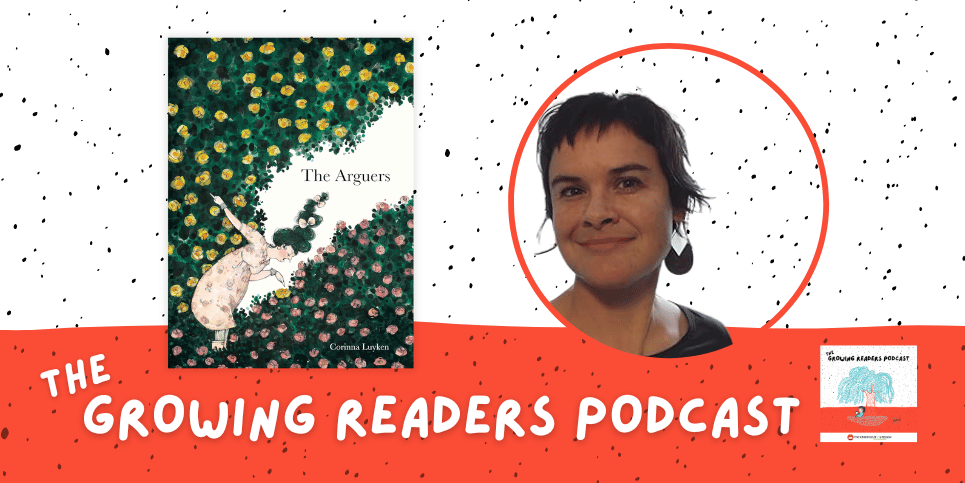
A podcast interview with Corinna Luyken discussing The Arguers on The Growing Readers Podcast, a production of The Children’s Book Review.
Talking Tangles, Spoons, and Storytelling: Corinna Luyken Discusses The Arguers.
What happens when everyone in a royal kingdom can’t stop arguing? In this delightful conversation, bestselling author-illustrator Corinna Luyken shares the decade-long journey behind her latest picture book, The Arguers. From silly squabbles over brushes and combs to deeper insights about human nature, Luyken reveals how she transforms everyday conflicts into whimsical storytelling gold.
Join host Bianca Schulze as they explore Luyken’s unique artistic process, her thoughtful use of color to evoke emotion, and why sometimes the best way forward is simply learning to laugh at ourselves. Whether you’re a parent navigating daily disagreements or an educator looking for conversation starters about conflict resolution, this episode offers fresh perspectives on the arguments we all have—and why they might not be so silly after all.
Perfect for fans of Luyken’s previous works, including The Book of Mistakes, My Heart, and Patchwork.
Listen to the Episode
Read the Transcript
Bianca Schulze: Hi, Corinna. Welcome back to the Growing Readers podcast.
Corinna Luyken: Hi Bianca, thank you for having me.
Bianca Schulze: I liked it when you came on the show last time, and you were with Matt de la Peña, and we talked about Patchwork. I just loved chatting with you. And so I have been living for this moment where I got to have you back on and have you all to myself. So so grateful that you’re here. But between I guess Patchwork and now, what have you been up to?
Corinna Luyken: Let’s see, what have I been up to? I’ve done, I guess I’ve done two books. So, one that I wrote and illustrated called ABC and You and Me, which was an alphabet book for younger readers. And it’s a movement alphabet book with grownups making the shapes of the big letters, kids making the shapes of the little letters, people moving together. And then I did a book with Kate Hoefler, another one called In the Dark, which is a little bit of a…
It’s a tale told from two perspectives and it opens horizontally instead of like—it opens the opposite way. And it’s sort of about misperception and there might, some people think there are witches in the woods. There might not actually be witches in the woods. So those are two books that have come out in the meantime. And then yeah, now The Arguers.
Bianca Schulze: Yeah, and I know our listeners are going to be so excited to hear about The Arguers. I mean, such a great theme and concept. But before we dive in, I’m hoping that we could do some just fun little rapid-fire questions. They’re all argument-themed, if that’s okay with you. Well, I guess technically the first two aren’t argument-themed, but the rest will be. So the first one is beach or mountains. Make your case in one sentence.
Corinna Luyken: Beach because I surf.
Bianca Schulze: I didn’t know that about you. Okay, I love that. I grew up by the beach, so it’s exciting.
Corinna Luyken: Definitely beach, although ideally both. I mean, mountains right next to beach, yeah.
Bianca Schulze: Yeah, yeah. My saying is if I can’t be by the beach, I need to be by the mountains and vice versa. So, all right. Sweet or salty snacks while working?
Corinna Luyken: Salty. A specific favorite snack.
Well, my guilty pleasure, which actually my daughter just for Mother’s Day, she just went to the corner store and got me some junk food. And we do this, we do this family game where we do this trail of clues through the house, which my husband made up when she was really little. We’ve been doing it forever where if we have a thing that’s a gift, like for birthday or something, we’ll put it in a weird spot and take something that ought to be there, like the, you know, the milk from the fridge and put it where the timer should be and put that where the toothbrush should be. And it like goes, you go through the house putting things away. Anyway, she did that for me this time, which she’s never done. And it was a double trail of clues. And halfway through, I got to a bag of corn nuts. And then at the end, there was a bag of spicy Doritos. So yeah, that’s my, you know, if I’m gonna eat junk food, those are the two.
Bianca Schulze: I love it. That is so fun.
Yeah. Yeah. Although I feel like if you eat the spicy Doritos, then you have to pause from working because then you got to go like wash your hands because they’re probably stained. Yeah. Unless you need like some red smudging on your artwork and then maybe it works. Yeah, exactly. Exactly. All right. Now this next one, it feels like a bit of a sinner’s question from a book person. So books or movies and you have to pick a side.
Corinna Luyken: Okay, I would choose books, I would, yeah. Yeah.
Bianca Schulze: I love it. I love it. I would too. Okay. If you had to choose, would you prefer a silent argument with facial expressions only or a loud argument without any facial expressions at all?
Corinna Luyken: Oh my gosh, I love this. Okay, I think…
I would choose the silent one with facial expressions only. Yeah. And I think, you know, we used to do, my favorite, one of my favorite TV shows is Foyle’s War, which is the British, like detective show. And he’s this detective with this face that like barely, barely moves. And so, you know, he raises an eyebrow and you go, “Oh my goodness.” It means so much. Like you’re just, “Ooh, wow. He really, really put them down with that little twitch in his cheek or something.” And so I love that. One of my favorite things. So definitely, yeah, the silent facial.
Bianca Schulze: Yeah, yeah, I think I’m the same too. Yeah, same. All right, if you could argue with any inanimate object for a day, what would it be and what do you think you would argue about?
Corinna Luyken: Hmm. Well, not arguments that I really kind of in a way do have. I’m thinking about my flowers and my paints, which I totally in a way feel sometimes like I’m doing that. I definitely argue with the weeds, you know, the dandelions out in the yard and you’re like, “You’re so pretty and I love you. And Thích Nhất Hạnh wrote poems about you, but I don’t want you there. There’s too many of you,” right? And actually that image from the book of arguing with the flowers, I do have a bush in my front yard that is a camellia that is this splotchy pink white bush that I really, I don’t want it there. We tried to dig it up. It’s too, its roots go too deep under the foundation of the house. So I feel like when I, I used to just be so grumpy about this one bush that was the wrong color in the wrong spot. Because I do like to plan my garden. Like this is, you know, a cool zone and there’s blues and yellows here. And over here I have the oranges and peaches and…
So there is a little bit of real life in that. And this tree that had the pink and white splashy flowers that I didn’t really love, I’ve had to make peace with it. And now I kind of love it. So.
Bianca Schulze: Yeah. And look at that, like also the book cover of The Arguers. Like, I mean, it’s like forever a part of you, that tree, right? Even if you no longer live in that house, those books will always exist under your name and that bush will live on.
Corinna Luyken: It will live on, yeah. And that, you know, I’m like, “Could you just be white or pink? Why are you splotchy?” But it’s beautiful, you know, if you look at it the right way, it’s beautiful. If you look at it a different way, you can, like many things in life, right? The beauty is in the eye of the beholder.
Bianca Schulze: Yeah, totally.
Well, what’s the most ridiculous thing that comes to mind that you’ve ever argued about?
And you can say pass if you want.
Corinna Luyken: Okay, I might not be able to remember exact details quickly enough, but I will say that when my husband and I get in arguments, it tends to be over really silly things. Usually, there’s something else that’s stressing, you know? And then that argument is like a sideways. And so I feel like we’ve had some really silly arguments about, I can’t think of an exact example, but right now, but you know, like over a food related thing in the kitchen or something that’s just, and then later you go back and you’re like, “What was that really about?” And same with, okay.
Bianca Schulze: Yeah, yeah. I think ours was about blue cheese. Like my husband loves to dip his pizza in blue cheese. And whenever I did the order for pizza delivery, he would be like, “Don’t forget to get a side of blue cheese.” And I always would forget to order the side of blue cheese. And he like took it really personally. He’s like, “Like, you don’t care about me if you can’t remember this simple thing.”
Corinna Luyken: Yeah. You can’t.
Bianca Schulze: And so now the joke is every time like I remember the blue cheese now, I think it took me like 10 years. Yeah.
Corinna Luyken: Yeah. Yeah. Some of those things take a long time and sometimes it’s a real effort or act of love to try. We have a thing about turning, like if you’re only going to use the water for a tiny bit and turning on the hot water instead of the cold water, because it’s never going to get warm because we have an on-demand hot water heater. So there’s a little bit of that, like when you realize how important it is to your partner at some point, you try to make adjustments, but it can be hard when it’s, you know, be hard, but that’s the thing, right? Is the people that we love the most are the people we argue with the most. And certainly with my daughter, you know, the whole arguing with a brush and a comb. I mean, my daughter had very long hair for a very long time when she was little. And I don’t know about you, but it’s pretty hard to brush the tangles out of that hair sometimes without getting into some tense, fraught moments.
Bianca Schulze: Yes. Yes. Yeah. Well, sometimes my kids listen to the podcast and sometimes they don’t. And I never know which episode, but if they’re listening to this one, they will nod in agreement. But one of my favorite lines is, “I’m not a hairdresser,” you know, like give me some grace here. I’m not a hairdresser. Like, I’m doing my best.
Corinna Luyken: Yeah, yeah, that’s all you can do. But those under, and if you go camping and the long hair gets tangled underneath and then the dread-like things start to happen and then there’s no way to get through that without a fair amount of discomfort. We did actually discover there is a brush, the like magic detangling little plastic brush thing that is much gentler. That helped a lot because I have to admit I may at least once in my life have said something along the lines of, “Well, we could always just cut that hair off. If you don’t want me to brush it, maybe, and you don’t want to brush it.” Yeah, yeah. “Let’s just cut it.”
Bianca Schulze: Yeah. Yeah. Moms everywhere, Corinna. I’m like, yes, yes, we’ve all said that. Yeah. All right. Well, if your art supplies could argue with each other, which two would have the biggest rivalry?
Corinna Luyken: Ooh. Okay, so when I’m, right now I’m working on this book about the ocean and it’s an ocean book and I’m using like some printmaking techniques, kind of like I did in My Heart book. And I run into this issue, I’m trying to do some weird things with mixed media where instead of using printmaking inks, I’m using this acrylic wash and rolling it out as if it was an ink, but it dries fast. And when it dries fast, it’ll like dry on things. And I’m also using these like dark colored or these dark gray pencils. And so sometimes when I’m rolling, I’ll do this thing where I want to put a layer over something and I already have the pencil marks. And there’s a like sweet spot of how wet the inks are where I roll over and I pick up all these pencil marks. And all of a sudden in my like sky that’s supposed to be pale, yellow or white or blue, I’ve got these like tick, tick, tick, tick, tick, you know, like marks of dark gray that came off of someone’s hair or…
And it’ll happen sometimes when the ink is a little too dark too. So I feel like those two, like the foam roller that I’m using and this dark charcoal pencil, like they don’t like each other. They’re like, “We shouldn’t be in the same, we shouldn’t be in the same artwork, please.”
Bianca Schulze: Yeah, yeah, yeah, yeah, I love it.
That’s so funny. I mean, I feel like I would love to see just like, it’d be mesmerizing to me to just watch, even if it was like a time lapse of you just creating one of those pieces of work and just like seeing how the layers all like come on. That’s so fascinating to me to just think about. Like I always see the finished product, right? And these beautiful books and like, you know, you can see the layers in it, but as a non-artist, I don’t always stop to think exactly what it took for you to create that. Just that fun little description of like you using the rollers and waiting for it to dry at specific times. It’s so fascinating.
Corinna Luyken: Yeah, yeah, it really is with that layering stuff. It’s like, if I do them in the wrong order, I might have to start all over. Like it really, it gets tricky. But that’s one of my favorite things. I actually, hearing you say that, I should, I have to redo a couple of images at the end of the book and I should set up a little camera and record because I have not done that in a while. And it is one of my favorite things. I love when artists share the little sped up process videos and printmaking really lends itself to that nicely because it is, there’s such a like, quick reveal sometimes. And a little layer of something can change everything, as opposed to like the like watercolor pen and ink tiny little careful, careful lines and bits.
Bianca Schulze: Yeah, well, if you post one, you’ll have to DM it to me so I don’t miss it. Now, if there were characters from The Arguers and they visited characters from any of your other books, which two characters would have the most interesting disagreements? So at least one character from The Arguers meets another character from one of your other books. Like, what are they going to argue about?
Corinna Luyken: Ooh. Well, I mean, I do think from the book I did with my first book with Marcy Campbell, Adrian Simcox Does Not Have a Horse, I do think Chloe, the main character in that she is so sure of herself and self-righteous and kind of sure of the way things are. So the Chloe from the beginning of that book, I think could really get into some good arguments with The Arguers. And I think she might win. Yeah.
But I think I’d also love to see some of the characters from The Book of Mistakes in the same world as The Arguers and just see what they would do. Because I think I almost feel like they deflect. It would be like the martial art thing where there’s… So I trained Aikido when I was in high school, which is a Japanese martial art. And one of the stories that the senseis would always say when they were describing Aikido is like when you first sign up and you want to train Aikido and you’re off the street, you’re like a white belt. You go in and there’s a conflict happening and you go and you’re walking down the street and someone attacks you and you just get, you get beat up. And then it’s like, if you’ve been training for a bit and you’re a blue belt, you might hurt them as much as they hurt you. And then if you’ve been training a little longer, you’re a purple belt, you’re going to be able to keep them from hurting you, but you probably hurt them a little bit in the process. And then you level up. As a brown belt, it’s like, not only do you not get hurt, but you can disarm them without hurting them. And so it’s a different kind of skill level. And then, as a black belt, the story goes as a black belt, you’re walking down the street and you see this person coming and you cross the street and you walk past them and you never even end up with a conflict because you saw that coming. And then a true master would walk down a different street. And so that’s how they would explain sort of these stages of development in this martial art that is about defending yourself, but it’s also about energy and chi and kind of a whole philosophical perspective. So I kind of wonder if the folks from Book of Mistakes would somehow, some of them anyway, would just sort of, they would walk down a different street. Yeah.
Bianca Schulze: Yeah, they’re so professional that they’re like brown belts maybe or yeah. That philosophy is so fascinating and I was even thinking about how that could relate to different parenting skills, right? And like, can we all just sometimes be black belts when we just like, you know, “I’m just gonna walk down a totally different street right now,” you know? Yeah, you’d be you, yep. Yep, yep. Yeah, yeah.
Corinna Luyken: You because you see it coming you’re like “I see you I see you coming I don’t have to do this right now” yeah yeah parenting is like the most humbling thing right too because you have these ideas in your head of how you’ll respond and behave and then sometimes that familiar argument is just so appealing or maybe not appealing but it’s just it’s a habit that is so hard to not fall into
Bianca Schulze: Yes. Yes. Yeah. Yeah. Yeah. I definitely, I take the bait on the hook all the time.
Corinna Luyken: Yeah. Yeah, my husband is much better than I am at not. He’s like, “Why did you go there? Why did you do that?” Yeah. Yeah.
Bianca Schulze: Yeah. Yeah, it’s easy too. It’s easy too, right? Well, let’s talk about The Arguers. It started as an idea 10 years ago. So what made you hold on to this particular story for so long? And how did it evolve over that decade?
Corinna Luyken: Well, so I think the reason I held onto it for so long and the reason it stuck with me, even though I hadn’t quite sorted it out completely was because when I first started working on it, there’s a couple of these images and lines that made me laugh. They really, this idea of these absurd arguments, I think the words came into my head first. I kind of wrote the first section like maybe third of the book it kind of all came together and I had this idea of this first argument and the brush and the comb and I’m sure that was like coming from my subconscious a little bit with the stage of life I was in but but then I had this these words kind of came to me about the the you know “When they began to argue with the flowers some said they had gone too far” and the arguing with the stones and the fence and
I had an image in my mind and then when I drew the images, they made me laugh. And they just, it felt like there was truth to it, but it was also engaging with that truth in a way that, I don’t know, it’s not that often that I draw a thing and it truly makes me laugh. So when that happens, I sort of perk up. I’m like, “This is, it’s funny, but it feels like it’s more like not me making the funny, it’s coming through me.” It’s like this sense this humor moving through my brush onto the paper and surprising me in the process. So it’s not like I had a clever idea and I wrote it down or I drew it, but it’s like I was surprised and that discovery, that process of discovery and sort of being surprised is hands down my favorite thing about writing and drawing both. And so if I find something that has that kernel in it, I’m more inclined to hold onto it and not necessarily let it go.
And so I had the bulk of this story sorted out, but I just didn’t have a well, I know if I should say I didn’t have a good ending. So the story, as I originally conceived of it, had an ending that satisfied me for a long time. And actually when I sold it to my publisher, it had this ending and the ending was, the never-ending argument. I mean, that literally was where the book ended. So it was just like, they were arguing already. They couldn’t hear the start of the contest. And because there was no beginning, there would be no end. And the book just ended there, bam, with no end. At a certain point, I imagined, I think at a certain point, my editor, my agent were kind of like, “Well, you know, this is for kids and not to be Pollyanna-ish about anything, but is there a way to have a feeling of hope at the end?” And in the beginning, I was kind of like, I liked that it was not very hopeful, I kind of liked that it was ending in the weeds, like a cautionary tale. And in fact, someone was talking to me about, is it The Butter Battle Book, the Dr. Seuss one?
Bianca Schulze: I’ve not read that one.
Corinna Luyken: There’s two of them. Is that the right one? I think it is the right one. And someone was talking to me about that as an example. I went back and looked at it. I hadn’t read it since I was a kid. And it’s dark. I mean, it ends with, that’s the one where they’re holding the, like the ticking bomb essentially, right? Over the wall. And is it going to get dropped or not? And the whole thing freezes on this, in this moment. It is very much a cautionary tale. When I went back and looked at that, after I had already gotten The Arguers to this point of ending with this never-ending argument, I was like, “Okay, no, I find that satisfying. I found that kind of disturbing in a very satisfying way as a kid.” You know, it’s like, like that can be powerful and important. But I think, you know, we’re always making artwork in a moment in time and we’re always kind of responding to that moment in time that we are in. And I think, it’s like when life is really great and everything is really easy. Sometimes it’s fun to watch like a dark movie that makes you think about life and death and deep things. And sometimes when life is a lot and a lot is being thrown at you, you’re already living that experience and what you want is something that makes you laugh or something that’s more hopeful or something that speaks to you in a slightly different way. And so I would say the process of making this book, you know, has, as I have moved through time, I, in agreement with my editor and agent, reached the conclusion that like some sort of hope would be a good thing. And then it was still a couple years of trying to figure out how to be hopeful without feeling false and how to, and so I had so many different versions at the end of this book. And in the end, I think towards the end, I started to realize that that hope comes in different forms. And sometimes honesty feels very hopeful and sometimes humor can be very hopeful. So you don’t necessarily have to fix or solve a thing. I think that’s why the ending took so long, right? It’s like, it’s a never ending argument. Arguing is never going away. And I, this book, bookmaker, like who makes picture books at, you know, Corinna Luyken, I’m not gonna solve the world’s arguments or even our families’ arguments. I’m not going to come up with a tidy ending that goes, “If we would just do this, then we would.”
Bianca Schulze: Yeah. Yeah, but what a great observation that like for kids to have that, you know, people do argue and sometimes it is over silly things. And I know every reader is going to take something different away from so many different books. But for me, like, I loved this idea that, you know, they couldn’t stop arguing. But yet when push comes to shove, and there was something catastrophic, they do all work together, right? But then like always, everybody just goes back to business, right? Back to how they were, like maybe for a little bit you have some peace, but we all tend to kind of revert back to whatever our typical state of being is. And I don’t know, I just found it to be such a great observation of people and… Yeah, I think you’re so good at that, right? Of observing just the state of people and capturing that moment. I loved it.
Corinna Luyken: Thank you. Yeah, I think, I mean, as a bookmaker, you start getting in there and you’re in the weeds of it you’re like, “What am I doing here? What’s the point? Why am I doing this? Why am I telling this story?” And you feel responsible to the reader who’s coming on that journey with you. And it’s like, “What is this about?” And I don’t think, I don’t think, you know, readers of a storybook, picture book, we’re not really there for like solutions or answers. It’s like, why are we reading? I mean, sometimes we’re reading to feel a little bit less alone or we’re reading to make sense of the world or we’re reading to have a shared experience with the grownup whose lap we’re sitting on or the kid. And there can be so much, it can be so like refreshing and also soothing, I think, to feel like you’re not alone and to have something called out for what it is. And I think this is part of why I like the books I make.
When I look back at all of my books, I start to see certain trends. And I definitely, one of the trends is like uncomfortable subjects. You know, whether it’s about mistakes or it’s about loneliness or sadness or arguing or it’s like these territories that are maybe, we don’t say, “This is off limits in picture books,” but there’s things that we sort of skirt around. And I think then there’s this possibility in like anyone’s mind, a child reader, an adult reader, where you can start to feel like, “Am I the only one who feels this way or does this thing or thinks this way?” And it can be a very lonely thing, especially if it’s something that’s a dark thing, you know? “Am I the only one that feels this way?”
I’ve been able, you know these are things you think about later or like as you’re making the book, like “What is the point?” But at a certain point, I really felt like I owe it to the reader. Like this ending has to be honest. And so what is that? What’s an honest ending? And I do think so many arguments, you know, if we can laugh at ourselves, they do sort of like, they can evaporate, right? You can have this like stuck thing. And then when you kind of… my husband is so good at this. He’s so good. I can be so serious and he is so good at making me, helping me to laugh at myself with him, at myself. And it just lightens everything up. And all of a sudden it changes the whole mood in the room. So I don’t know that this ending is not necessarily trying to like lighten the mood completely, but I think, I don’t know, I’ve shared the book with a couple of classrooms of kids because I’ve done a couple of school visits while it was while I had my first author copy like the one existing copy on the planet until I got the case of the rest and when I shared it with with students I like will ask them because when I read The Book of Mistakes I always say like “Who’s ever made a mistake?” and I get a show of hands and people are they get so excited they want to talk about their mistakes and and so with The Arguers I’ll just say like “Has anyone ever gotten in an argument?” and I have been sort of stunned by how excited the excitement of the energy in the room. And the kids, I mean, everyone’s raising their hands. And then I’m like, “Have you ever, you know, have you ever raised your hand if you’ve argued over something silly?” And then they’re all like jumping up and down and they want to tell you about the silly arguments that they have with their siblings or, and the reaction was so strong that it made me like think about like, this is not something they get to talk about.
When there’s that much excitement in a room, you’re onto something. And in this case, I don’t know. We’ll see as the book goes out into the world and how that conversation continues. But I think there’s something pretty thrilling about being allowed to talk about a thing in a group communal setting that usually is sort of like a thing to be ashamed about.
Bianca Schulze: Yeah, yeah, it creates a safe place to have a conversation about the things that we normally just sweep under the rug, right? And it’s so great to give kids that opportunity to share and offload and, you know, it’s okay. I love it. Well, in our last conversation, you did speak about wrestling with self-doubt in the creative process. So when a book is, you know, taking its time, like you know you’re not going to let it go. You know you’re going to push through. But like what sort of, I guess, challenges or like what sort of self-talk do you have to have with yourself to work through and be like, “No, no, like my gut is telling me that this is a story.” Like so how do you work through that?
Corinna Luyken: Yeah. So this book was hard that way, for sure. This was a hard one. And I think you… Well, I have a lot to be grateful to my first book, The Book of Mistakes for, because that book was also a really hard process to find the ending. And it took me a whole year to sort out the ending for that book. And it doubled in size. And what used to be the ending midway through with the tree, what used to be the ending became the midway point with the tree.
Through that process, I did learn something about my own process and I learned that I could be quite stuck for quite a long time and still find my way out. So somewhere in the back of your mind, there’s that like, “I’ve done this before. I think I can do this again.” But this book was very similar to that book in the way of the ending just being so difficult and not satisfying. You know, I eventually realized that like I wasn’t necessarily going for something hopeful, but I was going for something satisfying. You want the reader to have a satisfying experience. And so one of the things I would do, well, one thing I did is the book got bumped back a little bit, like twice, and it got swapped for other books. So I would write something new and be like, “This will be quick and easy to do.” And my editor’s wonderful and my art director is wonderful. And they were like, “Okay, let’s swap them because we’re all the same people making these books every time.”
But I will also say that there is a Substack that this writer George Saunders who has written one, two-ish books for young people but primarily writes for adults and writes primarily short fiction. He wrote, you know, a longer piece of nonfiction. Anyway.
Bianca Schulze: He did A Swim in the Pond in the Rain and it’s been one of my favorite craft books I’ve ever read. Yeah.
Corinna Luyken: In the rain, yeah. It’s brilliant, right? It’s wonderful. Okay, so he has a Substack and he’s a fabulous writer. I love his writing. And I should pause there and I should come back to that in a second. But he has a Substack that is partly reading books like The Swim in the Pond in the Rain, but those were all Russian stories, short stories that he kind of dove into. And he basically is taking his condensed course that he teaches, you know, college level, graduate level writing, creative writing courses, and kind of condensing that down into this book, Swim in the Pond in the Rain, which was all Russian masters. And the Substack is sort of taking that and doing that with lots of different short stories. So part of the Substack is reading these short stories and discussing them. But the other part of it, he has, he always has these, I think maybe it’s once a week, I’m not sure, a reader will write him with a question and he’ll respond to it. And they’re process questions.
And those for me have been just, they’ve been like a gold mine for this process for sure. I would say that finding the ending to The Arguers is tangled up in getting these little short process inspiration pieces on, it’s called “On Story” is the name of his Substack. And he really will get into things like being stuck with an ending or like, you know, so many complex, complex thoughts on how to listen to your story and focus not on the big grand vision, but focus on one step in front of the other on solving problems on the line level, the sentence level, the word to word level, and trusting that that process eventually helps you to do something on a larger scale that can be quite magical. And so he’s just, I think he’s like the wisest, best writing instructor out there right now. And I kind of can’t believe that you can just access his thoughts on Substack. It’s the best thing. Yeah. Anyone who’s a writer. Yeah. And you can go back and I can’t keep up with all of the short story reading and reading, but the process pieces I always read. So
Bianca Schulze: Yeah. Yeah. I didn’t know he had a Substack and I’m instantly going to go sign up and I’ll put the link in the show notes to this episode. Yeah.
Corinna Luyken: Sort of on the side of that, part of the reason why I was reading his Substack is that he also wrote this picture book, The Very Persistent Gappers of Fripp, which really is the book that made me want to get into making picture books. And so actually The Arguers is dedicated to George and then to Lane Smith, who’s the illustrator and Lane’s wife, Molly Leach was the designer of that book. She also designed The Stinky Cheese Man and Other Fairly Stupid Tales that Lane did with Jon Scieszka So she’s a brilliant designer and that original Gappers had this vellum cover and these, it was just, it’s such a beautiful book. So I feel like this book owes, you know, my career owes something to that book, to The Gappers for just starting me on this path. And then in an interesting way, being stuck figuring out the ending, the Substack came back through around and I felt like I got to these little bits of wisdom from George. Yeah.
Bianca Schulze: Hi, Corinna. Welcome back to the Growing Readers podcast.
Corinna Luyken: Hi Bianca, thank you for having me.
Bianca Schulze: I liked when you came on the show last time and you were with Matt de la Peña and we talked about Patchwork. I just loved chatting with you. And so I have been living for this moment where I got to have you back on and have you all to myself. So so grateful that you’re here. But between I guess Patchwork and now what have you been up to?
Corinna Luyken: Let’s see, what have I been up to? I’ve done, I guess I’ve done two books. So one that I wrote and illustrated called ABC and You and Me, which was an alphabet book for younger readers. And it’s a movement alphabet book with grownups making the shapes of the big letters, kids making the shapes of the little letters, people moving together. And then I did a book with Kate Hoefler, another one called In the Dark, which is a little bit of a…
It’s a tale told from two perspectives and it opens horizontally instead of like it opens the opposite way. And it’s sort of about misperception and there might, some people think there are witches in the woods. There might not actually be witches in the woods. So those are two books that have come out in the meantime. And then yeah, now The Arguers.
Bianca Schulze: Yeah, and I know our listeners are going to be so excited to hear about The Arguers. I mean, such a great theme and concept. But before we dive in, I’m hoping that we could do some just fun little rapid fire questions. They’re all argument themed, if that’s okay with you. Well, I guess technically the first two aren’t argument themed, but the rest will be. So the first one is beach or mountains. Make your case in one sentence.
Corinna Luyken: Beach because I surf.
Bianca Schulze: I didn’t know that about you. Okay, I love that. I grew up by the beach, so it’s exciting.
Corinna Luyken: Definitely beach, although ideally both. I mean, mountains right next to beach, yeah.
Bianca Schulze: Yeah, yeah. My saying is if I can’t be by the beach, I need to be by the mountains and vice versa. So, all right. Sweet or salty snacks while working?
Corinna Luyken: Salty. A specific favorite snack.
Well, my guilty pleasure, which actually my daughter just for Mother’s Day, she just went to the corner store and got me some junk food. And we do this, we do this family game where we do this trail of clues through the house, which my husband made up when she was really little. We’ve been doing it forever where if we have a thing that’s a gift, like for birthday or something, we’ll put it in a weird spot and take something that ought to be there, like the, you know, the milk from the fridge and put it where the timer should be and put that where the toothbrush should be. And it like goes, you go through the house putting things away. Anyway, she did that for me this time, which she’s never done. And it was a double trail of clues. And halfway through, I got to a bag of corn nuts. And then at the end, there was a bag of spicy Doritos. So yeah, that’s my, you know, if I’m gonna eat junk food, those are the two.
Bianca Schulze: I love it. That is so fun.
Yeah. Yeah. Although I feel like if you eat the spicy Doritos, then you have to pause from working because then you got to go like wash your hands because they’re probably stained. Yeah. Unless you need like some red smudging on your artwork and then maybe it works. Yeah, exactly. Exactly. All right. Now this next one, it feels like a bit of a sinner’s question from a book person. So books or movies and you have to pick a side.
Corinna Luyken: Okay, I would choose books, I would, yeah. Yeah.
Bianca Schulze: I love it. I love it. I would too. Okay. If you had to choose, would you prefer a silent argument with facial expressions only or a loud argument without any facial expressions at all?
Corinna Luyken: Oh my gosh, I love this. Okay, I think…
I would choose the silent one with facial expressions only. Yeah. And I think, you know, we used to do, my favorite, one of my favorite TV shows is Foyle’s War, which is the British, like detective show. And he’s this detective with this face that like barely, barely moves. And so, you know, he raises an eyebrow and you go, “Oh my goodness.” It means so much. Like you’re just, “Ooh, wow. He really, really put them down with that little twitch in his cheek or something.” And so I love that. One of my favorite things. So definitely, yeah, the silent facial.
Bianca Schulze: Yeah, yeah, I think I’m the same too. Yeah, same. All right, if you could argue with any inanimate object for a day, what would it be and what do you think you would argue about?
Corinna Luyken: Hmm. Well, not arguments that I really kind of in a way do have. I’m thinking about my flowers and my paints, which I totally in a way feel sometimes like I’m doing that. I definitely argue with the weeds, you know, the dandelions out in the yard and you’re like, “You’re so pretty and I love you. And Thích Nhất Hạnh wrote poems about you, but I don’t want you there. There’s too many of you,” right? And actually that image from the book of arguing with the flowers, I do have a bush in my front yard that is a camellia that is this splotchy pink white bush that I really, I don’t want it there. We tried to dig it up. It’s too, its roots go too deep under the foundation of the house. So I feel like when I, I used to just be so grumpy about this one bush that was the wrong color in the wrong spot. Because I do like to plan my garden. Like this is, you know, a cool zone and there’s blues and yellows here. And over here I have the oranges and peaches and…
So there is a little bit of real life in that. And this tree that had the pink and white splashy flowers that I didn’t really love, I’ve had to make peace with it. And now I kind of love it. So.
Bianca Schulze: Yeah. And look at that, like also the book cover of The Arguers. Like, I mean, it’s like forever a part of you, that tree, right? Even if you no longer live in that house, those books will always exist under your name and that bush will live on.
Corinna Luyken: It will live on, yeah. And that, you know, I’m like, “Could you just be white or pink? Why are you splotchy?” But it’s beautiful, you know, if you look at it the right way, it’s beautiful. If you look at it a different way, you can, like many things in life, right? The beauty is in the eye of the beholder.
Bianca Schulze: Yeah, totally.
Well, what’s the most ridiculous thing that comes to mind that you’ve ever argued about?
And you can say pass if you want.
Corinna Luyken: Okay, I might not be able to remember exact details quickly enough, but I will say that when my husband and I get in arguments, it tends to be over really silly things. Usually there’s something else that’s stressing, you know? And then that argument is like a sideways. And so I feel like we’ve had some really silly arguments about, I can’t think of an exact example, but right now, but you know, like over a food related thing in the kitchen or something that’s just, and then later you go back and you’re like, “What was that really about?” And same with, okay.
Bianca Schulze: Yeah, yeah. I think ours was about blue cheese. Like my husband loves to dip his pizza in blue cheese. And whenever I did the order for pizza delivery, he would be like, “Don’t forget to get a side of blue cheese.” And I always would forget to order the side of blue cheese. And he like took it really personally. He’s like, “Like, you don’t care about me if you can’t remember this simple thing.”
Corinna Luyken: Yeah. You can’t.
Bianca Schulze: And so now the joke is every time like I remember the blue cheese now, I think it took me like 10 years. Yeah.
Corinna Luyken: Yeah. Yeah. Some of those things take a long time and sometimes it’s a real effort or act of love to try. We have a thing about turning, like if you’re only going to use the water for a tiny bit and turning on the hot water instead of the cold water, because it’s never going to get warm because we have an on-demand hot water heater. So there’s a little bit of that, like when you realize how important it is to your partner at some point, you try to make adjustments, but it can be hard when it’s, you know, be hard, but that’s the thing, right? Is the people that we love the most are the people we argue with the most. And certainly with my daughter, you know, the whole arguing with a brush and a comb. I mean, my daughter had very long hair for a very long time when she was little. And I don’t know about you, but it’s pretty hard to brush the tangles out of that hair sometimes without getting into some tense, fraught moments.
Bianca Schulze: Yes. Yes. Yeah. Well, sometimes my kids listen to the podcast and sometimes they don’t. And I never know which episode, but if they’re listening to this one, they will nod in agreement. But one of my favorite lines is, “I’m not a hairdresser,” you know, like give me some grace here. I’m not a hairdresser. Like, I’m doing my best.
Corinna Luyken: Yeah, yeah, that’s all you can do. But those under, and if you go camping and the long hair gets tangled underneath and then the dread-like things start to happen and then there’s no way to get through that without a fair amount of discomfort. We did actually discover there is a brush, the like magic detangling little plastic brush thing that is much gentler. That helped a lot because I have to admit I may at least once in my life have said something along the lines of, “Well, we could always just cut that hair off. If you don’t want me to brush it, maybe, and you don’t want to brush it.” Yeah, yeah. “Let’s just cut it.”
Bianca Schulze: Yeah. Yeah. Moms everywhere, Corinna. I’m like, yes, yes, we’ve all said that. Yeah. All right. Well, if your art supplies could argue with each other, which two would have the biggest rivalry?
Corinna Luyken: Ooh. Okay, so when I’m, right now I’m working on this book about the ocean and it’s an ocean book and I’m using like some printmaking techniques, kind of like I did in My Heart book. And I run into this issue, I’m trying to do some weird things with mixed media where instead of using printmaking inks, I’m using this acrylic wash and rolling it out as if it was an ink, but it dries fast. And when it dries fast, it’ll like dry on things. And I’m also using these like dark colored or these dark gray pencils. And so sometimes when I’m rolling, I’ll do this thing where I want to put a layer over something and I already have the pencil marks. And there’s a like sweet spot of how wet the inks are where I roll over and I pick up all these pencil marks. And all of a sudden in my like sky that’s supposed to be pale, yellow or white or blue, I’ve got these like tick, tick, tick, tick, tick, you know, like marks of dark gray that came off of someone’s hair or…
And it’ll happen sometimes when the ink is a little too dark too. So I feel like those two, like the foam roller that I’m using and this dark charcoal pencil, like they don’t like each other. They’re like, “We shouldn’t be in the same, we shouldn’t be in the same artwork, please.”
Bianca Schulze: Yeah, yeah, yeah, yeah, I love it.
That’s so funny. I mean, I feel like I would love to see just like, it’d be mesmerizing to me to just watch, even if it was like a time lapse of you just creating one of those pieces of work and just like seeing how the layers all like come on. That’s so fascinating to me to just think about. Like I always see the finished product, right? And these beautiful books and like, you know, you can see the layers in it, but as a non-artist, I don’t always stop to think exactly what it took for you to create that. Just that fun little description of like you using the rollers and waiting for it to dry at specific times. It’s so fascinating.
Corinna Luyken: Yeah, yeah, it really is with that layering stuff. It’s like, if I do them in the wrong order, I might have to start all over. Like it really, it gets tricky. But that’s one of my favorite things. I actually, hearing you say that, I should, I have to redo a couple of images at the end of the book and I should set up a little camera and record because I have not done that in a while. And it is one of my favorite things. I love when artists share the little sped up process videos and printmaking really lends itself to that nicely because it is, there’s such a like, quick reveal sometimes. And a little layer of something can change everything, as opposed to like the like watercolor pen and ink tiny little careful, careful lines and bits.
Bianca Schulze: Yeah, well, if you post one, you’ll have to DM it to me so I don’t miss it. Now, if there were characters from The Arguers and they visited characters from any of your other books, which two characters would have the most interesting disagreements? So at least one character from The Arguers meets another character from one of your other books. Like, what are they going to argue about?
Corinna Luyken: Ooh. Well, I mean, I do think from the book I did with my first book with Marcy Campbell, Adrian Simcox Does Not Have a Horse, I do think Chloe, the main character in that she is so sure of herself and self-righteous and kind of sure of the way things are. So the Chloe from the beginning of that book, I think could really get into some good arguments with The Arguers. And I think she might win. Yeah.
But I think I’d also love to see some of the characters from The Book of Mistakes in the same world as The Arguers and just see what they would do. Because I think I almost feel like they deflect. It would be like the martial art thing where there’s… So I trained Aikido when I was in high school, which is a Japanese martial art. And one of the stories that the senseis would always say when they were describing Aikido is like when you first sign up and you want to train Aikido and you’re off the street, you’re like a white belt. You go in and there’s a conflict happening and you go and you’re walking down the street and someone attacks you and you just get, you get beat up. And then it’s like, if you’ve been training for a bit and you’re a blue belt, you might hurt them as much as they hurt you. And then if you’ve been training a little longer, you’re a purple belt, you’re going to be able to keep them from hurting you, but you probably hurt them a little bit in the process. And then you level up. As a brown belt, it’s like, not only do you not get hurt, but you can disarm them without hurting them. And so it’s a different kind of skill level. And then, as a black belt, the story goes as a black belt, you’re walking down the street and you see this person coming and you cross the street and you walk past them and you never even end up with a conflict because you saw that coming. And then a true master would walk down a different street. And so that’s how they would explain sort of these stages of development in this martial art that is about defending yourself, but it’s also about energy and chi and kind of a whole philosophical perspective. So I kind of wonder if the folks from Book of Mistakes would somehow, some of them anyway, would just sort of, they would walk down a different street. Yeah.
Bianca Schulze: Yeah, they’re so professional that they’re like brown belts maybe or yeah. That philosophy is so fascinating and I was even thinking about how that could relate to different parenting skills, right? And like, can we all just sometimes be black belts when we just like, you know, “I’m just gonna walk down a totally different street right now,” you know? Yeah, you’d be you, yep. Yep, yep. Yeah, yeah.
Corinna Luyken: You because you see it coming you’re like “I see you I see you coming I don’t have to do this right now” yeah yeah parenting is like the most humbling thing right too because you have these ideas in your head of how you’ll respond and behave and then sometimes that familiar argument is just so appealing or maybe not appealing but it’s just it’s a habit that is so hard to not fall into
Bianca Schulze: Yes. Yes. Yeah. Yeah. Yeah. I definitely, I take the bait on the hook all the time.
Corinna Luyken: Yeah. Yeah, my husband is much better than I am at not. He’s like, “Why did you go there? Why did you do that?” Yeah. Yeah.
Bianca Schulze: Yeah. Yeah, it’s easy too. It’s easy too, right? Well, let’s talk about The Arguers. It started as an idea 10 years ago. So what made you hold on to this particular story for so long? And how did it evolve over that decade?
Corinna Luyken: Well, so I think the reason I held onto it for so long and the reason it stuck with me, even though I hadn’t quite sorted it out completely was because when I first started working on it, there’s a couple of these images and lines that made me laugh. They really, this idea of these absurd arguments, I think the words came into my head first. I kind of wrote the first section like maybe third of the book it kind of all came together and I had this idea of this first argument and the brush and the comb and I’m sure that was like coming from my subconscious a little bit with the stage of life I was in but but then I had this these words kind of came to me about the the you know “When they began to argue with the flowers some said they had gone too far” and the arguing with the stones and the fence and
I had an image in my mind and then when I drew the images, they made me laugh. And they just, it felt like there was truth to it, but it was also engaging with that truth in a way that, I don’t know, it’s not that often that I draw a thing and it truly makes me laugh. So when that happens, I sort of perk up. I’m like, “This is, it’s funny, but it feels like it’s more like not me making the funny, it’s coming through me.” It’s like this sense this humor moving through my brush onto the paper and surprising me in the process. So it’s not like I had a clever idea and I wrote it down or I drew it, but it’s like I was surprised and that discovery, that process of discovery and sort of being surprised is hands down my favorite thing about writing and drawing both. And so if I find something that has that kernel in it, I’m more inclined to hold onto it and not necessarily let it go.
And so I had the bulk of this story sorted out, but I just didn’t have a well, I know if I should say I didn’t have a good ending. So the story, as I originally conceived of it, had an ending that satisfied me for a long time. And actually when I sold it to my publisher, it had this ending and the ending was, the never-ending argument. I mean, that literally was where the book ended. So it was just like, they were arguing already. They couldn’t hear the start of the contest. And because there was no beginning, there would be no end. And the book just ended there, bam, with no end. At a certain point, I imagined, I think at a certain point, my editor, my agent were kind of like, “Well, you know, this is for kids and not to be Pollyanna-ish about anything, but is there a way to have a feeling of hope at the end?” And in the beginning, I was kind of like, I liked that it was not very hopeful, I kind of liked that it was ending in the weeds, like a cautionary tale. And in fact, someone was talking to me about, is it The Butter Battle Book, the Dr. Seuss one?
Bianca Schulze: I’ve not read that one.
Corinna Luyken: There’s two of them. Is that the right one? I think it is the right one. And someone was talking to me about that as an example. I went back and looked at it. I hadn’t read it since I was a kid. And it’s dark. I mean, it ends with, that’s the one where they’re holding the, like the ticking bomb essentially, right? Over the wall. And is it going to get dropped or not? And the whole thing freezes on this, in this moment. It is very much a cautionary tale. When I went back and looked at that, after I had already gotten The Arguers to this point of ending with this never-ending argument, I was like, “Okay, no, I find that satisfying. I found that kind of disturbing in a very satisfying way as a kid.” You know, it’s like, like that can be powerful and important. But I think, you know, we’re always making artwork in a moment in time and we’re always kind of responding to that moment in time that we are in. And I think, it’s like when life is really great and everything is really easy. Sometimes it’s fun to watch like a dark movie that makes you think about life and death and deep things. And sometimes when life is a lot and a lot is being thrown at you, you’re already living that experience and what you want is something that makes you laugh or something that’s more hopeful or something that speaks to you in a slightly different way. And so I would say the process of making this book, you know, has, as I have moved through time, I, in agreement with my editor and agent, reached the conclusion that like some sort of hope would be a good thing. And then it was still a couple years of trying to figure out how to be hopeful without feeling false and how to, and so I had so many different versions at the end of this book. And in the end, I think towards the end, I started to realize that that hope comes in different forms. And sometimes honesty feels very hopeful and sometimes humor can be very hopeful. So you don’t necessarily have to fix or solve a thing. I think that’s why the ending took so long, right? It’s like, it’s a never ending argument. Arguing is never going away. And I, this book, bookmaker, like who makes picture books at, you know, Corinna Luyken, I’m not gonna solve the world’s arguments or even our families’ arguments. I’m not going to come up with a tidy ending that goes, “If we would just do this, then we would.”
Bianca Schulze: Yeah. Yeah, but what a great observation that like for kids to have that, you know, people do argue and sometimes it is over silly things. And I know every reader is going to take something different away from so many different books. But for me, like, I loved this idea that, you know, they couldn’t stop arguing. But yet when push comes to shove, and there was something catastrophic, they do all work together, right? But then like always, everybody just goes back to business, right? Back to how they were, like maybe for a little bit you have some peace, but we all tend to kind of revert back to whatever our typical state of being is. And I don’t know, I just found it to be such a great observation of people and… Yeah, I think you’re so good at that, right? Of observing just the state of people and capturing that moment. I loved it.
Corinna Luyken: Thank you. Yeah, I think, I mean, as a bookmaker, you start getting in there and you’re in the weeds of it you’re like, “What am I doing here? What’s the point? Why am I doing this? Why am I telling this story?” And you feel responsible to the reader who’s coming on that journey with you. And it’s like, “What is this about?” And I don’t think, I don’t think, you know, readers of a storybook, picture book, we’re not really there for like solutions or answers. It’s like, why are we reading? I mean, sometimes we’re reading to feel a little bit less alone or we’re reading to make sense of the world or we’re reading to have a shared experience with the grownup whose lap we’re sitting on or the kid. And there can be so much, it can be so like refreshing and also soothing, I think, to feel like you’re not alone and to have something called out for what it is. And I think this is part of why I like the books I make.
When I look back at all of my books, I start to see certain trends. And I definitely, one of the trends is like uncomfortable subjects. You know, whether it’s about mistakes or it’s about loneliness or sadness or arguing or it’s like these territories that are maybe, we don’t say, “This is off limits in picture books,” but there’s things that we sort of skirt around. And I think then there’s this possibility in like anyone’s mind, a child reader, an adult reader, where you can start to feel like, “Am I the only one who feels this way or does this thing or thinks this way?” And it can be a very lonely thing, especially if it’s something that’s a dark thing, you know? “Am I the only one that feels this way?”
I’ve been able, you know these are things you think about later or like as you’re making the book, like “What is the point?” But at a certain point, I really felt like I owe it to the reader. Like this ending has to be honest. And so what is that? What’s an honest ending? And I do think so many arguments, you know, if we can laugh at ourselves, they do sort of like, they can evaporate, right? You can have this like stuck thing. And then when you kind of… my husband is so good at this. He’s so good. I can be so serious and he is so good at making me, helping me to laugh at myself with him, at myself. And it just lightens everything up. And all of a sudden it changes the whole mood in the room. So I don’t know that this ending is not necessarily trying to like lighten the mood completely, but I think, I don’t know, I’ve shared the book with a couple of classrooms of kids because I’ve done a couple of school visits while it was while I had my first author copy like the one existing copy on the planet until I got the case of the rest and when I shared it with with students I like will ask them because when I read The Book of Mistakes I always say like “Who’s ever made a mistake?” and I get a show of hands and people are they get so excited they want to talk about their mistakes and and so with The Arguers I’ll just say like “Has anyone ever gotten in an argument?” and I have been sort of stunned by how excited the excitement of the energy in the room. And the kids, I mean, everyone’s raising their hands. And then I’m like, “Have you ever, you know, have you ever raised your hand if you’ve argued over something silly?” And then they’re all like jumping up and down and they want to tell you about the silly arguments that they have with their siblings or, and the reaction was so strong that it made me like think about like, this is not something they get to talk about.
When there’s that much excitement in a room, you’re onto something. And in this case, I don’t know. We’ll see as the book goes out into the world and how that conversation continues. But I think there’s something pretty thrilling about being allowed to talk about a thing in a group communal setting that usually is sort of like a thing to be ashamed about.
Bianca Schulze: Yeah, yeah, it creates a safe place to have a conversation about the things that we normally just sweep under the rug, right? And it’s so great to give kids that opportunity to share and offload and, you know, it’s okay. I love it. Well, in our last conversation, you did speak about wrestling with self-doubt in the creative process. So when a book is, you know, taking its time, like you know you’re not going to let it go. You know you’re going to push through. But like what sort of, I guess, challenges or like what sort of self-talk do you have to have with yourself to work through and be like, “No, no, like my gut is telling me that this is a story.” Like so how do you work through that?
Corinna Luyken: Yeah. So this book was hard that way, for sure. This was a hard one. And I think you… Well, I have a lot to be grateful to my first book, The Book of Mistakes for, because that book was also a really hard process to find the ending. And it took me a whole year to sort out the ending for that book. And it doubled in size. And what used to be the ending midway through with the tree, what used to be the ending became the midway point with the tree.
Bianca Schulze: Yeah, that’s so great. Because I was sitting here thinking as you were talking about, it was hard for you to get to this great ending that you have. And as I was sitting here listening to you talk, I was thinking, the ending that you originally wanted, that’s the ending I actually took away. So I feel like you got your ending. And then I was thinking, and before you even said all the George Saunders and started talking about getting down to the line sentence and the words, I was thinking it was probably just the shuffling of words that had to take place to get that satisfying ending. And so just to hear your process of kind of sticking with it and working through it and looking for inspiration and words of wisdom, you got there. And so I loved hearing that whole process.
Corinna Luyken: Yeah, yeah, and when it’s interesting too, because I do think at one point when I was just, you know, frustrated and there’s plenty of self doubt and plenty of like, “Am I ever going to figure this out?” But there was definitely one sort of desperate moment where I kind of was like, and I think it was partly inspired by some words from a friend, Kelly DePucchio, who’s a writer, really good writer, really smart storyteller. And she had said something that made me think about what was it that made me fall in love with a story to begin with? Like, what did I love to begin with?
And I was so busy trying to kind of solve this problem of this argument or provide hope or I don’t know, something, make the reader feel not completely bereft at the end. And I was like, “Wait, why did I even fall in love with this story? Why am I working on it?” And I went back around and I was like, “Well, because it makes me laugh.” Like it was all the funny pictures and all the funny arguments is what I loved about it to begin with. And so I really went back into that space of humor. And that really is where the last page came from.
It really was like a full circle, like, right. Yeah, let’s not forget to laugh.
Bianca Schulze: Yeah, exactly. And I love a conversation starter book and I love a book that has that kind of last page. And we’re not going to say what the words are because everybody has to go and read it for themselves. But that, I like to call it like the aha page and that aha can be whatever it is for the kind of book, whether it’s that like, “Great, I really get to laugh with my final chuckle” or “I really felt seen” or like whatever it is but that last page is like the connect the dot moment and your book has that and I love it. So do you want to share a short reading? Do you have a copy close by like a quote or just like a favorite passage?
Corinna Luyken: Sure, well, I would love to read, yes, those pages with the flowers and the stones. I will say, should I go back and read more? So.
Okay, I’ll read these like four pages that are all pretty quick here. “They could argue forward and backward, right side up and upside down. They argued in fog and sun and sleet and snow. When they began to argue with the flowers, some said they had gone too far. But most agreed it was a great talent to be able to argue with a fence or a doorknob or the wind, to be able to argue even with the smallest of stones in the road.”
Bianca Schulze: So because this is like a listening platform, right? All I want is for everybody to see your incredible art. So since they can’t see it, this is the moment where we’re going to kind of talk about it. But during our last discussion about Patchwork, you talked about how color is deeply connected to emotion in your work. So I found the artwork in this book so incredible because you really varied your use of color in different pages. And even in the one page, you know, where they argued in the sun and the sleet and the snow, there’s incredible four double page panels that like go across. And I mean, you varied it so much. So just talk to us about your approach to color in The Arguers and kind of what emotions you were hoping to evoke as you kind of went through. Like there’s kind of a lot of different things going on in the book. And so just talk to me about like how you decided to mix up the color. Because at one point there’s like a lot of really dark like background illustrations, which are gorgeous. So anyway, talk to us about that and your use of color.
Corinna Luyken: Yeah, so I think color is my favorite thing, really. Like, it is my, you know, my first favorite thing, I suppose, is being surprised when I’m writing or drawing, and then my other favorite thing is color. Like, it just is what keeps me engaged and enjoying it. And it’s also the first thing I have to figure out when I’m making a new book. I have to solve sort of, I have to, not necessarily the problem of the color palette, but I have to settle on a color palette or some sort of relationship to color to even understand the book and to even understand how I’m going to move through the book. And so it’s one of the very first things I sort of sort out is what are the main colors going to be because I also like to use a controlled palette. I rarely have all the colors in my book because of that emotional quality. I like to kind of control the emotions that are happening. And I, you know in the real world, we are surrounded by all kinds of color all the time, but I like to hone in on a few in my books usually. And so I knew early on that orange was gonna be one of the colors in this book. And I don’t know if that’s partly actually when I think about it now, like a deeply subconscious connection to that Gappers of Fripp because the end papers are bright orange and there’s this orange gapper. And I don’t know, I had bright orange end papers for a while in this book. It just wasn’t working and I settled on this dark green and peach for the end papers with the brush and the comb, I’m really, really happy with. We got to use Pantone colors and it was so much fussing with my art director to get the green just right and the peach just right. Way harder than you would think for these two colors on the end papers. But you know, because we’ve got flowers, I knew there’d be green. We have this and…
Part of it too is just like I started with those images of the flowers and the stones and the person arguing with the stones, it’s like there’s a lot of gray, but there’s these peaches happening in that image. I really liked that color palette of kind of the bluish greens next to the pale peaches with a lot of kind of grayed out undertones. And so I think pretty early on, I was just kind of like, “This is the backbone of the book is this, these greens and these oranges.”
But greens that veer, you know, the kind of a whole spectrum of green from yellowy green to blue green. And there’s something about orange to me, I think that I, you know, there’s a little bit of this sort of like, it’s bright and vibrant and catches your eye. It’s kind of can be a loud color next to other colors in the book. It is like a pop, which felt like it would just belong. It also felt a little bit royal in a certain way. And so I just kind of was like, the king and queen, you know, this fairy tale land, the orange is gonna be their color. And the other color decisions will fall into place because of that, either not wanting to conflict too much with that orange, wanting to support it or wanting to contrast it. So like in that scene with all the weather, the sun and sleet and fog and snow, you know, I’ve got this sun page. So we’re gonna have a warm spread that I want it to kind of pop and then amidst the other other shades. But the color was super fun. Yeah, I actually have, for the launch party for this book, I have a wig that I got. And I’m going to dress up. I have a dress and a wig that is a bright green wig that I’ve like, I think it’s originally meant to be maybe like a Christmas tree wig for like, it’s sort of like a Marge Simpson beehive kind of dark green, but I’ve like, made it, tied it with dental floss and made it cinch in a couple of times and I have these white bows all over it. So I’m going to wear this. And then I’m wearing peach and green. I have peach stripes and green. So those really are, when I think about like the core colors of the book, I’m like, “Okay, yeah.”
Bianca Schulze: Yeah. Yeah, I love it. Now, I don’t have a physical copy, so you’re going to have to help me out here. As we kind of get to the last third of the book, and then you’ve got kind of like a lot of dark backgrounds. So I am always so fascinated with like finding the right balance between like darkness and color. And I’m not articulating my question particularly well, but I’m always so fascinated when you can make something kind of like glow in a way against something black. And I don’t know what you think about as you’re creating images that do have this more, I guess, darkness to them. Like what goes into creating those ones?
Corinna Luyken: Yeah, I do love the contrast. I really, I love, I do love dark blacks, rich blacks in my work. And I like, I like black and white a lot, like just that contrast. And so these pages have like, it’s black and it’s almost like it’s a black that has the tiniest bit of blue green to it, but it really is like, you know, fading the sky and it’s a sequence of a storm where the sky is getting darker and darker over the course of like, what is it? One, two, three spreads with a storm coming. And I think I realized at a certain point this was part of trying to find the ending of the story. I realized, you know, that I wanted to focus a little bit more on these two girls that are in the story. There really is a wide cast of characters. There’s not necessarily like, when I was first making it, there wasn’t a central character, but these girls emerge and the people in this world are really into big hair and bows and hats. And so with the storm, there’s this opportunity for, you know, the white and the yellow hair to really kind of glow against the storm, like what you’re talking about, but also, and the beards and the mustaches, but also for these bows to kind of come unraveled.
And that was something that, you know, sometimes the idea really does come to you in the making of the art. Like it really is a thing that you kind of do a thing as you’re drawing and you go, “I like the way that looks.” Like there’s all this dark and now I have these bows and I really like what like this white bow is doing to contrast the darkness and to break it up and to give my eye, you know, something to look at, to keep it from being too dark. And so at a certain point I started to realize I had like, I think this third page in the sequence where I’ve got a woman’s white hair unwrapped beard and the wind is blowing and I sort of realized these girls originally their bows were still all tied up they weren’t undone and I really wasn’t loving the bottom corner of the composition it was feeling very static and I realized I really want it I want that bow to sweep over here and then once I did that I realized well their bows should be coming unraveled too in the wind and then all of a sudden I had this thing to play with which was this sort of gradual unraveling of the bows and the girls’ hair, the two girls, where it happened because I was solving a problem in this bottom corner. I didn’t like the composition. It was a little too static for the rest of the page. And then all of a sudden I’m like, “Oh, this makes so much sense. Like, of course it’s all coming undone.” And their hair is, you know, going from this very made up hairdo that the grownups, someone had to give it to them. They certainly did not do that for themselves. Coming down into something that is just more like, you know, their natural hair. That all just happened, like that’s the art guiding me towards the story, if that makes sense.
Bianca Schulze: Yeah, yeah, no, it does. And I think what I’m hearing too, it’s like, I think what you’re so good at with your use of color, and even when you use your white space, is you command the reader’s eyes to look where they need to look without us even realizing that you’re doing that to us. So I think that’s what I was feeling. And so I love hearing you explain that is that that’s what you’re doing. You’re making it so easy for us to know where to look. And then on top of that, as everything in their world is unraveling, it would 100% make sense that they too physically and metaphorically are unraveling. Yeah.
Corinna Luyken: Yeah. Which is, it’s so fun. Yeah, it’s so fun to be, again, being surprised as you’re making a thing. It’s what keeps you, and I think the reader can feel that, right? Like, if you go and start your story with all the answers already figured out, it feels boring. It has a different energy. You know, when you’re kind of lost and trying to figure things out as a writer, then in the end, the reader gets to have that experience, even though they didn’t. It’s a sped up condensed version of it, but they are along for this ride that I think you can feel it. You can feel that someone was finding their way and it’s more exciting. It’s more fun.
Bianca Schulze: Yeah, I love that. So I guess in a sense, The Arguers is offering a new perspective to whoever reads it, whether it’s kids or adults about disagreement or civility, just a way to look at it and to observe from, you know, an eagle’s view in a way. But how do you hope grownups and educators might use The Arguers as a conversation starter with children and other particular discussions that you’re hoping the book will spark?
Corinna Luyken: Well, I do always feel like the educators and the parents reading the book, I feel like they’re better at this than me. They really are. They’re so good at taking books to be a jumping off point for conversations in the classroom or using something to guide a larger experience for the group. So I hesitate to say much beyond I hope it will be a conversation starter. Like I really hope that it is an opening up for conversation. Certainly about disagreement and arguing, certainly about civility, getting along. I think for me there’s another layer there that is not as, that is not as obvious maybe, but as I was making the book and putting pieces together in my own head, I was thinking about excess for sure.
The hairdos, the bows, the arguing, there’s this excess of the royal court, you know, we have this king with a ridiculously long beard and we have a series of situations where whether it’s painting the throne or feeding noodles to the dogs, we have these situations where, how do I say this? Where it might seem like it’s a silly argument. “This is so silly. Why are they arguing about this thing?” But it’s that what’s underneath this piece. And sometimes the silly argument is the sign that something else is actually really wrong. There is something out of balance. And I do think if you go through this book, you will notice, because I started to notice this pattern before I was really conscious of it. And then once I saw it, I sort of tried to continue with it of like, the root cause of some of these arguments is maybe not necessarily so silly. Like there’s a lot of, there’s excess, there’s too much, people are being asked to do too much, to carry too much, or there’s not a, you know, time, resources, time is a resource, right? Like are not being distributed proportionally and people are suffering. I mean, you know, whoever has to comb that king’s beard, that’s a lot of work. I think it would make any of us argue, you know, it feels never ending. So, I don’t want that to be the primary point at all, but it’s something I kind of kept noticing was coming up as I was working on the book. And so I suppose that could certainly be an interesting jumping off point for conversation in addition to sort of the angle on, on arguing and civility, and on people coming together when it really matters, but also, you know, I think there’s questions there and some people might want to guide it towards “What can we do differently? What can we learn from this?” And that’s one way to go. There’s questions about “Why is this even happening to begin with and what could be changed maybe even on a deeper level to avoid some of these arguments?” And then there’s also just flat out like “We are never going to stop arguing, all of us ever.” And that’s thinking that is gonna happen is a futile. That’s not the way to solve things either, right? Is not to be falsely optimistic. When we can laugh at ourselves, sometimes that’s the best way forward.
Bianca Schulze: Yeah. If listeners would take away just one thing from our conversation, do you think it would be like, just, you know, make sure that you take the time to reflect and laugh at yourself or like, is there something else like just that you feel of everything we talked about would be like the most important takeaway?
Corinna Luyken: Yeah, I think, I mean, I think for me, the humor is a huge piece of the book and that self-reflective humor of being able to actually like laugh at yourself, which isn’t always an easy thing to do. Sometimes other people can see when you are behaving in sort of an absurd way. And we can, I certainly know I can get defensive, you know? It’s really an art, it’s an art and a gift to yourself and a gift to the other people we share the world with, I think, to be able to stop and acknowledge what’s true and and find the humor in it. I think that is, that’s certainly one takeaway, I think. Yeah.
Bianca Schulze: Yeah, yeah, it’s beautiful. Well, Corinna, I mean, I’m just a huge fan of all of your work, no matter what you put in front of me. This one is just so unique. It’s got this classic kind of fairy tale royal kingdom setting, but with such a, I mean, I think where your talent lies so incredibly is in the way you’re able to take an observation of human nature and just create such a nuanced moment of it. And so The Arguers is for me is so special in that way. I do hope that so many people pick this one up because I mean, not to, we’re not gonna go into politics or anything right now, but we are in a divisive time and it is so easy to spend time arguing with one another instead of truly listening to one another. And I think it’s what you said where there’s something at the root and we’re not getting to the root when we’re just talking at each other. And I do want to add one other thing that we, I talk about this a lot with one of my other writer friends, her name’s Nyasha Williams, but there’s so much talk about whether a picture book is child-friendly or what makes a good picture book. And I think that we forget that picture books are just as much for the adults that read them to their kids as well. And so like there are books like this, where it makes my heart so happy that if an adult picks this up and reads it with their kids, like they’re going to learn something about themselves too. And so you give that gift to families in the books that you create. So don’t ever stop. We love you. We love your work and and I’m just grateful for you for coming onto the show today.
Corinna Luyken: Thank you so much. Thank you for saying that. I appreciate that. And yeah, I mean, aiming to make books that have something in there for the adult reader as well as the child reader is definitely something that I’m thinking about, not all the time when I’m making a book, but it is woven into the process of sort of fine tuning a book. You know, my favorite TV shows to watch with my daughter are the ones where there’s there’s a lot of great animation that has come out in the last 10, 15 years where there’s so much in it for the grownups and books as well. Picture books have always, I think the great picture book writers throughout time have always sort of understood that, that there is, you know, if you’re a parent, you know, you want to be, if you’re going to read something over and over, you certainly hope there’s something for you in there as well.
Bianca Schulze: Exactly, exactly. Yeah. Well, Corinna, thank you so much for coming on today and hopefully we’ll have you back another time in the future because I know that you’re going to have more amazing books that we’re going to love talking about. So thank you.
Corinna Luyken: Well, it’s such a joy to talk with you. You ask really the best questions. You are such a thoughtful interviewer. So thank you so much for having me back. It’s been a joy.
Bianca Schulze: An absolute pleasure.
Show Notes
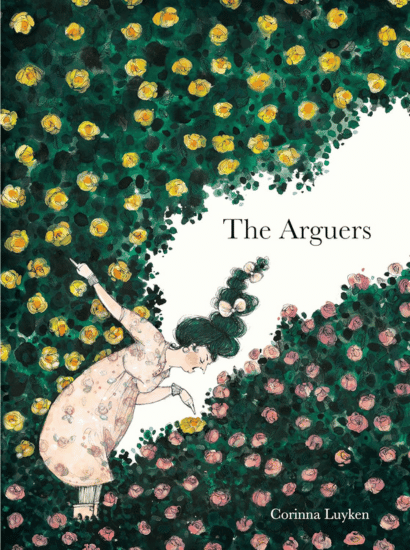
The Arguers
Written and Illustrated by Corinna Luyken
Ages 4-8 | 40 Pages
Publisher: Rocky Pond Books (2025) | ISBN-13: 978-1984814425
Publisher’s Book Summary: A delightfully preposterous and original fairy tale about a community that forgets how to get along, by the celebrated creator of The Book of Mistakes.
The first argument was over a brush and a comb, and which would be better for taking a tangle out of the king’s beard. Next came the argument over letters, and then over spoons . . . and soon they argued all the time, and no one could remember when the arguing had started or over what or by whom. They only knew that they had always argued, and that they did it well. Very, very well.
And so it was that the king and queen decided to hold a contest to choose the very best arguer in the land. But what will happen when everyone is so busy arguing that they can’t even hear the queen announce the start of the contest?
Buy the Book
Corinna Luyken is the author-illustrator of the New York Times Best Seller, My Heart, as well as The Arguers (May, 2025); ABC and You and Me (A Dolly Parton Imagination Library selection); The Tree in Me (an NCTE Notable Poetry Book and Indie Bestseller); and The Book of Mistakes (which The Wall Street Journal called “sublime”).
She is also the illustrator of many award winning picture books including In the Dark (A Marginalian Best Book of 2023) written by Kate Hoefler; Patchwork (A New York Times and Kirkus Best Picture Book of 2022), written by Matt de la Peña; and Adrian Simcox Does Not Have a Horse (A Junior Library Guild Gold Standard and Comstock-Gag Read Aloud Book Award) written by Marcy Campbell.
She was raised in Oregon, California, and Hawaii, and studied dance improvisation, poetry, and printmaking at Middlebury College in Vermont. Her work is rooted in improvisation and explores themes of connection, perception, and misperception. She lives in Western Washington, near the Salish Sea, where she also likes to dig in the dirt, surf, and read with a cat (or two) on her lap.
For more information, visit: https://www.corinnaluyken.com/

Additional Books Mentioned:
- ABC and You and Me by Corinna Luyken: Amazon or Bookshop.org
- In the Dark by Kate Hoefler, illustrated by Corinna Luyken: Amazon or Bookshop.org
- Patchwork by Matt de la Peña, illustrated by Corinna Luyken: Amazon or Bookshop.org
- The Book of Mistakes by Corinna Luyken: Amazon or Bookshop.org
- Adrian Simcox Does Not Have a Horse by Marcy Campbell, illustrated by Corinna Luyken: Amazon or Bookshop.org
- The Very Persistent Gappers of Fripp by George Saunders, illustrated by Lane Smith: Amazon or Bookshop.org
- A Swim in a Pond in the Rain by George Saunders: Amazon or Bookshop.org
- The Butter Battle Book by Dr. Seuss: Amazon or Bookshop.org
