

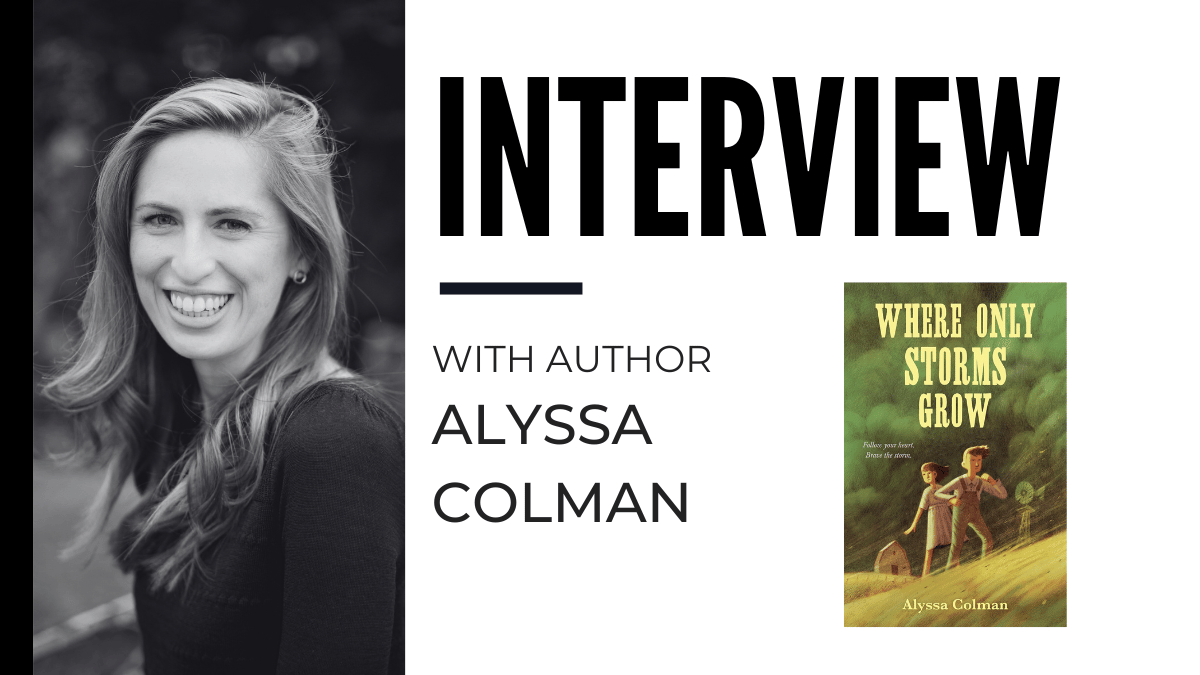
An interview about Where Only Storms Grow by Alyssa Colman, presented by The Children’s Book Review.
Alyssa Colman unpacks the inspiration behind Where Only Storms Grow—a sweeping Dust Bowl tale of grit, family, and finding strength in unexpected places.
With a deep respect for overlooked histories, Alyssa Colman brings a fresh perspective to the Dust Bowl era in Where Only Storms Grow. Blending meticulous research with personal experience, she crafts a powerful middle-grade novel about resilience, disability, and the quiet heroism of those who stayed behind when the storms rolled in.
From a pandemic-era search for masks that led to silenced survivor stories, to the parallels between past and present climate crises, Colman’s journey to this book reveals as much about our current moment as it does about the 1930s. Her own experience with scoliosis informed her protagonist’s inner strength, while her fascination with sibling dynamics and the complexities of staying versus leaving add emotional depth to this historical fiction tale.
In our conversation, Colman opens up about why she felt compelled to center the “stayers,” how she navigates writing nuanced historical fiction for young readers on the cusp of deeper understanding, and what the Dust Bowl can teach us about endurance in uncertain times.
I read in a Publishers Weekly article that your journey to writing Where Only Storms Grow began with researching COVID-19 masks, which led you to discover that Americans wore masks during the Dust Bowl for “dust pneumonia.” Can you walk us through that fascinating research rabbit hole and how it evolved into a full novel?

Alyssa Colman (AC): Thank you for inviting me onto your blog today!
It’s a pleasure to have you!
AC: I will start by saying that I never intended to write about the Dust Bowl. In 2020, like many other Americans, I was researching which masks to buy online. Somehow, I stumbled across an article about another time in history when Americans were asked to wear masks: the Dust Bowl. I read about the epic dust storms and the rise of a deadly new disease known as dust pneumonia. I was shocked to learn that it was the same kind of silicosis known as black lung in mines, but residents of the Dust Bowl area could catch it from breathing in the air.
I realized how little I knew about the period and started reading voraciously. I developed an immense respect for the people who lived in the Great Plains in the 1930s. At the time, I had been playing around with an idea for a historical novel about a girl with scoliosis. In that magical way that stories can take on a life of their own, the two ideas merged and became Where Only Storms Grow.
This is your first non-magical historical fiction after writing fantasy novels, The Gilded Girl and The Tarnished Garden. What drew you away from magic this time, and how was the writing process different when grounding your story entirely in historical reality?
AC: While I enjoy fantasy, historical fiction has always been my true love. It was definitely more challenging to write straight historical fiction because I couldn’t make things up as freely. In The Gilded Girl, I could wave my hands and say, “It’s different in this world because of magic!” This time, I felt an immense pressure to do right by the people who lived through the Dust Bowl. While I did soften some aspects because this is a novel for children, I also wanted to portray how they lived and what they endured as accurately as possible.
As a result, it was a more time-consuming process than writing The Gilded Girl and The Tarnished Garden. Those books each took about a year to write and edit. Where Only Storms Grow took closer to two years.
In the above-mentioned article, you talked about listening to over 100 hours of oral histories from Dust Bowl survivors. What was the most surprising or moving thing you learned from those firsthand accounts, and how did their voices shape your characters?
AC: Oh, goodness. Those oral histories had a HUGE impact on the novel. They not only shaped the character’s mannerisms and speech, but they also affected the structure of the story. In all the interviews, the first question was always about the participant’s day-to-day chores and responsibilities as children. Instead, almost every single person brought up their memories of one particular day: April 14, 1935, a day known as Black Sunday. It was the biggest, darkest storm of the decade. I knew I had to start my story with the storm that loomed so large over their collective memories. There were also fun details that made it into the book. One of the poems in the novel was inspired by a survivor’s story about a dare to eat a grasshopper.
The book focuses on the people who stayed during the Dust Bowl rather than the more commonly told stories of those who left. What drew you to explore the “stayers,” and what do you think their stories teach us about resilience?
AC: Did anyone else read Kristin Hannah’s brilliant The Four Winds and wonder about the grandparents who stayed behind? I read it between my first and second drafts and kept hoping the story would cut back to them. I wanted to know more about the people who chose to remain behind. I learned that two-thirds of families stuck it out in the region. There were financial or personal reasons they couldn’t or didn’t leave. I don’t think any of them viewed the decision to stay as anything extraordinary or resilient, even though they endured immeasurable hardships such as carting dust out of their houses with shovels, crop destruction, and a new illness called dust pneumonia that sickened and killed their families. They were simply keeping on.
I think that their stories teach us that “being resilient” isn’t always something we’re aware of in the moment. I hope that readers will take away the message that, even when things seem bleak, keep going. Things can, and often do, get better.
Your protagonist, Joanna, has scoliosis, which you also live with. How important was it to you to include this representation in middle-grade literature, and how did your personal experience inform her character’s journey?
AC: I wanted to write about a character that has scoliosis, but not make the novel about her scoliosis. From ages seven through twelve, I wore a Charleston Bending Brace that curved my spine to the side at night. I didn’t know anyone else with scoliosis and I felt isolated in the experience. My brace made it impossible to attend sleepovers at the height of their popularity. I dropped out of gymnastics and other activities that I loved. Some of that was necessity—I would never be able to do a back-walkover—but I let my scoliosis define me for years.
Joanna makes a similar choice to withdraw from the world at the beginning of the novel, but through the course of the story, she learns there are many ways to be strong and finds her place.
Your main characters are twins, and you’re also a mother of twins. How did your experience of parenting twins influence the sibling dynamic between Howe and Joanna, especially their conflicts and ultimate unity?
AC: My twins are five years old, but already I see the pressure of “sameness” that people put on their relationship. A man approached us at the library the other day to confirm that they weren’t identical and he was surprised to learn they are. He couldn’t understand why I let them cut their hair differently because it would be “so cute” if they matched. Though one of my girls is an athletic extrovert and the other is an artistic introvert, I can see that they feel the pressure to be a unit. At a recent block party, they were upset when one wanted a brownie and the other wanted a cupcake. Mind you, they were not asked to share them. I had to remind them that they are different people and could pick different desserts.
Howe and Joanna used to be best friends, but her diagnosis and their diverging interests forced a wedge between them. They both want to be close again, but they’ve grown out of their old techniques and games. Through the story, they learn to recognize where they’re alike and where it’s okay—and even pretty great—that they’re different. I hope my girls don’t have to struggle as much as my characters to learn that!
Black Sunday—April 14, 1935—serves as the dramatic backdrop for your story. You’ve called it “one of the most dangerous storms in American history.” What made this particular storm so significant, both historically and as a storytelling device?
AC: Imagine it’s Palm Sunday, April 14th, 1935. You wake up to a beautiful, blue sky. It’s the first beautiful and windless day you’ve seen in months. After church, you and your family open up the windows to air out your dust-clogged house. But you can’t resist being outside. It’s a perfect seventy-two degrees. Someone suggests a picnic and everyone agrees it’s a grand idea. You drive out to your favorite spot and enjoy the sunshine. Without warning, the air fills with the honking and squawking of thousands of birds all fleeing in the same direction: AWAY. You turn to the horizon and that’s when you see it: A dust cloud two miles high and so thick that it looks like a mountain. You can’t outrun it. The storm moves in at sixty-five miles per hour. When it hits, the darkness is so instantaneous that you can’t find your own hand in front of your face. It blocks out the sun so effectively that the temperature plummets 30 degrees in minutes. All the while you’re choking on the powder- fine dust.
What made this storm so dangerous was not only its ferocity but also its surprising arrival. Most dust storms blew up gradually or caused the sky to turn strange colors that foretold their arrival. This storm came out of a clear day, and people were exposed and unprepared. Over 300,000 tons of topsoil flew through the air and traveled across six states. Few other storms have caused such widespread destruction in such a short amount of time. As Timothy Egan points out in his National Book Award-winning The Worst Hard Time, that’s more dirt than was excavated when building the Panama Canal. That project took seven years. Black Sunday lasted hours. How could I not want to write about that?
You’ve drawn explicit parallels between the Dust Bowl and our current climate crisis, even writing during the 2020 California wildfires. The government’s response to Black Sunday was remarkably swift, creating comprehensive soil conservation programs within a month. How do you hope young readers will connect these historical lessons—both the environmental disaster and the effective policy response—to today’s climate challenges, and what role do you hope your book plays in inspiring young environmental activists?
AC: I hope that readers see that we can’t just shrug our shoulders and hope the current climate crisis will get better on its own. The government acted swiftly after Black Sunday and rolled out several strategies to mitigate the existing damage and prevent more. But those bills and plans had been in the works for several years and it took the concentrated effort of scientists and experts to make it happen. I hope that young readers come away from this book with an increased awareness that fixing huge climate problems takes expertise and coordinated action. We have to work together because no one person can solve it. But there are things we can do as individuals—even kids!—that add up to the greater good.
The book is positioned for readers graduating from the I Survived series who are ready for more complex historical fiction. Was it difficult to find the perfect balance of delivering that exciting survival story while tackling weightier themes about family, disability, and environmental responsibility?
AC: Yes, it was challenging, but I really enjoy finding the right balance of depth and adventure. Personally, I think the weightier themes add to the adventure by raising the stakes! I actually had to rein in some of the survival adventure aspects. It was tempting to have dust storms almost every day, which was realistic for early 1935. My editor and I worked hard to strike the right balance of action and quiet moments between the storms, where life goes on. The scenes with Howe, Joanna, and their brother, Lou, were some of my favorites to write. There’s one where they’re cooking, teasing each other mercilessly, and planning how to save their family, all at the same time.
Is there anything else you’d like to share about Where Only Storms Grow, yourself, your writing, or any upcoming projects?
AC: I would absolutely love to tell you more about what I’m working on now, but publishing makes us keep these things secret while they’re in progress. All I can say is that it’s another historical novel and there is a wonderful dog. Thank you so much for inviting me onto your blog today. I wish you all happy reading and I hope you enjoy Where Only Storms Grow!
It’s been an absolutely insightful and delightful pleasure to have this discussion with you. Thank YOU, and happy reading!
About the Book
Where Only Storms Grow
Written by Alyssa Colman
Ages: 8-12 | 256 Pages
Publisher: Farrar, Straus and Giroux (2025) | ISBN: 978-0374392789
Publisher’s Book Summary: For Fans of the I Survived series and The War That Saved My Life, this gripping middle grade novel is set during one of the most dangerous storms in American history.
It’s been four years since rain fell on the Oklahoma panhandle and the closeness between the Stanton twins has dried up as much as the land. Howe Stanton has been practicing running away and longs for the family to quit this land of dust where only troubles grow. Despite the scoliosis that causes Joanna Stanton near-constant pain, she isn’t ready to give up like her brother. But when Daddy leaves the family behind to find work in California, saving the farm from ruin falls on Howe’s unwilling and Joanna’s uneven shoulders.
To pay the mortgage, Joanna takes a job at the local hospital and discovers purpose in helping others. Howe finds unexpected joy in caring for his father’s horse and escapes in a borrowed book.
But then a tragedy in town reveals the dust’s deadly dangers. With the worst storm of the Dust Bowl bearing down on their home, Howe and Joanna must put aside their differences and work together, or everyone and everything they love will be lost to the dust.
Buy the Book
About the Author
Alyssa Colman is the author of Where Only Storms Grow, The Tarnished Garden, and The Gilded Girl, which won the 2021 Northern Lights Book Award for middle grade fantasy. Publishers Weekly called the story “a thoughtful and imaginative exploration of friendship, internal change, and perseverance” in a starred review. Alyssa lives in northern Virginia with her family.
For more information, visit https://www.alyssacolman.com/
This interview—Interview with Alyssa Colman, Author of ‘Where Only Storms Grow’—was conducted between Alyssa Colman and Bianca Schulze.
