

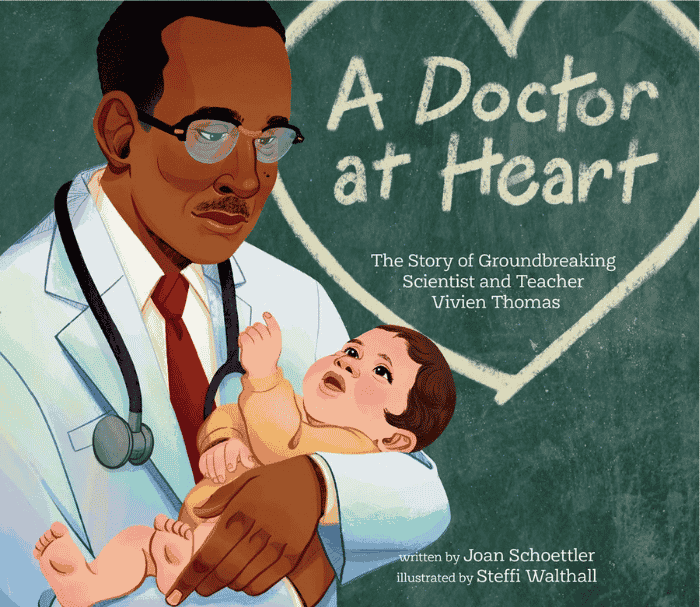
An interview about A Doctor at Heart: The Groundbreaking Scientist and Teacher Vivien Thomas by Joan Schoettler, presented by The Children’s Book Review.
Joan Schoettler discusses A Doctor at Heart, her inspiring picture book biography about children’s heart surgery pioneer Vivien Thomas.
Vivien Thomas dreamed of becoming a doctor at a time when racism, segregation, and economic hardship placed enormous barriers in his path. Yet through determination, curiosity, and an unwavering commitment to learning, he helped develop a groundbreaking surgical procedure that transformed the lives of children born with “blue baby” syndrome. In A Doctor at Heart, Joan Schoettler introduces young readers to the remarkable true story of a man whose brilliance and perseverance changed the future of heart surgery.
In this conversation, Schoettler reflects on discovering Vivien Thomas’s story, balancing the realities of racism with the wonder of his achievements, and the lasting impact Thomas had as both a scientist and teacher. She also shares insights into the collaboration with illustrator Steffi Walthall and discusses the powerful message she hopes young readers will carry with them long after they turn the final page.
Vivien Thomas’s story is one that many people — even adults — don’t know well. What was the moment you first encountered his story, and what made you think, this needs to be a picture book?
Joan Schoettler (JS): An HBO drama about Vivien Thomas captured my attention immediately. Something the Lord Made chronicled the partnership between Vivien Thomas, a Black research technician, and a white surgeon, Dr. Alfred Blalock. As the film progressed, I thought, “Vivien’s life would be an amazing and important story to share with children.” With journal and pen in hand, I jotted notes as each scene unfolded.
The next day, I viewed it again. This time I recorded his story on my computer, a sign to me of my personal interest in learning more and sharing what I learned. Vivien’s story portrays a young boy, a carpenter’s son, with an ambition to become a doctor, but who encountered economic setbacks, as well as racism, and injustice. But Vivien kept his vision on his goal, and, while he never attended college, Vivien went on to become a pioneer in cardiac surgery and to teach future cardiac surgeons.
Thomas developed a groundbreaking surgical technique without ever holding a medical degree — in large part because of the racial barriers that blocked his path. Can you talk about how you approached that reality for young readers without it eclipsing the wonder of what he achieved?
JS: When Vivien moved to Baltimore, he found it more racially divided than Nashville. Vivien experienced intensified racism and segregation in the city of Baltimore, as well as at the university. Vivien was classified and paid as a janitor while performing surgical research. He was expected to use the side or back door of Johns Hopkins’s hospital like other Black custodians; he was glanced at for wearing a white lab coat, and he was forced to eat separately from his white colleagues. I tried to balance the scenes of injustice with Vivien’s dedication and accomplishments.
Thomas worked alongside Dr. Alfred Blalock at Johns Hopkins at a time when he was denied many of the rights and recognition afforded to his white colleagues. Can you talk about the choices you made to address the racism Vivien faced in a way that feels honest without overwhelming young readers?
JS: It was important to me to reveal the reality that racism played out in many ways in Vivien’s life. Sometimes I wondered how he dealt with it. In Baltimore he was classified as a janitor until he confronted Dr. Blalock. I tried to balance the positive recognition he had with the racism he encountered.
Vivien wore the white coat of a lab assistant, but had to use segregated restrooms. He played an essential role in solving “blue baby” syndrome, but was not credited for it in medical journals until 2024. Vivien taught future cardiac surgeons, but met roadblocks for completing his own formal training.
Picture book biographies require such careful choices about what to include and what to leave out. Was there something about Vivien’s life or legacy that you loved but ultimately couldn’t fit on the page?
JS: I considered including some personal components that I thought children would like, such as the fact that he had two daughters, loved barbequing, and built a mahogany mantelpiece from an old piano. He was proud of the diplomas earned by his family that hung on the wall in his living room. Vivien was proud when his nephew, Koco Eaton, went on to medical school and become an orthopedic surgeon. But I am so pleased with A Doctor at Heart just the way it is!
The subtitle calls him both a scientist and a teacher. Which of those two identities felt most important to center as you shaped the narrative, and why?
JS: This is a tough question. Vivien’s experimental techniques led to the first heart surgery on a child with “blue baby” syndrome, so we know his cardiac research skills were among the best. So many lives have been saved by this procedure.
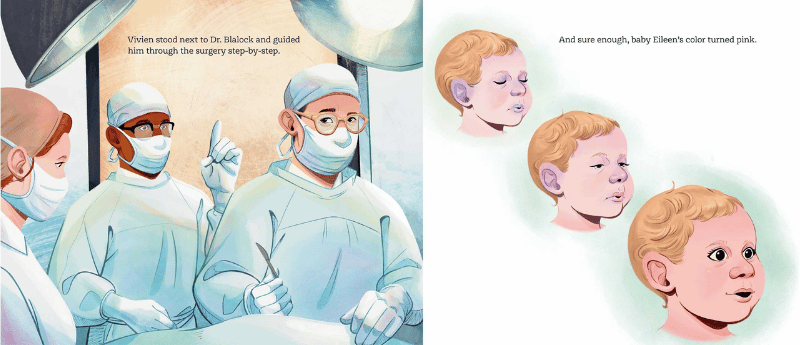
But I consider his teaching at the center. Notice how he walked Dr. Blalock through the first surgery for “blue baby” syndrome and for many subsequent surgeries. Vivien’s role as a teacher instilled an important and lasting effect on competence, knowledge, and teaching skills that created a generation of prominent heart surgeons, even though he had no formal medical training. The surgeons he taught went on to become heads of surgery departments across the nation, saving lives, sharing their knowledge, and remembering Vivien’s excellence as a teacher.
Illustrator Steffi Walthall brought your words to life visually. Was there a spread or an image she created that exceeded what you’d imagined on the page?
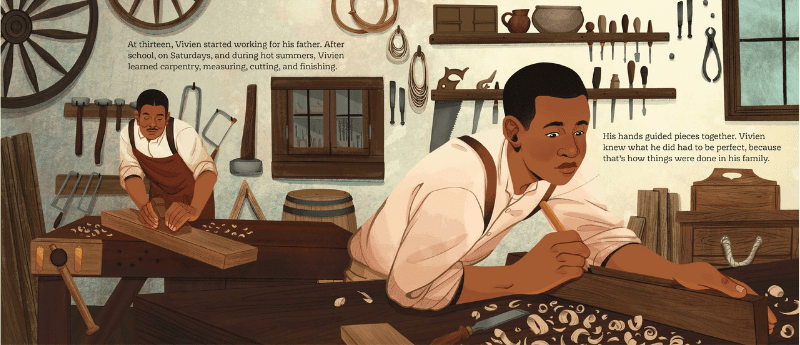
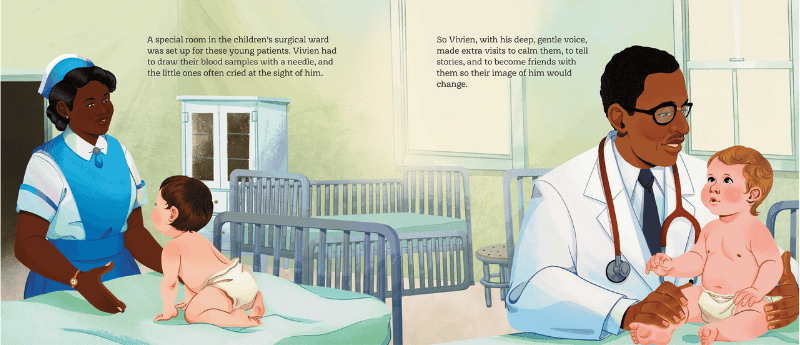
JS: Steffi Walthall exceeded my expectations for A Doctor at Heart! From the first page where wood blocks, sewing patterns, rulers, and scissors and nails are flying across the page and the second spread where Vivien and his father are in their woodworking shop, her sensitivities and research exceeded my expectations. I knew why Steffi was chosen to illustrate this book. What captivates me with her art is how she captured the facial expressions on page after page.
Vivien Thomas was eventually awarded an honorary doctorate by Johns Hopkins decades after his most groundbreaking work. You include that belated recognition in the book, and yet the story never feels like it’s waiting for that moment to validate him. How did you think about framing that for young readers?
JS: To me, Vivien didn’t expect the belated recognition. Perfecting the cardiac surgery for “blue baby” syndrome and sharing his knowledge and expertise with his students over his decades of teaching were enough for him. I felt he was humble and just doing what he had been taught at home and the belief he carried with him throughout his life: “…whatever you do, do your best.…”
What do you hope a child takes away from this book — especially a child who might be told, formally or informally, that certain doors aren’t open to them?
JS: Believe in yourself. Stand up for what you know is right. Follow your dreams. This is the example Vivien Thomas lived by. When his dreams evaporated or hit a dead end, he didn’t give up. He found another way around to reach his goal. Vivien hit many obstacles in life, but he always moved forward.
What do you most want children to do after reading this book — whether that’s asking a question, seeking out more information, or something else entirely?
JS: I would like the children to talk about the book: what amazed them most about Vivien Thomas, their thoughts, their beliefs, how they relate to the story, what questions they might have, what their favorite page was, and more. I would like them to share this story and remember this amazing scientist and teacher.
Is there anything else you’d like to share?
JS: I hope you enjoy reading the book as much as I enjoyed writing it. Enjoy Steffi Walthall’s illustrations that create an important book to share with young readers.
About the Book
A Doctor at Heart: The Story of Groundbreaking Scientist and Teacher Vivien Thomas
Written by Joan Schoettler
Illustrated by Steffi Walthall
Ages: 4-8 | 48 Pages
Publisher’s Book Summary: A fascinating and inspiring picture book biography about Vivien Thomas, a pioneer of children’s heart surgery and trailblazer for Black people in STEM.
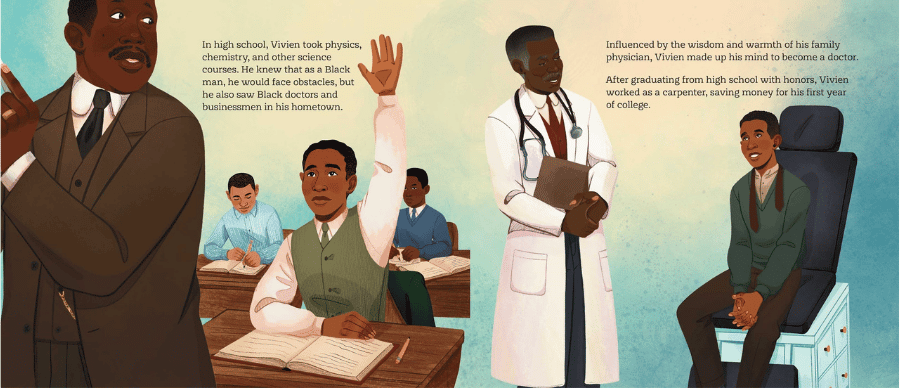
Vivien Thomas always loved solving problems and figuring out how things worked. In high school, inspired by his family physician, he decided he would become a doctor. Despite losing his college savings during the 1930 bank panic, Vivien stayed dedicated to making his dream a reality, a trait that would serve him all his life.
Vivien secured a lab assistant position at Vanderbilt University and later moved to Johns Hopkins Hospital, where he and his mentor developed a groundbreaking procedure to cure “blue baby” syndrome, which led to them performing the first open-heart surgery on a child.
With the power of his passion, perseverance, and dedication to learning (and without any formal college education), Vivien saved thousands of lives.
Buy the Book
Borrow the Book
About the Author
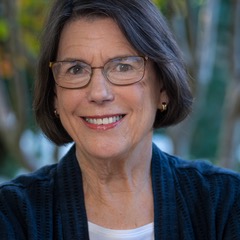
Joan Schoettler is a children’s author who taught children’s literature and storytelling at California State University, Fresno. Joan is an award-winning author of five picture books and one middle grade novel. A Doctor at Heart: A Story of Groundbreaking Scientist and Teacher Vivien Thomas (May 12, 2026) is her latest picture book. Joan’s storytelling is illuminated in her stories about nature, art, and artists. Her writing demonstrates a global view as her stories traverse the world. Joan lives in central California with her husband.
Visit her at joanschoettler.com.
This interview—Interview with Joan Schoettler, Author of ‘A Doctor at Heart’—was conducted between Joan Schoettler and Bianca Schulze.
