

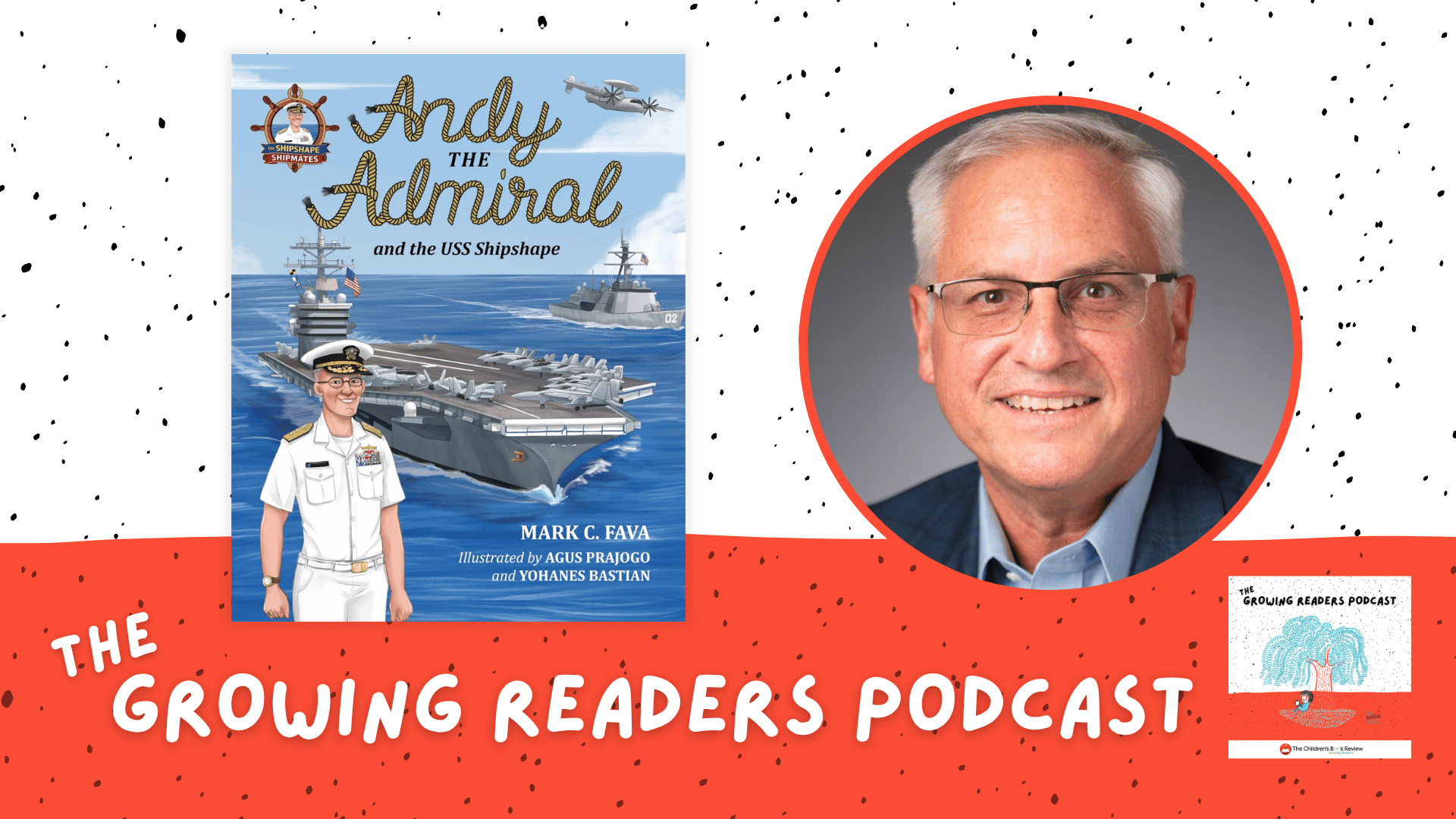
A podcast interview with Mark C. Fava on The Growing Readers Podcast, a production of The Children’s Book Review. This episode is sponsored by Expound Publicity.
Looking for a fun way to talk with kids about kindness, honesty, good manners, and teamwork?
In this episode, retired Navy Captain and author Mark C. Fava takes us aboard Andy the Admiral and the USS Shipshape, a picture book set on a bustling aircraft carrier, where 5,000 crew members depend on each other every day. Mark shares how Navy life models friendship and character for young readers, and offers encouraging advice for kids who dream big but don’t feel “perfect.” Aspiring authors will also get practical lessons on perseverance and publishing. It’s a great listen for parents, teachers, and anyone raising a young reader who loves ships, planes, and adventure.
Subscribe to The Growing Readers Podcast to ensure you never miss an episode celebrating the creators shaping young readers’ lives.
Listen to the Episode
The Show Notes
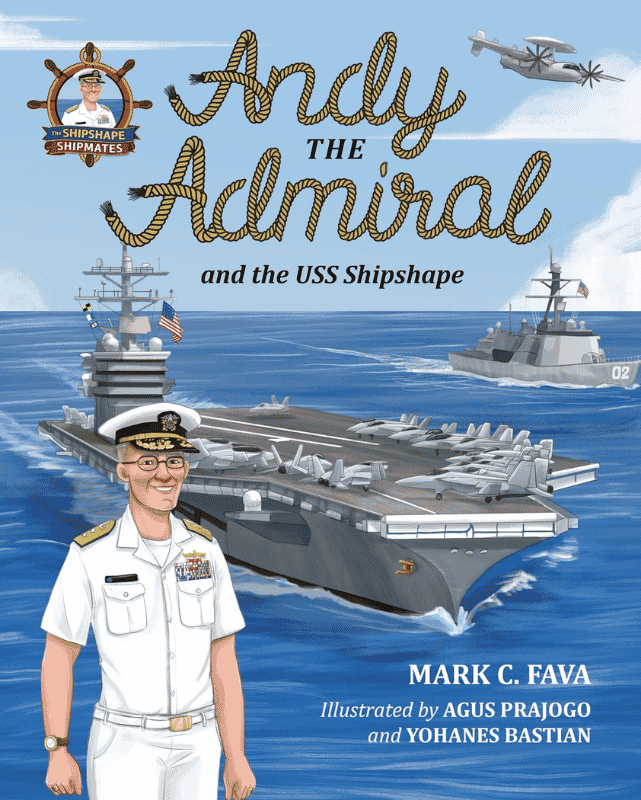
Andy the Admiral and the USS Shipshape
Written by Mark C. Fava
Illustrated by Agus Prajogo and Yohanes Bastia
Ages: 3+ | 32 Pages
Publisher: Mascot Kids (2026) | ISBN-13: 979-8-89138-803-1
Publisher’s Book Summary: Climb aboard the Navy aircraft carrier USS Shipshape with Andy the Admiral and his crew!
This ocean adventure is packed full of fun and valuable lessons. Readers will discover that the best Shipmates—and the best friends—show kindness, good manners, honesty, and teamwork.
Welcome aboard, Shipmates!
Buy the Book
About the Author
Mark C. Fava is a career aviation lawyer and retired naval flight officer. He is a prolific writer and entertaining speaker. Mark retired from the US Navy as a captain, having commanded three units, including an aviation squadron. He has been a law firm partner and a corporate executive lawyer. Fava is also the author of Lessons from the Admiral: Naval Wisdom and Sea Stories for Leaders, an award-winning leadership book drawing on lessons from his Navy, legal, and corporate career. As a law school adjunct professor, he has also taught aviation law and legal writing.
Mark was the chief operations attorney at Delta Air Lines on 9/11 and spent years in the Navy’s P-3 Orion chasing Soviet submarines. He has practiced law for more than thirty years and is currently a vice president at the world’s largest aerospace company.
He lives in his hometown of Charleston, South Carolina, with his wife and three daughters. When not working, reading, or writing, Mark enjoys life in the Lowcountry and appreciates a cold glass of sweet tea in the summer and a good oyster roast in the fall.
Learn more at theshipshapeshipmates.com.

Credits:
Host: Bianca Schulze
Guest: Mark C. Fava
Editor: Kelly Rink
Producer: Bianca Schulze
Read the Transcript
Bianca Schulze Well, I feel like the best way to start off this podcast episode with you, Mark, is just to simply say, welcome aboard, Captain.
Mark C. Fava Thank you so much. Thank you, Bianca. It’s such a pleasure to be here.
Bianca Schulze I would love to start off with a couple of fun rapid-fire questions just to kind of set the tone here and find out maybe a little bit about you. If you were to read a book, would you consider the best place to read it on a ship, in an airplane, or on dry land?
Mark C. Fava Oh, dear. It’s gonna be between the airplane and the ship. Probably the ship. It’s a little bit more relaxing.
Bianca Schulze And then if you had to pick one, would you pick aircraft carrier or submarine?
Mark C. Fava Aircraft carrier. Too claustrophobic for submarine.
Bianca Schulze And then do you have a favorite Navy phrase, something that was often repeated?
Mark C. Fava Yeah, we use it throughout the book. So, “Well done, shipmates.” And it’s kind of a love-hate expression because some people, you know, don’t like to be called a shipmate, some people do, but it really is a term of affection.
Bianca Schulze Okay, I love that. I actually, now—okay, I’m gonna break my rapid-fire rule. Like, why would some people not like to be called shipmate?
Mark C. Fava Yeah, it’s a phrase that typically might be said, and it can have a negative or a positive connotation, and I hope it has a positive one. It can be like, “Okay, shipmate, you need to do your job,” or it can be, “Well done, shipmates.” So it depends on how it’s said, and it’s kind of a joke now amongst my friends, because we call each other shipmates and we laugh about it now.
Bianca Schulze Yeah, yeah, yeah. So it’s all about the inflection.
Mark C. Fava Yes, the inflection, the look, whether the arms are crossed, who’s delivering the shipmate to you. So the context really matters.
Bianca Schulze Yeah. So then, final rapid-fire question. One word to describe Andy the Admiral in your book.
Mark C. Fava Gracious, fatherly.
Bianca Schulze Perfect. All right, so let’s get into longer answers now. So I want you to tell us about Andy the Admiral and the USS Shipshape. So who is Andy, and what kind of adventure are readers signing up for?
Mark C. Fava Andy is a fictitious character that embodies some of the best leaders I’ve met in the Navy and my father. So my father was also in the Navy. And he takes people on an adventure on an aircraft carrier. And when they’re out there, they learn that teamwork matters, kindness matters, asking for help matters, and they also get to see all the neat, busy things that go on in an aircraft carrier. You know, it’s a ship of five thousand people, and they’ve got everything on board to make it work.
So, shipshape is another nautical term that I picked up because, just like being called a shipmate, you can also be told whether or not you’re shipshape. And if you’re not—if your uniform isn’t shipshape—that’s not good. So it really is a play on the Navy. And again, the goal in writing the book was not only that it would be very enjoyable for children, but also that my colleagues who have since retired or are serving in the Navy will get a chuckle out of it, because they will see the words in there and they will see other things in there that are so genuine to the Navy.
Bianca Schulze Yeah. I actually had no idea that there would be five thousand crew members on a ship at one time. That blows my mind. Five thousand.
Mark C. Fava It’s unbelievable. Yeah. And the irony is, you know, I never served on an aircraft carrier. So this is just a book where I’ve been able to take some time that I had about two years ago. After I’d gotten out of the Navy, I was able to go on board a wonderful two-week cruise where they were actually doing carrier quals off the Pacific Ocean. And we didn’t have the full contingent. We probably had just half of the ship because it was just a training mission. But so much of what’s in the book came from the years I spent in the Navy combined with that two-week trip, and just, again, being amazed about it.
And all my Navy friends who really went on ships—I was in a land-based aircraft—were giving me a hard time and said, “Hey, Fava’s finally going on board a ship. After 30 years, he’s getting some real sea time.” So it was absolutely fascinating. And you see a lot of that in the book. I used a lot of the pictures I took while on board and the characters I’ve met to sort of go through my mind in creating Andy.
Bianca Schulze Yeah, yeah. It’s so fascinating because I feel like for many of us, we think of the Navy as everybody’s just sort of out on a giant ship, you know, in the ocean, in the seas, and there’s really so many roles that are in the Navy. And, you know, I feel like a lot of us don’t stop to think about what it takes to, you know, run all of that. So—
Mark C. Fava It’s incredible. It’s a living, breathing city. There’s dentists on board, there’s doctors, there’s electricians, there’s plumbers, there’s aircraft mechanics and pilots and ship drivers. So anything you would need to run a city is on board. And, you know, when you look at the amount of food each day that is cooked by the cooks on board, again, it’s just absolutely fascinating.
Bianca Schulze Yeah, yeah. All right. Well, to be a writer, they say you need to be a reader first. So was reading always a part of your life growing up, or is reading something that came to you later?
Mark C. Fava It came to me later, although I started reading—you know, I was a political science major in college, and then I loved writing and reading in high school. Much of my writing today and my inspiration to write comes from high school English, and I just enjoyed it. That led to a career as a lawyer. And, you know, you get to read a lot as a lawyer, and a lot of it is not for pleasure. I mean, it’s very reading-intensive, and in your job, it’s the same way. So I sort of dropped off for a while doing a lot of pleasure reading.
And one of the wonderful things about the pandemic was it brought me back to reading, right? We were all so bored. I was just tired. I never really watched TV, so I would pick up a book, and I did two things: I read, and then I wrote my first nonfiction book, which came out in 2025. And I would say now I always have a stack of three or four books at the bedside and ready to go with me, because I’m always traveling, and when I’m on the plane, I want to have a book or be listening to it.
Bianca Schulze Yeah, yeah. I feel like there’s something people don’t always, I guess, know about lawyers, which is that you’re also wordsmiths. I mean, just the finessing of one word can really change the meaning of an entire sentence. So do you feel like that’s a fair statement, that I think most lawyers have to be wordsmiths?
Mark C. Fava Oh, absolutely. Every word matters. I mean, my first job at my current employer, I worked for a gentleman who was the head lawyer of the company. And people listening to this who know the company and know him will know every word mattered. I mean, he would call you up and say, “Well, what does this mean, and why is this there?” And it was so funny: when I wrote my first nonfiction book, the first thing the editor told me was, “You’ve got to stop writing like a lawyer. You’ve got to get back to being a descriptive writer.”
So I had to undo everything that the law career had taught me. But definitely words matter, and constantly looking at them and deciding: Is there a better choice here? Is there one word, or one verb rather than an adverb? And that’s where it really gets fun. If you can just put a zinger in there and someone picks up on it, and it’s very well-intentioned.
Bianca Schulze Yeah, yeah. And I know you’re someone who likes to make lists and that you like to write everything down. So do you think that discipline shows up in how you write books, and maybe more in your drafting time? Like, you know, are you creating a list of what needs to be in your book? How does that play out?
Mark C. Fava Yeah, well, you know, for all of us, the thoughts and the visions come into your mind, and then I would just start jotting down. But nothing can be done without an outline, and then under the outline there’s sub-paragraphs. And definitely when I’m in the editing phase with an editor, I’m going through page by page, very lawyerly, with tabs and stickies and, you know, yellow highlighters, and still very old school. Nothing’s done on the computer other than printing it, and then I do all the edits by hand. Same thing with the children’s book.
It’s all done that way, and it’s very intentional, and I just like to have the paper and to be able to do it that way. And then, exactly what you said, I’ll put, you know, a dot list of ten or fifteen things that either need to be corrected or that I left out. And for the children’s book, it was very important that each one of the spreads had something in there that was kind of fun and fanciful. You know, it’s not all Navy work. Just to throw some Easter eggs in there. And I went back through and said, “Okay, on every page, do I have something in there that’s gonna be fun and fanciful that I can ask children about later?”
Bianca Schulze Yeah, yeah. Well, you spent thirty years in the Navy. I think you commanded three units and flew missions hunting Soviet submarines in P-3 Orions. So hopefully I have all my facts straight there.
Mark C. Fava Yes. Very well. Yeah. Six years active duty and twenty-four years in the reserves, and, you know, some of the absolute best and most genuine friends I met in the Navy, and a lot of that was during my reserve career. So I was a full-time lawyer. I did not become a military JAG officer. I stayed in the aviation community, and I was in the backseat of a P-3, which is a land-based aircraft, during the Cold War, and we’d go all over the world, and that was our mission: just hunt and track Soviet submarines. And if you were successful, you came home a hero. And if you weren’t, you came home not so much of a hero, and everybody knew about it when you got back to the base.
Bianca Schulze Yeah. Well, I guess between the Navy and law and corporate leadership, you’ve spent a career around adults, probably learning some pretty hard lessons about integrity and preparation. So what made you want to bring those same lessons to kids now?
Mark C. Fava Yeah. You know, it’s so funny. And these things just come to us, right? So I actually listened to a pastor one Sunday in church, and he was holding up this adult book, and then he said, “Here’s the kids’ book,” and it was the same lessons. And I said, “Gosh, I can do that.” And I think it’s so important now—one, as you say often on this podcast—that we inspire young kids and children to look to books, right? Get off the screen, get off the iPad—and maybe if that’s a book on the iPad, that’s okay. But to have the book in hand and to read it was, I think, so important when I was growing up. And I’m still a book person, you know. I still prefer hardback over anything else. You know, in a debate between the softback or the paperback or the hardback, I’ll get the hardback and say, “Good, I’m glad I got it.”
But all of these same lessons that I had in my first book, called Lessons from the Admiral—I wasn’t the Admiral, but I learned from an Admiral—were the same things that we had taught our children growing up. And they had heard them over and over. And I said, “Gosh, I could transfer those to a children’s book, but make it, you know, make it fun at the same time.” And it’s not just about being in the Navy. It’s just about what you need to do to be a good friend, right? To be kind to people, to help others, to admit when you’re wrong—all those things that I told our three daughters growing up. And I said, “Gosh, we can put this in a children’s book.” And I was very lucky that my publisher had actually started the publishing company producing children’s books. So yeah, it was just a very nice fit.
I sent him an email and said, “Hey, I’d like to do a children’s book,” and then I went from there to, “I’d like to do a series of children’s books.” So it just started growing, and that’s how we got to where we are today.
Bianca Schulze Yeah, yeah. Yeah, amazing. Well, I mean, I feel like what you described about being on these aircraft carrier ships, and sort of just that it is essentially a city—but beyond that, what is it about the community of being on an aircraft carrier, or even just being a part of the Navy, that you think helps, I guess, deliver these messages to kids about character and friendship? Like, why is the Navy such a great setting for character and friendship and relaying those messages to kids?
Mark C. Fava Sure. You know, it’s critical. We talked about all the different jobs, but everybody has a job, and everybody is looking to the other person to complete their job. And they’re dependent on that, right? You’ve got to be dependent on the aircraft mechanic for the planes to work, and the ship driver to get the ship in and out of port, and, you know, the gentleman to fuel the planes, and the dentist when you have a toothache. So I think that’s really what it came down to.
And what I found was the people that I met in the Navy, the shipmates now, became my closest friends. And to this day they are, because we were under that same environment. We knew what we had to do. We all were able to rely on each other. And the other really neat thing, Bianca, was at the same time our families might be at home, and our wives and our spouses and our kids were all relying on and trusting each other. And that’s how it was when I grew up. My father was in the Navy. So it was very unique, and I’ve yet to find that level of camaraderie and teamwork and really taking care of each other in what could be sometimes some of the most stressful times, but some of the most fun times.
And, you know, we moved every two or three years, and everybody says, “That must have been terrible.” And I said, “It’s wonderful.” You know, I got to live in Guam and Hawaii and Washington, DC. And, you know, one time—when I went to Guam, I was the only Caucasian guy in the classroom, you know, and I learned about diversity and friendship and taking care of each other. So I think that’s how I got to where I am, and why so much of it was that time in the Navy.
Bianca Schulze Yeah, yeah. Well, you and your wife have raised three daughters. Amazing. So, you know, you described Andy as fatherly, and your dad was in the Navy. So just talk to me about, I guess, this concept of fatherhood. Like, how did fatherhood shape the way you think about teaching character to kids? Like, why the fatherly figure?
Mark C. Fava Right. You know, my father—when I graduated from the University of North Carolina at Chapel Hill, he commissioned me. So he was the one that pinned my Navy bars on me, and my mother was right there. At that time, he was a Navy captain. And then also, when he retired, he gave me his Navy sword. And it really is this concept of tradition. The sword is the ceremonial sword that I still have to this day, and it has his name engraved on it.
And he gave it to me, and he said, “Son, make me proud.” And he said, “You take one thing out of this house, and that’s my name. Don’t, you know, don’t mess it up. And I know you’ll do good.” The other thing he told me when I was commissioned—he said, “Take care of your sailors,” which are the people who are going to have to salute you, but they might be in the Navy for 10 or 15 years, “and listen to the chiefs.” And the chiefs will be the senior enlisted personnel. Now, what Dad didn’t say was, you know, “Salute the boss,” and, you know, “Make sure you do what the admiral says.” He said, “Take care of the people you will be responsible for, and then listen to those who might be the senior enlisted people.”
So that concept carried over, you know, and being a father is so much like that, right? I tell people, we all know it’s our why. And whether you’re a father or a mother, every day you’re here, that’s what you’re doing. And I often say that when we get all three of our daughters out of the house—we’ve got one more left to go—and they’re done and they’re on their way, and their education is paid for and they have jobs, you know, we’ve met the mission and we’ve done our job. And that really has been what’s been driving me for so many years, with three girls spaced out pretty far. One of them is still in graduate school, one of them just graduated from college, and one of them is still in high school. So we’ve got a little bit more runway to go. But that really is the why, I think, for a parent every day: just to get up and say, “Okay, this is what I’m doing right now.”
Bianca Schulze Yeah, yeah, absolutely. So I think I know the answer you’re gonna give me here, but if you had to pick one line or moment from the book that captures its spirit, what would it be?
Mark C. Fava Yeah, you know it. It’s “Well done, shipmates.” So that’s gonna be at the end of every book. When they complete a mission, when they’re faced with some adversity, when they get something done, you’re gonna say that, and you’re gonna pat somebody on the back. You’ll see people getting awards for it, you’ll see people standing up in front of the group, just to know that, you know, working together with teamwork and helping each other out—at the end of the day, everything might not have gone perfectly, but as long as you try and you help each other, you get a “Well done, shipmates.”
Bianca Schulze Yeah. Well, Andy is the first of the Shipshape Shipmates series. I love saying that. That’s kind of like a tongue twister: Shipshape Shipmates series. So I think you have Patrick the Pilot coming, and Riley the Rescue Swimmer, and those are in the works. So what do you want us to know about where the series is headed? And what can we expect from those two that are already in the works?
Mark C. Fava Right. Definitely. They are.
Sure. Andy has a bunch of different lessons, right? Be kind, be nice, ask for help, admit when you’re wrong, be a good teammate. The next couple of books will just focus on really one theme. So Patrick and Paige will be pilots in two different aircraft, same training mission, and how they go out and help each other. And you’ll see that something happens to Patrick, and Paige is there to encourage him along the way. And it’s Patrick and Paige, and I think it’s called The Landing on a Foggy Day or something like that. Anyway, it’s so exciting because I just got the first round of drafts back from the illustrator, and you know how that is. I’m working on that now and making sure everything is consistent with the typeset and the colors of the first book.
And then the next one will be another character called Riley the Rescue Swimmer. So what I’m trying to do—I have a list of about ten or fifteen of them. I don’t know if I’ll get to all of them, but as we talked about earlier, it’s just all the different professions in the Navy that you can go do and go be. And I did have the chance to read Andy the Admiral during the summer—I had an advance copy—to a group of children, and there was one young man in the front who just kept raising his hand. He would not stop asking questions. He was so excited. And that was thrilling for me, because he was really getting into it. I said, “I bet you’re going to be a pilot.” So if I can encourage people—okay, maybe I want to be a pilot, maybe I want to be a swimmer. But to do that, you’ll see Patrick, Paige, and Riley all start off very young, swimming, you know, and who inspired them.
And so next, probably after that, I’ve got a list. Don’t wanna leave my Marine friends out. So there’ll be a Marine officer; there’ll be a submariner. And these have been so much fun, I’m almost ready to start on the next few, but I’ve got so much more work to do on the next two.
Bianca Schulze Yeah, yeah, yeah. I think that’s so fun. Now my brain wants to go in a couple different directions here, but I have to ask for my son. So he’s eleven, and he has been consistently saying he wants to join the Navy for probably a couple of years now.
Mark C. Fava Wow.
Bianca Schulze And, you know, I guess I love the idea that this series really—I mean, there’s kids that are just really drawn to the whole concept of protecting people, and also the draw to the big aircraft carriers, and, you know, I think there’s so much that attracts young kids. So what advice would you have for young kids? Like, kid-friendly advice for kids that read these books—what should they do next? Like, what should they focus on at school? Should they just focus on being themselves? How do they continue to foster that love of, and drive to, being part of the Navy?
Mark C. Fava Right. Listen, I think exactly what you said: follow your dreams, right? Whatever excites you. And it’s the same thing that we do now. I became an aviation lawyer because I love planes, I love the law, and I love to write. That makes work fun. And I’m writing books now for the same reason. To the kids, I’d say, you know, go build rockets, get into a little electric kit, you know, go fly paper airplanes, do anything like that that allows you that joy.
I was at Oshkosh, which is the world’s largest air show, this summer, and, you know, at one of the volunteer tables, all we did all day long was help little kids build rockets out of paper: roll the rocket up, put a cone on there, and then we’d go to the back, and there was a long line, and they would just put the rocket on a PVC tube—this was just a little makeshift gig—and then someone would press a button, and compressed air would shoot the rocket up. And the kids were just, you know, “This is wonderful, this is great.” Do those kinds of things that inspire you.
And then, as far as school, obviously do the best you can, but you don’t have to be perfect. I was never an A-plus student. I was always a B, B-plus. I barely got through physics, had a rough time with calculus, and it was so funny because, you know, three years later I’m on a P-3 Orion with a crew of 12, doing underwater acoustics and trying to figure out the sound from a Soviet submarine—as a political science major. So you can do whatever you want to do, and that’s also the lesson in Patrick the Pilot, the next book: just don’t give up and keep trying.
Bianca Schulze Yeah. Yeah. Yeah. That’s so great. And I feel like that just applies to all of us as adults, right? You know, I feel like we often put limits on ourselves, or consider ourselves—well, I wasn’t a straight-A student. Or, you know, I mean, I never studied literature, but here I am being a literacy advocate, right? And it’s just so important to follow those dreams. So I love that message.
Mark C. Fava Right. Yeah, you know, everybody thinks life—at least I did at a very young age—I thought it was gonna be linear. And, you know, the first time I applied to law schools, I think I applied to two or three of them when I was in the Navy. I don’t think I got into any of them, you know. My first book that I wrote—I went with a hybrid publisher, a very well-known hybrid publisher. I’d written the whole thing, we were getting ready to start editing it, and the publisher vanished. And in that cohort there were fifteen other people. Now, we all lost a good amount of money because it was a hybrid publisher, and I was very fortunate to find the publisher that I found after that. But only two of us kept going and actually published, because it was such a blow. But I was just convinced that it was something I wanted to do, and, you know what? I was gonna figure out a way to do it, even though my wife would say, “Now, how much money are you spending on that book?” So she was right.
But you know what? It wasn’t about the money. It’s like you said: it’s about the passion and the drive to get something done that you want to share with the world. And boy, when people start reading your books and come back and say they enjoyed it—especially if you have no idea who they are and you’ve never met them—it’s so fulfilling and so rewarding.
Bianca Schulze Yeah, yeah. Well, I guess on the publishing aspect of it, is there one particular lesson that you’ve learned, whether it was from that sort of not-great experience with the hybrid publisher? Like, what’s something that you’ve learned and now can carry forward with each subsequent book that improves the experience for you?
Mark C. Fava Yes, the first publisher did tell us this. And all of us that have written have experienced this: you start off and you’re very exuberant, and it’s fun and you’re happy, and you keep going, and then you reach the peak and you’re like, “Man, this is tough. And I don’t know if I’m gonna complete this.” Especially when you’re just looking at a manuscript. Now, when you get the storyboard with a children’s book, it’s very exciting. So I think the excitement comes a lot earlier. But I gotta tell you, when you get the first PDF, right, the first layout of the book, it just becomes real.
And by then you’re, you know, having a tough time. You’re still trying to figure it out. You’re saying, “Do I even need to do this?” I even had a hard time calling myself an author, to your point. It’s like—look, the first publisher said, “Look, you need to tell everybody you talk to that you’re an author.” “Well, I haven’t even published a book yet.” “No, you tell them you’re an author.” So I think by then, when you see the PDF, just know that the journey is worthwhile. And it is consummated when you see that box of books land at your doorstep.
And you open them up, and you pick out that book, and it’s everything you’ve dreamed of. You’re like, “I don’t care if I sell any or not, but I’ve published a book,” right? It’s such a wonderful day. And that’s what I would tell people who want to do it: don’t give up, you know. I’m writing another adult leadership book. Gosh, I’m about 75% through with it. It’s probably gonna take me two years before it’s done, because I’m still working full-time and I’m working on these children’s books. But I’m not gonna give up, just because it’s a passion and it fuels me, and, you know, I have as much fun doing it as I hope other people do when they read the books.
Bianca Schulze Yeah, yeah, absolutely. I always say I feel like if there’s one word that you need in your pocket as an author, it’s perseverance. You know, like, you have to persevere. It’s not some sort of quick, fast experience. I mean, the time it takes from the concept of the idea to that box of books landing at your front door—
Mark C. Fava Yes. Right.
Bianca Schulze I mean, it’s usually years in between. And I would argue that when it’s not years in between, then maybe you missed a couple of steps.
Mark C. Fava Absolutely. And, you know, you get so close, and I think it’s exactly that. And I tell people all the time, Bianca—and it’s funny because I flew in the P-3—I have three words that begin with P. I say perseverance, passion, and persistence. And persistence and perseverance are pretty much the same, but you set your mind to it and you just keep doing it. And then when the book is finally finished, you say, “Okay, when’s the release date?” And they say, “Well, it’s another three to six months, because we’ve got to get it in the distribution cycle.” And for me, it was just like, “You gotta be kidding me.”
So now that I know that, everything is mapped out, you know, in advance. I was like, okay, after it’s done, another two to three months to print, another two to three months to get it in the distribution cycle. Now let’s look at where it’s going to be released. And the first book I wrote, the first adult book, would have been ready to be released in December. And the publisher said, “You don’t want to release in December.”
And I said, “Why not? I’ve been writing this for two years.” And they said, “Mark, you know, you’re a no-name author. You’re not gonna make it, no matter how much money you spend on marketing in December. It’s the holiday season. They’re not even gonna see anything.” And it was the best advice I ever got. And that was, you know, a year and a half. And we released that book January twenty-eighth. We picked that date because it would have been after the holidays, after the presidential inauguration, and we gave it another two weeks, hoping that everything would settle down by then. And that was the date, and that’s where the perseverance and patience really come in, for sure.
Bianca Schulze Yes. Yeah, absolutely. So that is great advice. That’s excellent advice. That whole kind of—and I think even, you know, sure, you think, “Okay, well, maybe there’s some last-minute holiday shoppers looking for a book,” but, you know, it’s such an overwhelming time. And it’s true when people don’t know to look for you yet because you are a new author, or they don’t know to look for your book because they haven’t even heard of it yet, right? So I think that was fantastic advice, to wait till everything kind of settles. So—
Mark C. Fava Right. Very good advice. And, you know, that’s the other thing I would tell people: What is your goal in writing the book? Do you just want to say, “I published a book”? Do you want to actually sell the book? Do you want to make money on the book? I don’t know if you’re gonna do that, because, you know, it’s a very, very difficult thing to do, but you can. So, you know, I also say—and it’s the same thing a lawyer does—find the expert in the business, or somebody who can help you. You don’t know it all. So find a good publisher, a good hybrid publisher. You know, if you can get a good big-name publisher, do that too. And then listen to them, you know?
People pay me for legal advice, and I give it to them. They don’t have to take it, but that’s what they’re paying me for, right? And I felt the same way with the publisher, and now with a publicist. I said, “Okay, I wanna find the best person that I know who helps with children’s books.” And guess what? She’s a lawyer, and she’s the one that connected us. So I mean, I think—
Bianca Schulze Yeah. Yeah. I mean, I feel like we should give her a shout-out. It’s—
Mark C. Fava Aly is phenomenal. Expound Publicity. I mean, she and her team—just, Marcy—do just a wonderful job. I mean, they’re handling so much for me, and, you know, again, I’m in an arena, in a world, that I know nothing about. You know, I’m not the typical children’s book writer. So I was like, “Help me understand what to do and how to do this.” And boy, they’ve just done a phenomenal job.
Bianca Schulze Yeah, that’s awesome. Well, Mark, if a child reads this book today, Andy the Admiral, and remembers just one thing about it twenty years from now, what do you hope that is?
Mark C. Fava I hope it’s kindness, right? You know, one of the things about the military is, because you’re in and you’re thrown in with people from a bunch of diverse backgrounds, you really don’t care, you know, about any ethnicity or religion or whatever. You’re just all there to do a good job. And, you know, some of my best friends didn’t share any of my political views or religion, you know.
As a matter of fact, there could be a chaplain walking around on a ship, and you might go to him or her for help. And it might be a Jewish rabbi. That’s the only person available. You’re not saying, “Okay, I don’t want to speak to that person.” So I hope they remember that there is a reward for being kind to each other.
Bianca Schulze Yeah, yeah. And is there anything else that you want to say to the shipmates listening today?
Mark C. Fava No, I just—I tell you, I’m just so excited that, like I said, the next one, Patrick the Pilot, will be out in early 2027, and then Riley the Rescue Swimmer will be out. You can actually see previews of both of them. And the really neat thing is, you know, like I said, there’s Easter eggs in every book. There’s a brilliant lesson plan, again, and a guide, not only for educators, but for anybody that wants to see the games and find the questions that are related to each of the lessons in the book. Thirty-one pages that are free, that are downloadable, really written by professionals on Aly’s team for teachers, and by a child school psychologist. It’s just absolutely incredible, the materials that accompany the book.
And the neat thing is, as you get to the end of the book, you might see a cameo appearance on the last page of the next character. So that’s kind of fun. They’re hanging out there, and you’ll say, “Hmm, I wonder who this is.” And then throughout the book, the Easter eggs show up. In Andy, there’s a black cat, so you can find the black cat somewhere where things aren’t going well. And in Patrick, the black cat reappears, as does a dog. The dog is Skipper the Sea Dog, and the cat is Captain the Black Cat. So that’s a little bit of a preview, and all of that you can find on the shipshapeshipmates.com website.
Bianca Schulze My gosh. Mark, I feel like the joy and the enthusiasm that you have is so awesome. And I feel like this is why you should write books for kids, right? Because you have the joy, and I love it when the joy comes through in the words and the art and all of that too. So just thank you for putting together, I guess, your life’s work in these small little nuggets.
And I know it’s gonna inspire kids, and I know they’re gonna have so much fun reading these books and looking over the pictures and, like you said, looking for the cat, looking for the dog. And I’m just so grateful that you were here today, and just thank you, I guess, for your service as well, and I hope we get to meet again.
Mark C. Fava Well, thank you for having me as a guest. It’s been my honor, Bianca. Thanks so much.
