


A podcast interview with Meg Medina on the 15-year journey to create Graciela in the Abyss. Listen on The Growing Readers Podcast, a production of The Children’s Book Review.
What happens when a story refuses to let you go? For Newbery Medal winner Meg Medina, it meant fifteen years of returning to her “graveyard file” before finally bringing Graciela in the Abyss to life.
In this conversation, Medina opens up about her debut fantasy novel—a haunting underwater adventure about a sea ghost named Graciela and a mortal boy named Jorge who must retrieve a dangerous magical harpoon from the ocean’s deepest places. She shares how personal loss, the pandemic, and her role as National Ambassador for Young People’s Literature finally gave her the emotional tools to complete this long-gestating story.
From the science of bioluminescence to the art of making your own light in dark times, Medina reveals how she transformed years of false starts into a powerful tale about friendship, courage, and finding hope in the abyss. Whether you’re a writer struggling with a stubborn project or a reader curious about the creative process, this episode offers insights into persistence, patience, and the magic that happens when the right story finds its moment.
Subscribe to The Growing Readers Podcast to ensure you never miss an episode celebrating the creators shaping young readers’ lives.
Listen to the Episode
Read the Transcript
Growing Readers Podcast: Interview with Meg Medina
Bianca Schulze: Hi Meg, welcome to the Growing Readers podcast. I’m very happy as well. One of the things that I do is I kind of have some first-time guest questions, and so I’m really excited that I get to ask you these questions. So one that I always like to ask is what’s one thing that you do in your day-to-day practices that you feel would either be the most surprising or the most relatable to listeners?
Meg Medina: I’m so happy to be here. Well, I would say I snack heavily. I will say that. So as I’m writing, I definitely stop for snacks all the time. I don’t know. I’ll stand in front of the pantry and think. But I think the most surprising thing would be that, especially these days, I take a moment to close my eyes and be consciously thankful for something that day. It might be something as simple as a beautiful sunny day. We’re recording on a day that’s gorgeous outside. It might be that I had a wonderful walk with my dog. It doesn’t have to be large, but it helps quiet the noise of our times and centers me on things that are positive. So I think that would surprise people that I make time to do that every day.
Bianca Schulze: Yeah, I think that’s such a beautiful practice, and like you said, it feels even more important right now than ever. So it is the Growing Readers podcast, and you are an incredible author. So I have to ask you this one: what drives you and guides you in creating books for kids?
Meg Medina: You know, first of all, I just love kids. I love children really at all points that they’re growing up, whether they’re four years old, you know, dressed in a Spider-Man costume or tutu in the supermarket, or whether they’re, you know, kind of a surly 17-year-old taking names. I love all of those stages, and I have enormous respect for kids for what they’re going through in growing up. But I think what really drives me is a sense of story, a sense of making sense of what I saw and felt myself growing up. And I write for that connection moment with the reader when they write to me and say, you know, “This story was very much like what happened to my family,” or “I completely get that character,” or “I despise that character,” or “Why did you do this?” Like the connection that they make to the story and to themselves and to their own situation—that feels like gold to me every time it happens. It’s really sustaining because what it does is sort of move your work from just being, you know, pushing words around and characters around on a page and so on into something more meaningful. Something that lasts longer with kids, that becomes the book they remember from when they were growing up and so on.
Bianca Schulze: Yeah, absolutely. Well, to be a writer, they say you must be a reader first. So let’s start with: do you agree with that?
Meg Medina: Yeah, well, you know, I do and I don’t. For me, I was a reader always. I can’t remember a time when I didn’t love to read and really just consumed story. I like oral storytelling as well. My family just couldn’t help themselves. It was just a constant barrage of stories of Cuba, their lives, et cetera. So for me, yes, I was absolutely a reader. But what was surprising for me is that I recently finished my ambassadorship for the US as the youth literature ambassador. And part of it, I did a video series called “Let’s Talk Books, Cuéntame! Let’s Talk Books,” which readers can find on YouTube. And I interviewed, I think it ended up being like 19 children’s and teens authors about who they were as children and what their habits were and what their thoughts were on reading because that was so much of the job of the ambassadorship, right? Encouraging people to read and get in touch with their reading lives again. And I was really struck by the number of authors who were poor readers when they were children and didn’t come to reading right away and didn’t feel seen or entertained or engaged by reading until much later, until they felt like the choices they were making were being respected, whether they liked comic books or whatever, or whether the story really spoke to their lives in a way that other books that we typically see taught in high school and so on weren’t reaching them. So I don’t ever think it’s an easy answer. I do think that reading just amplifies your toolbox as a writer, for sure, because it’s not only about vocabulary, but it’s about styles and strategies and what’s on the minds of authors as they’re working, how they handle hard things, easy things, how they’re funny. All of those things you can unpack and learn as you’re reading. So for me, it worked that way. But I don’t know. I don’t necessarily think that as children, all writers were readers. Yeah, it’s kind of surprising. Were you a reader when you were young?
Bianca Schulze: You know what? When I look back, I can make, like, connect all the dots where I think I was a reader, but I didn’t identify as a reader, and I struggled to learn to read. Like, I found it really difficult. So, I mean, and I look at my children, and I know it’s different for everybody, but by second grade, they were reading all of the fun chapter books and whatnot. For me, in second grade, I was still sounding out each word. And getting through an early reader book was a challenge for me. So yeah, I love asking that question because everybody actually has a slightly different response to it. And yeah, I love that one that you gave.
Meg Medina: And I like that you were not a strong reader and here you are with this podcast. And I have three kids, grown. They’re in their 30s now. That should tell you how grown they are. And I had all different kinds of readers. I had the kid who was the early, really wonderful reader. I had the kid who could read really well, but didn’t like it. And I had a daughter, my oldest daughter, who in her case, she had lots of learning disabilities and is intellectually disabled, and she really struggled to read. But today in her 30s is a reader. So it’s interesting, you know, the path that we take to find how to unlock story. And it sounds like when I look at this podcast, you found a way to do it with both words and audio and this wonderful storytelling in conversation.
Bianca Schulze: Yeah. Well, I’m going to ask you a question. Will you just do me a quick favor and flatten your scarf? It’s just the mic part is just like rubbing on it a little bit. Oh, yeah, that’s perfect. Yeah, there we go. So Meg, I actually love the words that you use there, like “unlocking story.” So like, was there a specific moment for you where you felt like you unlocked story, and did that happen for you as a kid, or did that happen more for you as you were coming into being a writer? Like what does that mean to you?
Meg Medina: What a great way to think about it. I think it happened at both points in my life. I think we unlock different things at different points. So as a child, I remember Charlotte’s Web. And I just remember this one day when I was reading it, I was at the part where Charlotte leaves her eggs to Wilbur. And it suddenly occurred to me that she was gonna die. And she was entrusting this big thing to leave the most precious thing to her friend Wilbur, who she had of course saved. And I remember it so clearly because we were, our class used to read after lunch for 20 or 30 minutes. And I remember my desk and how the sun was coming in the window. And I remember that my eyes filled up with tears, and I just felt this overwhelming sense of feeling. And it’s the first time that I could remember that a book inspired emotion inside of me and emotion linked to things that I was feeling. I had a friend who I loved very much. I was learning all about being a human. And here is this book featuring animals that is in fact about the most important parts of being a human being, you know, kindness and loyalty and helping one another. So that’s the first memory I have of a book doing that for me. And then in writing, I think what had to get unlocked for me was the notion that the stories that reside in me were enough and worthy of becoming a book. So, you know, I come from folks who were oral storytellers for sure, just chatterboxes, but no one would have said that they were a writer or storyteller or anything like that. But the richness of their experiences of what they had gone through to leave their country, the tempo of how they told story, the details that they shared, the sense of drama. My grandmother was just the best. Bina was just the best at storytelling. That all fed into this ability to look at my aunt buying the first family car for us. And that became the Aisa Wonsa car. My very first friend as a child was a girl named Evelyn Guzman, also a Cuban girl who lived a couple of blocks away. And I have a picture book called Evelyn Del Rey Is Moving Away. No More Señora Mimí about a little girl and her babysitter. My first babysitter’s name was Mimí. So none of them are memoir, but all of them capture like the thing that stayed in my heart about that person or about that event. And then I reshape it. I give myself permission to reshape it and work with it and create something else. But for me, it was a surprise to me. I had to come to that knowledge that I didn’t have to be some sort of super exceptional person leading this incredible life to have something to say. And I think that’s important when we’re working with young people and their own writing and their own stories to celebrate the life that they’re living exactly as it is and to remind them that that is enough. Thinking about what you’re living and capturing it and retelling it is enough to connect with other people and to say something of value about being you and being a kid or in a family or in a school or whatever.
Bianca Schulze: That was a beautiful answer. And you know, it’s funny because my next question for you, I feel like you kind of just answered it, but I’m going to ask it just in case you want to add anything. It’s like, did you enjoy being a kid, and how much of your childhood finds its way into your stories? And like I said, I feel like you just naturally exposed that, but if there’s anything else you wanted to add there.
Meg Medina: Well, I would say what I would honestly add is did I like being a kid? Not always. You know, my life had a lot of difficult parts to it growing up. So, you know, when my family arrived, of course there was economic need, the life of newcomers to this country, no language, very little money, et cetera. My parents’ marriage dissolved. And I grew up with my mom and my sister in New York. And there was just a lot of sadness and a lot of trauma and a lot of mental health things that went on in the family that experience those kinds of upheavals. So that was absolutely part of my childhood. So while I did love my friends and Glee Club and learning about Girl Scouts and all of the sort of quintessential American things of childhood, I was also juggling very adult things that were happening at home and troubling things. I found being a teenager just excruciating, and you can see that in Burn Baby Burn, you could see that in Yaqui Delgado, you know, parts of the things that stayed with me and that I remember. I try to grab those and put them on the page and just see what they do. There’s a reason we remember things. They claw in our memory, not just because of the event per se, but what it really meant or what it did to you in some way, either positive or negative. And that could be something simple like remembering your grandmother’s hands rolling dough, or it could be something really painful, like being in the crosshairs of a bully. So, you know, it’s funny because when I was emerging from adolescence and in my twenties and so on, like my overwhelming thought was, “Thank goodness I made it through. I never want to do that again. Get me out of here. I want no part of this.” And how do I spend my life? 100% of the time thinking about childhood and growing up and all of that. But I mean, it comes in handy because in some way, like when you’re writing for children, right, the idea is that there is hope, like the characters go through, you know, all these terrible things you put in their path, but eventually, like they end sort of on a propulsive note, like we expect a stronger character, a future for that character as you’re finishing the novel or the picture book or anything like that. I mean, I think that’s hallmark to writing for children. But I feel like there’s something about writing the hard things and letting kids see that you can experience these really awful things and eventually they can turn into something really beautiful and powerful. You don’t see it when you’re living it, but that’s what I know anyway.
Bianca Schulze: Yeah, that’s beautiful. You already kind of touched on being the eighth National Ambassador for Young People’s Literature, which is amazing. And that you did talk to like 19 different authors about writers for kids and teens. But just that whole experience sort of in a nutshell, like what did that mean to you to be able to hold that role? Did having that role make any—did you end up like kind of adjusting the way you thought about writing for kids, or just, you know, what impact did that role have on you personally?
Meg Medina: That’s very interesting. Well, it was an amazing experience and it’s a very humbling experience, right? There’s a huge amount of trust that’s placed on you. And I felt that weight in two ways. One is I was the first Latina in that role, and so I knew that I was the ambassador for all children in the US. But for Latin children in particular, I had a special responsibility, right? To really celebrate what a literate life looks like. So I felt like there was a need to make sure that I was celebrating all children and that Latin children especially got to celebrate this moment with me. The other thing was, you’re an ambassador of children’s literature, which means you’re also bringing the work of your colleagues to children. So you spend two years really celebrating the beautiful work that is being produced by children’s authors right now. And there’s no way to talk about all of them. So there’s the pressure of like, who am I gonna talk about and where and so on. So I just tried to be as expansive as possible and to book talk and to listen to kids book talk to me about the books that they were reading and why, and offering kids new authors that maybe they weren’t aware of and to experiment with. So it was really wonderful. The other thing that was wonderful was office hours. I did public office hours at the Library of Congress. I had this beautiful office. It’s in the dome, what the library calls it, the attic of the library. And just if you’ve ever been there, the Library of Congress is just a stunningly beautiful building. So I would come up every other month on a Saturday from my home in Richmond, and I would hold office hours with the public, and kids would come with their families and book talk to me. And what stayed with me from that experience was it was fun to certainly tell them about the library and have them tell me what they wanted to say about reading. But I realized that the families that came to me, there were some that were really knit together. There was one in particular, the dad loved comic books. And so he kept his whole collection in those little plastic folders and so on. And his daughter was a graphic novel fan. She was 14, and she kept her favorite books for the 10-year-old sister who was coming up. And then there was a little boy in the family. This family went to book events. They came to see me, of course, at office hours, but they did, they would go to author signings. They would go to book festivals. They would read to each other. They would share books. And what I saw in live action was that reading, that a literary life is yet another way to knit families together. We think about families, you know, doing sports together, going to see their children’s school play and so on. But reading, if we think of it bigger than a subject at school, and instead we think about it as a family activity, something our family believes in, something that we do sort of separately and share together, that was such a beautiful thing to behold. And I guess I knew it in the back of my mind, but I got to really see it as ambassador. So yeah, I mean, that was the biggest impact. That and my reading list, the kids left me with so many things I’m supposed to read. I think I will be 90 or 100 before I finish all the titles that they gave me, but I kept careful track and I’ve been reading them. So I’ll buy new books that are coming out, but I always make sure that I’m at the library grabbing the one, you know, that they said, “You have to read this manga” or “this horror” or “this series,” just because that’s what was in their heart enough and important enough that they wanted to tell me about it. And so I feel like it’s important to honor them.
Bianca Schulze: Yeah, I love that. There were so many things I wanted to like ask you about there. But I guess where my heart is going right now is, you know, when you said like, which books do you book talk, and there’s so many amazing, talented writers to choose from, and this is my day-to-day struggle. Like who is the next guest on the podcast, or I have the Children’s Book Review. Which book am I going to pick to read and review? You know, it’s so hard. But I used to go off of if somebody I trusted that I know knows me really well recommended a book to me, I was like, “Well, then I have to read it because they know me, they’ve seen a piece of my heart, they’ve read this book, and they’re connecting it with me.” And that was such a magical feeling. And I feel like I can’t do that anymore because there are so many people saying “You have to read this book.” So now it’s purely just like my gut instinct now is like no, this is the next book. But yeah, I love that you took down all the kids’ recommendations.
Meg Medina: I did. I maintain them on a little shelf that I have on Bookshop, keeping track of all of that. So if folks want to see the books that I book talk and the books that kids told me to read, I have that shelf. You can look up “Meg Medina books” and you’ll see them there.
Bianca Schulze: Perfect. I’m going to put it in the show notes so anyone listening can go and find that link directly. Well, and then for anybody that listens to the podcast that likes my book recommendations, then you absolutely have to pick up Meg’s newest book. And ahead of recording, I chuckled because I’m terrible at pronouncing Spanish words and names. So Meg, will you say the title first for everybody so that when I say it, they’ll just know what it’s supposed to sound like?
Meg Medina: Graciela in the Abyss.
Bianca Schulze: So Graciela in the Abyss marks your first venture into fantasy. So what inspired you to create this underwater world of sea ghosts and a magical harpoon?
Meg Medina: Well, I owe so many things. How to say it. I started writing this book in 2010, if you can believe it. It was supposed to be my second novel. I had written a first novel that was called Milagros: Girl From Away. It was published by Henry Holt Books, and it just was a quiet book. It was magical realism, touching on magical realism. So I’m not completely foreign to fantasy, but my career evolved mostly with the contemporary voice, contemporary realism, whether in picture book or in novels. It’s been a very long time, but I put that book away. I knew I wanted to write about friendship. I knew I love the ocean and I’m terrified of the ocean. So I knew I wanted a story set there. But my goodness, I couldn’t make it work. I kept every year—I have a file in my computer. I tell everybody this, and I tell writers this because I think everyone needs this. It’s called The Graveyard. And I put all the things, the false starts, the chapters that my editor will have me remove from a book, let’s say if we’re working, all the false steps, and I keep them dated. And with Graciela, the bones in there go back to 2010. And every year you can see I have a new version. Sometimes it’s first person, sometimes it’s third person. Sometimes it’s two girls, sometimes it’s this boy. It kept evolving, and I couldn’t find the story. And that is the most frustrating thing for a writer when you want to make something work and you just can’t. What’s in your heart and what’s coming out of your fingers will not match. So what happened, I think, is that the world needed to tilt and I needed to grow at the same time. My—you know, I had a couple of very big losses in my life. My mom died in 2013. And then my aunt, who was my mother’s sister, died in 2020 during the pandemic in a very sad set of circumstances. The world went into the pandemic, and we were all suddenly cut off from each other and very afraid. And there was death everywhere. And about that time in 2020, my middle daughter became a nurse. She graduated nursing school, and she was thrust into nursing during the very worst of the pandemic. And on top of all of that, people—just our national discourse, the temperature of how people are with one another just became really, really hot and toxic and difficult to bear. So all of those things were cooking. And I went back into the graveyard, and I dug up the bones of this story. And I set it in the abyss, which is the very deepest part of the ocean where there is no light, where for a long time, it was thought that there was no life. But in fact, it is teeming with life that does not depend on sunlight. It depends mostly on chemicals in the earth. One thing that I loved is I was thinking about the abyss, and you have to think really deep. Picture about seven, between seven and 11 Empire State Buildings stacked one on top of the other. That’s how deep we’re talking. The thing about the abyss is that the creatures there migrate every night. It’s the biggest migration in the world. And it happens every night at sunset because the darkness expands and what’s in the abyss can rise to hunt. And that’s when you see so much bioluminescent display. And what struck me about bioluminescence is that sometimes it’s a lure, right? To get something to come close so you could eat it. Sometimes it’s a disguise to make yourself look bigger so something won’t eat you. Sometimes it’s a scream. There’s something called a fear scream where they explode in light as a last-ditch resort. But ultimately, it’s light that you have to make yourself. And as I was thinking about kids growing up, I think that if you boil it all down, is what you have to learn when you grow up. How to make your own light to survive, to protect yourself, to see, to be seen, all of those things. So that started sort of as a central image. And then I just kept going, and I ended up with this adventure story that, you know, these two unlikely friends, a girl named Graciela who’s dead. She’s been a sea spirit. When you die and are buried at the sea, you sleep for a hundred years, and when you awaken, you awaken in a new form and you have a job. Hers is being a glacier. So she turns all the broken things, the trash and so on in the world into beautiful pieces of sea glass that are left on the shore for the living. But spirits have all kinds of jobs, which the novel explains. So it’s a story of her and this young boy named Jorge, whose family, he’s a living boy, whose family was responsible for making this, fashioning this really terrible magical harpoon. And so it’s an adventure story. Are they going to get this harpoon out of the sea before it causes, you know, the balance of the sea to end? But it’s also a story about friendship and loyalty and what we owe each other in a community. And what kindness looks like and what happens. What are the things that turn us away from kindness and to bitterness? So, you know, it’s meant for kids who are 10 to 14, a little older, right? Because, you know, they are all dead and things happen, right? But, you know, we don’t want to—we’d like children to someday sleep again. So it is for 10 to 14-year-olds, I think what I said to my editor was, “Okay, please make sure I don’t write a silly fantasy. I don’t want something that’s just plot. I want something that really gives kids something to talk about and think about with each other, with their families, with their teachers as they read it,” and that they also enjoy because it’s fast-paced. So that was the job. And so far, the response has been really positive. The reviews are coming in. That horrible, lonely time of waiting for the reviews to come in is in itself an abyss. But I’m happy with how people are responding to it so far.
Bianca Schulze: Yeah, it’s so beautiful. I could only come up with really corny lines, but I was like, “Your language feels like a whale singing to me.” It was so beautiful, your descriptive language, and I loved that there was the glossary in the back because I definitely had to go check that out for a couple of the words. I love that because it stretches you and helps you grow as a reader and obviously that literacy part. But your language is so beautiful, and I’m not gonna do any spoilers whatsoever, but the ending, my eyes were watering, and so it really touched me. I wanna know about the characters, but before I do, I just, I wanna go back to the fact that this was a story that you started writing in 2010. And it’s now 2025. So what advice do you have for anyone who might be thinking about giving up on a creative project they’ve been working on? And that doesn’t necessarily have to be writing. It could be whatever creative outlet. But when do you know to put something aside? When do you finally decide to put it into the graveyard file?
Meg Medina: I think you should honor the graveyard and always think that you are a gravedigger. Like, own those two things. Because the fact is that writers do have to give up on work. It’s very rare that you start a project and you can just go through without hitting skid marks and dry spots and you don’t know what to do. So sometimes you have to put the project away for a day, sometimes it’s a week, sometimes it’s years. There’s no telling. That’s the truth, which is funny because I used to teach writing in high school, and, you know, I didn’t honor any of that. You know, I assigned it, I gave a date that it was due. We did a couple of rounds of workshop, but it was due when it was due, and it didn’t take into account what I now know is true about writing, which is that sometimes you can’t finish it. You don’t have what you need yet. Sometimes that’s maturity. Sometimes it’s world events. Sometimes it’s just clarity or emotional space to be able to do the work that you need to do for that book. So, you know, take heart is what I would say. Have a graveyard. Put things in there. Don’t be afraid to go back to the graveyard periodically and see what’s there. See if you have a new idea. Work on it some. It’s still not working. Okay. Go on to the next thing. So I think it’s okay to give up, but to give up with an open end, meaning I’m giving up for now. I may come back, and it may become something beautiful. I may let it be. There’s no telling. And that’s the really hard part about being a writer. You think like it ought to get easier that you write your first book and then you learn to be better and your next one is better and your next one is better after that. It’s nothing like that. Nothing like that, especially not if you are challenging yourself to write new forms. Experiment with what you can do, which is the exciting part about being creative. If you’re doing that, then you’re going to go up and down quite a bit.
Bianca Schulze: Yeah. All right, so I want to talk about two of the specific protagonists in your books. They’re from very different worlds. So Graciela is a sea ghost, and Jorge is a mortal boy who fears water. He doesn’t actually know how to swim. So talk to me about your exploration of such an unlikely friendship.
Meg Medina: I love both of these characters, and they are such unlikely allies. Jorge to me is—I don’t know, for me he has so much valor. He’s so valiant. And he’s packaged in this thin boy who’s really essentially neglected by his parents, and he’s very quiet. He appears to be someone who can be pushed around and held down, but he’s not. He has such a strong moral fiber about what’s right, about what is kind, about what is the right thing to do. I love that about him. And he was wonderful to write for those reasons that I just cared for him so much. I, you know, the story that I gave him, the family that I gave him, his circumstances were so bleak that he was an interesting combination, right? This young boy who ought to be terrible if you followed his family tree, but who was not. So you don’t have to be, right? What people think you’re destined to be. You can be yourself. So I love that about Jorge. And with Graciela, so many regrets and just a sense of wanting to undo things that she can’t undo, wanting to be remembered, you know, just so frustrated that her life ended so briefly and so afraid to lose this one person, Amina, who is central to her that she’s willing to do really unthinkable things and selfish things to keep her friend to her. And I like writing Graciela because she also is strong and she’s full of mistakes. And I think young people make lots of mistakes, and they have to figure out when they’re in a hole how to stop digging, so to speak, and how to fix a mistake. And that’s essentially what Graciela has to do. She has to figure out her way back to the right thing to do. And she has to figure out how to undo decisions that she’s made that were the wrong decisions. And I think kids often have to do that.
Bianca Schulze: Yeah, absolutely. So I think the underwater world building that you did was fascinating. And I noticed in your acknowledgments, and hopefully I pronounced this name correctly, that Jill Heinerth, who wrote Into the Planet, helped with questions about the sea caves and the lava tubes that you’ve written about in the story. So why don’t you tell us about the research that went into creating such a vivid ocean world? Because I think that’s the important part about whether it’s like fantasy, sci-fi, magic, magical realism. What is it that makes a reader believe this actually could be a real world? And that’s because of the realistic elements that are relatable. So anyway, talk to me about the research that you did and like what you read and all of that to create this world.
Meg Medina: Yes, so I did read Jill Heinerth’s work. I read a lot of oceanographers, especially female oceanographers and scientists who’ve done work in the caves that exist in the deep and all of the as much research as I could lay my hands on on how the seafloor was mapped, what we’ve discovered. I was very interested in the women doing this work because it’s been such a male-dominated field. And so difficult to be an oceanographer when, you know, for a long time women weren’t allowed on boats and so on to be part of the research and the contributions, the huge contributions of women into the field of oceanography. I’m fascinated by the idea that we know more about Mars than we do about Earth’s ocean. I was fascinated to learn, I just didn’t know that we have all of these different landforms beneath us, mountain ranges and lakes, and there’s waterfalls in the deep. I mean, there’s all of this stuff that you can’t imagine, and yet it exists beneath us. So you’re exactly right. When you’re writing fantasy that has elements that are recognizable from the actual world, I think what really helps is to—you need to use the research so that the fantasy elements seem plausible. So for example, I was studying the currents and how they move. And so how would that intersect with the spirit world? Well, how about if we have spirits whose job it is to move the currents, and they do so by holding hands and dancing, sort of moving the currents that way. Mists that happen, fog haunters are inside those mists creating light and shapes and sound. Those cold spots, do you ever go in the water and suddenly it’s cold for no reason? Well, guess what? A sea spirit just went by you. So you have to sort of figure out what is it in the natural world that the kids will know and recognize and how does that mesh with what I know. The other fun part was thinking about sea spirits and what happens when they leave the water, driftwood and all of the things. Those were the amazing moments. I mean, and you can get really tangled in research. It’s so fun to do the research that it’s easy just not to write because you’re learning. But I took copious notes, and I wrote to the scientists with questions, and I said, “What does a lava tube look like inside?” And when it’s inside a cave in the water, et cetera. And, you know, they answered, and I used all of the information. The mistakes are on my own. If there’s any mistake in there, they certainly didn’t lead me astray. But I tried to listen and create something that was, that could feel like it could be in actuality.
Bianca Schulze: Yeah, and the way you wrote it too, I could see it. And then of course, there’s like incredible artwork and illustrations that just kind of help, and yeah, talk to me about the artwork because I just love how just textured it is too, because it’s not often in a novel, like yes, we’ve gotten some, like I think about Brian Selznick and like how incredible, right? Often there’s just some spot art—it’ll be like quite simplified and cute and, you know, but like this is like full on like art, and the acrylic sprays like splashes, and I love it.
Meg Medina: It’s gorgeous. It’s absolutely gorgeous. I agree with you. Ana and Elena Balbusso, they are known as the Balbusso twins. They’re very well-known graphic artists. They win lots of awards for their graphic work, but I’m so grateful that they took on this project because their art adds a layer to the experience of reading this novel that’s unbelievable. The illustrations do capture the eeriness of the deep, the beauty. It’s also very stylized looking. It’s beautiful artwork. So you can just, if you take a moment and just study the art that’s in the book, you would have a beautiful experience as well. I’m so happy that they were the illustrators. I’ve been lucky over the course of my career to have wonderful illustrators attached to my work. But I’m just so pleased with the Balbusso twins’ work here. It’s beautiful. The cover, the spot art, all of it, large and small, the detail, the artistry, the elegance of it is so—I don’t know, it took my breath away, but I’m partial, of course, but I loved it.
Bianca Schulze: Yeah. Well, I don’t have to be partial. And it’s incredible. It’s so good. In fact, I was telling a friend about it yesterday who’s also a children’s book illustrator, an ALA winner. And I was like, “My gosh, it’s so incredible.” So yeah.
Meg Medina: That’s what I thought too. That was my reaction also. I remember, there were just a couple of spreads. There’s one with Graciela when she comes into her full light and this whale creature is about to get her, and it just, I remember saying, I just took in my breath because they captured that moment so well. The emotional moment beautifully. They’re really something.
Bianca Schulze: Yeah. Well, if you wouldn’t mind, I would love to read a few passages that just really stood out to me. And after I read them, I’d love to hear whatever thoughts come to mind as you listen. So any memories or insights about writing these parts, is that okay?
Meg Medina: Sure.
Bianca Schulze: Okay. So this is on page 35. And I have an advance reader copy. So I’d like to say that if you have a real copy in your hand, it could be a slightly different page. For me, it’s page 35. “A tang of disappointment spread in the water. And though Graciela could hardly contain her relief, she found herself wanting to offer Amina comfort too. Suffering was strange that way. It didn’t have to be your own for it to hurt.”
Meg Medina: It’s true. It’s true.
Bianca Schulze: And then my next one is—
Bianca Schulze: Okay, so this is the very beginning of chapter seven. “It is sometimes said that fisherfolk are prone to silly superstitions. But the villages of Pesca Grata knew that that was wrong. To be a fisherman was to live on the thin edge between air and water. It meant wandering between life and death every single day. As surely as the sun rose in the east and set in the west, they were aware that powerful things lurked beneath the mirrored surface of the sea. They’d seen spirits’ faces in sudden mists, heard the unearthly groans of the dead from long ago, seen abandoned vessels with their crews nowhere to be found. The dead roamed the sea, they knew, and it was best to leave them be.”
Meg Medina: I do remember writing that. I remember writing all of these moments. That how to start a chapter is often, you know, you want to hook the reader, right? Sometimes you’re giving them rest from what has happened before, but this was pulling out into the living. Right? So now I’m not in the sea, I’m at the living, but I wanted to capture that notion of making your living on the ocean, on the water is just right there between two realms. And the whole novel is between two realms, life and death and where those two things meet. So I think that chapter is a good example of like the larger way that it works.
Bianca Schulze: So do you have like a favorite moment in the book or—I mean I don’t want to put you on the spot but like is there a passage that you would want to read to us or you know or maybe just share like another piece of your favorite artwork but what’s like a special moment in the book for you?
Meg Medina: You know, my favorite moment in the book is actually the very end. And not just because it took me 15 years to write this novel. Because it captures the essence of friendship. And it captures, I think, they went on to be their best possible versions of themselves and found each other. For me, that felt, when I wrote that ending with Graciela’s last, the last thing she says, it felt, I don’t want to spoil it, so I’m not going to share it, but that felt right. It felt exactly right. Sometimes when you write an ending, you’re like, “I haven’t stuck it quite yet. I haven’t got it. I haven’t got it.” But that felt right. So I think that for me was the favorite. And of course, the opening, the prologue, where we’re setting up the world that Graciela has left behind and the feeling, the promise of the novel. So the language of it, the otherworldliness of it, it was, that was the first thing that I wrote for it. Even all those years ago, I remember having started with this early scene. And I really loved that. The cliffs, the wind, and the sea being the color of oyster shells.
Bianca Schulze: I was holding my breath for you. I mean, both of those moments, I think, are my favorites too. And for any of our writer listeners, if somebody is wanting an example of a first chapter that’s going to hook you, that prologue, I was like, “Wow, we’re going there. Like, this is going to be a great story. I was in.” So just reading the prologue from this book is like, it’s such a great example of how to start a story and have the reader invested in it. It was beautiful. We’ll come in close to the end. So I thought maybe we could end with some kind of light, fun, rapid-fire questions.
Meg Medina: Do it.
Bianca Schulze: So what scares you more, depths of the ocean or heights of the cliffs?
Meg Medina: Heights of the—gosh. I would say heights of the cliffs.
Bianca Schulze: Okay, which would you rather be? A sea ghost or a mortal with magical abilities?
Meg Medina: A sea ghost.
Bianca Schulze: If you could breathe underwater for a day, would you explore a shipwreck, a coral reef, or a deep sea trench?
Meg Medina: Deep-sea trench.
Bianca Schulze: If you could possess one special ability from any character in your story, what would it be?
Meg Medina: I would like to have Amina’s ability to ward off attack or hatred by holding her hands in front of herself.
Bianca Schulze: Me too. I want that one. In one word, what does the abyss in the title most represent?
Meg Medina: Those deep spaces inside ourselves that we feel lost inside of.
Bianca Schulze: And then this can be a longer answer. What’s one thing that you’d like our listeners to take away from our conversation today? Just one thing. Anything we’ve talked about, it could be something new, but what do you want to leave them with?
Meg Medina: I want to leave them with the idea that when you’re working on something, in this case it’s a book, but it could be anything. Sometimes it will not come together when you want it to, but that doesn’t mean that it won’t ever. So I think the idea of persevering to wait with patience as you’re building something that could be something really good and really satisfying. That’s what I want to leave them with, both the writers and the readers.
Bianca Schulze: I love that. Well, Meg, what a privilege to dive into the depths of Graciela in the Abyss with you. I feel like I’m finally pronouncing her name, you know, mostly correctly. I mean, you’ve woven important themes about friendship, courage, finding one’s place in the world, and the partnership between your words and the Balbusso sisters’ illustrations has created something truly magical, and I know that it’s going to captivate young readers.
Meg Medina: I hope so. I hope so. That’s my deepest wish.
Bianca Schulze: Yeah, it will. And whether writing picture books or middle grade novels, your commitment to authentic storytelling shines through. And I especially appreciated hearing about the long journey that this book took from conception to publication. I think it’s such a powerful reminder to our listeners that creative work often follows its own timeline.
Meg Medina: Absolutely.
Bianca Schulze: Yeah, so thank you so much for sharing your creative process with us today and for crafting stories that honor the intelligence and emotional depth of your readers. Thanks for being here.
Meg Medina: Thank you so much. It’s been a pleasure. Happy reading.
Bianca Schulze: Happy reading.
Show Notes
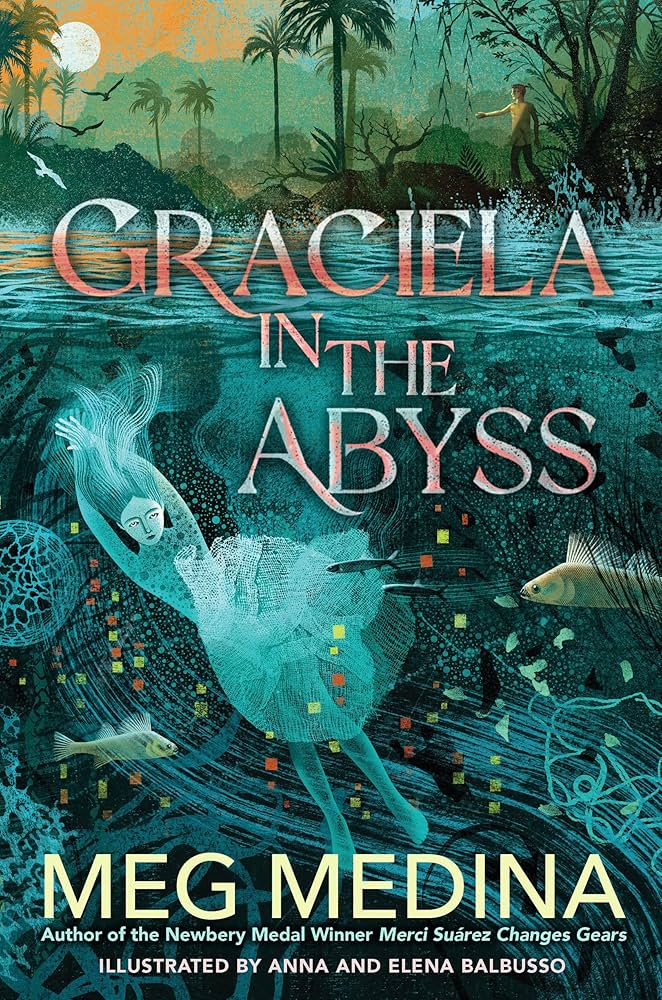
Graciela in the Abyss
Written by Meg Medina
Ages 10+ | 256 Pages
Publisher: Candlewick | ISBN-13: 978-1536219456
Publisher’s Book Summary: A sea ghost, a mortal boy, and a dangerous enchanted harpoon . . . A Newbery Medalist takes us far beneath the waves in this extraordinary foray into fantasy.
In the deepest recesses of the ocean, Graciela—once an ordinary girl—now makes sea glass and assists her friend, Amina, as she welcomes newly awakened sea ghosts from their death sleep. Though Graciela’s spirit is young, she has lived at the bottom of the ocean for more than a hundred years. Meanwhile, in the mortal world on land, twelve-year-old Jorge Leon works in his family’s forge. He’s heard of the supernatural spirits living beneath the ocean’s waves—tales that do nothing to quell his fear of the water. But when Jorge discovers a hand-wrought harpoon with the power to spear a sea ghost, he knows he must destroy it any way he can.
When the harpoon is accidentally reunited with its vengeful creator, unlikely allies Graciela and Jorge have no choice but to work together to keep evil spirits from wreaking havoc on both the living and the dead. If only the answer to saving what they care about didn’t lie within the depths of the abyss . . . Newbery Medal winner Meg Medina and illustrators Anna and Elena Balbusso have crafted a thoughtful tale infused with magic and high-stakes adventure that will leave readers wondering what power lies in the depths of the ocean—and inside each of us.
Other Books Mentioned:
- Burn Baby Burn by Meg Medina: Amazon or Bookshop.org
- Yaqui Delgado Wants to Kick Your Ass by Meg Medina: Amazon or Bookshop.org
- Evelyn Del Rey Is Moving Away by Meg Medina: Amazon or Bookshop.org
- Tia Isa Wants a Car by Meg Medina: Amazon or Bookshop.org
- No More Señora Mimí by Meg Medina: Amazon or Bookshop.org
- Milagros: Girl From Away by Meg Medina: Amazon
- Charlotte’s Web by E.B. White: Amazon or Bookshop.org
- Into the Planet by Jill Heinerth: Amazon or Bookshop.org
About Meg Medina: Meg Medina is the 2024 Newbery Medal winner for Merci Suárez Changes Gears and author of many acclaimed novels and picture books, including Burn Baby Burn, Yaqui Delgado Wants to Kick Your Ass, and the Merci Suárez series. She served as the eighth National Ambassador for Young People’s Literature (2022-2024) with the platform “CuÉntame: Let’s Talk Books.” As a first-generation Cuban American, she draws on her heritage and experiences to create authentic stories that celebrate the strength and resilience of Latino families and communities.
Connect and Follow:Learn more about Meg Medina: https://www.megmedina.com/Meg Medina’s Bookshop shelf with books she book talks and kids recommended: https://bookshop.org/shop/MegMedinaVisit The Children’s Book Review at https://www.thechildrensbookreview.com/
Credits:
Host: Bianca Schulze
Guest: Meg Medina
Producers: Bianca Schulze and Kelly Rink
