

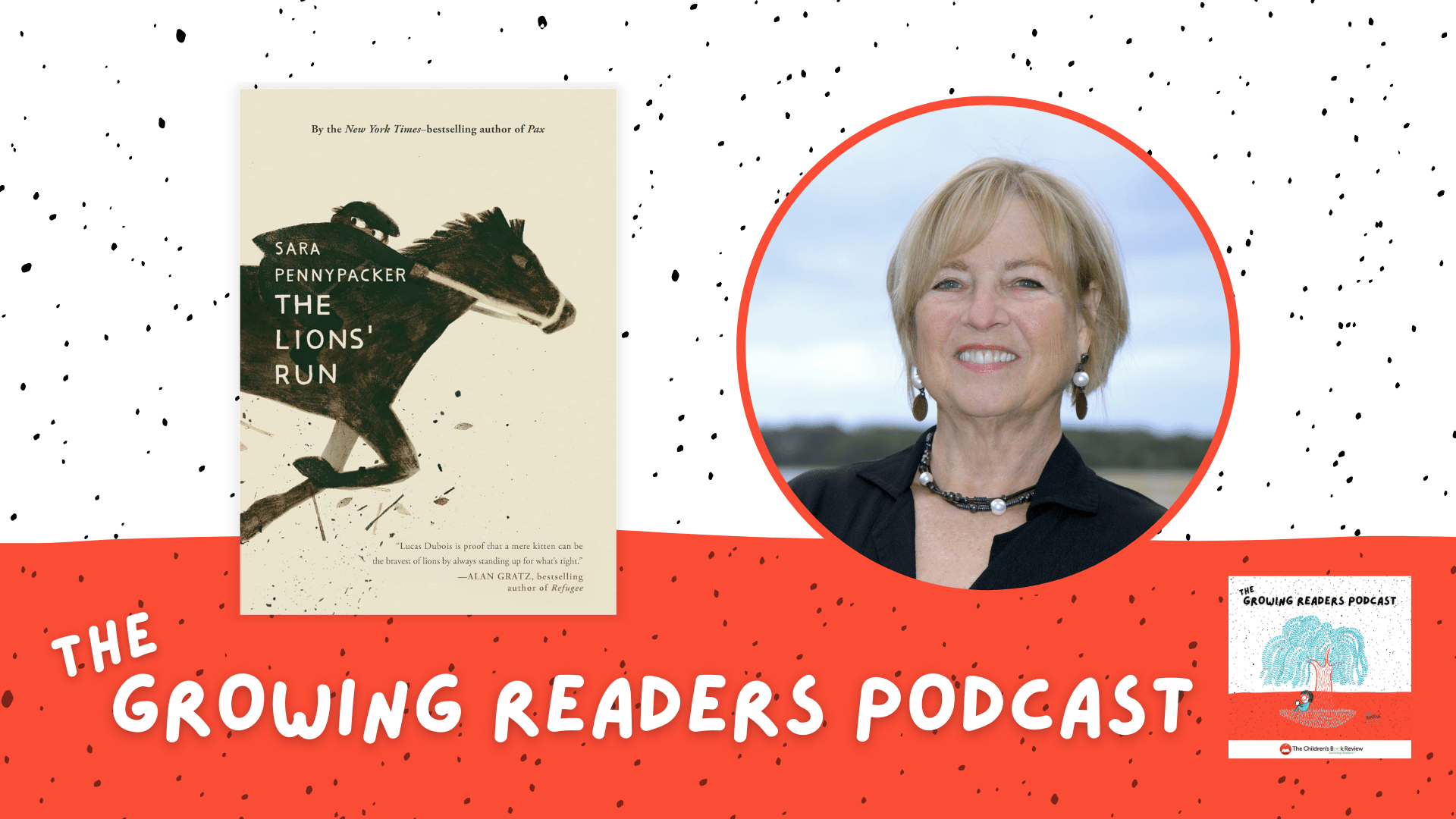
A podcast interview with Sara Pennypacker discussing The Lions’ Run on The Growing Readers Podcast, a production of The Children’s Book Review.
What does real courage look like when you’re small, powerless, and living under occupation? Sara Pennypacker, author of Pax and the instant New York Times bestseller The Lions’ Run, joins Bianca to explore why empathy—not muscle—is the truest form of bravery.
Set in Nazi-occupied France, The Lions’ Run follows an orphan boy named Lucas who begins by saving a litter of kittens and ends up entangled in something far greater than himself—a web of quiet resistors, hidden secrets, and everyday people choosing courage in the smallest, most powerful ways.
Sara and Bianca dig into the little-known Nazi Lebensborn program that sits at the heart of the story, the African proverb that sets the entire novel’s moral compass, and why Sara believes that what kids see in the media as “courage”—loud, explosive, and muscle-bound—has almost nothing to do with the real thing. Sara also shares the deeply personal connection she has to this era of history, the storytelling wisdom of Joseph Campbell that shaped one of the book’s most satisfying scenes, and a sneak peek at what’s coming next.
This is a conversation about history, heroism, and why stories like this one feel more urgent than ever.
Subscribe to The Growing Readers Podcast to ensure you never miss an episode celebrating the creators shaping young readers’ lives.
Listen to the Episode
The Show Notes
The Lions’ Run
Written by Sara Pennypacker
Ages: 8-12 | 288 Pages
Publisher: Balzer + Bray (2026) | ISBN-13: 978-1250392817
Publisher’s Summary: The acclaimed, New York Times bestselling author of Pax delivers a historical novel about an orphan during WWII who discovers unexpected courage within himself when he becomes involved with the Resistance.
Petit éclair. That’s what the other boys at the orphanage call Lucas DuBois. Lucas is tired of his cowardly reputation, just as he’s tired of the war and the Nazi occupation of his French village. He longs to show how brave he can be.
He gets the chance when he saves a litter of kittens from cruel boys and brings them to an abandoned stable to care for them. There, he comes upon a stranger who is none too happy to see him: Alice, the daughter of a horse trainer, who is hiding her filly from German soldiers.
Soon, Lucas begins to realize they are not the only ones in the village with secrets. The housekeeper at the German maternity home and a priest at the orphanage pass coded messages; a young mother at the home makes dangerous plans to keep her baby from forced adoption; and a neighbor in town may be harboring a Jewish family.
Emboldened by the unlikely heroes all around him, Lucas is forced to decide how much he is willing to risk to make the most courageous rescue of all.
Perfect for fans of Alan Gratz, Ruta Sepetys, and Kimberly Brubaker Bradley, this accessible novel, told in short chapters, illuminates a little-known aspect of World War II history.
Buy the Book
Additional Books Mentioned:
- Pax by Sara Pennypacker, illustrated by Jon Klassen: Amazon or Bookshop.org
- Pax, Journey Home by Sara Pennypacker, illustrated by Jon Klassen: Amazon or Bookshop.org
- The Borrowers by Mary Norton: Amazon or Bookshop.org
About the Author
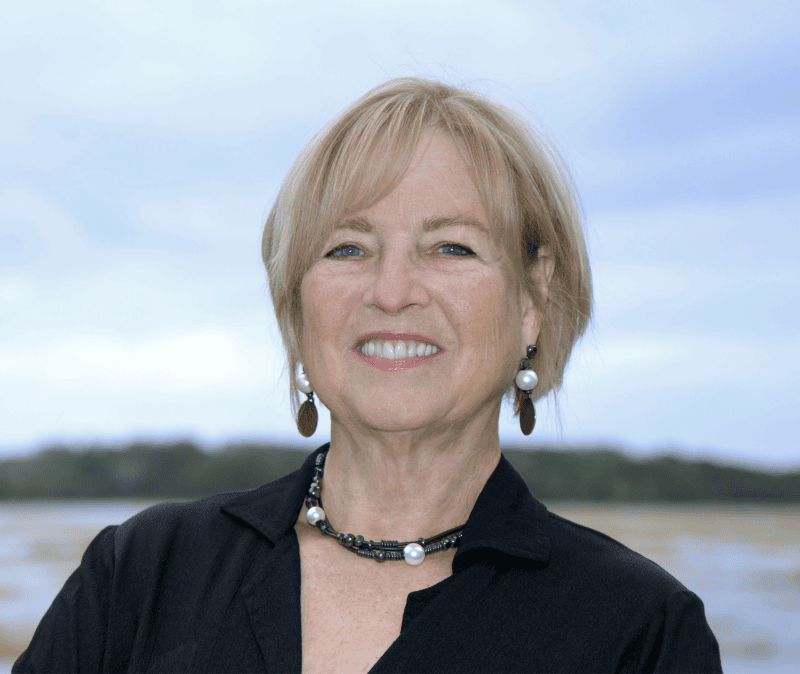
Sara Pennypacker is the author of several acclaimed novels for middle-grade readers, including The Lions’ Run; the #1 New York Times bestselling Pax (a National Book Award Longlist title) and Pax, Journey Home; the Clementine series (Boston Globe-Horn Book Award Honor) and its spinoff series, Waylon; and Summer of the Gypsy Moths, Here in the Real World, and Leeva at Last. She divides her time between Cape Cod and Southern California.
For more information, visit sarapennypacker.com
Credits:
Host: Bianca Schulze
Guest: Sara Pennypacker
Producer: Bianca Schulze
Read the Transcript
Bianca Schulze: Hi, Sara Pennypacker. Welcome to The Growing Readers Podcast.
Sara Pennypacker: Hi, thank you so much for having me.
Bianca Schulze: It’s an absolute pleasure. Just a little intro to how I first came across your books. Clementine, the first Clementine book, came out in 2006, which was the same year my first child was born. I became a children’s bookseller in 2008, and one of my favorite series to hand sell to young readers was the Clementine series. So I’ve been with you for a long time.
Sara Pennypacker: That’s a long time now. I’m now meeting girls who are in their late twenties who told me they were reading it then, and that sometimes they pick it up just to feel comfort. That’s beautiful.
Bianca Schulze: Yeah, amazing. Well, I thought we could just start with a couple of warm-up rapid-fire questions—just the first answers that come to your mind. They’re a little bit of fun. So, pajamas or bathing suit: which is your real writing uniform?
Sara Pennypacker: Very interestingly, pajamas for most of the time, of course. But I swim every day—or I don’t call it swimming. I get into water every day. Sometimes I just stand there and dance and move around, but I do it every single day. So yes, bathing suit as well.
Bianca Schulze: I love it. Pie or cookies?
Sara Pennypacker: Right now? Cookies. I don’t have time for the whole deal of pie, but cookies—lots of them.
Bianca Schulze: What kind of cookies?
Sara Pennypacker: You know, I have this little thing now—these are so healthy. A little promo for them: Alyssa’s vegan bites. There’s like nothing wrong with them. I eat them constantly.
Bianca Schulze: I love it. Okay, kittens or horses?
Sara Pennypacker: Kittens.
Bianca Schulze: Kittens. One word to describe Lucas from The Lions’ Run.
Sara Pennypacker: I’m going to say empathetic. There you go.
Bianca Schulze: Empathetic. And a book from childhood that you’d put in every kid’s hands today?
Sara Pennypacker: The Borrowers. Yes.
Bianca Schulze: I love The Borrowers too. All right, longer answers now. This is my signature question: it’s often said that to be a writer, you need to be a reader first. So was there a pivotal moment when you considered yourself a reader?
Sara Pennypacker: I was probably too young to consider myself a reader. I was into it so early and so fast that I don’t remember a time when I wasn’t. I started reading very early. In fact, when we moved, I had to skip a grade because they wouldn’t let kindergarteners in unless they could already read—and I could. I’d just been reading forever. But here’s when I knew I might have had a problem—not a problem, really. They used to have this thing in my school, and I think in all schools back then, called the SRA Box. It was a reading box that had these laminated little cards with things to read, and you could plow through the colors. I remember Aqua—I was so excited to get to Aqua. The way you had to get there was to get all your questions right, to super-achieve. And that’s exactly what I did. I became the super classroom achiever as a third grader, just so I could be allowed to leave the class and sit with that box. I loved that box.
Bianca Schulze: I love that. So you truly were just a reader from the very beginning.
Sara Pennypacker: I loved it. Yeah.
Bianca Schulze: So I think it’s always really fun to learn about the day-to-day of how our favorite authors work. I know you have some unconventional writing habits that may involve your swimming—and I heard possibly a trampoline. Well, secret intel comes my way. Tell us about the quirks of your creative process.
Sara Pennypacker: Yeah, I have a couple of things I’ll tell you. You’re absolutely right—I have to swim. I started swimming because I have a bad back, and it’s the very best thing for me. But what I quickly learned was that in order to work well on my books, I try to exclude the real world. And I’ve learned that when you’re swimming, you don’t see the real world. You see only the sky, or one bit of ceiling if you’re in an indoor pool. You don’t feel the real world because you’re underwater. I swim on my back, so I don’t hear the real world. It’s so easy for me to slip into whatever scene I’m working on. So I never get in the water without a scene ready to go in my head. The other thing is the trampoline—for a couple of reasons. It improves my mood a lot, which is important. You need to be feeling hopeful and bouncy and good. But it also brings oxygen to my brain; that’s the science of it. So once or twice a day, I get out of my chair and go over to the trampoline I’m looking at right now—it’s a small one—and I dance and feel energized. Then the last thing, and I think it’s a big tip: when I’m falling asleep, I always put whatever I’m working on into my head—a problem, or the scene I’m going to work on the next day. I roll it around at that point between sleep and awareness. Science backs me up that that’s allowing my subconscious to do some work. Just tucking it right in there for the guys in the back of the head to take care of while I sleep. That really seems to help.
Bianca Schulze: I love that. It’s so fun talking to everybody about their little creative processes and quirks. The last time I felt compelled to try something different was when Candice Fleming told me that when she’s drafting, she uses loose-leaf paper in a binder because she starts everything by handwriting. I like to handwrite first too, but I was always crossing things out and then didn’t have space to rewrite. So I’d find myself rewriting a whole page—which I actually kind of enjoyed—but the loose-leaf paper idea was brilliant. And now I’m like, I need a mini trampoline in my office.
Sara Pennypacker: Wait till you try it. I think you’ll be a fan. It’s all positive. I love my little trampoline.
Bianca Schulze: Yeah, that’s brilliant. Well, I also know from your bio that you were a painter before you became a writer. After all these years—and is the number correct to say 27 books published?
Sara Pennypacker: It is correct, and I’m working on my 28th. Yes.
Bianca Schulze: Wow. So how do you think having a visual artist’s eye helps shape the way you build a scene or a character on the page? Or do you not think about that at all?
Sara Pennypacker: I don’t really think about it as a positive. What I see is that I was just misdirected. I knew I wanted to make things—things that told stories or made you feel something. And I didn’t believe I could be a writer early on. So painting seemed right for me. When I finally understood that I’m meant to be a writer and went to do that thing, it felt as if I was going from a second language to my first—as though painting had been the second language. This is what I’m really meant to do. So I kind of think I was misdirected. However, almost everything I learned as a painter travels into my life. It was like I walked up one side of a ladder and then said, no, I’ll go on the other side. There are things about structure that are the same in any art. There are things called passages—in dance, in music, in painting. So there are some things that build and transfer no matter what art form you’re working in.
Bianca Schulze: Yeah. What do you think made you realize that writing was what you were supposed to be doing? How did you know?
Sara Pennypacker: I knew because once I had my two kids and we spent so much time reading together, I just wasn’t going to give that up. When they started reading on their own, I still didn’t give it up. But early on, I was so blown away by how beautiful books had become since I was a young reader—how intelligent they were, how moving. Seeing my own children moved by books is really what directed me there. But I’ll also tell you this: here’s when I should have known. When I was in fourth grade, I was very shy—I couldn’t look at adults, I was that shy. One day I was standing at my teacher’s desk to pick up a story I’d written, and I won’t look at her of course. I feel my story in my hand, and I’m trying to take it. I’m tugging, and she won’t give it up. Finally, I turned to look at her—which is what she wanted—and she said, ‘I want you to remember this. You are going to be an author.’ Can you believe that? She said that to me in fourth grade, and I just thought, that’s ridiculous. I’m not special, right? It’s something I make sure kids know now: authors are special because we get to do this wonderful work and connect with the world this way. But we’re not special before. We’re just often shy, often introverted. And we definitely don’t feel special before we do it.
Bianca Schulze: Yeah, I got goosebumps hearing that story. I love knowing that. What a great teacher—to empower you in that way, even though it may have taken some time for you to believe it. The words that grown-ups can say to children, and the fact that they stay with them—it’s so magical.
Sara Pennypacker: Yes. One of the great sadnesses of my life is that once I was a writer—now in my forties—I tried to contact her to tell her, and she had just died. That’s a real sadness for me, that I couldn’t say: you were great just for believing in me, and for telling a kid that. Yeah.
Bianca Schulze: Yeah. I wonder if she knew you had become an author, or even remembered that moment. That would be special to know. But that is a sadness. Well, there are so many little components to a book. I don’t know why I didn’t know this before, but I recently learned that a short quotation, phrase, or poem placed at the beginning of a book or chapter—one that hints at the themes to come—is called an epigraph. Let’s talk about the epigraph at the beginning of your beautiful new book, The Lions’ Run. That epigraph is an African proverb: ‘When elephants fight, it is the grass that suffers.’ What does it mean to you, and how does it guide the story you wanted to tell?
Sara Pennypacker: It’s perfect, isn’t it? It’s almost too much of a spoiler for the theme. But I came across it a few years before the book, and I just knew this is something I’ve been thinking about, been moved by, and probably talking about in my books for many years—since Pax, I would say. It means that anyone who has power, when they decide to clash, they’re just not thinking about who is in the way—who doesn’t have the power. And that’s very often children and animals. The African proverb is actually saying the earth will suffer, but it means that those who are smaller will suffer. Do adults really consider, when they’re fighting—when they’re arguing in front of a child—what that does? This is upsetting at every level, all the way from that up to war. When large powers are warring, you cannot calculate the damage done to children, animals, and people who have no power and no say in that war. It’s incalculable.
Bianca Schulze: Yeah. And what a perfect proverb to set all of that up. It’s also true that most World War II fiction for young readers tends to center on familiar events—concentration camps, the German bombing of Britain known as the Blitz, and of course Anne Frank. But you chose to illuminate the Lebensborn maternity homes. For listeners who haven’t encountered this part of history—and I was one of them, I did not know about this—can you walk us through what these homes were and why you felt it was important to bring them to light for kids?
Sara Pennypacker: Yes. The Lebensborn program, in brief, was this: back in the 1930s, Hitler had grand goals. He planned to conquer all of Europe and beyond. He did the numbers for 50 years out—how many soldiers he would need to continue holding those lands, and how many citizens he would need to populate them. He still believed in Nazi eugenics theory, which was widely debunked even back then. He believed that blonde hair and blue eyes were associated with superior interior characteristics, which is just ridiculous—and responsible for so much suffering, pain, and horror in the world. He changed the mores of Germany so quickly that it became the highest thing a woman, or a girl as young as 15, could do was to give a child to the Führer. That was the theme: give a child to the Führer. Girls as young as 15 were encouraged to get pregnant by their leaders in the Nazi youth programs. That didn’t produce enough people, so he hired Himmler—a chicken breeder—to expand the program. Himmler went into occupied countries where he felt the girls and women were blonde and blue-eyed enough, and he encouraged soldiers to get the girls pregnant. Once they were pregnant, those girls had basically no choice. Their families were angry, their towns were furious—calling them collaborators—and there was no food, no medical supplies. So they went into these homes, which were almost always stolen Jewish spas or estates. They were taken care of very well there, but then the Nazis took the babies, brought them out of the country, changed all the records, obscured everything, and had them raised by—air quotes—’good German families.’ Those children never knew what happened. They never knew why their mothers didn’t seem to care for them. They never knew who their birth mother was, or that their mother had loved them. The mothers were never able to find those babies. That just horrified me. And we’re getting a little too close to that in our own country right now—this idea of needing to increase a certain part of the population—and I thought: no, we can’t just let this fly under the radar. We need to at least look at it. The third phase of Lebensborn—which people do know about—was that they went into places like Poland and simply stole hundreds of thousands of blonde, blue-eyed children. But I want to be really clear: this is not a book about that. It happens to have occurred all around the village in my book, and it is merely a trigger for someone who’s deeply sensitive to what it might feel like to not have a mother—he’s an orphan—or to not know who your mother is, or to wonder, is my mother looking for me? That person is my main character, and he is triggered to action by what he sees. It’s not a book about Lebensborn.
Bianca Schulze: Yeah. So let’s talk about Lucas. He has a nickname the other boys at the orphanage call him: Petit Éclair. And it’s not a compliment. He feels he’s seen as a coward. But there’s a wonderful distinction in your book between what a character wants and what they truly need. Lucas wants to prove that he’s brave. But what is it that he actually needs? And why do you think he really needs to learn this throughout the story?
Sara Pennypacker: He definitely wants to be seen as brave, because it hurts to be ridiculed. And he’s never really been a coward—but to the other boys, he looks like one because he’s empathetic enough to not want to play war games. He has been with friends when a bomb hit, and he’s seen the damage that can happen. It’s not funny to him—that’s all. He’s also very sensitive to others, which is not cowardice. In fact, I believe that’s the true root of all courage: empathy. You have to care enough about someone other than yourself to go into action. And I think kids are really good at that—at a kind of radical empathy. They’re able to empathize beyond their own species, even with wild animals. Lucas has never really been empowered, and he’s seen as a coward. But what does he need? I think he just needs to be okay with himself. He needs to feel good about himself—not by acting heroically, but by understanding that his own empathy is courage.
Bianca Schulze: Yeah, I love that. Well, Alan Gratz—the New York Times bestselling author of Refugee—said, ‘Lucas is proof that a mere kitten can be the bravest of lions.’ I love that. And I also love that the story literally begins with Lucas saving kittens, an act that some of the other boys see as soft. Was that always your opening? And how did you decide that tenderness, not toughness, would be Lucas’s superpower?
Sara Pennypacker: Well, first I want to say—I’ve been out on the road for a week talking to kids about this book, and I just want to say, Alan, enough! There’s always a question from the audience: ‘Do you know Alan Gratz?’ He is very beloved. The kitten thing was fairly easy. I knew I wanted a small example—something that every kid reading would say, ‘Me too. I would not be okay knowing those kittens are going to be drowned.’ I knew the name of the book was going to involve lions. I knew it was great to start with kittens if you’re going to end with lions. And I’ve been thinking for several years now about what courage really looks like for kids. I’ve been thinking about it since I was on the road with Pax and Pax Journey Home, because kids ask me: what does courage look like when you don’t have agency? Kids can’t vote. They don’t have a paycheck to throw at a project. They can’t drive to a protest. So I’ve talked a lot with kids about what courage looks like, and it always ends up looking like empathy to me. So yes, I knew that was going to run through the book. If you read it watching for those things, there are four times when Lucas is triggered by something more vulnerable than he is being abused or threatened. Each time he reacts, and by reacting, he starts to understand what’s possible. It’s the theory of termites in the book: no termite is ever going to get his own superhero show, right? But working together, termites can take down a cathedral. I feel really good about saying this to kids, because what they see in the media for ‘courage’ is bulging muscles, weapons, chaos, and explosions. It’s loud. And none of that has anything to do with real courage. Those are heroics for the theater.
Bianca Schulze: Yes. That’s exactly where I was going to go next, because the media version is just big and loud. But when you think about the French Resistance—those people, and all the small acts they made together—that is so genuinely heroic, knowing what could happen to them for one small choice, like carrying a note in their pocket. And I love that this book is filled with so many unlikely heroes: a housekeeper passing coded messages, a priest in the Resistance, a young mother making desperate plans, a neighbor harboring a Jewish family. What were you trying to show young readers about what everyday courage looks like—especially during wartime?
Sara Pennypacker: Just that—it is many small acts. It’s very hard to overcome any real obstacle with one move. But many small moves, made by many people working all around you—no matter what you are resisting, you are not alone, whether you know it or not. No matter what the authoritarian issue is, there are people working behind the scenes, and you’re not alone. Remember Mr. Rogers: ‘Look for the helpers.’ I think now it’s: look for the resistors. And one more thing—I want to say that it feels good. This is not a book that feels bad. These kids—both Alice and Lucas—are feeling pretty good as the book goes along, because they are taking steps.
Bianca Schulze: Yeah, I agree. And I have to talk about the cherry strudel. Without giving too much away for listeners who haven’t read the book yet, there is a moment involving cherry strudel that is truly an extraordinary piece of storytelling. It creates an ultimate pivotal moment. I’ll stop there. It’s one of the things I admire most about your writing in this book—and in all of your books: how small details that seem almost throwaway early on, like Lucas hearing how to mix baby formula, turn out to be absolutely essential later. One thing leads to another leads to another—like dominoes you’ve set up for the reader without them even realizing it. So how much of that intricate chain did you plan from the start, and how much revealed itself along the way?
Sara Pennypacker: I’d say half and half—and I need to credit Joseph Campbell for that detail. It was through studying his work on story that I learned: a very satisfying thing you can do in a story is use the antagonist’s power against them. The cherry strudel is a perfect example of that. The antagonist in this book—Nazi control, embodied by the woman who made that strudel—has already made it clear that she holds power over Lucas because she looks down on him as an orphan and as poor. That is the power she holds against him. But he turns it against her. That’s what Joseph Campbell said: do that. And I tried to do that. You caught it. He used it against her—and I won’t say any more either.
Bianca Schulze: I just think you’re so clever. I read a lot of books, and sometimes there are scenes that could have been cut. There’s nothing in your book that I would have ever cut. It all just led to the next thing.
Sara Pennypacker: Well, I’ll pass that along to my editor, Donna Bray, because my books when I first write them—the first draft is generally twice as long as the finished book. I need to do it for myself. It’s not that I think it will all be there at the end, but it’s just my process to overwrite. And Donna is very good about the parts I don’t want to give up but should.
Bianca Schulze: Yeah. I just had author Megan McDonald of the Judy Moody series on the show, and she said she overwrites her original drafts and then whittles them down to the most distilled version. And I think with a subject this rich—the Lebensborn, the Resistance, the fate of stolen children, families being torn apart—how did you decide what to keep and what to pare away to keep the story tight for middle grade readers? And it sounds like that’s a great partnership with your editor. But how did you decide what to keep in, and how long did it take?
Sara Pennypacker: It’s ongoing—always. I’m always thinking about that. I heard a great piece of advice from a historical fiction author, and I’m sorry I don’t remember who, but she said: remember that your job is not to teach history. Your job is to tell a story. And I caught myself several times basically saying to the reader, ‘Wait till you hear this great thing I learned’—and I could have shown it in the scene, but it wasn’t my job. So I’m pretty good at cutting it down, and then Donna does the hardest editing at the end.
Bianca Schulze: Yeah, I love that. And trusting the reader—trusting that these kids are smart and can read between the lines and take the messages with them. So your book is told in short, energetic chapters. Was that a conscious choice about structure and pacing, or did it just come naturally? Are you a plotter? Does the story come to you? What conscious choices are you making for a middle grade audience?
Sara Pennypacker: I love writing scenes—imagining them, writing them. And then I have to bind them together, because too much transitional prose is a little hard to follow. I prefer writing scenes. I am a very strict structuralist—not strict about which structure to use, but once I’ve decided on one, I really pay attention to it. That helps me with pacing. We don’t stay too long in the good moments, but we also don’t crash through problem after problem. I want us to stop and say, here’s life. We’re making a friend here. We’re enjoying some scones when we haven’t had anything good to eat. So yes, I’m pretty aware of structure.
Bianca Schulze: Yeah. So I’m wondering if you have a highlight—whether you’d like to read a little piece to us or share something that’s most meaningful in the book to you.
Sara Pennypacker: I would like to tell you two things. One is—wherever I go to talk about this book, I do this: I pull out my dad’s dog tags. My dad was not far from where this book is set, when it happened. He was in a German prisoner of war camp. He had been a pilot. He was a teenager. He ran a mission, bombed some oil fields that the Germans were counting on, and they captured him on the way back—shot him down. So he spent the rest of the war in a German POW camp. I bring out these tags for two reasons. One is to remind kids that historical fiction was real to real people. It was real. But also that it’s past—it’s over. The Nazis do not occupy France. And basically everything that happens in historical fiction represents a challenging time; we don’t write historical fiction about the good old days, right? They were challenging. So I want to remind kids that good forces are always going to win over evil—it just may take longer than we’d like. I made a little mention of him in the book early on: some women are gossiping about the ‘American flat voice.’ That was a joy for me. The second thing I was so excited to include is this: while I was writing the book, I happened to be at a house concert by a British singer-songwriter, and he sang a song and told us the story behind it. The song was about silver florins nailed to the beams of a pub in England. He had seen them and asked what they were. He learned that just before World War I, this town was emptied—all of its young men had to leave and go to war. They all left one day. The night before, they went to the pub, they drank, they said goodbye. And each young man nailed up a coin and said: we’re coming back, and we’re going to buy each other beers with these. Of course, only half of them came back. So half those coins are still up there. What I love about that is this: art is a river. All forms of creation—we take things out of the river, we put things back in. I put that story in my book. And my greatest hope is that some child reading it will one day retell that story after reading my book. Isn’t that beautiful about art?
Bianca Schulze: Yeah. I think that is the importance of story. And I personally feel so frustrated that we have these stories, these lessons that should have been learned—and yet history, unfortunately, repeats itself in new formats. So I want to read a quote from the book. Now, do you say Madame Garnier?
Sara Pennypacker: She was married, so she’s Madame. Madame Garnier, yes.
Bianca Schulze: ‘Madame Garnier surprised him then. “You’ve got a strong sense of justice, little termite. Don’t lose it as you grow up.” Is it possible I could lose it? Maybe I should hope that happens. Then I wouldn’t get so angry all the time. She stopped sanding. “You should be angry. But you’re frustrated because you can’t do anything about the things that upset you. That’s natural. You’re young. You don’t have much power yet. But when you’re older, you could use that sense of justice to correct what’s unfair. There are a lot of ways an adult can right what’s wrong. Become a lawyer, perhaps. Defend the poor.”‘ When I read that, that was the moment I was talking about—so relevant then, and still so relevant now. And this is why books like this are so important for kids to read. So thank you.
Sara Pennypacker: Thank you. My pleasure. It was a hard book to write because every day I had to be immersed in that time period. And to get it right, I had to be really respectful. I watched so many videos, listened to and read interviews with people who had children during that time. That was very hard to do. But at the same time, I felt really good about what I was doing. And that made all the difference.
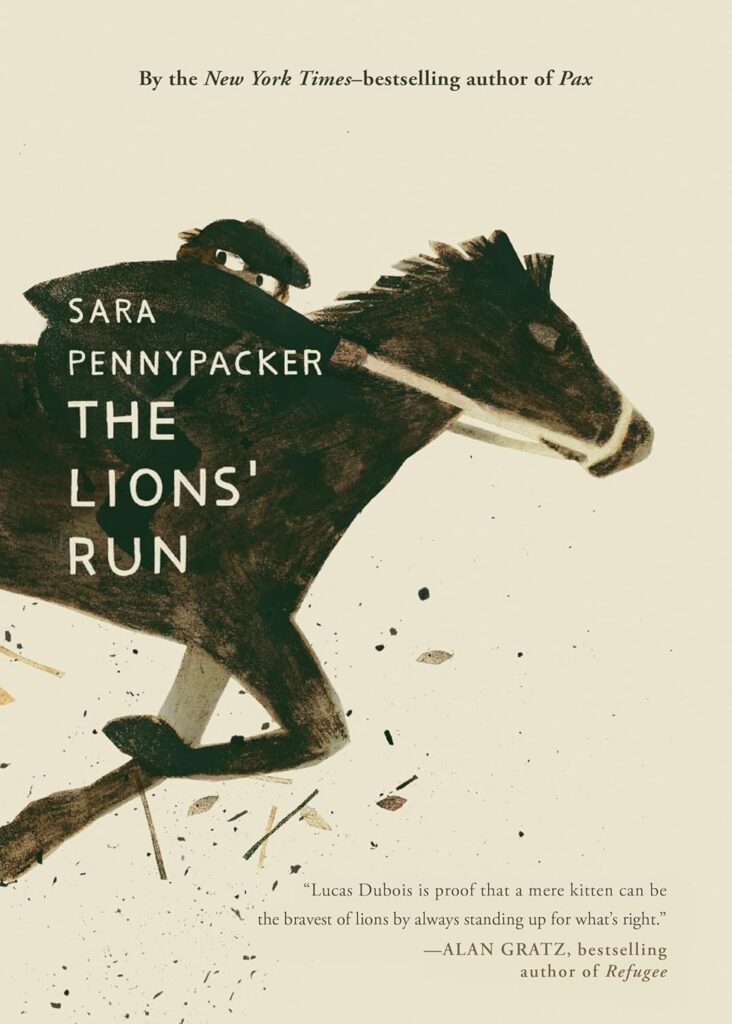
Bianca Schulze: Yeah. Well, let’s just jump right to the cover. I mean, how stunning is that illustration? It’s so cool. My middle school daughter, when she saw me reading it, said, ‘I know that artist—he’s the guy that does the square and the circle.’ And then I said, ‘Yeah, and it’s written by Sara Pennypacker.’ And she said, ‘That’s the author of Pax!’ The cover is just so striking. So tell me about it.
Sara Pennypacker: Yes! Well, you can see behind me—I have the actual cover art. Jon just gave it to me. Not only is he brilliant, but he’s so kind and generous. He’s a treasure. I will tell you this: when I saw this cover for the first time, both my editor and my agent were at my house—which had never happened before—and they showed it to me. I gasped audibly. Because it’s so stunning, especially when you see the full spread as you would when you open the book. And I did something the next day: I went back into my studio with one goal, which was to do a light revision on a book that was pretty much finished. I told myself: you have to make it as exciting as the cover. That meant shortening some sentences, upping some tension. My book became better because of Jon’s cover—which I just think is wonderful. The two arts together can elevate both artists.
Bianca Schulze: Yeah, I’m such a book nerd that my eyes are starting to water right now. As I was reading, I feel like I know which section you went back and revised—because I actually paused and looked at the cover while I was reading. I never really thought about how cover art might be completed while you still have an opportunity to make edits. So that’s very cool that you were able to do that.
Sara Pennypacker: Well, what I saw wasn’t quite complete, but it was pretty close, and the energy was there—the terror, but the joy too. And I had just enough time to go through it. It was more a vibe than any major change, and I’m so glad.
Bianca Schulze: Yeah. Well, in a moment in our lives when things we thought we’d laid to rest in history are raising their heads again, what do you most want a child to carry with them after they close this book?
Sara Pennypacker: Wonderful question. A couple of things. For all my books, I always want kids to ask questions afterward. I really hope that every reader at the end of this book asks themselves: is it ever okay to break a law in order to correct a crime? I think that is at the heart of it. And I hope that I have not answered it—but that my characters have had to think about it—and that I’ve stepped back enough to leave room for my readers to ask the question and answer it for themselves. That’s my job: to get readers to ask questions. But I also hope—in this time when it sometimes feels like we’re losing control, and forces we don’t want seem to be gaining strength—that there’s this small but real sense that small things can be done, and that doing them feels good, and that they actually make a difference. As tiny as they seem, they make a difference.
Bianca Schulze: Yeah. I think you’ve succeeded in that. And I want to touch quickly on something new on the horizon for 2028—the title is Big Cheese. I’m so intrigued. Can you give us a little taste?
Sara Pennypacker: Once I get fairly far into a book—maybe halfway—I always put it in a binder and make it look like a book. Because around halfway, I start looking at it and thinking: my god, I’m overwhelmed. I don’t think I can do this. It’s too hard. So I put it in a binder and say: nope, this is a book. Now finish it. Big Cheese is a logical follow-up to The Lions’ Run and to everything between Pax and The Lions’ Run. All of those books are saying: kids don’t have enough power, they shouldn’t have power, here’s how they can have power anyway, here’s how they can feel good about themselves with whatever power they have. I’m getting more and more fed up with kids having no power. Kids are the ones most at risk. This is their world. Whatever’s going on, this is their world, and they’re going to inherit it. They’ll have to live with our decisions now. I really think they should have a little more say in that. So Big Cheese—which means a powerful person, right—features, for the first time I’ve ever written, a child with all the power. This girl has all the power, but only because adults have made mistakes and given it up by being foolish. So what does she do with it? She has a friend who has recognized her position first, and he’s worried. He says: ‘Think about it. If kids had all the power, there wouldn’t be any wars—except in video games, and we’d enjoy those. People would be nice to each other. Fair things would be fair. And we wouldn’t wreck the planet.’ I just love writing that. It’s kid thinking at its finest. And it’s one of the funniest books I’ve written. I love to write funny, but it helps me balance. After a more serious book, I love to write something much more fun.
Bianca Schulze: I’m excited. Kids are going to love that. And if I remember correctly, did you win the Sid Fleischman Humor Award for Clementine at some point?
Sara Pennypacker: Yes—the Sid Fleischman Award. I’ve also won some state humor awards. Yes. Yes.
Bianca Schulze: There you go—evidence that you are truly funny.
Sara Pennypacker: Although my kids deny it. When I won that award—and several times after—I said, ‘Well, you have to admit I’m funny.’ And even now, they’re in their forties, and they still say, ‘Mom, you’re not funny. We were funny and you just remembered us.’ They’ll tell me that forever. And in truth, the book may be funny, but I had some pretty funny kids.
Bianca Schulze: Oh my gosh, they’re forever your kids no matter how old they get. Well, Sara, I always love to finish by giving you the opportunity—if there’s anything we haven’t talked about that you wanted to share, or just a little nugget you want listeners to leave with.
Sara Pennypacker: Nothing that you didn’t cover—you did a wonderful job. I feel like I talked about everything I wanted to. But I’ll tell you one more thing that gave me great joy as I wrote this book. Here are two kids in 1944 in an occupied country, sick of war, sick of not having freedom. And they continue to discuss America—what they know of the United States. They’re discussing whether it could really be true that everyone has a chance in this country, that it doesn’t matter where you come from, that you can be whoever you want to be. And they argue it. Sometimes one of them says, ‘I think it’s true.’ And sometimes the other says, ‘Ah, I don’t think it is.’ That was just a joy for me—to remember for myself, and for my readers, that that’s what we’ve always said we are. A place where everybody is free, and everybody has a chance.
Bianca Schulze: What a great way to end. To me, The Lions’ Run is one of those rare books that manages to illuminate a piece of history most of us had never heard of, while telling a story that feels personal and urgent—but also empowering and encouraging. It’s about what it means to be brave, even when the world makes you feel small. I think Lucas is going to stay with readers for a long time. And I think that’s exactly what great books do—they linger, in the best possible way. On behalf of me and all of our listeners, we’re so grateful that you shared this story with us. A huge thank you for spending time with us today.
Sara Pennypacker: Thank you, Bianca. Thank you to all your readers out there. It means the world to me. Thank you. Bye.
