

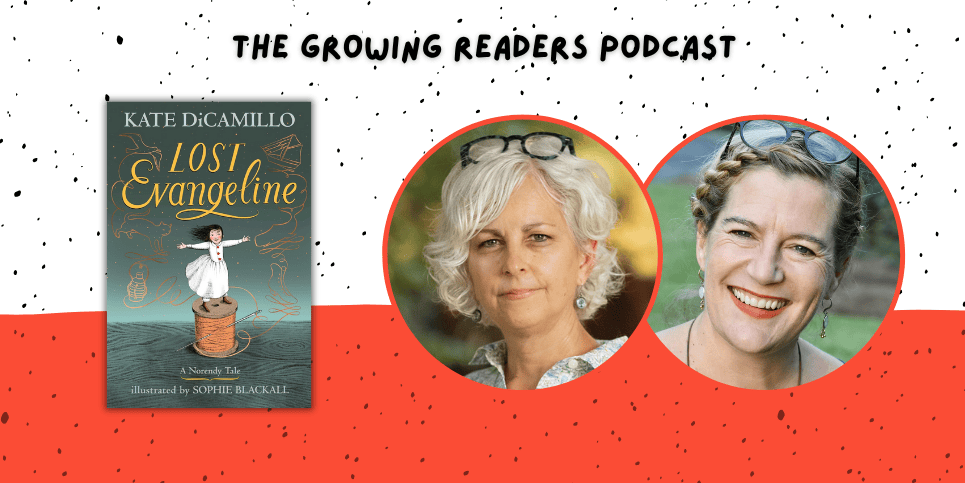
A podcast interview with Kate DiCamillo and Sophie Blackall discussing Lost Evangeline: A Norendy Tale on The Growing Readers Podcast, a production of The Children’s Book Review.
What happens when a two-time Newbery Medalist and a two-time Caldecott Medalist come together to create magic?
In this deeply personal conversation, Kate DiCamillo and Sophie Blackall discuss their collaboration on Lost Evangeline, the third tale in the Tales of Norendy collection.
Kate reveals how she carried the seed of Evangeline’s story for 15 years before discovering the key that unlocked it, while Sophie shares her joy at illustrating a world filled with everything she’s “itching to draw”—from sea serpents to marmalade cats. But the conversation goes far beyond craft, exploring how creating children’s books becomes a form of self-healing, why songs are appearing more frequently in Kate’s work, and the universal longing for parental approval that surfaces even in a story about a girl the size of a mouse.
Whether you’re a writer, illustrator, parent, or simply a lover of beautiful books, this episode offers rare insight into the creative partnership behind some of children’s literature’s most beloved works—and the personal journeys that make them possible.
Subscribe to The Growing Readers Podcast to ensure you never miss an episode celebrating the creators shaping young readers’ lives.
Listen to the Episode
Show Notes

Lost Evangeline: A Norendy Tale
Written by Kate DiCamillo
Illustrated by Sophie Blackall
Ages 7+ | 160 pages
Publisher: Candlewick | ISBN-13: 9781536225525
Publisher’s Book Summary: This captivating original fairy tale set in the world of The Puppets of Spelhorst and The Hotel Balzaar features an exclusive color illustration and gilded edges on the first printing.
When a shoemaker discovers a tiny girl (as small as a mouse!) in his shop, he takes her in, names her Evangeline, and raises her as his own. The shoemaker’s wife, however, fears that Evangeline has bewitched her husband, so when an opportunity arises to rid herself of the girl, she takes it. Evangeline finds herself far from her adopted father and her home, a tiny girl lost in the wide world. But she is brave, and she is resourceful, and with the help of those she meets on her journey—including a disdainful and self-satisfied cat—she may just find her way again. Return to the magical land of Norendy in this third original fairy tale by renowned storyteller Kate DiCamillo, perfect for savoring alone or for reading aloud with someone you love. Graced with exquisite black-and-white illustrations by Sophie Blackall, this timeless story of a girl and her father will make you believe in the impossible.
Buy the Book
Other Books Mentioned:
Thumbelina by Hans Christian Andersen: Amazon or Bookshop.org
Lost Evangeline by Kate DiCamillo, illustrated by Sophie Blackall: Amazon or Bookshop.org
The Puppets of Spelhorst by Kate DiCamillo, illustrated by Julie Morstad: Amazon or Bookshop.org
The Beatryce Prophecy by Kate DiCamillo, illustrated by Sophie Blackall: Amazon or Bookshop.org
The Borrowers by Mary Norton: Amazon or Bookshop.org
About the Author
Kate DiCamillo is one of America’s most beloved storytellers. She is a former National Ambassador for Young People’s Literature and a two-time Newbery Medalist. Born in Philadelphia, she grew up in Florida and now lives in Minneapolis.
For more information, visit https://www.katedicamillo.com/

About the Illustrator
Sophie Blackall is the acclaimed illustrator of more than forty-five books for young readers and a two-time Caldecott Medalist. Born and raised in Australia, she now lives in Brooklyn.
For more information, visit https://www.sophieblackall.com/

Credits:
- Host: Bianca Schulze
- Guests: Kate DiCamillo and Sophie Blackall
- Producer: Bianca Schulze
Read the Transcript
Bianca Schulze: Welcome back to the Growing Readers Podcast. I’m so excited to have Kate DiCamillo and Sophie Blackall all at once. I mean, it’s just so wonderful to have you here together. But just so everybody hears your voices, if they don’t know who’s who, Kate, why don’t you say hi first?
Kate DiCamillo: Hello, hello. You know how thrilling it is to get to do this every time I do this podcast, but also to get to do it with Sophie, because Sophie makes everything better. So, that’s me. I’m Kate.
Sophie Blackall: And hello, I’m Sophie, and that’s a tall order. We can hope, we can hope, but I’m delighted to be here with you both.
Bianca Schulze: Such a pleasure. And I’m just so curious—how does it feel, Kate, to have Sophie illustrate another one of your books?
Kate DiCamillo: I guess probably the word would be addictive, as in I want more. It’s just—and it has been so magical. You know, one of the great things about children’s books is that you tell the story and then the art comes along and deepens it and changes it. And that has been particularly true here. And of course it happened with The Beatrice Prophecy too, but this is what Sophie has done here. Sophie, just let me talk about you like you’re not in the virtual room, as it were. It’s the thing where the fact that I told the story disappears, the fact that I’m an adult disappears. And what happens with this art that Sophie has made for Lost Evangeline is I’m turned into an eight-year-old reader who just goes down the rabbit hole. So it is a huge, huge gift. And I say more, please.
Bianca Schulze: And so I have to ask that question in reverse. So Sophie, how does it feel to have illustrated another one of Kate’s books?
Sophie Blackall: You know, at the risk of merely echoing and also getting too waxing lyrical, it’s the word that Kate used—that it’s a gift. And I know I said something very similar with The Beatrice Prophecy, but I didn’t even know then. It really felt like such a gift, not only because we were in the early days of the pandemic and Kate’s stories kept me going through those uncertain days. But Evangeline came all on its own, and I think because it was the second book, it really felt like Kate had just walked into my head and could see all of the things that I was itching to draw and gave me the stories to bring to life these worlds, these little houses, Evangeline, her father, the sea, the albatrosses and cats and mermaids and ships and sea serpents—all of these things that were swimming around in my head or floating above them like Evangeline’s when she looks at the flickering flames. Such a joy, such a joy. And as Kate said, addictive. Let’s just do this all the time.
Kate DiCamillo: You know, can I say something, which is that, Sophie, I never knew that you were a seafaring soul at heart, you know? And I didn’t know until you were partway through Evangeline. So it was just like—it was kind of one of those things where I wrote it for you without knowing that I was writing it for you, you know? Which is deeply pleasing to me.
Sophie Blackall: And to me. And then also I think we’ve both had the experience which just feels like such incredible good fortune—that we make these things that I will say quite selfishly at times for me. I’m just thinking, this is so self-indulgent. This is exactly what I want to be doing right now. I’m not really thinking about anybody else. And then this book goes out into the world and some child we don’t know about will find it and read it and think that this story was made just for them. And that is the thing that is astonishing every single time that happens.
Kate DiCamillo: That made me tear up. Bianca, did you like the book?
Bianca Schulze: Oh my gosh. I’m like, you know what? I was just sort of thinking to myself, I could just sit back and—this would be the easiest podcast to host. Because the two of you—I would just listen to you both having this conversation about it. But of course I loved the book, and I want to ask some sort of fun random questions before we dig really deep into it. But before I get into the little fun questions, when Sophie was describing how it was all the things that she was just itching to illustrate, I actually had that thought when I was looking. I was like, oh my gosh, this is just so Sophie, like your whales and the mermaids and the shapes of them. I was just—I mean, I just had this feeling you loved this opportunity. So I’m glad that you said that. But before we get into the nitty-gritty of Lost Evangeline, I want to ask Sophie a question that I asked Kate the last time we spoke. And it was along the lines of, you’re such a phenomenal creator of children’s books, but I imagine that you have some other super skill that we don’t know about. So is there anything special about you that we don’t know yet?
Sophie Blackall: Super skill. Wow. No, I mean, I make a good cake. I made a stone wall that I’m very proud of because that felt like the world’s heaviest jigsaw puzzle and gave me such an appreciation for the thousands of miles of stone walls that still stand in New England and in the Lakes District in England where I was a little while ago admiring the stone walls. No, but look, I would like to find something. When Kate and I talked about this recently, it ties into Evangeline in the sense of always being curious and looking out to sea, wondering what the next thing is. And we talked about what else might we do? You know, if we stopped doing books, what would we do? And I think that is something that I find very exciting—thinking of what else. And that there are all sorts of possibilities of things that could be done. We could learn things, we could suddenly speak in different languages or learn to build a house or something.
Bianca Schulze: Yeah, so fun. Yes.
Kate DiCamillo: Can I tell you about a dream I had? Sophie, you had made—and this is in no way a request—however, you will not believe how happy I was in the dream. You were standing in the threshold of my doorway, front door of my house, and you had in your hand an Evangeline that you had made. And it was just—she was, quote unquote, life size, which means very, very tiny. And she was balanced in the palm of your hand. And you were standing in the threshold of the doorway. And it was one of the most pleasing dreams I’ve ever had. And even though I promised myself I wasn’t going to tell you about it, I’m telling you now because I know that you will take it as what it really is—a request to make me an Evangeline sculpture.
Bianca Schulze: Oh yes. Well, if you do do that, I hope we get to see it. I love—
Sophie Blackall: It’s funny because I don’t think I would want to pin her down in that way because I love the fact that she’s in a pocket or she’s in the nape of Timothy’s neck behind his beard or she’s tucked in the palm of the hand, but we don’t quite—you know, we don’t really want to hold her. I don’t think—see, I’m talking myself out of this very neatly, Kate. I would love to make her little bed and her lantern and her tiny shoes. But I don’t think I want to make a Vangie. No, I think she needs to be a little blurry, I think.
Kate DiCamillo: That’s great. Okay, sorry Bianca.
Bianca Schulze: That’s okay. That’s actually really fitting for the world of Narendi—to just be a little blurry, right? Like it’s that—
Kate DiCamillo: Yes, right. It’s like you squint and it’s a different world. Yeah.
Bianca Schulze: Yep. Mm-hmm. Exactly. Well, I’m hoping we can do just a couple of little rapid-fire questions here. If you could be tiny like Evangeline for a day, what object would you most want to explore?
Kate DiCamillo: I would like to go inside a kaleidoscope, which would be like being in Sainte-Chapelle in Paris maybe. Yeah.
Bianca Schulze: Cool. What about you, Sophie?
Sophie Blackall: I mean, I think it would be pretty fantastic to ride a begrudging cat. But even more, I think, to sit on an albatross. Not that Evangeline did that, but she probably would have. I think she would have at some point in her sea adventures taken a flight with an albatross.
Kate DiCamillo: And “begrudging cat” is redundant.
Bianca Schulze: All right. Well, on the topic of cats, so I know that the marmalade cat in Lost Evangeline does not have a name. So Kate, what would you name a sassy, self-important cat if you had one in real life?
Kate DiCamillo: You know, one of the—of all the voices that I have gotten to write, and you know how it is when you plug into a voice—the marmalade cat’s voice was just like, I never knew what was going to come out of that cat’s mouth, and it was so much fun to write that disdainful, dismissive, arrogant voice. And so I would never be brave enough to have a cat. And I don’t think any cat really wants to be named. I just don’t believe that they want anything to do with our nonsense, you know.
Bianca Schulze: Yeah, yeah. Sophie, do you have a name for a self-important cat?
Sophie Blackall: My daughter’s cat is named Middle, which I think is just such a slight to a cat, and it’s fantastic. It’s just—all right, you’re just middle.
Bianca Schulze: Middle. I think that goes to what Kate’s saying. Do cats really want to be named? Because I have owned one cat in my life during my childhood and I named it Puss. So it was just Puss. So do they want to be named? I’m not sure. Some probably do.
Kate DiCamillo: I don’t think they do. Yeah.
Sophie Blackall: When I first moved in with my late ex-husband, we were babies in our early twenties and I really wanted to get a cat and he really didn’t, and he eventually said, “Fine, if we get a cat, it’s got to be called Cutie.” And he thought I would be so horrified by this name that I would give up. And I said, “Fine.” And so we had a cat called Cutie for years, which again is an anathema to a cat to be called Cutie.
Bianca Schulze: Cutie. All right, well, Sophie, I’m going to stick with you on this. The first thing that pops into your mind on this—so what’s something brave you’ve done that made you feel like Evangeline in the story? First thing that pops into your mind, something brave.
Sophie Blackall: Oh geez. I was just thinking that—well, the first thing that popped into my mind was giving birth, but, you know, millions and millions of people do that all the time. It’s not really that extraordinary. But I guess when you’re confronted with it, you know, you feel brave, and afterwards you feel like I can do anything for a very short time.
Bianca Schulze: Yeah, funny. All right, Kate, what about you? What’s the first thing that pops into your mind? Something brave you’ve done.
Kate DiCamillo: You know, at the risk of being self-aggrandizing, I think it’s brave every time you sit down and try to tell a story. I’m just thinking about what I was working on this morning and what a gigantic mess it is and how the only thing I have learned in all the years of doing this is not how to do it, but that showing up all the time, eventually you will find your way. And so I think it’s brave just to keep on showing up and thinking, even though you think this is the time it’s never going to work out. Yeah.
Sophie Blackall: Yeah, that’s good.
Bianca Schulze: Mm, yeah. While in the world of Narendi, magical things happen if you squint just a little. So Kate, what ordinary thing in your life would you love to discover is actually magic?
Kate DiCamillo: You know, I feel like it’s that thing that we’ve talked about before about peripheral magic, which to me—I always use The Borrowers as the example of that, that feeling that if you turn your head slowly enough, you’ll actually see the tiny people who are living in the floorboards of your house. And that feeling is always there for me. And when the world sits heavily upon me, as it has recently, I can gauge my health, my psychological health, by whether or not I can plug into that feeling that there is always magic to be discovered if I can just turn my head slowly enough and appreciate it. Does that make sense?
Bianca Schulze: Absolutely. Yeah. Sophie, what about you? I mean, to follow that—if there was just an object that you squint a little bit and you find out it’s actually magical, what would that ordinary object be?
Sophie Blackall: I think I’m a collector of old things, especially old, slightly broken, repaired things that I can feel some tangible sense of its history, the stories that it holds, the people who have touched it, mended it, lost it. And I think I’m constantly trying to find my way back into parallel stories of the past. And so I think some sort of little time travel portal—some one, any number of these—I’m just looking at my shelves—any number of these objects. No, I’m not going to show them to you. Any one of them—and just think, yes, that little tiny lighthouse or that handmade boat or that earless animal. Yeah, take me back to—
Bianca Schulze: Yeah, I love that. I love that. Well, Kate, in case we have some listeners here that haven’t read the first two Narendi tales, The Puppets of Spelhorst and The Hotel Balzaar, why don’t you—so we’re talking a little bit like Narendi is a place that’s here, but you have to squint a little bit. So just describe that a little bit more for anyone that maybe hasn’t listened to our last two episodes when we talked about the different tales.
Kate DiCamillo: So it is this world, but it’s this world where you can catch hold of those magical possibilities, the hem of the magical garment a little bit more easily. And to me, that is the power of children’s books in general. But it is hopefully particularly heightened here, that feeling of, wait a minute, there’s another world hidden inside of this world. And here is the magic carpet that will take me there.
Bianca Schulze: Yeah, so well said. Well, this story, Lost Evangeline, features a tiny girl the size of a mouse discovered by a shoemaker inside of a—it was a boot, right?
Kate DiCamillo: Yep.
Bianca Schulze: And it feels to me like I got Hans Christian Andersen’s Thumbelina meets Mary Norton’s The Borrowers, but at the same time, it’s 100% a DiCamillo story. So who or what inspired this particular tale? It almost feels like something that has stemmed from your own childhood of reading when I take it in. But what or who inspired you to write this one?
Kate DiCamillo: Well, let’s back up and say how delightful all those references are that you made—Hans Christian Andersen and The Borrowers—because you know how much they matter to me. And then I would like to pause for a brief uncomfortable moment on “a DiCamillo story” as a phrase, which is horrifying and also pleasing to consider. We’ll just bleep right past it. And this is interesting to me because when I talk to kids and also to adults too, this story is a primary example to me of not letting something go. I carried around the idea for this story, I don’t know, probably 15 years. And I knew that she was small. And it was just like, it was one of those stories I would get—I would get first draft, second draft, and it was like, nope, dead on the page. But I also knew that there was something there and I kept on coming back to it. And it didn’t all click into place until Evangeline’s father was a shoemaker and she was found in the boot. And then that’s when the voice of the story came. And I don’t know why that is, and it could be that my grandfather was a shoemaker who came over from Italy. And so it could be that it has extra power, that idea, you know, for me. And it gets—it’s that thing that it gets you out of the way of yourself and you’re plugging into something that speaks to you on a cellular level. But yeah, is that an incomplete answer? And the rest is just a mystery. But it didn’t all come together until I had the shoemaker, the boot, and then the sea.
Bianca Schulze: Kate, when you say, “Was that an incomplete answer,” the first thing that pops into my mind was when I said 100% DiCamillo story and you’re like, “Well, let’s just bleep right past that.” Well, that was 100% a DiCamillo response, and I loved it. It’s perfect.
Kate DiCamillo: I’m bleep right past that too, yeah. But this is a great thing though. And Sophie, I don’t know if you’ve had this kind of experience too—I would imagine you have. But it’s something that I think people who want to make something, either art or to write a story—it’s this notion that people have that if you have the idea, it’s going to work right away. If you carry this thing around with you and then you sit down and try to make it come alive and it doesn’t, that’s no reason to give up. It’s just this thing about—Anne Patchett and I talk about how it’s like a house and you can see it, it’s complete, but you can’t get into the house. And so you don’t discard the house. You just keep on trying this window, that window, this door, that door, the chimney sometimes might work, until you can get in and make it work. And I think that that’s a good thing for people to know—that it’s not, you know, it’s not all going to come out right the first time when you try.
Bianca Schulze: Yeah, my little writer heart feels really happy knowing that this particular story that just came out in 2025 was hovering inside of you, and outside of you and around you for 15 years. I think that’s refreshing for me to know because I’m struggling on something right now that’s been with me for seven years and I can’t set it aside. And I’m like, do I give up? Do I not? And so to hear that from you is—I think that’s so great for so many of us to hear. Sophie, I have a—you go, Kate.
Kate DiCamillo: Yeah, but it’s also the thing of—you know, this is always hard to articulate because you don’t want to give up, but I always compare it to if I feel like I’m pushing something or I’m pulling something. Pulling is okay. And pushing will never get you anywhere. Does that resonate for y’all? So it’s just like you want to coax the story out. You can pull it, but if you push it, if you’re making it do something that it doesn’t want to do, you know, so put it aside for a while and come back to it. Yeah. Okay. Sorry.
Bianca Schulze: Yeah, yeah, that’s perfect. Sophie, I have a question for you, but if you want to add anything onto that first—
Sophie Blackall: I just—I love all the metaphors and analogies we come up with for trying to make sense of this incredibly difficult, complicated thing we try to do, the writing thing. At least I find it incredibly difficult and complicated. I’ve been thinking recently about making bread, which I do all summer at Milkweed—make the bread. But my daughter once tried to make bread by growing the wheat and threshing the wheat and grinding the wheat and roasting it and making flour and then making the yeast and the flour and the whole process. And I do think about that for me when I’m beginning writing a story. It’s—I’m just standing in a field and there’s some wheat in there, there’s a whole lot of weeds, there’s everything else. And it’s such a long process between all of that gathering and processing and separating the wheat from the chaff and grinding until it actually becomes bread. And so many pitfalls—it may not rise. It may have a really soggy crust.
Bianca Schulze: It may not rise. Oh yeah, that’s true. I love that analogy, actually. It’s a great one.
Kate DiCamillo: Yeah, it’s very daunting though, isn’t it? I mean, it makes you think, and it goes back to what have you done recently that makes you feel brave? I’ve stood in that field and thought, hey, I think you can make some bread. What a—
Sophie Blackall: Yeah, yeah. But also, and I think we’ve maybe talked about this before, Kate, for me anyway, I feel like writing is a whittling down. There’s everything, all the words and all the possibilities of stories—it’s refining and whittling it down and discarding. Whereas drawing, I feel it’s the other way. It’s building. It’s beginning with a blank canvas, piece of paper, and it’s building something that wasn’t there before. But writing for me is whittling down. I don’t know why I feel that way. It doesn’t really make sense.
Kate DiCamillo: Yeah, no, and it is. It’s like you keep on taking things out so that the reader can bring themselves in, you know? Yeah.
Sophie Blackall: Right, right, which is why Evangeline should be a little shimmery.
Kate DiCamillo: Right, and how we’re not going to get an Evangeline sculpture out of Sophie.
Bianca Schulze: Yeah. I have this question—I was going to ask Sophie a question, but now we’re on something that I’ve been trying to find a way to express—what you just described, Kate, of leaving the space for the reader to come in. I know what that means, but I find it really hard to articulate how you do that as a writer, right? And I’m not really sure that there is a way to describe how you do that. But Kate, do you have some way to describe to a writer how you allow space for a reader to put themselves into the story?
Kate DiCamillo: Well, for me and the way that I work, it is because I do multiple drafts and because I retype from draft to draft, which lets my subconscious make decisions. It’s like if you play the piano and you know how your brain can check out and your fingers are still doing exactly what they’re supposed to be doing. And that’s what happens when I retype. And it is—there’s an Isak Dinesen thing about clear soup that she was famous for making where you distill—you keep on cooking it down, all the ingredients until it is literally there’s nothing in it that is visible. And that’s what you’re doing draft after draft. You’re stripping away all the ingredients. But the flavor of them is still there. And I think that that flavor—I should never be using any kind of cooking metaphor because I can’t cook anything. But here I am in the middle of a cooking metaphor.
Bianca Schulze: You can’t cook anything, Kate, but your superpower is to know when pasta is done in the pot, you know.
Kate DiCamillo: That is so true. I really truly have a gift for that. And everybody makes fun of me for it, but they call me into the kitchen when they want to know when the pasta is done. So it’s just—it’s like you strip it away so that the essence of it is still there. But—and does that help at all? Metaphor?
Bianca Schulze: It does, and that’s probably why Sophie’s word for writing for her is a whittling down. I think that’s kind of what it is. So I love that. Sophie, your illustrations bring this tiny character, Evangeline, to life so beautifully from Kate’s words. So could you talk about the unique challenges of depicting a character who exists in a world that’s so much larger than herself?
Sophie Blackall: Hmm. When I read Kate’s stories, apart from my initial thinking, “Well, obviously she’s written this just for me,” there’s this sense—and you mentioned it too—of these are stories that are carried on the shoulders of stories that have come before and stories, beloved stories, and Hans Christian Andersen, and you mentioned The Borrowers, and this wealth and history of fairy tales, I think, courses beneath all of the Narendi tales. So there was that for me. Whenever I’m drawing something too, I’m thinking about all of the books that have come before and the books that I loved and that are coursing through my veins that I maybe am not even thinking consciously of, but they’re there. And so with this book, Kate does a lovely thing where it’s never a specific time period or a specific location, but I have a freedom to set it in a—obviously it’s by the sea, though there were those parameters. And I was thinking of it as being 19th century. I whittled it down—here I am whittling again—to Cornwall, where I’ve never been but always wanted to go. It felt like the right sort of narrow cobblestone streets leading down to the harbor. Then I pored over some favorite old fairy tale illustrators—Arthur Rackham and the Eighth Shepherd. And then I looked at a lot of Japanese 19th century woodcuts and postcards, kind of those fairly disposable paper ephemera things that came out of Japan—just beautiful compositions and fresh and lively little tiny vignettes of storytelling. So those were all the little disparate things that came together when I was thinking about making these drawings. And then a little bit like Kate was talking about writing the cat, I don’t have a whole lot of control over what they look like. They come out the way they do. And I don’t really ever think, “The woodcutter’s hair should be different” or “The shoemaker’s—” you know, in any particular story or book, they just come onto the page and then I just have to kind of live with them and hope that, you know, especially that Kate will think this feels true. And if she didn’t, then that would be—I’d have to go back and say sorry to the person who arrived on my page. You’re wrong.
Kate DiCamillo: I would never. It’s interesting to me though because it makes me think of visiting some university and then part of what I did was talk to the graduate students, and I was supposed to talk to them about character development. And it was like, I don’t know. I mean, it’s just like—with you drawing these characters, just like you don’t think they’re supposed to be this way, this way, and this way, rather they arrive. And that’s how it is with characters when I write them. It’s like, if you’re lucky enough, they arrive. But I don’t know how to develop them, yeah.
Sophie Blackall: Yeah. And then sometimes just as everything—you know, I think everything is, now that I’m so old, everything is in these layers, these archaeological layers in my brain. And it’s hard to kind of shovel that stuff out and begin fresh. So when I was reading Spelhorst for the first time, P.T. Barnum came to mind. And so without even really thinking about it, I drew him looking not unlike the famous malevolent circus owner, P.T. Barnum. So there are those sorts of things that feel a little inescapable if I just go with my gut and don’t think about it a lot before I put pencil to paper.
Bianca Schulze: Yeah. Well, I’m going to ask Kate a question about which is her favorite illustration in this book, because I love to find out which ones she likes the best within a story. But I was particularly drawn to the illustration of Evangeline hiding behind the scissors. I don’t know why, but I just loved that little moment. So talk about creating that specific image and any other moments that just show Evangeline’s vulnerability but at the same time that bravery. Because if those scissors fell on her, that wouldn’t be great, right? And she’s just so teeny tiny. And anyway, I feel like what Kate did with her words is show how vulnerable, you know, Evangeline is being so tiny in this great big world, but she also with her words showed how brave she is. And that’s what you depicted in your artwork too. So just talk to me about creating that little scissor image and any others that just showed that contrast between vulnerability and bravery.
Sophie Blackall: Right. I mean, I think that’s what I love so much about Evangeline. She is brave and curious. And when she’s at the mercy of the cat who wants to dispatch her as he dispatches all vermin, she’s afraid, but she’s also on an adventure and she’s conscious of that in that moment. And, you know, she awakens those dormant feelings in the shoemaker who has had those feelings and those desires for adventure and curiosity, and they’ve been tamped down, they’ve been dampened by his wife’s fear and the curtailing of a domestic life. And Evangeline wakes him up. And so there’s the playfulness of their life together and she’s—it was so much fun just thinking of her being that size and what would be on his table, his work table, that she would be able to hide behind and interact with and what shapes could she make. And so the scissors—I mean, in a way, the scissors don’t quite make sense because they’re standing upright. Like, what is happening with those scissors? Defying gravity. But I think I try and always think about the kid reading this book and the kid I was and kids I know and just what would they want to see on the page? What would I want to see on the page? So, yeah.
Kate DiCamillo: Yeah, and you were going to ask me, Bianca, my favorite, and it is that two page—it’s not a two-page spread, but it is those two pages where Evangeline is hiding. And that is when I tumble out of my self, my adult self, out of my, you know, the willing suspension of disbelief. I become a child at that—there, that’s it. I’m in, I’m sold. And the magic is just like—I don’t rock back and forth in front of it, but it is that kind of profound kind of like, yep, that’s it, you’re in the world, you know? And it is so magical to turn the page and see those. And talk about how, you know, what makes a story be literature and how you develop empathy is that thing of inserting yourself into the story. That’s what the art here literally lets you do. You insert yourself into that game of hide and seek, you know? Yeah.
Sophie Blackall: And there are little things that made me laugh. I enjoyed hurling her into the box of nails with her legs akimbo and skirt hanging over the edge. She wants to be found in a way too. She’s not really—she’s not hiding out of fear at this point or anything. She’s hiding so that her father can find her. So she’s left her legs sticking out. But I just thought that the child who reads this book over and over again—and there will be those children, and I love those children, and I think about them, and I draw pictures for those children—will enjoy the idea that she’s in there. And are there nails in that box? Because if there are, that’s not going to be comfortable. She’s not going to be in there for long.
Kate DiCamillo: The notion that she wants to be found. That’s a beautiful sentiment. Yeah.
Bianca Schulze: And I think that’s what I love about the little scissor illustration—just the parts of her that are visible, like her arms and her hands. Yeah, I love that. So Kate, you and I have talked a lot about that often it’s the readers that tell you what your story is about, or almost always. It’s the readers that tell you what your story is about. And so in my reading of the story, of course, there’s the themes I found of belonging and chosen family and bravery in the face of abandonment. But what I found to be the most thought-provoking part of the story is the tension created between accepting one’s fate and refusing to let circumstances define you. And so if I can be so bold and read out loud to both Sophie Blackall and Kate DiCamillo, I’m going to read a little quote from the story. Let me just pull it up here real quick.
Bianca Schulze: And actually, I have to ask a question. I’m cutting this little bit out because I only have the digital advanced reader. Is it all black and white in the printed book or is there a color version?
Kate DiCamillo: Black and white. There is going to be something special, right, Sophie?
Sophie Blackall: There’s a—I believe there’s a color plate in the front, but I’m not sure if that’s just a special edition or—yeah, I’m not entirely 100% on.
Bianca Schulze: Yeah. I was just—because I’m familiar with your artwork, Sophie, I could see the colors, even though it was black and white. All right. So I’m going to try and do a voice. I’m not that great at voices, but I think Sophie mentioned Stumpfhauf, which is the more P.T. Barnum-type character. So it begins with him talking. I don’t know what P.T. Barnum’s-type character would sound like, so we’ll just go with this.
So he said, “You are quite spirited. You bite, you sing, how wonderful. It will all serve us well.” He laughed. “I understand you do not want to be here, my little cuckoo. You wish to be somewhere else, but we do not always get what we want in this world, do we? So here is how it is. We find ourselves thrown together by that wily enchantress called fate. We must make the most of it.” This breezy poetic summation of what had occurred was too much for Evangeline to bear. She stamped her foot, the one that still had a shoe on it, in frustration. “We find ourselves thrown together because you caught me in a net,” she said, “not because of some wily enchantress called fate.”
So the book also has a really powerful line that’s “We do not always get what we want in this world.” So with all of that, that quote that I read, Kate, talk to me about this idea of fate that comes up. And also, how do you hope young readers might relate to Evangeline’s determination? Because that’s what I love most about her.
Kate DiCamillo: Yeah, well, I don’t know. I can only tell you how I listened to that, which was, here is a good person for me to keep in my mind as I proceed through these days of—it’s just that refusal to let somebody dictate who she is and how she will move through the world. And it is a refusal that is in every fiber of her being. It is not in any way a manufactured bravery. She’s outraged. And I find it quite bracing, I have to say. So I hope that a kid does too. Don’t ever let somebody tell you who you are and what you can do and who you can become in this world, you know.
Bianca Schulze: Yeah, I love that. Sophie, do you want to add anything to that?
Sophie Blackall: What I love about this story and I think all of Kate’s stories is that the villains are multi-dimensional and you almost always have some level of empathy for them. And I think this is definitely the case with Evangeline. And right at the beginning the shoemaker’s wife says, “Be content with what you have. There is no point in thinking things would be different someplace else.” And that’s very understandable. She’s afraid. And most of the villains are acting out of fear. I think Stumpfhauf is acting out of avarice. And he’s maybe the exception. I’m not sure—does he have any redeeming qualities, Kate?
Kate DiCamillo: I was thinking, I don’t really know that he does. I guess the redeeming quality is also very closely linked to his avarice, which is he can recognize when something is extraordinary and you can get a buck out of it.
Sophie Blackall: Right. But Gristle, who is the manservant who sort of captures Evangeline or bargains for her or manipulates the situation so that he can take her, is really only acting on orders. He wants to please his mistress, Mrs. Penrith Smith, and she’s only acting out of fear of her own mortality. She wants to live forever. And so these are not good people necessarily, but they’re not wholeheartedly bad either. Their vices are understandable, and I think as a reader we can see ourselves in all of them a little bit, as well as we can see—hopefully—that we should not be afraid and that there is a big world out there and that we should take a leap and be curious and go to sea and open our hearts to a stranger who might come unexpectedly into our lives and provide us with unspeakable joy we didn’t know existed.
Kate DiCamillo: Well that’s kind of beautiful. Can we end there? Because who’s going to top that?
Sophie Blackall: But I have more questions.
Bianca Schulze: Do you know what’s funny? Because the next thing I wanted to go into was all of those side characters. You might have kind of already answered my next question, but I am really fascinated by the side characters who—it’s almost like they believe they’re not fit for heroics and they’re more interested in attending to their own survival. And then of course there’s that amazing marmalade cat, which is like such a great character with his “expect nothing of me” attitude. So Kate, why don’t you talk about those supporting characters and what they lend to the story?
Kate DiCamillo: It’s funny because I’ve never really thought about them now as this cast of characters, which I now have as you ticked them all off. And they are all reluctant to turn around and face what is before them, while Evangeline is very, very good at turning around and facing, you know. She accepts the way things are and faces them, and everybody else seems to be in a state of denial one way or another. Muffle, and of course not the marmalade cat, but—excuse me. It’s interesting because I’ve never considered the secondary characters as a whole, and they do stand in sharp contrast to Evangeline herself. All of them.
Bianca Schulze: Yeah. Well, there’s something else I’m completely obsessed about—Kate DiCamillo and the fact that she has this list of words in her notebook just waiting to be used in a story. Because I know this, when I’m reading a Kate DiCamillo book now, I’ll come across a word and I can’t stop but think to myself, like, was this one of the words from her notebook? So I started noting down some of the really rich vocabulary words. And the ones that kind of I managed to pencil in were “palliative,” “euphemistically,” and “penury.” I actually had to Google “penury.” So how often do you think about vocabulary, Kate, when you’re writing? And what do you feel when you finally find the right space in a story for one of your special saved words?
Kate DiCamillo: I never think about vocabulary when I’m writing. I don’t think about vocabulary until we’re at this point where the book is poised to go out into the world, and then I hear all the words that I can’t pronounce. But I know them. I know them as a reader, you know, and I love them and I carry them around. I carry them around like jewels in my pocket. But I don’t think, you know, they’re never consciously—okay, I’m going to use this one here or that one there. Rather, I have them and they show up when they need to show up.
Bianca Schulze: Yeah. I just—now it’s stuck in my head that I know you have it. So when I see these words, I just can’t unsee that maybe it came from your notebook.
Kate DiCamillo: Right. You know, so many things. Sophie, do you keep a list of things that you think could become stories? Do you have a—
Sophie Blackall: I do. I do scribble things down and I also keep words. Did you know that Anne Frank kept a notebook of beautiful sentences when she was in the annex?
Kate DiCamillo: No.
Sophie Blackall: Yeah. Isn’t that good? She just wrote down beautiful sentences.
Kate DiCamillo: Wow, wow. And boy, there’s a great title for something—”Beautiful Sentences,” right? Just to call it that. Yeah. And often, you know, the words that are in the back of the notebook that I carry around are just things that I make up. Like, Stumpfhauf was back there for a long time. And Louisiana’s Way Home—I had carried around “Elf Ear, Nebraska” for, I don’t know, from notebook to notebook I transferred it. And then it’s just like, this is where Elf Ear shows up, you know? I would like to see Sophie draw Elf Ear, Nebraska on a map. Yeah. I can see—I’m going to move a little bit because they’re doing yard work out there. Okay.
Bianca Schulze: You’re fine. Kate’s creating a to-do list for you, Sophie. You’ve got a little character to create and a map to draw.
Sophie Blackall: Well, I’m there for it. It’s a terrible thing. I have to curtail myself because I want to make—when I read The Hotel Balzaar, I wanted to make little books in walnut shelves. Basically every book I read of Kate’s makes me want to go and make things instead of doing the work that is on my desk. One day we’ll have all the time in the world to make tiny shoes and little beds and walnut shell books.
Kate DiCamillo: Not Evangeline.
Sophie Blackall: No, no. It’s like pinning down the butterfly. I think that’s the—yeah, yeah, yeah.
Kate DiCamillo: Yeah, no, I totally get it. I get it.
Bianca Schulze: Sophie, just like I said, you know, I feel like there are things that just read so—like this is definitely Kate DiCamillo’s story. But I feel the same way about your artwork. I think the artwork in this book is so distinctly Sophie Blackall to me. I don’t know what does that mean—maybe like timeless, like a classic feeling, but really fresh at the same time. Like from your ribbons that swell across the page depicting light from the lantern, and at other times those ribbons are Evangeline’s singing voice. And of course, the characters have the classic rosy cheeks. You use, I think it’s called—I’m not an artist in any way—but like that hatching technique where there’s just the lines. And you said earlier that you’re influenced maybe by some Japanese block prints, I think is what you said before, but just tell me about creating such detail because that detail adds such a beautiful movement. And just when did you become the artist that did that technique that kind of—I don’t know if it’s always hatching or but just these fine lines that just create such a movement and a shape and a pattern that feels classic, like I’ve seen it before, but also so distinctly you.
Sophie Blackall: There are many lovely things. Thank you, Bianca. I think that’s the goal, is to have it look familiar and coming, as I said before, on the coattails of all of these other beloved illustrators, but also seeming fresh. I really enjoy working in black and white for these books, even though, like you, I kind of see them in color. But there is something to distill these lines and shapes down into just a monochromatic gray and black that feels like getting to some kind of truth. That seems very grandiose, but that’s what I think about it. And it’s also—it’s quite time consuming and laborious doing these little—I’m waving my pencil in the air—these little pencil marks. But I just have such a nice time when I’m doing that. And it really feels like I’m living in the story when I’m spending time—and I said very similar things when I was talking about doing the drawings in The Beatrice Prophecy—that they sort of evolved. And I do go into a little bit of a dreamy trance and then I look up several hours later and there’s Evangeline on the page. It’s a lovely thing. Which is not to say it’s all dreamy and easy. For me, the sketch process where I’m wrestling an idea onto the page is just miserable, terrible torture. No one knows how hard it is. It’s awful. Some people are really good at it. Their pencil is an extension of their hand, which is an extension of their brain. And they just move swiftly across the page. But for me, that path is torturous. But then when I’m really just giving everything shape and tone and light and shade, that’s the joyful part where it comes alive.
Bianca Schulze: Yeah, yeah. I think what I hear from both Kate and Sophie is just the joy that even though there are parts that are laborious or hard or tricky or, you know, carrying a story around for 15 years before you’re able to complete it, it’s like you couldn’t really do anything else. It’s just in you both to create this kind of work. I don’t know. Does that ring true?
Kate DiCamillo: You know, I feel like—Sophie, I’d be really curious to see how you answer that because I’m going to come at it kind of sideways and say that it is this thing where I have gotten to become—that I have access to my best self through telling stories and access that I might not otherwise have had. So I have insight into myself, insight into my better self. And that all comes from—you said, Bianca, that there’s this joy in it. There is, but so much of it is terrifying. And you always—it’s that thing of wondering if you’re going to—I’ll have this image in my head for the rest of my life now of standing in the field and thinking, how am I going to make a loaf of bread from this? And so it’s always terrifying. But what you get after you’ve grown the wheat and threshed the wheat and ground the grain and milled the flour and made the bread, you have a loaf of bread that connects you to the land, to everybody else, and also more deeply to yourself. And that is extraordinary and a real gift to get to do that. It’s like this golden loaf. Yeah.
Sophie Blackall: That was lovely, and we could end right there, except I’ll just ruin it and add on to say that all of those things are true and that what we’re ultimately making is a story. And just as Kate’s books are in many ways often about stories and the way that telling stories equates to survival—Evangeline saves herself by telling the cat a story and she saves herself by imagining herself at sea and the shoemaker imagines the stories, the adventures at sea—and it’s all the telling of the stories. It’s the sharing of the stories. It’s the passing down of stories and how they connect all of us and link us all. And of course it’s what we’re ultimately making, and if you can’t escape your immediate circumstances, you can open a book and you can transport yourself to sea or to anywhere. And there are few things ultimately more rewarding than that.
Kate DiCamillo: There you go. That’s beautiful.
Bianca Schulze: So, so beautiful. Well, I want to, as always, end by sharing my deepest gratitude, but before I go on my spiel, is there anything that either of you want to add to the conversation or do we want to end beautifully? Sophie has her hand raised. Sophie, go ahead.
Sophie Blackall: Kate, I have a question for you. In so many of your books, there are songs and characters sing songs, there are songs that are refrains throughout stories. And I just wonder what your relationship to music is and if at some point you have a composer in mind to make all of these beautiful lyrics that you’ve written to songs, to turn them into songs. I want to hear these songs.
Kate DiCamillo: Yeah, that’s so interesting because what I was working on this morning has a song in it. And Sophie, you’ve read that collection of fairy tales that I’ve worked on and there are a lot of songs in there. And it’s something that I’ve noticed about how there seem to be more and more songs in what I write. And I don’t know what it means. I have a very complicated relationship with music in that my father was somebody who late in life taught himself to play the piano very well. And then I expressed an interest in the piano and was put through brutal lessons and hated it and was very good at it, which was a terrible combination. And so it’s weird because I think I’ve—you know, I can’t read music anymore. And there’s got to be some psychological reason for that because I was a really good piano player. So it’s like the music that got kind of beaten out of me as a kid is resurfacing now in the last part of my life. And I think that that’s what the lyrics are about. And I had never articulated that to myself until right now. I have thought, it’s curious that there are just more and more songs. But so thanks, Sophie. Thanks for the therapy session.
Bianca Schulze: Yeah, and I’m so glad you asked that question because when I was reading the songs in this too, I wanted to be able to hear them the way that Kate hears them, you know, because as we’re reading the words, we’re putting our own interpretation and our own level of musicality, which on a spectrum of zero to ten is going to be varying for so many people. I had wondered that, so I’m really glad that you asked that.
Sophie Blackall: I have another therapy question and we can say—Bianca can say enough. And Kate, you can say I don’t want to answer this. But I was thinking about the part when Evangeline is—the cat has reluctantly agreed to give her a ride back and they are out under the sky and Evangeline is—she’s filled with joy. There are the stars above, but she also can’t help thinking how proud her father is going to be when she finds her way home. And it kind of—it makes me a little teary just thinking about it now because even as a 54-year-old growing up, there is a little part of me that I think will never stop seeking my parents’ approval, even though it doesn’t come very easily from either of them. I tell myself I don’t need it. But then there’s a little part of me that’s always—I hope they’re proud of me. And we’ve talked before about complicated relationships with parents, but this was a particularly beautiful father-daughter relationship. And I wondered about that thing about wanting our parents to be proud of us. And if you thought consciously about that or if that was something that just slipped in.
Kate DiCamillo: No, I didn’t think consciously about it. And we have talked about our parents, and you know, my mother went out of her way—”Don’t let her get a big head.” That was the way that she always operated with me. And my father, I was doing basically what he wanted to do, which was to write and didn’t get to do. And so there was resentment on his part. And it is really—it’s that thing of, I said this earlier, Sophie—it shows up again and again in my work, that telling the story to heal yourself. And that is, with each story, I make myself more complete to the point where I can put a healthy father-daughter relationship in there that satisfies me on a subconscious level and I’m not even aware that I’m doing it. But all the stories that have preceded it where I’m working toward that are the ones—those are the things that have allowed me to do it. You know, the storytelling, the stories have healed me.
Sophie Blackall: Ugh.
Bianca Schulze: Yeah. That was a great question again, too, because when I was reading, I thought of Casey Cep’s amazing article. Sophie, I don’t know if you’ve read this article.
Sophie Blackall: Yes.
Bianca Schulze: And I was thinking about how this may have been a healing story for you to have created, Kate. So, wow, those were amazing questions, Sophie. Would you like to be a co-host? Who should we interview next? I know.
Sophie Blackall: No, I just want to talk to Kate all day.
Kate DiCamillo: It’s just—yeah, I’m humbled and gobsmacked by those questions. Yeah. Thank you, Sophie, thank you.
Sophie Blackall: Thank you, Bianca, for letting us have these conversations.
Kate DiCamillo: Yeah, a safe place, a safe place to talk about things that matter. And do you know, all I can think is how long—I’ve thought two things. One, that when I go up there tomorrow morning to write, I’ll envision the field. It makes me think of Isak Dinesen and “Sorrow-Acre.” Do you know that story?
Sophie Blackall: No.
Kate DiCamillo: Anyway, that, but also that whole notion of just being able to heal yourself through—I mean, do you feel that, Sophie, with the art that you’re completing some part of yourself that—
Sophie Blackall: Yes. Yeah, definitely. Definitely. Definitely. Yeah.
Bianca Schulze: I am going to have my little spiel now to just tell you both how grateful I am for you sharing your insights, not just about Lost Evangeline, but just about yourselves and creating art. Your stories and illustrations continue to create magic for readers of all ages, inviting us to squint a little and see the extraordinary in our ordinary world. Kate, your words build bridges between childhood wonder and life’s deeper truths in ways that resonate with everybody who reads them. Sophie, your illustrations breathe such life and emotion into characters that step right off the page and into our hearts. And together, you’ve created another timeless tale that will surely inspire readers to find their own courage and chosen families. So thank you for bringing Lost Evangeline into the world and for spending this time with me and the listeners on the Growing Readers Podcast. We can’t wait to see where your creativity takes you next and most selfishly, where your creativity takes us next. So please keep creating and sharing stories that help us all feel a little less alone in this big, crazy, wild world. Thank you to both of you.
Kate DiCamillo: That was beautiful. Thank you. Thank you to both of you.
Sophie Blackall: Thank you, Bianca. Lovely to talk to Kate.
