

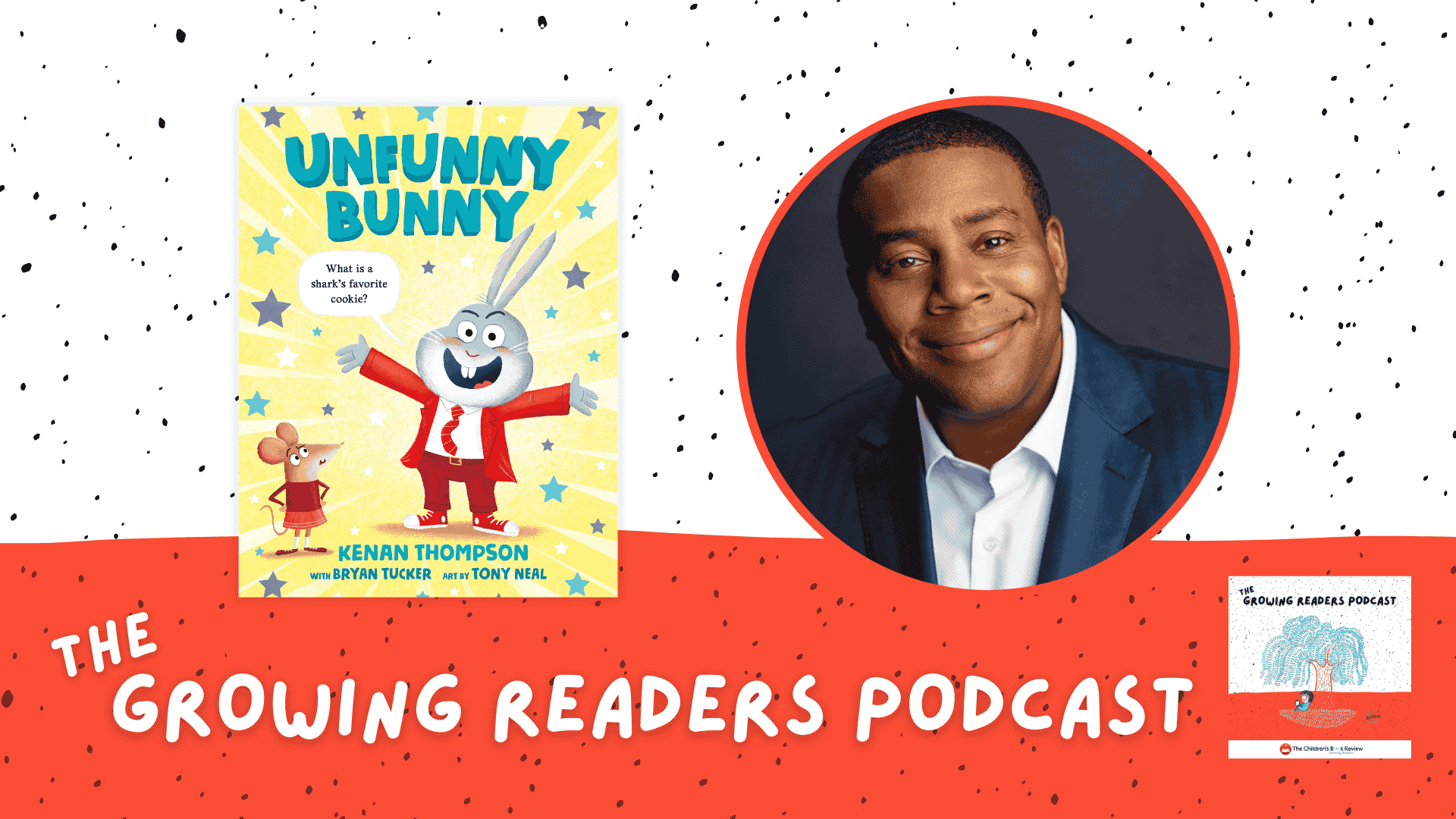
A podcast interview with Kenan Thompson discussing Unfunny Bunny on The Growing Readers Podcast, a production of The Children’s Book Review.
What happens when one of comedy’s most recognizable voices writes a picture book about not being funny?
SNL legend Kenan Thompson knows a thing or two about perseverance—and in this heartfelt conversation, he shares why scraping your knee, finding a good friend, and trying again are the real secrets to success. Unfunny Bunny is, at its heart, a story about perseverance, friendship, and finding your funny—even when things don’t go according to plan. Whether you’re a parent prepping for back-to-school or someone who’s ever felt like their best efforts didn’t land, this episode is a joyful reminder that you really can do anything you put your mind to.
Subscribe to The Growing Readers Podcast to ensure you never miss an episode celebrating the creators shaping young readers’ lives.
Listen to the Episode
The Show Notes
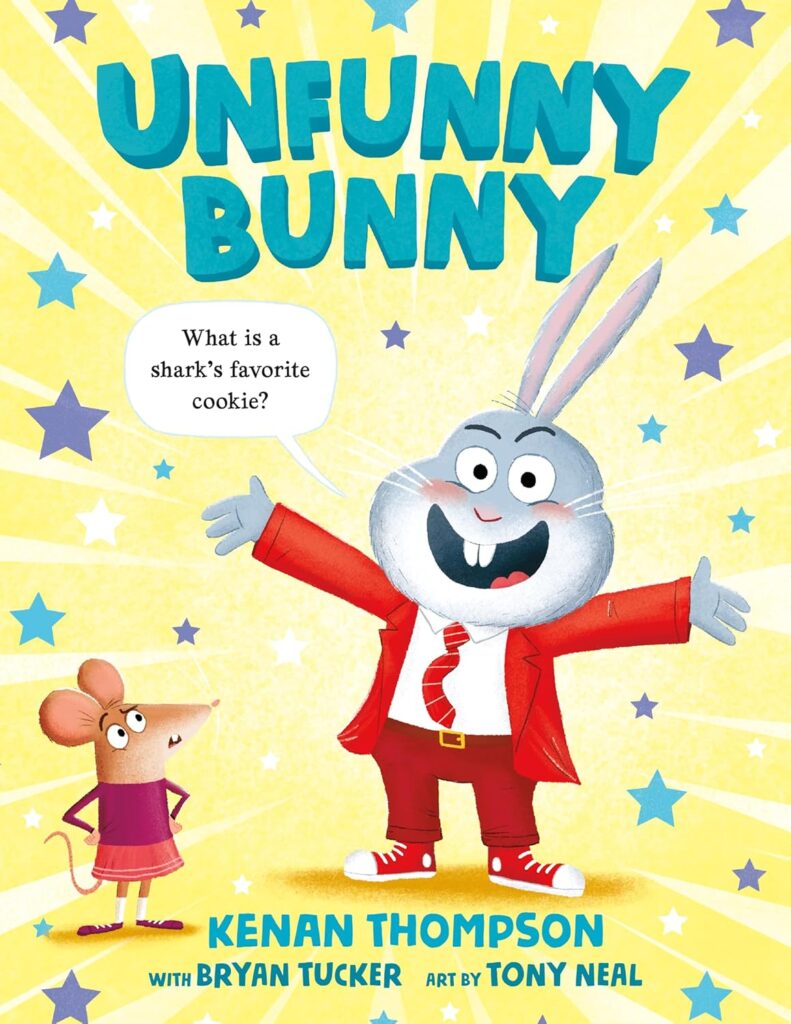
Unfunny Bunny
Written by Kenan Thompson with Bryan Tucker
Read by Kenan Thompson
Illustrated by Tony Neal
Ages: 3-6 | 40 Pages
Publisher: Feiwel & Friends/Macmillan Audio | ISBN-13: 9781250431004
Publisher’s Summary: From the beloved longest-tenured cast member of Saturday Night Live, Kenan Thompson, comes a hilarious new picture book perfect for fans of Jory John and Grumpy Monkey.
Tomorrow is Bunny’s first day of school, and everything is going to be perfect. All he wants is to be the funniest kid in class and make everyone else laugh. But when Bunny gets there, his jokes fall flat. What’s an UNfunny bunny to do?
This laugh-out-loud tale about unexpected friendship and pursuing your dreams is a silly, lighthearted read-aloud stuffed with 30 “unfunny” jokes that are sure to send readers of all ages into fits of giggles.
Buy the Book
About the Author
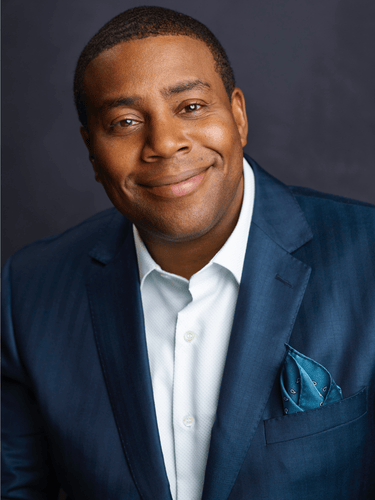
Kenan Thompson’s career spans decades, including being the longest-tenured Saturday Night Live cast member in history and starring in family-centric projects like Kenan and Kel, All That, The Grinch, the Trolls franchise (as Tiny Diamond—the cutest character ever), The Mighty Ducks 2 and 3, Smurfs 1 and 2, and both Good Burgers. The Emmy award-winning actor’s iconic work has made him a beloved household name. Unfunny Bunny is his debut picture book.
For more information, visit us.macmillan.com
Credits:
Host: Bianca Schulze
Guest: Kenan Thompson
Producer: Bianca Schulze
Read the Transcript
Bianca Schulze: Welcome to The Growing Readers podcast, Kenan.
Kenan Thompson: Thank you very much. Good morning.
Bianca Schulze: Well, as you once said in an SNL skit, we’re going to have a conversation, we’re going to get some information, and it’s going to be a sensation.
Kenan Thompson: Uh-huh, that sounds like “What’s Up with That.”
Bianca Schulze: Exactly, ooh-wee. I couldn’t help myself.
Kenan Thompson: Yeah, I love that. Thank you. I love those. Those are my favorites.
Bianca Schulze: Well, I want to start with just some quick, rapid-fire questions. The first one I have is, I read that you’re a fan of The Price is Right. Which was your favorite game as a kid?
Kenan Thompson: Yes. I think I like the climber because they sing the little yodel song.
Bianca Schulze: Me too. And then how stressful it was when he got right to the top and then toppled over the edge.
Kenan Thompson: That and Plinko. Yeah, when he toppled over the edge, it’s like, oh God. But yeah, between that and Plinko, Plinko’s my favorite. Hence, the wall, which is the greatest game show ever. So yeah, thank God for Plinko.
Bianca Schulze: Yeah. Love it. You’re the longest-tenured cast member in SNL’s history, so congrats on that. You’re welcome. What’s been your favorite sketch that you’ve ever been a part of? I know that’s a hard question.
Kenan Thompson: Thank you very much. Yeah, my baby is “What’s Up with That” because that was my first—well, it was my second idea that I got on the show, but it was the first one that I felt I really planted that seed myself. “Scared Straight,” I had a lot of help from Colin when we were sharing an office back in the day. Those were the days. But yeah, “What’s Up with That” is my baby.
Bianca Schulze: Yeah, good. Well, I’m glad I started with that intro. All right. Well, my favorite SNL song is “Come Back, Barack.” What’s your favorite song you’ve ever sung on the show?
Kenan Thompson: Oof, that’s a tough one too. There’s so many good ones. I can’t really recall all of them. I can only think about recent ones. The sillier the better, I think. And sometimes it’s the ones that I’m not even in, like “Lake Beach.” I love “Lake Beach” because Andrew and James have just been holding down Southern culture pretty strong from their perspective. And it’s just so great. I think “Lake Beach” is a prime example of them showcasing their roots, which is always fun. It makes you feel closer to them. So yeah, I like “Lake Beach” a lot.
Bianca Schulze: Okay, and then if you had to pick one character you’ve played that best represents who you are and your sense of humor when you’re at home, who would it be?
Kenan Thompson: Probably David Ortiz. Just that, a big happy guy who eats a big lunch and just loves life, wants to help the world with inventions or whatever he can. Yeah, he’s just a solid individual.
Bianca Schulze: Yeah. All right, and then last rapid fire. What’s the last book you read to a kid in your life, and did they laugh?
Kenan Thompson: The last book I read to a kid was my book, The Unfunny Bunny. And yeah, they laughed a lot. I read it to a school that had elementary up to middle school, and the middle school kids even enjoyed it. So it’s a pretty good range. Kids are so adorable. God bless the children.
Bianca Schulze: Yeah, I think I saw a clip of that on social media, and yeah, it was adorable. Well, so that’s a great lead-in. So let’s talk about The Unfunny Bunny. You’ve been making people laugh for decades, and now you’re tackling picture books. So what made you want to jump into the world of children’s literature?
Kenan Thompson: I loved it growing up. A lot of my colleagues have done it. So I guess once I scratched the book itch with my memoirs, it made sense as a next step because I enjoy children’s entertainment. Being a child entertainer myself, I understand that world. And I just enjoy the freedom and innocence of your childhood. It goes by way too fast before you even know how precious it is. So it’s always nice to revisit through other people’s eyes. And that’s what this book is—back to the colors, back to the characters, and just having a good time looking at funny images or listening to funny jokes. So back to my childlike innocence, I think, just having a good time with your day and listening to good and bad jokes.
Bianca Schulze: Yeah. Yeah, Bunny wants to be the funniest kid in class on his first day of school. That’s a lot of pressure to put on oneself. So what inspired this particular story about a character whose jokes start falling flat right from the start?
Kenan Thompson: Yeah, I was about to say those are some high hopes—to be the funniest right off the bat without even testing the audience first. But what inspired it? I guess if you could say we were mostly starting from title—like, what should we write a kid’s book about? And then we landed on the title. And then there was that rhyme, I think it was “Funny Bunny.” And then it was like, maybe it’s “Unfunny Bunny.” Maybe there’s more of a journey there, starting from unfunny to actually funny. And that’s, I think, the thought process and how we got there. And yeah, I could relate because I’ve been there where I thought something would play a lot better than it did. And you just have to figure out, okay, where did I miss you guys? Where’s the bridge that needs to happen with these references? You just start figuring it out based on—you gotta get out there first. You gotta put yourself out there first. So there’s no way of getting around that if you wanna be a person that entertains people. You kinda gotta know how groups respond to what you’re thinking, which is very stressful and also scary, but it’s also very rewarding because once you have that toolkit, it’s pretty useful. I think once people figure out how to translate their personal sense of humor to the rest of the world, that’s when you have your successful stand-up comics, performing comics, anybody like that.
Bianca Schulze: Yeah, I feel like you might have answered my next question, but I’m going to ask it anyway, because you, with your career spanning so long, you have to know a thing or two about persistence and what it takes to stay funny year after year. So how does Bunny’s journey of dealing with jokes that don’t land intersect with your own experience in comedy, and particularly when it comes to the writing piece? Because I know when you’re in person and maybe doing a skit on SNL, if something’s not quite landing, maybe in the moment you can just be spontaneous and improvise a moment. But when you’re writing and it’s gone to print, this is it. So how does Bunny’s journey of dealing with those jokes that don’t land intersect with yours?
Kenan Thompson: Yeah, I think they’re pretty similar. Anytime you say something that you expect people to laugh at—whether it’s a joke or just a funny expression or anything—trying to get a laugh out of people and it doesn’t go according to plan is the lesson. Like, all right, well, I missed that one. So how do I get back to it? There’s a joy in calling it out, which is what SNL is fun for. When things go awry, you can always speak on it in the moment, whether it’s a facial expression or whatever. You can acknowledge the fact that that was not expected. And that can be a laugh. But that doesn’t necessarily help the joke get better. So you still have to figure out wordage-wise, or if enough people even care about the subject matter enough to laugh at the joke. Sometimes you just have to simplify and just make it real, real, real simple. If it’s a simple joke, as opposed to trying to make it sound more complicated than it is—the audience is a lot smarter than you think. And they’re very aware of current events. They’re PC, they’re this and that. So you just have to be a little more intriguing in your directions. If you’re going to take people down a certain road, you have to be really, really smart about it. And that journey of figuring out exactly your level of intelligence and also your audience’s level of intelligence—I think that’s a big part of what the bunny is going through, in a much more truncated form because it’s a children’s book. But that’s exactly what the bunny is going through. Tell the joke, realize that the joke doesn’t work, and then figure out why. So yeah.
Bianca Schulze: Yeah. Yeah. I feel like you said something that really hit the spot for me, which was that enough people have to maybe care about the topic that you’re creating. I think kids—I mean, adults too—we all just want to belong, right? We just want to feel like we belong. And I feel that’s the part that kids are really going to relate to, and that’s why they’re going to care about The Unfunny Bunny, because whether they want to be a stand-up comedian or an entertainer or—Bunny at the beginning thinks maybe I’ll be the sports player, right? Whatever it is, you just want to belong. And I think all kids are going to relate to that part.
Kenan Thompson: Yeah, I think the bunny—I think a person that’s telling jokes to try to entertain people, that’s their way of saying, “Accept me, please.” You know what I’m saying? Like, bring me in. I’m a useful part of the group. I can make everybody happy as we figure out what we’re doing throughout the day. I’m useful, so bring me in. It’s definitely that.
Bianca Schulze: Yeah. Yeah. Well, the book includes about 30—and I’m going to put this in quotation marks—”unfunny” jokes that are actually quite funny. So do you want to give us a sneak peek at one of your favorites? Or do you want to share one, or even the first joke that pops into your mind? I’m putting you on the spot, I know it.
Kenan Thompson: Yeah. No, there’s so many good ones. There’s the dad—they just have a very dad-jokey vibe, where it’s just pull-my-finger. But I have the book. Hold on a second. Let’s see. All right. Yeah. “Why is the airplane so good at football?” It has dozens of touchdowns. Okay, come on. “How do you make a cat fly?” With a catapult. Little stuff like that. That’s classic joke-telling.
Bianca Schulze: Yeah. Yeah. Yeah. I love it. Yes, I think there’s one about the—I’m not even gonna try. I won’t land it. But the snowman at the beach. What’s a snowman at the beach? A puddle.
Kenan Thompson: Yeah, man. Visuals, plays on words—all of that. Those are writing dynamics, creative writing skills. And if you have those opportunities to take those classes, I think that’s where you will learn how to wordplay but also how to help the reader or the listener visualize. And those personal visuals can make the laugh more so than just saying the word “puddle.” It’s you’re imagining a snowman that was at the beach and is no longer.
Bianca Schulze: Yeah. Now I’m actually foreseeing that—I hadn’t thought about it until this specific moment—that teachers could use this in the classroom for creative writing to really get kids to think about their wordplay and their use of words. And so I don’t know, Macmillan, if you’re listening, if there isn’t already a teacher educator guide, I think you need to whip one out.
Kenan Thompson: Really? Don’t worry, we will contribute. We want our percentage.
Bianca Schulze: Well, the book has those themes of unexpected friendship and also pursuing your dreams even when things don’t go as planned. And so I also see an overlap here because Bunny—Unfunny Bunny—makes friends with a hedgehog that actually helps support him in writing the jokes. And this book is co-authored as well. And I wonder if part of that relationship between Unfunny Bunny and Hedgehog is similar to yourself and Bryan?
Kenan Thompson: 100%. Bryan and others. Me and Bryan did “What’s Up with That” together, and we’ve done a lot of sketches over the years—”Black Jeopardy” and stuff like that. Colin was a large collaborator too when I first started really getting my personal ideas into the mix. I was mentioning earlier with “Scared Straight” and stuff like that. But I also worked closely with James Anderson and Paula Pell, and Seth Meyers used to write a lot. Tina would throw things in. So I’ve always been very blessed to be the recipient of fantastic writers writing in my direction. And the hedgehog, I think, encompasses the art of collaboration in general. Me and Bryan Tucker definitely have that relationship because when he’s in the office, he’s my go-to check-in guy on a weekly basis. Like, “Got any ideas this week?” Or, “I have this idea, let’s try to flush it out.” And we’ve been doing that for years. So I was going to say that hedgehog relationship is pretty critical, in my opinion, for certain people. If you’re not just born a writer, you need a collaborator. You need somebody to help get the jumbled ideas bouncing around your mind and put it down like an actual blueprint that makes sense for everybody else. In my mind, I have all these references from movies that I’ve watched a million times. But if you haven’t seen The Three Amigos, then I can’t just throw out generic references inside that movie and expect everybody to laugh when I’m trying to talk about being late for the subway and trying to make those two things work together. Maybe it’s too abstract, so maybe you have to pick a more popular movie that everybody’s seen or just say—because you know they’re gonna get off the subway? You know what I’m saying? Like, there’s just ways to explain humor that are a little more universally understood. And that’s where my relationship with the hedgehog comes in. My collaboration with the hedgehog explains, like, hey, maybe you should do this or say that. And then once we get to that place, then it clicks. Then it starts to flourish. So I think that hedgehog relationship is very critical, and I appreciate it.
Bianca Schulze: Yeah. Yeah, it was interesting hearing you say before that you just need to get out there, right? You need to know your audience, test those jokes. But I love that you do have that one person that is, like, your go-to that gets you that you can workshop ideas with. And so, again, I just feel there’s so much that young readers are going to glean from this. Like, I feel the story has so many layers to it. It’s funny on the surface, but when you really dig in, there’s a lot of depth here.
Kenan Thompson: Yeah, I hope so. I hope so.
Bianca Schulze: Yeah. Yeah. What was the most enjoyable part of creating this book for you?
Kenan Thompson: I would say probably just working with Tony Neal and watching his color choices and designs and just the fun that he had illustrating. I think it really comes across on the page. I think it’s beautiful work. And I was also very surprised. We don’t see each other face to face and figure all this stuff out. A lot of it is through Zooms and kind of very vague descriptions. Like, I’ll give one sentence about what’s happening, and then he’ll come back with something way more flushed out and just really perfect. So shout out to him for helping make this book what it is.
Bianca Schulze: Yeah. Yeah. And to be clear, he’s the illustrator, right?
Kenan Thompson: Yeah, yeah, yeah. He is the illustrator.
Bianca Schulze: Yeah. So it’s almost like, in a way, he was a reader, right? He was reading the book and interpreting it his own way. And so when you were then seeing it, you were seeing it through his eyes, kind of.
Kenan Thompson: A hundred percent. Yeah. And he nailed it. Like, I think about the actual mechanics of what we mentioned, like a close-up scene, right, where it’s, Bunny’s head sweating. But he just even got those smaller details that kids can pull over. Right from the—I think it’s on the first page, and Bunny’s in bed, and there’s a pair of lava-hot undies poking out from under the dresser. I mean, kids love that stuff. He nailed it. He really did.
Bianca Schulze: Yeah, thank you, man. So yeah, good job, Tony. Yeah, a round of applause. All right. Well, you’ve played so many memorable characters—from Tiny Diamond in Trolls to your iconic work on Kenan & Kel. And my kids’ favorite was Bricklebaum in The Grinch. When I said I was talking to Kenan Thompson—and just so you know, they don’t watch Saturday Night Live because they’re not old enough yet—they said, “Who’s Kenan?” I said, “Kenan Thompson.” And they’re old enough to Google, so they Googled. And I wish that I’d have recorded it. They were like, “He’s in this movie? He’s in this? He’s in a Home Alone movie? What? He’s Bricklebaum? Bricklebaum?” And then they just started dying. So…
Kenan Thompson: I love this. Thank you. Go into a deep dive. Like, that’s fantastic.
Bianca Schulze: Yeah. So what have you learned about what makes children laugh throughout your career that you think you were able to bring into this book?
Kenan Thompson: I think a lot of it is just your honest portrayal of what you think is funny. You know what I mean? Like, smiles are infectious and all that stuff. So the sillier you are, they’re just gonna latch onto whatever you’re doing, energy-wise. And then, as far as kids are concerned—and then when you get into older kids, now they’ve got a little more reference material. They’re a little wiser. So then you can actually start formulating your speech patterns towards them in a funny way. But as far as kids, kids just—stubbing your toe even, or whatever, just playing with them and giving them the attention—is what makes kids excited. So yeah, that’s what I learned.
Bianca Schulze: Yeah, I love that. So it sounds like directing the attention towards them, because they do just want to be seen. Yeah, I like that a lot. Well, do you think that there’s going to be more Bunny books or like different characters? Like, what are you thinking?
Kenan Thompson: Yeah. I think it could do a lot of that. It could easily be one of those teaching tools about life. Like, Unfunny Bunny learns how to do this, or Unfunny Bunny goes to the moon, or—I think there’s a lot of potential there. So I’m looking forward to watching it grow, whoever wants to take the reins and just push it in one direction or another. And then also maybe bringing it into the animated world possibly and stuff like that. So yeah, I think there’s a lot of potential there.
Bianca Schulze: Yeah. Well, what do you hope kids take away from Bunny’s story, and especially kids who might be nervous about their own first day of school or trying out something new?
Kenan Thompson: Yeah, I mean, we touched on perseverance. We touched on just being confident but also not being too naive to see what’s really going on and learning the lesson. Engaging with a good friend when they pop up and being a good friend back to a good friend. And then the magic that two friends can create is what you’re probably looking for in the first place. But sometimes it takes a partner to tell you, like, “Change this word” or “Change that word” or “You’re coming off a little crazy over here. Maybe pull that back and normalize it a little bit for everybody else.” Like, any of that balancing of the scales. And being yourself. There’s nothing wrong with being outward if you want to be that person that wants to command the classroom and tell jokes when it’s appropriate. But also, don’t be afraid to scrape your knee. If you scrape your knee, put the Band-Aid on it and keep it moving. It’ll heal, and you’ll be better off for it.
Bianca Schulze: Yeah. Yeah. I feel like that part—that last part—I feel like that’s my favorite. Just, yeah, knowing that not everything you’re gonna do in life is gonna land, right? And I feel like your story of using jokes and comedy writing and being a comedian and telling that is such a perfect metaphor for all aspects of life.
Kenan Thompson: Yeah. All aspects of life. Like, it really goes hand in hand with the simplicity of try, try again. Because you’re talking to a guy who couldn’t even roller skate, and I learned how to play hockey. And I fell so much the first week or so trying to learn how to ice skate. I didn’t think I would be able to do it, especially after day one. Day one was the craziest. Like, I spent the whole day trying to stand up for just hours and hours and hours. And when I was done, I was like, “I don’t know if I want to be an actor,” because I didn’t know acting came with having to learn sports like hockey on the fly. But my mom didn’t let me quit, thank God. And I went back day two, day three, day four, day five. And you’re like, “I know I can play.” Which is a wild concept to me. Like, I can play hockey coming from Atlanta. Like, that’s wild. So you really can do anything you put your mind to and try hard at. The timing part is the key.
Bianca Schulze: Yeah. Yeah. It’s the trying part. I do. I love that. Well, Kenan, thank you so much for sharing The Unfunny Bunny with young readers everywhere and with everyone listening to this podcast. And I have to say that in a world that can feel pretty heavy sometimes, creating a book that celebrates friendship and laughter and reminds kids that it’s okay when things don’t go perfectly—I think that’s such a gift. And I just want more of this kind of joy and energy that you’ve brought in 2026. I want more of it. So just thank you. And I have no doubt that Bunny’s story is going to help kids find their confidence and their own path to making people smile. So we’re just so grateful to have had you on the show today.
Kenan Thompson: Thank you so much, Bianca. It’s a pleasure. Yeah, I hope kids love the book. I hope parents love the book, grandparents—like, whoever. It’s just another tale as old as time of just keep going, man. Don’t let anybody stop you. But also, be willing to take on a passenger. There’s nothing wrong with going down the road not alone. We’re supposed to be united in this world. So keep that in mind as well.
Bianca Schulze: Perfect way to end, Kenan. Thank you.
Kenan Thompson: Thank you. I appreciate it.
