

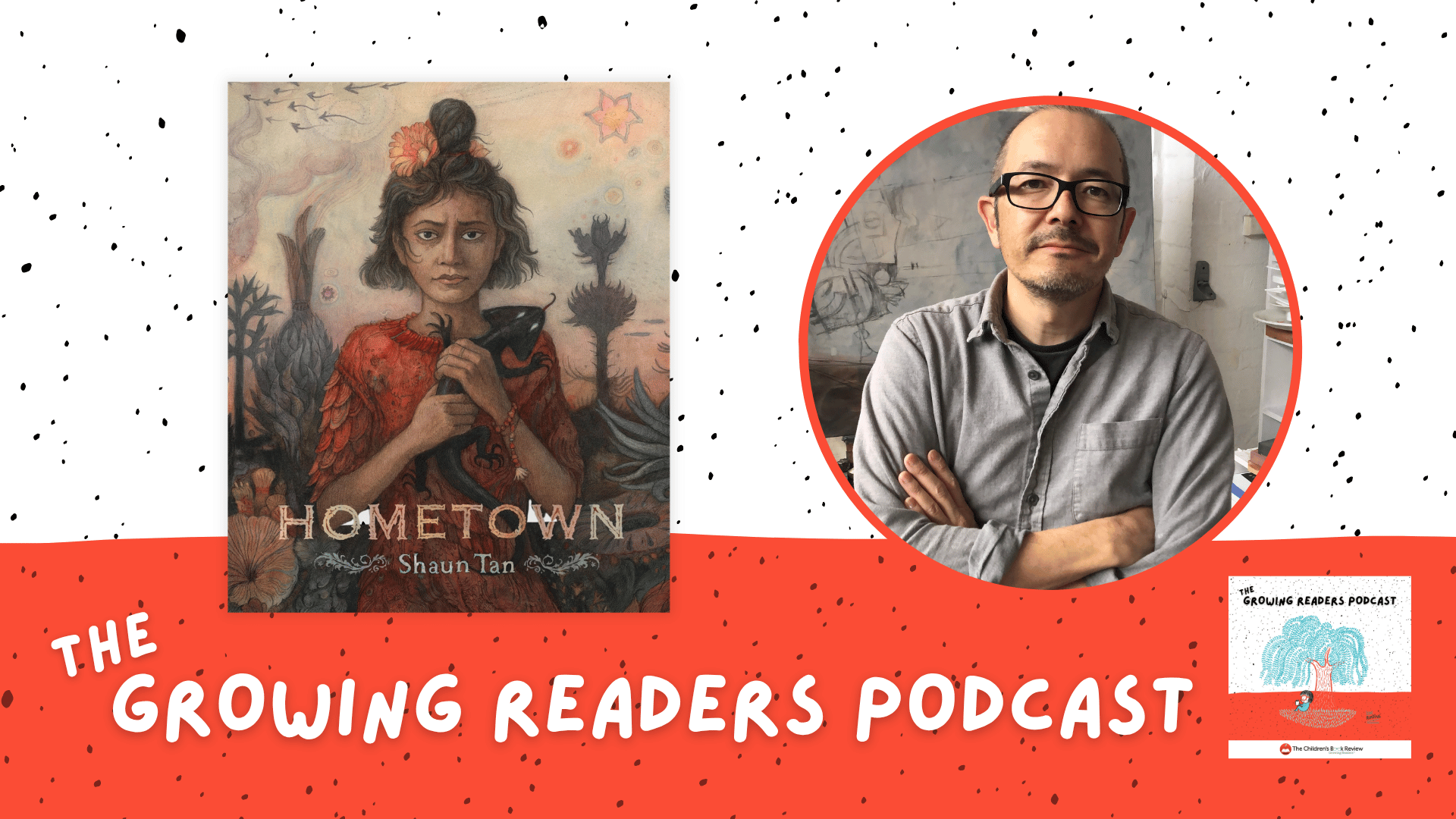
A podcast interview with Shaun Tan discussing Hometown on The Growing Readers Podcast, a production of The Children’s Book Review.
Join us for a conversation with Shaun Tan about Hometown, a visually stunning story that asks big questions about identity, belonging, and where we call home.
In this episode of The Growing Readers Podcast, Academy Award-winning artist, writer, and filmmaker Shaun Tan takes us inside the creation of Hometown, his funny, strange, and thought-provoking new picture book. He talks about the art and craft behind the story, its connections to The Arrival 20 years later, and the questions about identity and belonging that continue to inspire his work.
Subscribe to The Growing Readers Podcast to ensure you never miss an episode celebrating the creators shaping young readers’ lives.
Listen to the Episode
The Show Notes
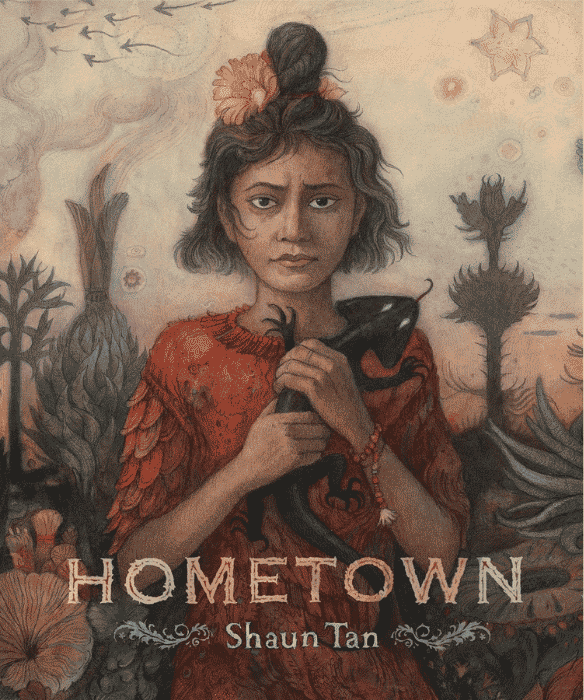
Publisher’s Summary: If a stranger arrived and told you that the world you knew-your community, your family, and your hometown-wasn’t really where you belonged, would you follow them and leave it all behind?
Imagine living in a perfect world. You have a loving family, a beautiful home, awesome friends and about three hundred loyal pets.Everything is just as it should be. Until one day, when a stranger arrives. A stranger who looks just like you. A stranger with a very disturbing message . . .
Hometown is a visually gorgeous, emotionally stunning (and frequently funny) meditation about what it means to belong, and what makes us who we are. From the singular mind and brush of Shaun Tan, creator of The Arrival, Tales from Outer Suburbia and The Lost Thing.
Buy the Book
About the Creator
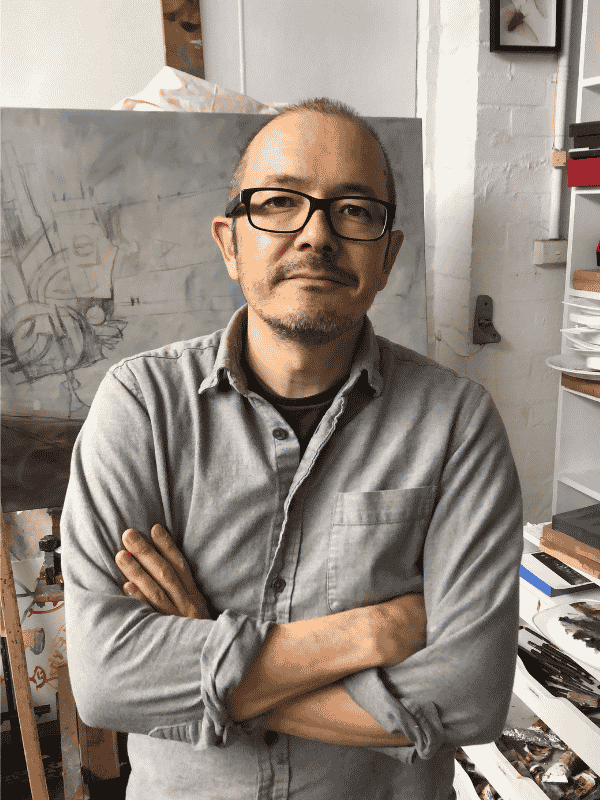
Shaun Tan grew up in Perth, Western Australia, and works as an artist, writer and filmmaker in Melbourne. He is best known for illustrated books that deal with social and historical subjects through dream-like imagery, widely translated throughout the world and enjoyed by readers of all ages. Shaun is the recipient of an Academy Award for short animation, the Astrid Lindgren Memorial Award in Sweden and the Kate Greenaway Medal in the UK. He lives with his wife, two children, a dog, a parrot, some fish, and stick insects.
For more information, visit shauntan.net.
Credits:
Host: Bianca Schulze
Guest: Shaun Tan
Editor: Kelly Rink
Producer: Bianca Schulze
Read the Transcript
Bianca Schulze: Hi Shaun, welcome to The Growing Readers Podcast.
Shaun Tan: Hello, good to be here.
Bianca Schulze: This is fun. I was just in Australia, but now I’m back in Colorado, so it’s fun chatting with someone in Australia — I miss hearing the Aussie accent.
Shaun Tan: Right, yes. Your accent is an interesting mix.
Bianca Schulze: Yeah, exactly. I’m officially more American now than Australian. I’ll always be Australian at heart, but I’ve been living in the United States longer now, so…
Shaun Tan: Yes, but with key words like “heart,” it’s definitely an Australian accent.
Bianca Schulze: Yeah, exactly. Well, I’ve recently been loving to kick off the podcast with some rapid-fire questions, just to get us warmed up. Is that okay with you? Great — I’ll jump right in. Sketchbook or straight to canvas?
Shaun Tan: Sketchbook.
Bianca Schulze: Pencil first or paint first?
Shaun Tan: Definitely pencil.
Bianca Schulze: One word to describe your art style.
Shaun Tan: Unexpected. For me, that’s what makes it interesting.
Bianca Schulze: One word to describe what home means to you.
Shaun Tan: Boy… familiarity.
Bianca Schulze: If a stranger showed up tomorrow and told you that you belonged somewhere else, would you go?
Shaun Tan: If I could come back, yes.
Bianca Schulze: I love it, I love it. All right, well, we’re going to get into the longer answers now. This year is pretty exciting for you because it marks two milestones: The Arrival, which won a gazillion awards, turns twenty. And Hometown, which is being billed as its perfect companion, releases this year too. So I want to know — was that pairing intentional? Did the anniversary of The Arrival somehow shape how you approached Hometown at all? Or did the two just happen to land in the same year, with Hometown developing on its own timeline?
Shaun Tan: Definitely the second one — no plan at all. Since completing The Arrival, I honestly didn’t think about that book much while I was working on this one. It only occurred to me afterward — the similarities — when other people started pointing them out, which is normally the case. But since that time, I’d gotten married, had kids, moved interstate, lived in several houses — lots of stuff, family life, as you’d know.
My brain isn’t really tracking any kind of career at this point. I’m just treading water. This book — I’d say it took longer, partly because of doing other things. They’re similar because they’re both long, visual narratives, but Hometown has a very different tone, and it has words in it. So it’s almost a reversion to a more traditional word-and-picture relationship, which is where I started my career — in some ways, a return to factory settings.
Obviously I learned a lot from doing The Arrival about how graphic narrative works, and how to put pictures together on a page to tell a story that’s predominantly visual, which is what I try to do. And then the themes — home, displacement, belonging — I have no idea why I keep coming back to them. I wouldn’t just mention The Arrival; I’d say every single book I’ve ever done is basically the same story, told from a different point of view. I really don’t know why. I’ll leave that for a psychologist, or for readers, to decide. I have my theories, but when you try to explain yourself in an interview, afterward you always think, “That’s not quite right.” There are so many other things going on. That’s kind of the narrative I tell myself, but the truth is, I’m not really sure. It’s very subconscious. It’s like I fall asleep when I’m drawing, painting, and writing, and these dreams well up — and then afterward I try to explain them. But it’s deep childhood stuff, perhaps.
Bianca Schulze: Yeah. Well, after more than two decades of doing this — including winning the Oscar in 2011 for Best Animated Short Film for The Lost Thing — and after all the awards and acclaim, what is it that still makes you, after two decades, want to sit down and make a book?
Shaun Tan: Pretty much the same thing that did when I was eleven, which is when I started — not as a serious thing. I never intended to be a picture-book creator; that was never an ambition of mine. It sort of happened along the way, through unemployment and certain opportunities becoming available.
When I was eleven — and I think when we’re all eleven — it’s a really good time to think about what you want to do. It’s almost the peak of the first phase of your life, that golden time of childhood, if you’re lucky enough to be living in a safe, secure, happy home environment. All the stuff you’ve learned as a kid is starting to reach a level of consciousness. You’re starting to be able to reflect, and you’ve got the tools — you’re articulate, you can write, you can usually draw — and you can start to make things that entertain yourself. I guess that’s basically it for me: it’s quite a selfish act, in the first instance. That’s why, going back to your first questions about sketchbooks — the sketchbook is where things start, and it’s highly personal. It’s got nothing to do with critical acclaim or past experience. Every time I start a project, I feel like a novice, like a student — I don’t really know what I’m doing. There’s a little muscle memory in the hand from previous work, but generally, when you come back to the studio… artists and writers typically work alone. I can’t imagine it any other way, to be honest. You come back into that little room, and everything — the desk…
Bianca Schulze: Yeah.
Shaun Tan: …and I still use the same table I drew on when I was six. It’s a family dining-room table, just made of very good wood that’s lasted. But everything comes back to being alone in a room with your thoughts — like camping in the wilderness. Past experience has something to do with it, but you’re dealing with the same anxieties, problems, curiosity, and desire to express some kind of joy or questioning. So it always feels the same. It’s a great reset, the artist’s or the writer’s desk.
Bianca Schulze: Yeah. Well, this is something I ask everyone on the show — they say you need to be a reader before you’re a writer, but since you’ve built a career equally out of images, I’ll widen that a little. Was there a pivotal moment when you started to think of yourself as someone who absorbs and reads stories, whether they came as words or pictures?
Shaun Tan: “Someone who absorbs and reads stories” — that’s interesting, like a self-conscious reader, more aware of it. I’d say it was probably around the time I became seriously interested in writing. It’s funny, because I did a lot of illustrated books before I started writing my own, and I’m often asked when I decided to become a writer and how difficult that was. I have to explain that I was a writer before I was an illustrator — that’s actually the only formal study I’ve had in this field, the writing part. I haven’t really studied illustration; I’ve studied art a little, but not book illustration. I learned that through actually doing it, over many years, with small-press publications.
But way before that — as a teenager, maybe thirteen or fourteen — that’s probably when I started thinking I’d really like to tell my own stories. I liked what I was reading and seeing, both in books and on television and in movies. Growing up in suburban Perth, TV and movies were the art form of the suburbs, and that influenced me a lot, especially visually — the idea of telling visual stories. Around that age, I started breaking movies down when I watched them: “How did they do that?” I was almost more interested in the “making of” specials than the movies themselves. When DVDs came out with special features, I was thrilled — I’d watch all of that. So my visual education came a lot from movies, and then from books about how people made books. I was starting to get interested in how these things were made — partly because, on a few rare occasions, an actual author or illustrator would visit our school. That was a lightbulb moment for me. There was an Australian writer in particular, Tim Winton…
…who was quite young at the time, who came and visited our school and the local library in Karrinyup, not far from the Karrinyup shopping centre. He fascinated me because I’d read some of his adult books — which I didn’t fully understand at the time, because I was too young — but I recognized the landscape he represented. I’d never seen anybody write about the Southwest, or fishing, or the things my family did, and the Swan River. I knew these places, and it made a strong connection for me between ordinary experience and literature. Before that, I’d had the impression that books were produced by people in other countries, far away, who were very different from me — almost a different order of species. The books would come raining down to the suburban public library, and we’d just consume them, the way we look at manufactured goods without thinking about somebody sitting there and putting the parts together. So it was great to have that connection. Around that time, I started sending little short science-fiction stories to magazines, which were all routinely rejected — exactly what I expected, but I loved doing it. Writing these little stories and sending them off was like playing a lottery you’re unlikely to win, but it was something to do.
Bianca Schulze: Yeah, yeah. This is actually blowing my mind, because I’ve always thought of you as artist first, illustrator first. But hearing you talk, I think it’s because you came from writing and storytelling first. You’re an incredible artist, but there are a lot of incredible artists — not everybody knows how to tell a story. I think because you know how to tell a story, that comes out in your art, and that’s why your art moves people the way it does. Do you think that’s fair to say?
Shaun Tan: Yeah, it could be — it’s hard to know. But story construction is definitely more difficult each time for me than I expect, and I’m reminded how much editing is involved, which a lot of people maybe don’t realize. When I first started writing my little short science-fiction stories, that’s when I first became aware of it — and you’re taught this in school, so I learned it there too, in a normal government education, which was pretty good, actually. I learned that it’s what you leave out as much as what you leave in. A lot of people don’t realize that, especially picture-book creators and first-time creators. I’m always telling them: you’re writing only half a story. The reader is writing the other half in their mind. You mustn’t tell them everything, or overload them with your amazing ideas — and your ideas are amazing — but you have to leave space for the other person’s amazing ideas.
That restraint is everything, and you learn it as a painter too. It’s very difficult, because when you’re inspired, there’s an outpouring of feeling and ideas, and you want to show everything to everyone, because it feels great. But then you realize it has to be a measured conversation with a person. It can’t be like one of those conversations where someone says, “Let me tell you all about my passions,” and starts mansplaining. You have to sit back, almost listen to the reader who isn’t there yet, and put in pauses and empty spaces. Writing — and poetry in particular, which I wrote a lot as a kid — is a really good discipline for learning how to say the absolute minimum and still get the resonance, and give the reader space.
Bianca Schulze: Yeah, yeah. All right, let’s talk about Hometown. In a nutshell, it’s about a girl who’s part of a family built on love rather than biology, and she’s confronted by someone claiming a different kind of belonging. Unless you want to correct anything there — was there a real moment, conversation, or observation in your own life that fed into that?
Shaun Tan: That’s an interesting question. Again, I’m not entirely sure — I can’t pinpoint a particular thing, except that I started writing this story around the time my daughter, our first child, was five years old and coming into the phase where kids start asking interesting questions. I wouldn’t go so far as to call them philosophical questions, but close. I remember she was pointing at a dead beetle on the ground and asking, “Is that old?” And I said, “No, that’s dead.” For a while, she confused the words “old” and “dead” — she’d point to our elderly Greek neighbor and say something similar, and I’d have to explain, “No, she’s just old.”
As she got older, she kept asking follow-on questions, especially about memory and what happens to memory when you die. She became interested in the idea of impermanence, because as a small child, things feel very permanent — the world feels expansive, huge, and stable, and your parents are ideally these pillars of stone helping you. Then you become aware that actually everything’s in flux, changing, and that you’re mortal, and every moment is passing. It’s a mind-blowing thing. My daughter was worried about this question — I can’t remember exactly what age — but she asked me what happens to memories when you die. My usual answer is that nobody really knows, but there are lots of theories. I said, “I think your memories go to other people, if you’ve shared things with them — they carry on bits of your memories, but they’re not exactly your memories anymore, they’re theirs.” And she said, “Well, what about my memories?” And I said, “Well, they kind of just…” — like when you turn off a TV screen —
I think maybe they disappear, or change, or in some way don’t exist the way they do now. Whatever happens, they’re different, and probably disappear, like when you fall asleep, or like the time before you were born — do you remember that? I think death is a little bit like that. It’s not a bad thing, it’s just a thing. So that question — what happens to memories when you die, not your soul or anything, she wasn’t so concerned about that — became interesting to me. That has something to do with this story.
The other thing was that I was watching a lot of kids’ TV, as you do as a new parent — it’s weird, I didn’t realize I’d also be reading a lot more picture books. As a picture-book creator, I hadn’t really sat down with a kid and read lots of picture books before, and now I was. They’re crazy — it’s like the most surreal genre in literature, children’s literature and children’s television. When we were traveling, my daughter was very little, and we were in Spain, and at one point there was a weird Icelandic TV show dubbed in Spanish, with a human girl and these rubbery puppets.
Bianca Schulze: Okay.
Shaun Tan: I was jet-lagged, looking at this thing, thinking, “What on earth is this?” — quite confused. But I was also in that state where my mind is loose and wandering, and I thought: what if this is reality TV in Spain? What if this is a village somewhere, and this is a documentary, not fiction? That’s the kind of weird thought everybody has — but when you’re an artist, you actually keep going with it. That’s the difference.
Bianca Schulze: Ha ha.
Shaun Tan: Instead of thinking, “Okay, what’s for breakfast, let’s get organized,” I thought, “I’m going to sit here and imagine that’s real for a bit and see where this goes.” My daughter was asleep, and I thought: what if she was born in this place? I think she’d do pretty well — she’d love all these creatures, and they’d love her. And at what age would she start to think, “Why don’t I look like you guys? Why am I different?” So that was the germ of the idea — but that alone isn’t a story. It was all these other things that came later. Usually I have a little question like that — I probably have about a hundred of them at any time — and they’re looking for other ideas to attach themselves to. Other ideas came along as I was reading about colonial history, seeing things in the news, having conversations with people — and they all attached themselves. Eventually I realized I was still thinking about this girl, raised in a strange place, who doesn’t know she’s human. At some point, the idea came in of somebody arriving and telling her she’s human, and that maybe she should go somewhere else, where other humans are. My first thought was, this is such an obvious kind of fable — surely it’s been written before. I did some checking and couldn’t find a story like it, so I thought, okay, I’ll write that story.
Bianca Schulze: Yeah — well, I was going to say, I can’t think of any other story like this one either. I love that your mind went visual when you had the idea, and it was just looking to attach itself to other ideas to become something greater. I read, I think on your website, that your books often start from a single image you visualize — like a fish floating down a street, or a boy feeding a monster in a shed. Was there a seed image for Hometown? What was the first image you remember visualizing, or putting down on paper?
Shaun Tan: That’s a good question. The first image isn’t necessarily a seed image — it’s just that everything has to start with something, like the first part you build of a house isn’t the “seed,” it’s just the bit you had to start with. In this case, I think it was almost the first page of the book — the girl standing with her arms out. There are a few paintings I’ve seen, particularly of girls standing in fields — I think Andrew Wyeth’s Christina’s World is one, which for many Americans is a very well-known image of a girl in an open field, looking toward a house on the horizon. It has a very disquieting feeling, and that’s the kind of feeling I was interested in for my work.
There’s also the Australian painter Jeffrey Smart, who often paints tiny figures in vast landscapes with a bit of industrial menace. And a painter I was really fascinated with, who got me interested in painting when I was young, is the Australian impressionist Arthur Streeton. He has paintings of figures in fields from the 1880s — places that are now deep suburban Australia, but were farmland back then — European, displaced settlers standing in these fields, a beautiful, lyrical landscape feeling, but always with a bit of tension. They’re wearing little pinafore dresses, and there’s that scrubby Australian —
Bianca Schulze: Yeah.
Shaun Tan: — bush. It’s not a gentle, soft European place. It’s prickly, ragged, blasted with heat — all this intensity, which, for an Indigenous Australian, is totally home. But for these people, I feel like they’re still getting there — they’re in process. That kind of imagery has always fascinated me: portraits with background landscapes where the figure doesn’t quite match the landscape. A lot of European nobility portraits are like that — “I’m the landowner, and you’ve spent almost no time on that land.” I’m really interested in that tension, because I think it’s the root of culture — that contradiction and tension we’re always trying to resolve. I feel it the same way as a suburban Australian: at home, and not entirely at home, here. I’m aware this is stolen land. A lot has happened. This culture is very new, rapidly changing, not sustainable — it’s like a strange dream that could unravel at any point. But at the same time, it’s peaceful, it’s functional, everything’s come a long way. There’s all this positive and negative together, and that fascinates me.
So that opening image — she’s standing there with her arms out, saying, “Here I am.” It’s almost a statement of the paradox of existence: we didn’t choose the time and place to be here. Here we are — what are we going to do? How are we going to manage, how are we going to live in this place, as the time travelers that we are? Who are we? In any alternate universe we might have popped into, what are the common bearings — what makes us who we are, where is our soul, what’s our moral compass? All those questions. So I love that image of a person standing in a landscape with their arms open. In this case, she’s quite accepting — different from The Arrival, which begins with someone thinking, “I’ve got to get out of here, this is awful.” And then, “Now where am I? This is just as bad — how do I manage?” But through those different displacements, I think they both reach a similar point.
Bianca Schulze: Yeah. Yeah.
Bianca Schulze: My gosh, my brain is just pinging — there are so many tangents we could take right now. As the reader, receiving that first meeting with the girl, everything you said really does come across. It’s like, “This is me,” and you can tell she’s happy to be there. But as the reader, you also know there’s more to come — it was a really great opening. The tangent I want to take is that I noticed, at the very end of the book, your acknowledgment — I hope I’m pronouncing it correctly — to the Wurundjeri people. I was always fascinated by Indigenous stories as a kid; my teachers read a lot to us at school, and I feel like that formed a lot of my appreciation for storytelling. I wanted to thank you for including that acknowledgment. I’m sure it’s been in other books before, here in the United States, but I’d never noticed it before, so I can’t say for certain how common it is for Indigenous acknowledgments. But I loved that you acknowledged the book was created on the land of the Wurundjeri people. Has that been in your other books before?
Shaun Tan: Yeah, I think so. It’s becoming more common, I’m happy to say — a bit like the Welcome to Country at events, school events, or any public event. It’s good, it’s long overdue, and I see it now with artist exhibitions, catalogues, books, public readings, and every panel at writers’ festivals. It’s an important thing to say, and it’s become more common. Obviously it’s relevant to this book, because it’s about home, and I’m thinking about my own place in it, and how this has been home to many other people — as well as recent… Indigenous people. You’re giving thanks to elders past and present, but it goes back sixty thousand years — imagine the different peoples who have lived here, the many cultural variations there would have been. That’s where art and literature opens a pathway to imagination, because sometimes that’s all we’ve got when we’re dealing with things so distant. It’s nice to make that connection, and to think about the land where you are as something you can feel a deep belonging to, even as a non-Indigenous person. But like the girl in the story, she doesn’t have any roots there — you don’t need roots to feel a sense of belonging. For so many migrants, that’s the story: they have to reconstruct a sense of belonging, which is what you see in The Arrival — a slow process of constructing belonging. This book is sort of about that unraveling…
…but then coming back together at the end.
Bianca Schulze: Yeah, yeah. Well, let’s dig into that unraveling. The protagonist is this girl who’s grown up loved at home, in a family where none of them look alike. She’s confronted by a stranger from out of space who tells her she looks more like him than anyone she loves, and urges her to leave with him. The stranger isn’t a villain, exactly — he’s telling the truth, or a truth. That’s an enormous amount of doubt and upheaval to put on a girl who’s always accepted her life as it is. I also noticed there’s an irony for readers, because it looks like she’s the one living “out of space,” but the person we’re calling that probably looks more like what the reader might look like — being the one who’s actually “out of space.” I loved that irony. So, talk about what you’re really exploring in this story, and how you went about it.
Shaun Tan: It’s interesting the way you put it, because it makes me realize there are three characters: the girl, the boy, and the reader — and we’ve all got different points of view, and we’re all a little estranged. I’m not a big builder of character, actually, so we get only a vague sense of them. It would be lovely to drill down into the boy and tell his story, because I’m sure it’s very interesting, but that’s not within the scope of this story — it’s her story, her experience of what happened. We don’t really see anything very human in him; even the way he appears is pretty strange. I wanted to estrange that from our culture, so we have that nice distance — like reading a Grimm’s fairy tale. It’s not like we’re sitting outside watching these strange things happen, knowing there are human elements but not being sure exactly where they sit.
So I think it’s definitely about conflicting ideas of what belonging is. And, like you said, the boy is not a villain — I was very keen for that to come across. He’s a little dogmatic, that’s all — a bit fundamentalist. We don’t know if his fixation is religious or scientific in nature, because there’s no reference, but he’s very fixated on a book of recorded information — everything you need to know is there, and that’s “the truth,” this wellspring of human knowledge condensed into a volume he can carry around and show. He’s a little naive himself, believing that because it’s the truth, everyone will be impressed by it and immediately converted. Of course, the girl doesn’t understand it, and it all happens very quickly, so the narrative device that moves the story along and creates tension is that this wormhole has somehow opened…
…and I’m not big on explanations in my stories, because I don’t care about them — I just want things to happen. He appears, and, as with space travel in these kinds of stories, there’s a time limit; he can’t just hang around, he’s got maybe two days. It’s pretty tough for him — he’s got two days to rescue this girl, for whatever reason. We don’t know where she comes from, or how she got there — that’s not relevant to the story. It’s just that he’s come to rescue her. The reason I don’t include those explanations is that the metaphor becomes much broader — I don’t think this is a book about interplanetary visitors, it’s a book about relationships. He’s like the somewhat misguided boyfriend who thinks he knows everything: “If you could only see things my way, everything would be rosy.” And that’s true — but it would also help if he spent a little time listening.
So the biggest difference in their relationship is: he shows and tells her a bunch of things, and she’s fascinated — she says, “I want to learn more. Come and look at my place, look at where I live.” She takes him around, and he rejects it — for pretty good reasons, too, when you see what happens to him. It’s a bit of a horrifying place, very confronting. A lot of the humor in the book comes from this — I love the scenes where awful things are happening to him, and she’s saying, “Isn’t this awesome? This is wonderful, I’m so glad you’re here.” I think a lot of people have been on dates that have gone like that. It is, in a way, a story about a bad first date.
Bianca Schulze: Yeah. Yeah, pretty much. I’m such a believer that we shouldn’t tell people what a story is about, or how it’s going to make them feel — but at the end of the day, when I’m talking about a book, I’m always talking about what it’s about to me, as the reader, what I took away, and hoping that other readers will find all these other things it means to them. I’m also always afraid I’m going to ask a question that drops a spoiler, so I’ll preface this by saying — if it leads anywhere you’d rather readers discover for themselves, just say, “Hey Bianca, next question.”
The stranger’s claim — that looking like someone should count more than a lifetime of being loved by people who don’t look like you — turns out to be the question the whole book turns on, and for me, it sits right alongside contemplating what makes somewhere home, and what makes you feel like you belong there. I love that the book doesn’t hand the girl, or the reader, an easy answer about whether this guy from out of space is right. So — how much resolution did you want the ending to give, versus how much did you want to leave open, for both the girl and the reader? If it’s possible to talk about that without giving away the ending.
Shaun Tan: Yeah — I’m trying to think back to the very early draft process, about eight years ago, when I was jotting this down, thinking, “This could happen, this could happen.” Your mind moves a hundred miles an hour with all the permutations — when you write a story, it could be like this, it could be like that, and you have to pick one.
I’m a big fan of ambiguous endings. This book is far less ambiguous than many of my other books, while still being quite strange and open-ended — there’s a sense that this girl is going to go on and do a bunch more things. We don’t know what they are, but the adventure is just starting; it’s like the first act of a three-act structure. I felt that was a nice place to start, because it then shifts over to the world of the reader — you put down the book and begin your day, and you’re that girl with some new agency, going off to do your thing. So it’s really a book about finding the self-confidence to move on to the next chapter, and it ends that way. The Arrival is the same — it ends with a beginning. The viewpoint shifts, at the end of that book, from a man in his thirties or forties — about the age I was when I made the book, following his journey of building a home — and in the final chapter, the viewpoint suddenly shifts to his child, going on an errand to buy something in the new city where they live, and all the strange things she sees along the way, which are very normal to her — much like in Hometown. Then the story cuts off in the middle of a conversation with another person. It’s just like — well, life is like that. It doesn’t end, it just keeps going on, and more things will happen.
So, getting back to your question — the idea of how it ended came quite early, and that informed the rest of the story. But it also developed out of things the girl does with her family, which at the beginning you think are just introductory — establishing who she is. You don’t realize how critical they are until you go back. A lot of my books make a lot more sense on a second reading — you go back to the beginning and think, “Oh, these things I thought weren’t particularly significant are actually pretty significant, but they’re so natural to her that she doesn’t think anything of them.” We can see that the solutions to all her problems are embedded in the story all along, and I hope there’s a little “aha” for the reader when they go back and reread. That’s what I love about picture books — they’re short enough that you can do three readings in one sitting. They’re different from movies, novels, and longer fiction that way, and I try to take advantage of that — including the fact that flipping backward and forward through a picture book is absolutely normal for kids, whereas we don’t really do that in a novel; we don’t go back and check what happened two chapters ago, it’s just not convenient.
As an illustrator, you’re creating a story that’s a linear narrative — this happened, then that happened. But at the same time, there’s a map, and that’s where illustration comes into its own, in drawing a map. When you look at a map, or a painting, it’s not a line through time — it’s everything at once. There’s a foldout in the book that summarizes that. It literally says in the text, “as if I could see everything all at once,” and I tried to create something approaching a map of her world, so you see it all — and then it closes again. It’s like, yes, that’s always there, but it’s not always visible. That’s the idea of home — it’s a vast map, but we can’t be looking at it all the time. We have to follow these tiny threads of experience as we move through time.
So, back to your question again — the way it resolves was what kept me interested in the story. At first I thought, “This ending’s not going to work, this is crazy, it doesn’t make sense — how am I going to tell this, especially in the past tense, because that would give something away.” Then I just wrote it out, as I usually do — this is where the sketchbook is critical, you just sketch the whole thing out, and then read it through as a reader who’s never thought of it before, and test it. And it worked. I don’t know why the story works, but it works. I tested it on a few other people — “Does this make sense to you?” Because I can’t really say exactly what happens at the end, but I can suggest it. Everybody said, “Great ending.” And I thought, “Okay, I’m confident now — I can do this book.”
Bianca Schulze: Yeah, yeah, yeah — I absolutely loved the ending. It’s not really a comparison, but the picture book The Paper Bag Princess, by the American writer Robert Munsch, who’s quite beloved here — it’s an old one — for anyone listening who’s ever read The Paper Bag Princess, that’s one of my favorite picture books. I felt like this was kind of that story, but magical, tribal, celestial — for anyone who enjoys the word “weird” as much as I do, it was just perfectly weird. I thought you nailed the ending.
Something you just touched on, which I think is incredible about picture books — I love that they encourage kids not to stop reading picture books. I love it when I see older kids sitting with a picture book, and because your books are longer, and usually have a concept that requires a little more pondering, I feel like they’re for everyone — adults and kids — but particularly for kids who are bridging into novels; I love that they can sit with one of your books and still feel like it’s a picture book for them. And I love what you said about picture books being for rereading. I’m dying to go back and reread this one, to really study the artwork. So I was wondering — is there a specific visual detail, or something hidden, that you think people might miss on the first reading and should go back to look for? On the pages with her secret place, in the setting, it almost looks to me like she’s being curled around by a dragon — I’m not sure. So, what are you hoping people will stumble upon on a reread that they didn’t notice the first time?
Shaun Tan: That’s a good question. I try not to think about that too much, because it could get very confusing for me as a creator — I’m really just trying to make it work for myself. I’m not necessarily going back and asking, “What should people be noticing?” as I go. I also don’t want it to become an Easter-egg hunt, because that can be quite distracting when you’re telling a story. It’s lovely to have some of those things in there, but they should feel casual and incidental. I was very careful to track the different minor characters — you could go back and follow the little sister, for instance, who only speaks maybe twice and doesn’t figure much in the narrative; the story could exist without her. But I feel she’s quite an important character, in a supporting role, as the confidante who listens — even though she can be a little insufferable, according to the narrative, she at least listens, and asks a lot of “what if” questions.
I think it’s nice — and this is the luxury you have as a creator, especially with a book, because I spend as long as I need on a book. It’s different with film and TV projects, where it’s more, “Just make it work, and move on to the next thing.” With this, I went back again and again — it’s like layering a pearl in an oyster, because I’m irritated by the idea until I can smooth it out and make it work. I really love that aspect of picture-book making — that you can go back and revise. The father, for instance, looked very different in early drafts. I knew he was this big, stone-like figure…
…and the mother too — as the story developed, I realized the mother needed to be able to do certain things. There’s a shape on her body that becomes important later in the story, but you don’t think about it at first, because she’s just “mum” — always there, doing this, a background figure looking after everyone. But she’s quite critical, and her definition of “mother” shifts slightly toward the end, because of something she does. The characters also looked more humanoid in the first sketches — more human-like, with faces and things. Over time, I realized what I was actually trying to do: create a world that’s oppositional to the boy’s view — that the world is divided into species, races, male and female, and so on, and that these categories must be respected, or the universe collapses. That’s not stated in the story, but it’s implied — his fundamentalist view, that there are categories of things, and the moment you start messing with those categories, you’ve got a nightmare. So I thought, let’s put her in that nightmare — let’s see what this nightmare looks like. Is it such a nightmare after all?
So the family became much more monstrous-looking over time, and the more monstrous they looked, the more I loved them. I thought, “I would love these parents, they’re great” — these brothers who look like they’re going to rip your head off at any moment, awesome, because they also have your back. And looking after three hundred little prehistoric reptiles…
…at first I did it because it sounds fun on paper, but the more I drew it, the more I thought, “This is great, I would love to have three hundred of these things — let them out the door every morning, watch them all go out, let them back in.” The same thing happened with The Arrival — the process of drawing it over many iterations was about gaining familiarity, and a sense of home.
Bianca Schulze: Yeah.
Shaun Tan: …of that world, for me. So it stops being this strange, confronting thing, and starts to become lovable. I’m hoping that readers, if they go back and look at the details, won’t find a specific clue that says “this is going to happen,” but more a general feeling — that every time you read the book, you love the characters more, and they feel warmer, and you can see how tolerant they all are, and how much they’re trying to help the girl. On the first reading, they might seem a little distant — like, when she basically discovers she’s adopted, the parents are kind of like, “Is that a problem?” They don’t quite understand that part of human feeling…
…but if you read it again, you realize they’re actually taking a step back and letting her figure things out for herself. That’s their parenting style — they’re not going to tell her what to do, or warn her of the dangers. They just say, “We could do this, we could do that. We will love you no matter what.” That’s the key thing — that’s where they’re different from the boy. He’s like, “I’ll only love you if you agree with me.” They’re like, “If you disagree with us, we’re still going to love you.” That’s the difference.
Bianca Schulze: Yeah, so beautiful. Let’s touch on the title — you’ve said the word “home” a few times, describing where she lives as home, and the title is Hometown. So what’s the difference, to you, between “home” and “hometown”? Is there one?
Shaun Tan: I guess “hometown” suggests a place that isn’t necessarily constructed by you. There’s a little foreignness and arbitrariness in the word — “this is my hometown, I didn’t choose it, it’s just where I was born,” and you don’t have to like everything in your hometown. Whereas if you say “this is my home,” I guess you could have the same feeling, but “home” feels much more constructed. I think they’re very similar concepts.
I liked the word “hometown” because it doesn’t quite fit this story — it actually sounds like a very American word to me; Australians don’t really use it much, so it feels a little awkward, and I liked that. I’m not sure exactly how it reads to American readers, but also — because “hometown” has such a strong sense of familiarity as a term, you expect someone to say “Denver” or “New York” straightaway; it’s very linked to a specific time and place. I like words where we assume we know what they mean, and then you subvert them. So it’s “Hometown” — well, I wonder where it is. Is it Denver? No, it’s not. There’s that real sense that anything could be a “hometown.” It’s not even really a town — I don’t know what you’d call it. It does have power lines; that’s the one almost-recognizable thing, and it’s something I kept in all the sketches over time. Early on it had more normal-looking houses and power lines, so it read as a hometown. Over time it changed, but I kept the power lines — they look a bit more like an organic nervous system now, but serve the same function. There’s a feeling that there’s a neighborhood, different districts — I’m not the sort of person who draws Tolkien-esque maps of everything, but in my heart I have a sense of “this is here, that’s there, you can go here to be by yourself, there’s a lot of activity in this part of town.” But we don’t really see what she means by a “town.” What is a town, in this place? It’s not clear.
Bianca Schulze: Yeah, yeah. I always write down thoughts as I’m reading — capturing the mood of the book. I’d written down “tribal,” “celestial,” and a few others, and I’d also written “industrial” and “otherworldly” — I feel like it’s those power lines that lead to that sense of the industrial. But two decades on from The Arrival, has what you want a picture book to do for a reader changed at all? Or is it the same instinct, just with more experience behind the hand holding the brush? I feel like you touched on this at the beginning, so we’re coming back full circle.
Shaun Tan: Yeah — the second one, a little more experience. I wouldn’t say I’m “better” — I think in some ways I was a better artist and writer in the past, just in a different way. I don’t see it as any kind of progress, more like slipping sideways. The one thing I’m better at now is knowing when I’m making a mistake. For example, if I’m spending too long on a drawing or a painting — when I was younger, I’d believe that meant I hadn’t quite cracked it yet, that I needed to keep solving the puzzle. Now I understand that, in most cases, it’s because I’ve gone down the wrong path, and I’m not admitting it to myself.
So I’m much more — I’m fifty-plus now — I’m much more accepting of failure than I was when I was younger. When I see something’s going wrong, I don’t get upset; I think, “We’re in that part of the process now — we’re in the failure part. Okay, what should we do?” That’s how things have changed, and I think it’s made creativity a happier experience. The level of the work is the same, the output is the same, what readers get from it is more or less the same — but for me it’s slightly happier, because I get less anxious about things going wrong, and boy, do they go wrong often.
There’s also a feeling of despair that comes with creative work, which artists talk about a lot amongst themselves, but it’s not really discussed in interviews like this, because it’s a bit of a downer. But with every burst of inspiration, there’s almost a counterbalancing moment of despair — the feeling of “who would want to read this pile of steaming garbage” — because often that’s what it looks like, it just looks awful. And then I’ve learned, okay, that’s part of the process too — the steaming-garbage-pile part.
Bianca Schulze: Yeah.
Shaun Tan: Then you put it away, do something else, come back, and think, “It’s not as bad as we thought” — just like many problems in life. So, yeah, I’m still getting there, there’s still a lot to learn. I still feel like an art student — seriously, like I’ve just graduated high school, and every single book project is, “What are we doing now, what can we learn?” I’m still following other artists, seeing what they’re doing, trying to learn from them. I’m still reading about how to make books — Mac Barnett wrote an interesting book about writing for kids, and I’m reading that, thinking, “Okay, that’s interesting, hadn’t thought about that before.” You go to conferences and festivals, all that sort of thing — it’s never-ending. I don’t feel like an expert, and any acclaim a book gets has very little to do with the creation of the book, or what I end up doing afterward, because that’s not really why I’m making books. I’m making books to have a conversation with people — as broad a group of people as possible. That’s what interests me: stories you could show to an immigrant neighbor who barely speaks English, and say, “Here’s a book I made, what do you think?” and hopefully have some kind of conversation about it. Or a five-year-old kid. That, for me, is the ideal — being able to have a conversation about something I made with somebody who’s really different from me, not someone who’s the same, and getting a different point of view. They might come back and say, “This book is about something I didn’t expect at all,” and that’s interesting to me, rather than frustrating. I’m sure people will have a lot of different interpretations of this book, and some people might hate it, and I find that interesting too. I love negative reviews, because it’s really interesting to see how different other people’s points of view are, and how different their worlds are. It’s not something I’m offended by — I find it interesting.
Bianca Schulze: Yeah. My gosh, Shaun, we’re almost at the end here, and I feel like I could talk for another hour, because I love digging into things like despair and negative reviews. In fact, I’m about to be on a panel for SCBWI with three of my favorite local author friends, on rejection, resilience, and finding your joy after that — so this is definitely stuff that creators need to dig into, because it’s part of their creative life. My final question for you: what do you hope a reader remembers about Hometown twenty years from now?
Shaun Tan: Boy — a tough question. Twenty years from now, you know, when we’re controlled by robot overlords, I hope that when I’m queuing up for soup, they wave me through without checking my papers. “Good book.” I don’t know — I think the world will be different. We’re living in a weird time, aren’t we? The world is going to be different.
When I was at university, my history lecturer said something interesting — that in the past, people thought the future would be more of the past. In ancient Egypt, or under the Ancien Régime, or wherever, it was like, “For your grandchildren, well, I’ll show you how to milk the cow and put these wooden joints together, because that’s what you’re going to be doing.” What a wonderful, stable kind of universe — but we’re not living in that anymore. You have children, I have children, and you think about this all the time — the fact that we’re teaching them things, but a lot of what we teach them, even something like coding, isn’t going to be relevant in twenty years. Now we’ve got AI, and all these other complications — the political landscape, who knows what, it’s just so crazy at the moment — and what’s going to happen environmentally, which is the big elephant — not in the room, the elephant in the planet — the environment, and the fact that our sources of living could collapse. Very devastating ideas.
But through all that, humans are always going to have societies and exist — no matter how bad things get, there’s going to be some sort of society, some sort of conversation. So I think, for all of us writing books, what we’re trying to do is find some sort of granular truth. Any elaborate truth, observation, or political comment we make now isn’t going to hold — but we’re looking for these little seeds that can be planted, and that grandchildren can still grow. So I’m hoping this book is so weird and strange that even in some post-ecological, AI-driven future, some kids will still go, “I get this story. I understand what they’re talking about.” When I see the astronaut, when I see the girl, when I see the mother and father, I know who these people are — the way we read a Grimm’s fairy tale, which goes back centuries, and we still get something from it. I know my stories won’t feel the same in the future — it’s a really great question, because I do think about this a lot. They won’t feel the same, and a lot of meaning will be lost, but there’ll be something there — and maybe someone will retell the same story in a different way. That’s what I’d like: for someone to rewrite it completely, with the robot overlords and the bread lines — but there’ll also be a lot of positive things that happen in the future. I think there’ll be a big positive cultural change, a big swing. And I’d like to think a book like this is still relevant in any circumstance.
Bianca Schulze: Yeah. One of the words you used at the very beginning of this conversation was “belonging,” and I think, truly, no matter where we are or who we’re surrounded by, it’s just human nature to want to belong. I think that theme, which keeps coming up in your books, will be the theme that keeps coming up for humans, for eons. So…
Shaun Tan: Yeah — and a more specific answer to your question, which is a really good question, is: belonging, but also critical thinking about belonging. That’s the key for me — don’t just go along with a cult. You’re welcome to, but think about it, think about it carefully, and listen to a lot of other points of view. One thing the girl does in the story is, before she makes a decision, she asks a wider variety of people for their opinions first, and takes them all in. I think that’s not really what we’re doing right now, whether you’re on the left or the right — we’re mostly talking to a narrow group and going down these little rabbit holes. So, yeah, I’m hoping that, like you say, belonging is essential — the feeling of belonging is essential — but there’s got to be some critical thinking involved, because otherwise it’s going to end in chaos.
Bianca Schulze: Yes — such a great ending, Shaun. Thank you so much for this conversation, for the book, for the generosity of your time, and for all your books and animated films. I think there’s real magic in how you make readers and viewers sit with these hard questions and ponder them, but through it all, I think we still feel comforted by what you present. So — thank you, and Hometown is out September 1st from Levine Querido Books. Congratulations, and thanks again for being here.
Shaun Tan: Great — thanks, Bianca. Great to talk to you.
