

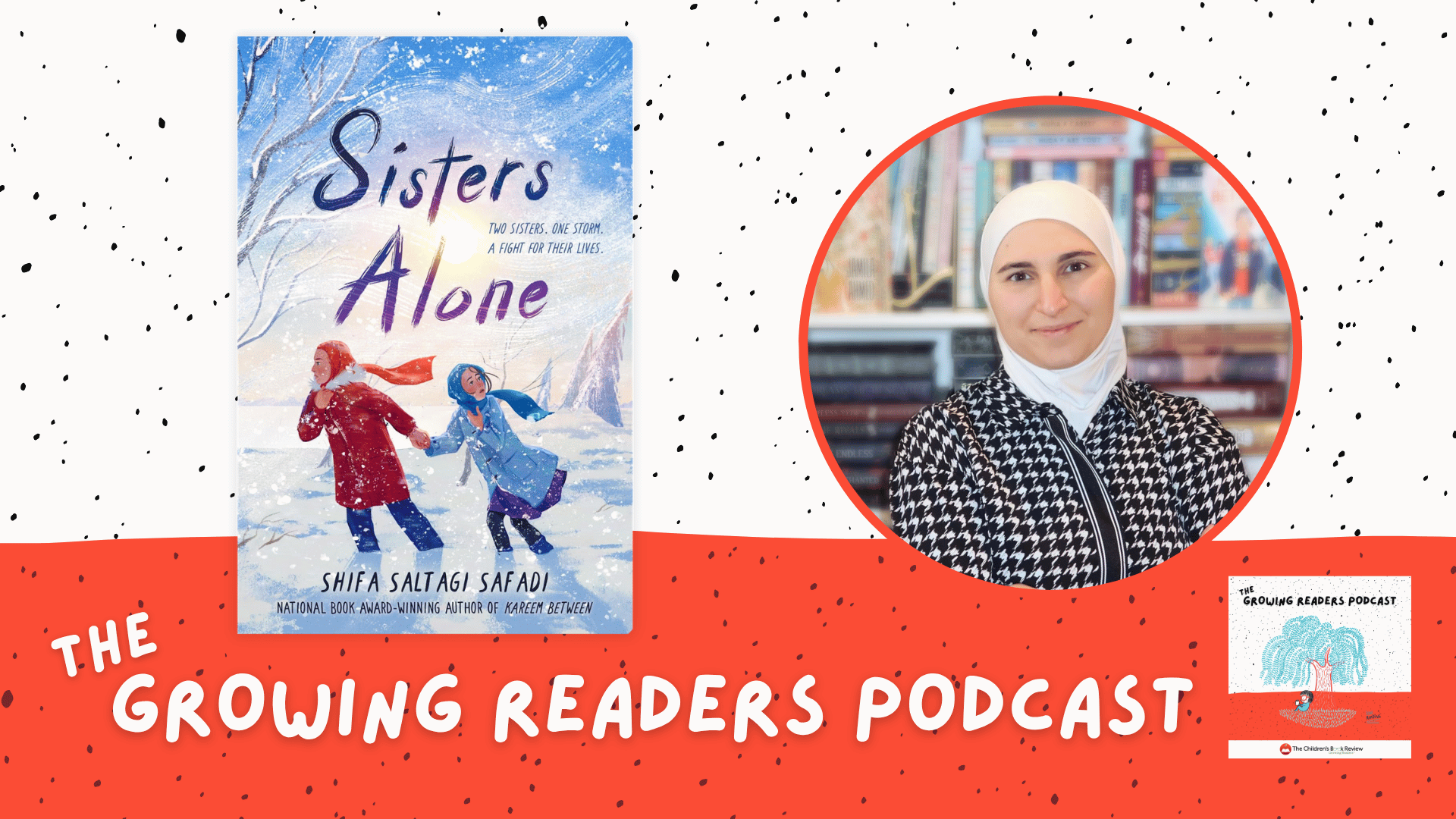
A podcast interview with Shifa Saltagi Safadi discussing his Sisters Alone on The Growing Readers Podcast, a production of The Children’s Book Review.
National Book Award winner Shifa Saltagi Safadi joins us to talk sisterhood, survival, and writing straight from the heart in Sisters Alone.
In this episode of The Growing Readers Podcast, National Book Award-winning author Shifa Saltagi Safadi joins us to talk about Sisters Alone, a novel in verse that brings sisterhood, survival, grief, and honesty together in the middle of a raging blizzard. From the stolen library book that first made her a reader to discovering why verse was the only way to tell Rama and Leena’s story, Shifa reflects on the experiences that have shaped her as a writer. She also opens up about winning the National Book Award for Kareem Between, the imposter syndrome that persists even after success, and what it means to write “straight from the heart.”
Subscribe to The Growing Readers Podcast to ensure you never miss an episode celebrating the creators shaping young readers’ lives.
Listen to the Episode
The Show Notes
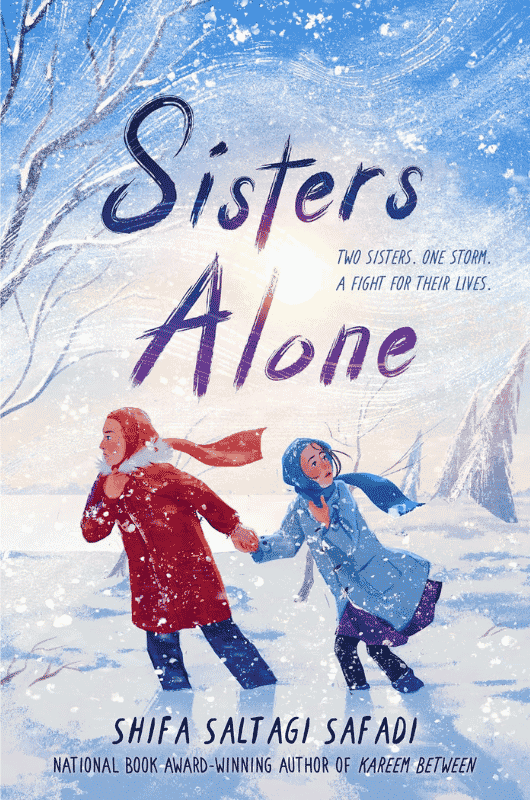
Sisters Alone
Written by Shifa Saltagi Safadi
Ages: 8-12 | 336 Pages
Publisher: G.P. Putnam’s Sons Books for Young Readers (2026) | ISBN-13: 979-8217111091
Publisher’s Summary: Two sisters. One storm. A fight for their lives.
Rama is all fire—fierce, quick to anger, and trying to hold her family together while battling the monster of intrusive thoughts. Leena is all ice—quiet, numbed to the vibrancy of the world, as she silently blames herself for their mother’s death.
When their father must travel for work, a sudden blizzard traps the sisters alone at their rural home. As the storm tears through their house, they’re left without power, without food, without shelter—and with no one to rely on but each other.
Told in powerful, poetic verse, Sisters Alone is a heart-stopping story of sisterhood, survival, and the quiet strength it takes to keep going, even when the world feels like it’s falling apart.
Buy the Book
About the Author
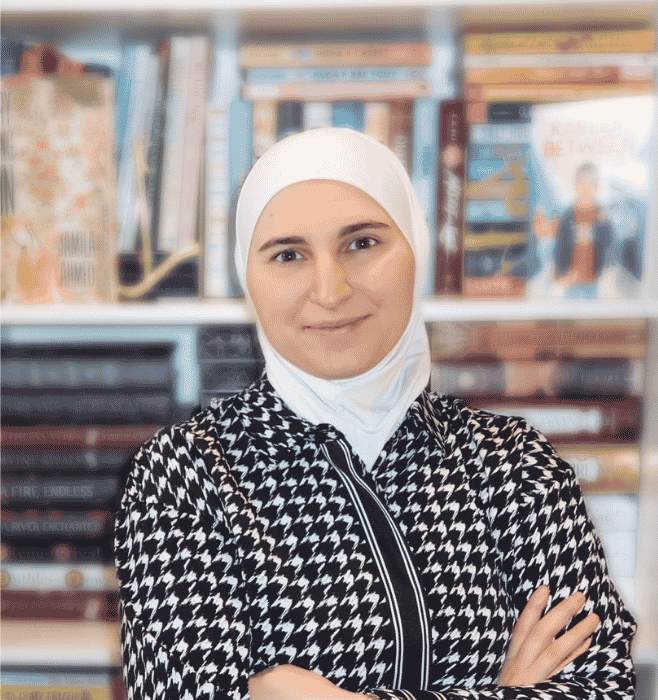
Shifa Saltagi Safadi is the National Book Award-winning author of Kareem Between, the Amina Banana series, and several picture books, including The Gift of Eid. She has a bachelor’s degree in English literature, is a former ELA teacher, and is passionate about spreading a love of reading through storytimes and school visits. Shifa was born in Syria and immigrated to the US with her parents as a young girl. She lives near Chicago with her husband and four children.
Credits:
Host: Bianca Schulze
Guest: Shifa Saltagi Safadi
Editing: Kelly Rink
Producer: Bianca Schulze
Read the Transcript
Bianca Schulze: Hi, Shifa, welcome to The Growing Readers Podcast.
Shifa Safadi: Hi, thank you for having me.
Bianca Schulze: Such a pleasure. I love doing a mixture of brand-new guests and repeat guests, and you’re a first-time guest, which is really fun for me because I get to ask some of my favorite questions. So I’m going to kick it off with a question that I ask everybody for the first time: to be a writer, they say you need to be a reader first. So, was there a pivotal moment in which you considered yourself a reader?
Shifa Safadi: Oh my god, yes, absolutely. I think I’ve been a reader my whole life, since I was a little girl. I can’t remember a time when I didn’t love books — I mean, maybe when I was too young to remember, but I do remember one story very much. It’s from when I was in second grade, and it’s an early memory I have because I realized, now as an adult, that must have been where I really fell in love with books. I was in second grade, and I was in ESL.
I think my teacher said something like, “Books are really important for learning English.” So I went back to my regular classroom and took a book — it was about dolphins. I still remember that. It was a nonfiction book about dolphins, and I took it, put it in my book bag, and took it home. It was not meant to be taken home — I totally stole it from my classroom library. And when I went home, I remember the feeling of shame, like I was doing something wrong.
But I needed that book for some reason. I have no clue why — in my head, I think it represented me learning English. So when I got home, my mom said, “You have this dolphin book — where’d it come from? Shouldn’t you return it to school?” And I said, “No, no, my teacher gifted it to me.” I lied on top of that. And it was only many years later, after we had moved cities and I found the dolphin book still with me, that I said, “Mom, I need to tell you something.”
Bianca Schulze: Ha ha.
Shifa Safadi: “Honestly, I stole this book from my classroom. We need to give it back to the teacher.” So, a very weird way to realize I liked reading — by snatching a book from the library! But I definitely think I’ve liked books since second grade. So I was, what, six years old? I was put in school early, so I was about six at that age. I don’t know a time before that.
I mean, thankfully my book-stealing days are behind me now — I do the proper thing and borrow from the library or purchase them. But ever since then, I’ve always, always loved books. I love reading, and I’m so thankful to be writing as well, because that in itself was a process — finding the confidence to do that when I admire so many authors who do it so well.
Bianca Schulze: Yeah, that little story just made my glasses fog up — my eyes are watering, and it’s warm in here! I just love the idea of you loving books so much that you had to have it. So I have to ask: you stole the dolphin book in second grade because you couldn’t bear to be without it. Is there a book now that feels really special to you — one that, if you could only
Shifa Safadi: Oh my god.
Shifa Safadi: Oh my gosh.
Bianca Schulze: keep one book from your bookshelf — and I’m going to cheat and say it can’t be one of your own, it has to be one that someone else wrote.
Shifa Safadi: Oh my gosh. Probably As Long as the Lemon Trees Grow by Zoulfa Katouh, because that book — you know, books are so interesting, because it’s on my shelf and it means so much to me, and I think about it all the time, but it’s also a part of me now. Even if I were to leave the physical book behind, I don’t think that book would ever leave me. It’s in my heart.
That book is definitely a part of me. I think it was the first young adult book I read about a Syrian character, so that’s probably one of the main reasons it’s stayed with me for so long and meant so much to me.
Bianca Schulze: Beautiful. Wow — with a National Book Award behind you for Kareem Between, can we talk about whether or not you wrestle with imposter syndrome? Because so many writers do, and I think it’s always so surprising for people to hear that somebody who’s won a National Book Award could still feel that.
Shifa Safadi: Yeah.
Shifa Safadi: You know, it’s so interesting, because before — so Kareem Between was my debut middle grade novel, and even before I was published, I’ve always struggled with imposter syndrome. I think even taking the step to write is such a big step, because I do it with fear. I don’t do it easily; it’s hard. Every step of the way, even now — I’m drafting my fourth novel in verse right now — I’m asking myself:
Is this good? Is this worth it? Imposter syndrome is so hard to shake off. But I’ll be honest — especially with Kareem Between, I had this idea in my head that if the book did well, I would cure my imposter syndrome and finally feel like a valid writer, someone who writes great books that people love. And of course, the National Book Award was so unexpected —
Being one of the five finalists, I did not expect to hear my name. And yet it’s so funny, because right after I won, the first thing I felt was, “Do I even deserve this?” It’s wild. I don’t know why imposter syndrome is so strong, but the first thing I did was wonder if I deserved it, and grapple with that.
I won this award, and it didn’t make me feel better — I felt worse. So even unpacking that, and having to revise my second novel in verse after the win, dealing with the pressure of “will people like my second book or not,” and having to figure out what type of storyteller I am — the reality is that imposter syndrome has not gone away. It doesn’t go away. I’m always unsure of my writing. And when I start a story —
Bianca Schulze: Ha ha.
Shifa Safadi: I’m exploring it. I’m like, “Let me see where this goes.” And sometimes I’ll write a book and get halfway through — this actually just happened to me, where I pitched an idea to my editor and had reached about 30 or 40% of the book written. I’d written a sixteen-page synopsis, and I decided it wasn’t going to happen. I just didn’t feel it. It was really about three days after I’d sent it to her that —
I emailed her back and said, “Yeah, I don’t think that idea is going to work.” So we hopped on a call, talked about it, and figured out the next idea, which I feel stronger about. But it’s so funny, because when I start writing, I’m unsure — I’m discovering these characters, discovering the story, and I’m not sure if it’s going to go anywhere. I think that’s why imposter syndrome happens, because writing is a journey. It’s not meant to be a formula; it’s not meant to just be words on a page.
Bianca Schulze: Huh.
Shifa Safadi: I know AI is a big discussion right now, but as a creative, I would never use it, because that’s not how storytelling works. It’s not just words on a page that you follow, because literally every time I sit down to write, I’m surprised by what comes out. No matter how I plot the story, or have a vision or direction for it, it always surprises me — and for the better. So I think writing has to come from the heart. And that’s definitely not
AI, right? So I think that’s why we’re so scared, and why imposter syndrome is a thing — because we’re sharing our hearts with the world as writers, and it’s scary to share your heart with the world.
Bianca Schulze: Right, right, right.
Bianca Schulze: Yeah. So imagine you’re having a hard day — you’ve turned in the manuscript to your editor, or your agent, and you’re completely doubting it, and then suddenly you say, “No, no, no.” What’s the piece for you
that keeps you motivated to keep trying and keep writing the next story? What’s guiding you and driving you to specifically keep showing up and writing these stories for kids and teens?
Shifa Safadi: I think part of it is knowing what I’m trying to say with my stories. It’s really important for me to write from my heart. With Kareem Between, I wrote it thinking about what it was like for me to grow up as Syrian American, and really wanting to tell kids that it’s okay to be different. And with Sisters Alone, my story is about how, no matter the blizzards and storms and rough parts of life, you’re not alone.
You’re not alone — lean on those you love, and it’s okay to be scared, but you’re not alone. You can do this. You can survive anything. So I think knowing what I want to say keeps me going, because it keeps me thinking about what I’m writing for, and grounding all the poems in the book toward that theme. And then, once the manuscript gets accepted, I’m like,
well, it’s with my editor now — I’m waiting to see the edits. We’ll work on it, and we go through the process of trying to make it better. I’m really fortunate to work with an editor who just gets my work, because she always knows how to help my stories shine the brightest and excavate the story underneath. And then, once we’re in copy edits, I tell myself, okay, it’s too late now —
it’s not mine anymore. Let it go. I convince myself to turn off the caring part and just focus on drafting something new, because if I sat and kept thinking about each book, I don’t think I’d ever be able to publish one. I have to take it step by step: finish the story, send it to my editor, finish the revisions, send it off to copy edits, and then keep focusing on the future, because
you can really get in your head and stop yourself from creating if you keep asking, “Did I do a good enough job on this book? Is this book going to resonate? Is it going to do well?” You can’t let yourself stop like that. You have to keep going, keep improving, and keep striving to be better.
Bianca Schulze: Yeah, and I love the idea you brought up of excavating, and how, when you partner with your editor — whether it’s a critique partner, an editor, or your agent — when you’re writing something, and it’s in your head, and it makes so much sense to you as the writer, but then when you get that opportunity with a reader you trust, a reader who gets you,
Shifa Safadi: Yes.
Bianca Schulze: to help you dig in deeper — because we see something as clear as writers, but they can help you see what’s not quite translating on the page, and make it all the richer. So I love that you brought up that excavation piece.
Shifa Safadi: Absolutely, a hundred percent. It has to be a partnership. I think editing relationships can get tricky, because sometimes authors feel like they have to please the editor — myself included, I’ll own up to that. My editor is so great because I genuinely feel like she’s asking me to figure out what I want to say, and trying to help me reach it, rather than giving me the answers and making it her book, if that makes sense. It really is a process of excavation, because —
with Sisters Alone, I didn’t really figure out what I wanted to say with that book until very much after most of the revisions were done. It was a journey.
Bianca Schulze: I love that — you might have already answered a question I have for you a little later on, so hold on to that thought. I know that you want all readers to find themselves in your work, not just Muslim readers. As somebody who isn’t Muslim, I felt seen — I understood these characters. I was reading in the ’80s, so I was a Judy Blume reader, and
Shifa Safadi: Yes.
Bianca Schulze: a Katherine Paterson reader, and those were the names coming up in my head as I read your books. So, with that intention of having representation in your books for Muslim readers, but also knowing these are universal stories — has that intention been something you’ve had to fight for, from before you got your first book published?
Shifa Safadi: Yes.
Bianca Schulze: Or did you just go for it, and it landed right away?
Shifa Safadi: Yeah, I think the first roadblock was myself. Even now, it’s not like I completely feel like I know what I’m doing, to be honest. With every book, I’m wondering how I should approach the story, how I should approach the characters. Being Muslim and Syrian is part of me, so it’s naturally going to show up in my characters as a worldview, as a part of their lives.
I don’t know if I could write a character where it’s not a part of them, just because it’s such an intrinsic part of who I am. But at the same time, when I write, there’s this fear: will other people relate? Will it cause people to not relate? Will it be something not understood? That’s something that definitely crosses my mind.
I think I’m very sensitive to Islamophobia too, because I’ve experienced parts of it in my life. And I tell myself it shouldn’t matter, but sometimes it does raise these questions of whether it’ll be a factor when someone’s reading my book. So when I write, I have to remind myself to leave behind the fear, be brave on the page, and just let the character show up how they want to show up — thinking of the character,
their life, their world, their voice, and how I can show them on the page as accurately and authentically as possible, and take them through the story in a way that feels natural to them — not even to myself, but to them. And sometimes that means more Arabic, or less Arabic, or
certain views — even with Sisters Alone, right? There are two Muslim girls, but they approach things differently despite being siblings. And I think that’s so natural, because siblings, despite having the same parents, same nature and nurture, are still very different from each other. So I want to think of the characters as humans first, before anything else. And I think
Shifa Safadi: focusing on the craft, and being brave, is what has led to people who don’t share my identity resonating with the story — because at the end of the day, this is a book with characters who are, first and foremost, human. Even books with animal characters have a humanity to them, and that’s what we connect with. It’s definitely been something
I’ve struggled with, but also tried to be intentional about. My editor — I have a great team, and my editor is someone I really trust with this — has been very supportive in allowing me to be myself on the page. I’ve never felt censored or silenced at all. And it’s wonderful to see, as you said, so many readers resonating with these characters. That’s encouraged me to
keep pushing forward, let go of those doubts, keep trying to improve the craft of the story, and not hide myself in it.
Bianca Schulze: So beautiful. Well, Sisters Alone is a novel written in verse about two sisters who become trapped alone in a blizzard. What pulled you toward this particular story?
Shifa Safadi: I think I started off just wanting to write a survival story. It started with me imagining one of the sisters alone, and just thinking about how cool it would be to write a survival story — my kids love survival stories, my students love survival stories. I was a huge fan of Hatchet growing up; I still remember teaching it in middle school and thinking, “I read this when I was a kid — this is really fun.” But it’s so interesting, because as I was
writing, and finished the book with one POV, it felt like it was missing something. I kept trying to figure out what, until I realized the other sister needed to be stuck with her as well. Once it became Sisters Alone, that’s when I figured out the first real step of the story — what is this story going to be about? And I realized it was about sisterhood and the complexities of sisterhood. So then, obviously,
once you add a different POV, you start struggling — you have to figure out the plot, the mechanics of it, the voices and the characters. All of that was something I had to consciously work on during revisions, because there were so many different pieces to the story. It was only toward the end that I realized: okay, the title itself is what I’m trying to say here, which is that
sisterhood is how you get through being alone, but sisterhood can also be lonely. You can be with your sister and still feel absolutely alone — just like Leena and Rama at the beginning of the story. But toward the end, you see that reconnecting with each other is what helps them feel less alone, and helps them survive. That realization came much later in the process — I had actually finished the title much earlier on, but
it really is a process of excavation — continuing to write and revise and think until you figure out what you’re trying to say through the story. So this story, which started off as just me wanting to write something survival-y, ended up being this much bigger story about sisterhood, and having to lean on other people and trust them, in order to feel capable enough to survive the storms of the world.
Bianca Schulze: Well, let’s talk about the sisters — and I’ll probably pronounce the names the Australian way, so you can correct me later. Rama, the older sister, is quite outward with her emotions, and Leena, the younger sister, is more inward. What went into building two such different girls while keeping both of them equally worthy of being lead characters?
Shifa Safadi: You’re okay.
Bianca Schulze: I think it’s really common for a reader to gravitate toward one main character, but I felt connected to both the whole way through. So — what went into creating them so that they both felt like lead characters in their own right?
Shifa Safadi: Oh my gosh, it was so hard. This book challenged me in all the best ways, because that’s precisely what you said — I wanted them to be equally worthy of rooting for. That was exactly what was going through my head. I’ve read books where you can see two points of view, but they feel like the same voice, and I wanted to make sure these characters stood out with their own voices, where you didn’t have to look at who was speaking to know who it was.
So one way was format — I was able to put one sister’s poems on the right and one on the left, and that helped. But also, just sitting with these characters so much — I had to do a deep dive into characterization in this book. Even once the plot was done, even while I was working on the poetry, there were revision sessions where I’d just sit and stare at the screen for six hours straight, thinking:
What is this character trying to tell me? How would she react to this situation? I really had to figure out who they are, how they feel, and what shapes their worldview, because it was only once I actually knew these characters on a very deep level that I was able to write their story. There were things that didn’t make it into the book — things I had written about them, or knew about them, that didn’t
show up on the page, because you don’t want to info-dump the reader. But I had to know them to be able to write them. So I kept digging and digging until I figured out who these characters were. My gosh, it was not easy at all — it challenged me, but it made me a better writer. I’m grateful for that, because I was able to really understand how to characterize characters and show voice. And now I’m carrying that into
my other stories. So, yes, it was hard, but it changed me, and it made me able to write more compelling characters going forward.
Bianca Schulze: Well, Rama is battling intrusive thoughts throughout the book, as well as some angrier outbursts, and you handle that with a lot of care. Leena carries a more quiet, private guilt about her mother’s death — so that’s a good contrast: Rama’s a little more outward
Shifa Safadi: Mm-hmm. Yeah.
Shifa Safadi: Yes.
Shifa Safadi: Yes.
Bianca Schulze: and outburst-y, and Leena’s more introspective. I feel like verse was built for this combination of intensity and internal thinking — verse can really carry an unspoken weight that people hold within them. So, do you think the verse form
chose this story, or did the story demand the form? Do your stories always come out in verse, or was this one particularly well-suited to it?
Shifa Safadi: I love that you mention verse, because with Kareem Between, I started it in prose and transformed it into poetry because the voice wasn’t working in prose. And one of my concerns with writing poetry was, “Am I good enough at poetry?” — because, right, the imposter syndrome. Am I good enough to do this? Because I love poetry. I’ve loved writing it forever — even as a little kid, I would write poems all the time.
For this story, I definitely think verse was chosen before I even started, because these girls’ voices were just coming to me in poetry. Especially, as you said, Rama’s intensity shows up through repetition — her thoughts come over and over and escalate and get bigger, which is very poetic. In a way, it’s devastating poetry, but it is poetry. And then Leena, with her
flowy, lyrical poetry that moves into itself — the scrapbook images come to life through her language, and that also has to be poetry. What I really love about verse is that you’re able to shape the story by building images for the reader. In a way, just like Leena is building a scrapbook of her mother,
this book of poetry is building a scrapbook for the reader, so they can learn a story through these snapshots of the characters. That’s what I love about poetry — it’s so truthful. The truth of the story shows through; you don’t get extraneous details. You’re only shown what’s necessary for the story, for you to understand what’s happening as a reader. And I think that
at this point, working on my fourth novel in verse, this is definitely the format I love — but it also has to match the story. Sometimes I’ll write a book and know it will come out in prose, because the voice wouldn’t be poetic. I think it really depends on the character. Verse serves emotional stories really well.
Shifa Safadi: It really does — I think it lets the characters show themselves on the page authentically. That’s why the poetry shows, especially with their characters: Rama’s explosiveness shows up through loud poems and through a motif — I was able to weave the motif of fire with Rama, and Leena’s flowy water, and you see that poetry trickle down and move on the page like a wave.
There’s just so much fun you can do with poetry, and I really enjoy playing with formats — using concrete poetry, like I did in Kareem Between. It’s really enjoyable. And with my third book, I’m excited for readers to see that, because I weave a mystery through the poetry — I’m excited about that, in a few years. I can’t talk about it yet, I don’t think. Yes.
Bianca Schulze: I see a future conversation coming! Well, as you mentioned before, you grew up bilingual, navigating Arabic and English. Does that experience of living between two languages show up in how you hear rhythm, or maybe the silence on the page? Because
I only speak English — I can say hello in a few different languages, but that’s about it — and as somebody who only speaks English, I find language and pronunciation from other people so beautiful. The rhythms, the inflections. So, do you feel like being bilingual
supports you in how you’re able to write your verse?
Shifa Safadi: Absolutely, a hundred percent. It’s made me think about language a lot more. I remember growing up wondering why Arabic is a certain way, why English is a certain way. A lot of multicultural kids have this experience of blending our languages — I call it “Arabish,” where I weave Arabic in with English and add “-ing” to Arabic verbs.
My kids do the same thing, and honestly, I still do it too. You get to play with language in a way that really uses rhythm and sound, but it also makes you think outside the box — how language can be used to do so much more than just be what it is on the page, or in a book, or in a lesson. Language has emotion, it has history. Arabic
was definitely the language used at home, so it has an emotional connection for me — when I think about Syria, or my parents, stories in Arabic feel a little more emotional and lyrical, but they also remind me very much of my culture and my heritage. Whereas English is kind of
linguistic and musical and cultural, connected to my upbringing here as an American — it very much connects with me on a musical level especially. I think being able to see the differences between languages, and weave language without borders, has given me the freedom to play with poetry. I think poetry is the perfect format for English-as-an-additional-language learners, because
there’s so much you don’t have to worry about in terms of the rules of writing. In Sisters Alone, for example, you probably noticed that Leena never capitalizes “I” when she talks about herself. The grammar in that book — I removed commas, there were capital letters in places that didn’t need them — it was all intentional formatting.
Shifa Safadi: So I know the rules; I just decided to break them. It freed me up not to have to be so purist when it comes to language, and allowed me to play with it in a way that felt like it added to the characters and their voices. I really think that’s because I was able to step outside that language box. And I think that when we teach kids —
Bianca Schulze: Ha ha ha.
Shifa Safadi: whether they’re multilingual or not — I think readers will be empowered to see that you don’t necessarily have to have perfect punctuation or grammar to write a good story. What matters is the heart in your stories, whether that means using multiple languages or not using grammar rules — as long as you feel good about what you’re writing, that’s all that matters. That’s definitely my intention when it comes to writing, and to empowering readers to write as well.
Bianca Schulze: Yeah. Well, let’s talk about some of the themes that come up in Sisters Alone. I pulled out grief, guilt, sisterhood, mental health, and physical survival — and we see those themes through a dead mom, a dad who could lose his job, a challenged friendship, sisters not getting along, and of course, the wild storm. That’s
Shifa Safadi: Yes.
Shifa Safadi: Yes. Mm-hmm.
Bianca Schulze: an enormous amount to carry in a book that’s built on brevity — novels in verse are all about whittling things down to the most concrete, essential words. So how do you know when a single line is doing enough, and when it needs more room to breathe?
Shifa Safadi: It’s really a lot of thinking, and also trial and error. When I first start drafting, I don’t censor the words that come out — I just write the story and focus on the plot and the characters at first. I know it’s not my best writing; it’s the first draft, it’s coming onto the page, it’s meant to be bad. It’s just a placeholder — sometimes it feels like I’m writing an outline instead of the book. And then
the second step in the process is going back in and filling in more — adding to the book, filling in the gaps of understanding, areas that feel like plot holes, or areas that could be expanded emotionally. Once I start revising, I get into cutting mode. And when I’m in cutting mode, everything is on the table.
I go in and very intentionally strip away anything that feels unnecessary. With Sisters Alone, I think in that last round of cutting, I cut about seven thousand words. That’s a pretty significant chunk of a book that was around twenty-eight thousand words — I got it down to about twenty-two thousand. That was the last round, because my editor really encourages cutting; she’s remarkable at it.
Bianca Schulze: Wow.
Shifa Safadi: And it only inspires me — she’ll cut some, and then I’ll go back and cut even more. It’s inspiring, because, as you said, novels in verse are known for their brevity, so as a writer, I have to make sure they only speak what’s necessary. If something feels like it’s not working, it’s going to bog down the pace and make the reader pause instead of feeling like it flows.
So the cutting is really the end of it, and when I cut, I’m brutal — cut, cut, cut. I sit with each poem separately and think about how it’s singing. I read it aloud maybe ten times, and every time, I notice where my mouth stumbles, where I can add beauty. But you also don’t want it to be purple, or forced.
So it’s a balance — figuring out how much to cut, how much to add, and where it feels just right. It takes trial and error until my gut says, “Okay, that feels right.” It’s practice, for sure.
Bianca Schulze: Yeah. And then let’s get into the emotional piece of the story — what the reader’s going to experience. All of those themes I just mentioned lead to a turning point, and I’m not going to spoil it here, but the sisters finally become honest with each other. I think that might be your favorite part of the book.
We exchanged a few questions before this conversation, so — without giving away too much — can you talk about what has to happen, emotionally, to earn that specific moment in the story?
Shifa Safadi: Absolutely. Emotional arcs in stories are hard to get right, because they’re there without the reader necessarily knowing the writer worked on them — there’s obviously an external plot, but you also have characters who have to change. For this book, I had to make sure these characters changed, but that they met in the middle, and that the story felt like it belonged to both of them.
That was a really difficult thing to do. One of the ways I tried to make it feel earned was to have it mirror the plot — the blizzard is a kind of symbol for their emotional relationship. You’ll notice the blizzard starts off building, just like their relationship is simmering with anger and tension. It gets worse the more they fight, and their fights build too.
If you read a book where the characters have the same fight over and over, it’s not going to be as satisfying — you want to see that tension build, so I really tried to make sure it builds, and that they have more and more reason to get angry with each other, in step with the plot. Then, at the point where the blizzard is at its worst, and they’re in the worst physical situation — without spoiling anything — their relationship also reaches its climax,
right alongside the plot, before they’re able to lay it all out on the table for each other. That’s where you start to see their relationship simmer down a little, ebb, and start to settle — and the blizzard settles along with them. It has to happen that way, because
that’s what makes it feel earned — you don’t feel like they suddenly made up, or like you’ve been watching the same thing over and over. It had to build toward a climax that felt like a natural part of the progression of both the plot and the relationship.
Bianca Schulze: Yeah. I’m going to skip past the ending of the story, because that’s for readers to experience for themselves — but I do want to acknowledge the author’s note. You share some relatability to Rama with intrusive thoughts, and I thought your note to readers was really clear, thoughtful, and supportive for anyone who sees themselves in
any of the characters in the book. Do you want to talk about that at all?
Shifa Safadi: The author’s note is definitely me trying to help the reader feel less alone as well. It was a very scary thing for me to write, but I’m hoping that being brave on the page — being brave in the author’s note — helps readers know they’re not alone. That’s sort of what I wanted to leave the book with:
no matter how many storms this world sends you, you’re not alone. There are people in this world who love you, and you can survive it.
Bianca Schulze: Yeah. Now, only if you have a copy handy and you’re up for it — would you read a little excerpt?
Shifa Safadi: Absolutely. Would you like it from the beginning?
Bianca Schulze: You get to choose — it’s author’s choice.
Shifa Safadi: Let me see.
I think I’m going to do the beginning, because I want readers to not feel like I’ve spoiled anything, and I want them to be left on a cliffhanger to keep going. All right.
[Shifa reads from Sisters Alone.]
Bianca Schulze: Yes.
Shifa Safadi: And that’s the first two poems of the book.
Bianca Schulze: So, if a reader closes Sisters Alone and only remembers one feeling, what do you hope that feeling is?
Shifa Safadi: I hope they remember love and sisterhood — and that honesty, and opening up to those who love you, is a strength, not a weakness. It’s not a weakness at all to be honest with other people about what our demons are.
Bianca Schulze: Well, before we go, I do want to ask — you’ve got The Kaabah Cat coming in January. Can you give listeners a preview of what that story holds?
Shifa Safadi: Absolutely. The Kaabah Cat comes out in January, right before Ramadan, and it’s about a little boy who goes to Mecca — the site of pilgrimage for Muslims — and sees a cat. Right before he got there, his mom had told him that when you make a prayer in Mecca, it comes true. So he prayed to not be lonely anymore, and when he arrives and sees the cat, he thinks, “That must be the answer to my prayer.”
So he runs after the cat and tries to catch it and take it home. But, as we all know, cats do not like being taken away from their homes. It’s a hilarious and joyful romp around the Kaaba, and also a story about family, about wish fulfillment and what that might mean, and about a really cute and funny cat. I’m really excited for readers to get it.
Bianca Schulze: It sounds super fun. So, on the note of fun, we’re going to end with some rapid-fire questions. One word for what sisterhood means to you.
Shifa Safadi: Let’s do it.
Shifa Safadi: Honesty.
Bianca Schulze: A food memory from childhood that still hits hard for you.
Shifa Safadi: Mm, shakriyeh — it’s a yogurt Syrian dish that’s so comforting.
Bianca Schulze: Are you more fire or ice? One word that describes writing in verse.
Shifa Safadi: Fire.
Shifa Safadi: Heart-wrenching. It’s very much me opening my heart and putting it on a page.
Bianca Schulze: Okay, and then this last question — feel free to make it rapid-fire, or elaborate as much as you want. What would you want a listener to do after hearing this conversation? Would you want them to pick up Sisters Alone, or do something entirely different?
Shifa Safadi: Yes, please! The more support authors get for their books, the more we’re able to write and continue making stories. So please — get it from the library, get it from Libby, gift it to a friend, whatever works. I definitely understand people’s economics right now are very different, so getting it from the library is very supportive, and I hope you enjoy the read.
Bianca Schulze: So beautiful. Well, Shifa — Rama and Leena teach us, without ever really saying it outright, that being okay is different from having to be perfect; surviving messy, and loving each other messy, is still surviving. So thank you for trusting us with Sisters Alone, thank you for writing it so honestly, and thank you for spending time on The Growing Readers Podcast.
Shifa Safadi: Yes.
Shifa Safadi: Yeah.
Shifa Safadi: Thank you for having me.
