

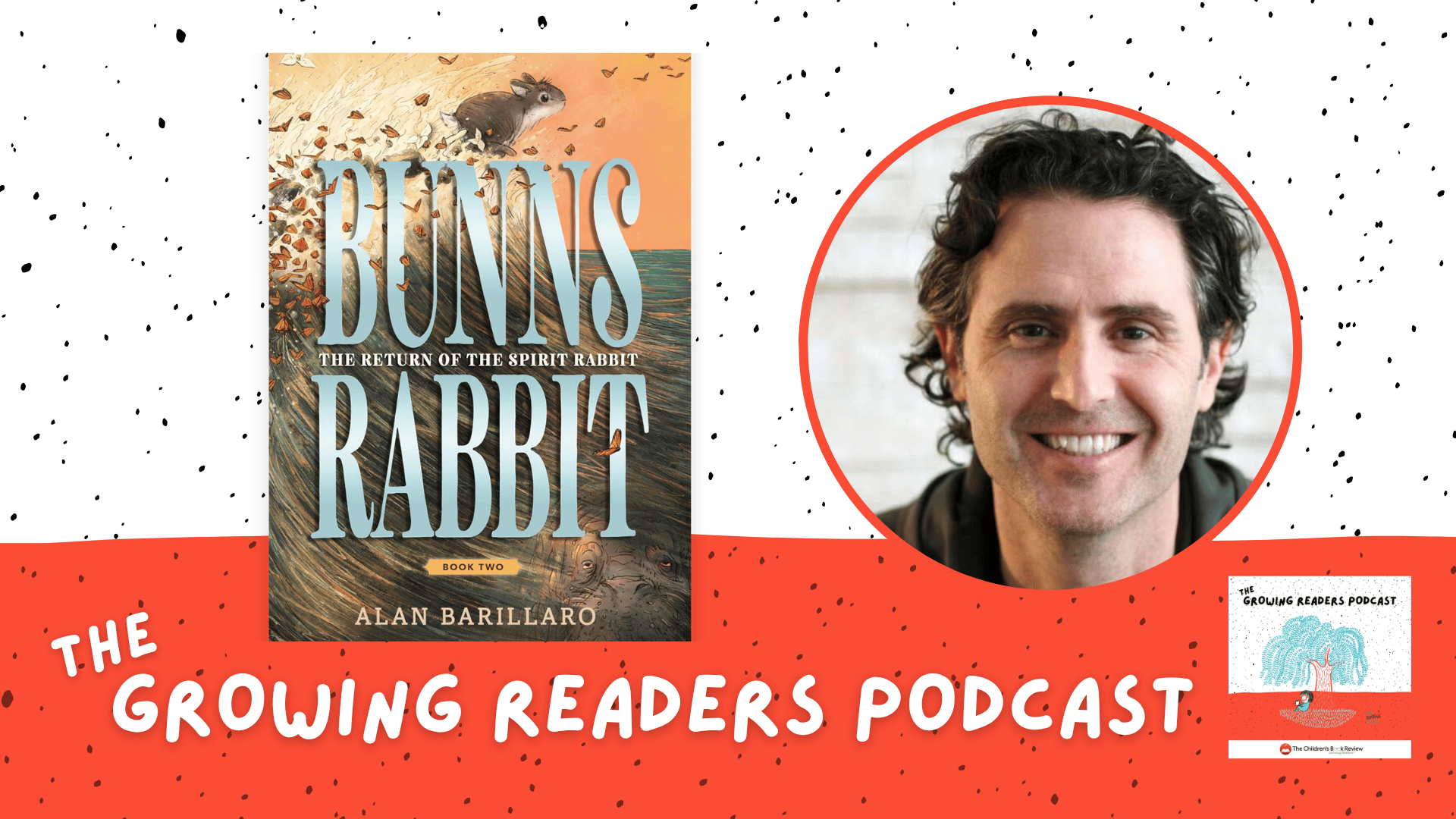
A podcast interview with Alan Barillaro discussing Bunns Rabbit II: The Return of the Spirit Rabbit on The Growing Readers Podcast, a production of The Children’s Book Review.
Bunns Rabbit is back, and this time, the future of an entire world rests on her shoulders.
Academy Award-winning filmmaker, author, and illustrator Alan Barillaro returns to the Growing Readers Podcast to talk about Bunns Rabbit II: The Return of the Spirit Rabbit, the action-packed sequel that sends Bunns into a bigger, more uncertain world.
In this thoughtful conversation, Alan explores hope and courage, the tension between fate and an unwritten future, and what it means for Bunns to not just discover her power, but carry it out loud. He also shares how he weaves meaning into a story without turning it into a lesson, what a difficult writing day looks like, and the heart songs that continue to shape his storytelling.
Subscribe to The Growing Readers Podcast to ensure you never miss an episode celebrating the creators shaping young readers’ lives.
Listen to the Episode
The Show Notes
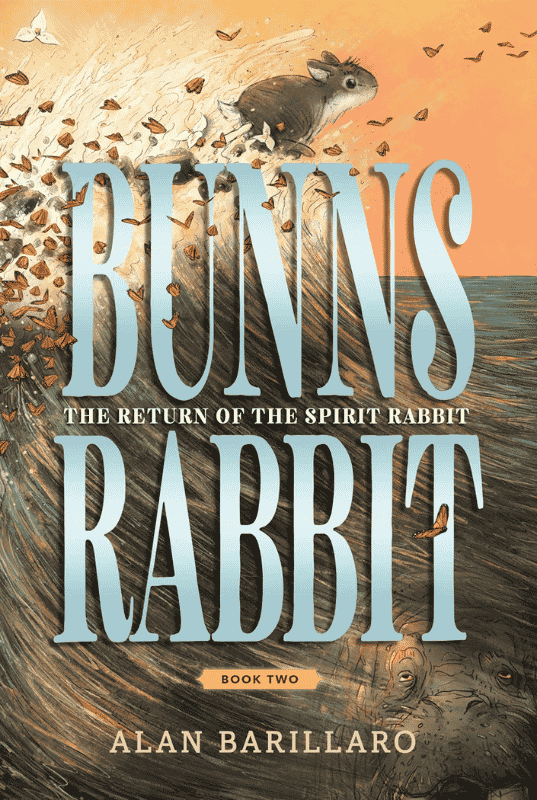
Bunns Rabbit II: The Return of the Spirit Rabbit
Written and Illustrated by Alan Barillaro
Ages: 8-12 | 320 Pages
Publisher: Candlewick (2026) | ISBN-13: 978-1536214680
Publisher’s Summary: When Bunns Rabbit returns from her quest to find the Spirit Fox, she hopes to go back to her quiet life among her family. But Fox has other plans for her. A war is on the horizon, pitting the Spirits of the Sea and Wind against those of the Land and Fire. According to Fox, only one little rabbit stands in their way—her.
This time there is more than just her family on the line. It is up to Bunns to save every living creature on the land before they are washed away by the sea forever. With war imminent and newly acquired powers she barely understands, Bunns must avert disaster and find it within herself to stand up and face this new world, whether she is ready to or not.
With his inviting prose, warm illustrations, and dramatic graphic panels, Alan Barillaro brings another action-packed tale of daring, bravery, and adventure, filled with heart, kindness, and hope.
Buy the Book
Additional Books Mentioned:
- Bunns Rabbit: Amazon or Bookshop.org
- Today We’ll Be Eaten: Amazon or Bookshop.org
- Where the Water Takes Us: Amazon or Bookshop.org
About the Creator
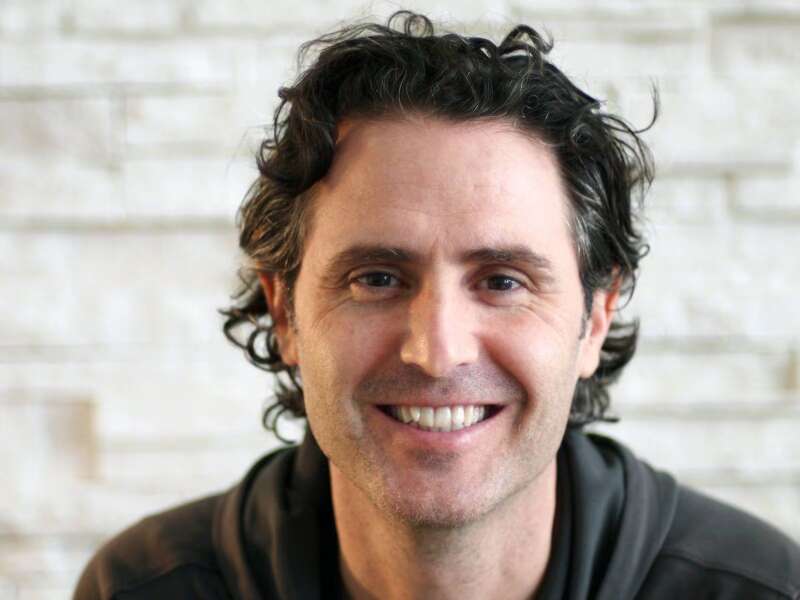
Alan Barillaro is an Academy Award-winning director, writer, and animator who has spent over 25 years at Pixar Animation Studios, bringing beloved characters to life. His directorial debut, the animated short Piper, won the Oscar for Best Animated Short Film in 2017. Alan has contributed his animation talents to numerous Pixar classics and now brings his gift for visual storytelling to children’s literature with his debut middle-grade novel, Bunns Rabbit.
For more: alanbarillaro.com
Credits:
Host: Bianca Schulze
Guest: Alan Barillaro
Sound Editor: Kelly Rink
Producer: Bianca Schulze
Read the Transcript
Bianca Schulze: Hi, Alan. Thanks so much for coming back and spending time with us again.
Alan Barillaro: Thanks so much, Bianca. Great to be here.
Bianca Schulze: So I thought it could be fun—well, actually, I’m gonna just start. Anybody that didn’t listen to our episode, which was almost a year ago, when we talked about your first Bunns Rabbit book, I really hope they’ll go back and listen to that, because we got to know a little bit about how you think about writing and creating art, how you were as a reader, and who influences you. So I really want everyone to go back and listen to that. But I wanna warm us up with some rapid-fire questions. Is that okay?
Alan Barillaro: Yeah, that sounds great.
Bianca Schulze: All right, perfect. Hope or courage? Which one do you think comes first?
Bianca Schulze: In terms of creating animation or children’s books, which one lets you sleep better at night?
Alan Barillaro: Ooh, this is a hard one. I love both so much. Children’s books, ’cause, you know, to wind down with a children’s book is a perfect way to go to sleep. Watching a movie, I’ll be up all night. So I’m gonna lean on the book world. Yeah.
Bianca Schulze: Sea, wind, land, or fire—which spirit would you want on your side?
Alan Barillaro: Ooh. I love the fox so much, so I’m attached to fire. And although I’m more land myself—is that what I’m imagining? Because I’m always nervous, and I like safety on the ground, you know, versus flying. So it’s like I’m on land, but I prefer having the spirit of fire helping me out.
Bianca Schulze: One word for what Bunns has that you wish you had more of.
Alan Barillaro: She’s so empathetic. And that, to me, is such a beautiful thing that I always wish in the moment you had more of. To see someone else’s point of view so clearly, to me, is a great gift, and I could always do with more.
Bianca Schulze: One thing your kids have taught you that has ended up in one of your books.
Alan Barillaro: One thing? So many things.
Bianca Schulze: One thing. It’s rapid fire. It’s rapid fire.
Alan Barillaro: Exactly—so many things, you know. I draw from my kids and learn from my kids constantly. There wouldn’t be a piece of artwork or writing, even, without how they reacted. Even in the reaction—not necessarily like I’m showing them everything, but their emotional reaction if they saw something, and whether they paid attention or not when they were younger. Like, how long did I hold their attention? So from any movie I worked on, even on Bunns, it could be as simple as just her pose or posture, her eyes. Eyes are a big deal for me, from animation to story. Kids really connect to the eyes, and whether they feel like it’s someone they trust or not. So with Bunns, I would say just having her head tilted up is a huge, huge deal, because it’s someone who’s open and curious about the world, and a lot of my posing will be that. It’s similar to Piper in my short film. I’m small, but I’m looking up at the world with a certain amount of optimism versus looking down on things or judging. So something as simple as a head tilt, and whether my kids respond to that head tilt or not—I’m talking two, three degrees—can be really make or break for me.
Bianca Schulze: Wow, all right. And if Bunns Rabbit had a theme song, what’s one word to describe that theme song?
Alan Barillaro: Her theme song. Yeah. I mean, hope, I think, is a great one for this, you know, with what she’s facing and kind of growing up, and being hopeful sets up so much. I’m trying to think—I wish I had a great lyric right off the top of my head that would play to that. Do you have anything?
Bianca Schulze: No, no, I mean, I don’t. I don’t know, but dramatic came to my mind. But it’s not the right word. It’s just because there are dramatic moments. So if there’s a word that described whimsical hope and dramatic, and it was one word that summed those up, then maybe.
Alan Barillaro: Yeah. Musically, you can hear me working with composer Jake—for the nerds out there who love film, Jake Monaco did the orchestral work with Adrian Belew for Piper and also did the themes for Bunns. And if you listen to the trailer—I did a little book trailer—the music there, he’s always doing my books’ music, because we’re kind of planting seeds for the tone and the feeling. And I listen to his music sometimes before I even write a sequence. And I say “sequence” like I’m in movies, instead of “chapters.” It’s like a language where I keep switching, you know, like French and English—I’ll throw in a word once in a while. For books and movies, I feel that way. But there’s a chapter called “The Voyage” in book one of Bunns, and that is the teaser music to me—if there was a movie—of the tone. A lot of filmmakers do that, and authors do that. I don’t know of other authors you have on the podcast, but certain songs can really set you off in the right direction. And I’ll be that weirdo that puts it on repeat and just listens to it and then starts writing, just because it can capture that emotion in the right way. And it’s like, wow, if I can write in this tone, that would be a book I’d want to read. I don’t know if others do that, if that’s a weird thing, but we definitely do that in film, where it becomes a real temple—like a North Star.
Bianca Schulze: Yeah. Yeah, I definitely have encountered authors that will have a Spotify playlist. And so it’s their repeat, because it is capturing that energy and essence that they want.
Alan Barillaro: Yes. Yeah, and sometimes it’ll be really off. Like, why? If you listen as an outsider—but it’s more like, no, this will get me out of the things I’m usually stuck in. It might be a playful scene, but maybe I need this other element that I’m missing in my work. I feel like it kind of overcompensates in my mind. It just gets me into the zone of being looser, or, you know, whatever it is.
Bianca Schulze: Yeah, yeah. Well, since November of last year, when we last talked, I’m just curious if anything’s changed for you in terms of what’s driving and guiding you in creating.
Alan Barillaro: That’s a great question. You’re constantly reacting, so in a year, it does change. And you also get the feedback of, like, how’s this book doing? How are people feeling? To me, there’s a constant communication. I’m always feeling like, where’s the area I want to explore on the map creatively that maybe others aren’t digging? What’s really interesting to me? What’s changed is I’ve done a lot of school visits and seen kids’ reactions to the books and what they’re interested in. Not necessarily like I now have to write and cater to that, but just the feeling of what they’re reacting to in your work and what’s really resonating—what could you lean in on? So I’m having fun in picture books right now, and that’s been a new year for me. And one I’ve been very nervous about, because the shorter it gets, the harder it gets, to me—how you can be poignant in the short form, and what’s your style, and what do you have to say? So I’ve come up with a picture book called Today Will Be Eaten, and I’m doing a companion book to that that will be out the following year. I’m kind of in the finishing touches, so I’m having a great time.
Bianca Schulze: Yes, I love Today Will Be Eaten. And the line that was coming to my head to describe it is, you know, “Be still, my anxious little beating heart.” Any little anxious heart out there—they’re gonna feel that book so much.
Alan Barillaro: Thank you. Yeah, yeah. It’s for the little bug in all of us, is how I feel, where you might be anxious about something, and you need a moment just to take almost a meditation on not letting your stress get to you. So it’s a silly title, but it’s how I feel sometimes. You know, it’s like you’re in this river going along, and all these things can go wrong. Can I take a breath and reset? And hopefully others feel the same, young and old. They can use that as a way of opening it up and reading and having a lighthearted laugh too. It’s not as serious as the title.
Bianca Schulze: Yeah. Exactly. I think that’s what’s so great about it, you know?
Alan Barillaro: Thanks.
Bianca Schulze: Well, Bunns Rabbit 2: The Return of the Spirit Rabbit. For readers new to the series, I think it’s gonna be really fun for them to discover both books at the same time. The first book is kind of the origin story before she essentially becomes, you know, what some might deem a superhero—the spirit rabbit. I really want readers to pick up the first book first and read Bunns Rabbit if they haven’t. But they could read these stories in reverse. Do you agree with that?
Alan Barillaro: I do, absolutely. And I think that goes back to your previous question of what’s changed for me as I react to readers. It feels very similar to what’s happened in cinema, which is that we love certain structures, but we also love to jump into a series anywhere and fall into a really big world. And Bunns has that, and I find that really interesting myself as a reader and as a viewer of films. So I do like that, and I love that I finally get to put that out there—that these two books have kind of been written in conjunction. And I’m thrilled that a young reader can grab both and go, “Wow, I can live in this world for a good while and have all these stories.” So it’s nice to have both on the shelf. Even the design of the cover—when I first pitched the book, there was a little painting of the two covers and how they would work together. You know, Bunns one is about the land, Bunns two is about the sea. So you’re moving through the different elements, even just in the art of the book.
Bianca Schulze: Yeah. Well, I love reading dedications. And you dedicate this book “to your mom and to all the great storytellers that emerge at bedtime.” And, you know, I’m a bedtime-reading mom. It was just built into our family structure. We read together at night. So I love that. Tell me about that dedication for you.
Alan Barillaro: Yeah, I mean, that’s exactly it. If we’re talking about where I fell in love with writing, where we fall in love with reading—a lot of effort is put into telling kids, “Read, read, read.” But so much of it, to me, was the dynamic as a parent of what you show at home, and what my parents did. It’s a part of all of our routines—it’s not a punishment. And my mom was fantastic. I mean, she’s a fantastic storyteller. And she hasn’t even seen this dedication yet, so I can’t wait. But, you know, a hundred percent, my love of books came from being in the room. I have three other siblings—we’d all be in the room. I remember very clearly her reading us stories that were honestly well beyond children’s—from The Old Man and the Sea to My Side of the Mountain to The Lord of the Rings. There’s a big five-year age gap from my oldest brother to my youngest sister, and that’s hard to read to as a parent. And I remember when she stopped The Lord of the Rings exactly on Gollum’s riddle and said, “Well, you guys think about it, and tomorrow night we’ll see what your answer is.” Like, can you be the character there and solve the problem? So it was really interactive and really, really important to me. And a lot of what Bunns is to me is honoring that. Even the whole structure of the book is meant to be read at bedtime, and hopefully, if you had kids at different ages, it would be able to work for all of them. A little bit more pictures for the younger. The older get a little bit more drama and story that the youngest might not fully pick up on. So yeah, that’s definitely the intent, and that’s an important dedication for me.
Bianca Schulze: Yeah, yeah, yeah. Well, do you wanna talk about how Bunns’s story has evolved and the challenges that Bunns faces in book two as she takes on this greater responsibility as a spirit rabbit?
Alan Barillaro: Yeah, yeah. Without giving too much away—you know, I don’t wanna be too spoiler-y—to me, the way the two books work is that at the beginning, you have to know who you are and accept your differences and kind of accept yourself before anything else. Like childhood, when you get into school systems, everybody’s different. Everybody’s unique. Where do I fit in? And how do I accept myself? And the way I saw the series is always as you mature—and I always imagine a reader a couple of years older, or a year older, reading this book—they’re in a different place too. And Bunns is as well. Now that I know who I am, and I accept myself for my differences and strengths and weaknesses, what do I do as a citizen of the world? Where’s my responsibility as a part of this larger community? Bunns is a character that’s been in a very sheltered meadow, and she goes out into the world and sees that she’s a big part of that world. I do see that as the intention, hopefully coming across as a metaphor of growing up—that now you have more responsibility, but you can handle it. You can move away from home. You can do all these things. Your parents aren’t always there at every moment. Now, how do you behave, and what do you take on? And in Bunns’s world, that has this extra bit of story of being a superhero and the responsibilities that come with that—you know, to help others. To me, that’s where it was always headed. But I’m really having fun with it in book two, to see her grow. It’s always fun to see an origin story of your powers growing. There’s that side of it—you wanna see Spider-Man become Spider-Man—in my own way, in this world that’s specific to Bunns.
Bianca Schulze: Yeah. Well, everything you just described there, I completely took away from Bunns’s growth—that staying true to yourself, and others will eventually come around and see you as you are. But I feel like they don’t always. And your book also shows that, too. So ultimately, it’s more about knowing that you’re living a good and decent life through the choices that you make. I love that kind of character growth that she has, that shows readers that it’s more important to be true to yourself and not become somebody based on the expectations of you—what’s meaningful to you.
Alan Barillaro: Well, thanks. Yeah, and that the world is complicated. There’s distrust, and there’s history, and how do I find the truth in things when there are so many different points of view? On one hand, that’s a complicated concept, but I prefer to keep those complicated concepts. I think kids are very smart, and readers are very smart, and I loved reading books at different ages and getting different aspects from the story. So I don’t want to talk down. I want that book to have an entry point for any age. At the same time, for instance, there’s an environmental aspect to it—the stress of it. I never want to preach in my stories, but I do think there’s a certain amount of anxiety that kids feel about the environment. And even having in the book that Bunns feels it too, in her own way, and that there aren’t easy solutions—I’m not gonna say there’s something simple. But she also realizes her connection to the environment as a spirit, and—without going too deep into the story and giving anything away—that matters, and it connects us all, and how that might bring us all closer together. I don’t mind covering those themes over and over in my work, ’cause they feel valuable to me. And hopefully I’m not being too repetitive, but it’s something I care about. So it comes out in my work whether I like it or not.
Bianca Schulze: Yeah, yeah. Well, there’s an epigraph, a short poem by Emily Dickinson, at the beginning of the book, and it’s “Hope is the thing with feathers / That perches in the soul, / And sings the tune without the words, / And never stops at all.” So why this beautiful poem? What’s it setting up? And, you know, why this kind of emphasis placed on hope?
Alan Barillaro: Yeah, why hope? Because I think Bunns is gonna have an insurmountable task, and it’s easy to lose hope and say, “Hey, all these problems are difficult. Why not give up?” To me, that’s the crux of it right there. Having hope in the darkest times—in any time—is very important. And that kind of drives everything, you know, the optimism that Bunns has to keep. ‘Cause without it, what can you do? That’s why I started the book off that way. I think it also has this beautiful side of Bee being her closest friend, and feathers, and the feeling of flight. There’s always this side of the story that feels really close to Bunns, and what Bee offers almost as a mentor figure, as a friend, who’s always optimistic. It felt right in many different ways and angles that I looked at this story. And it’s a beautiful poem.
Bianca Schulze: Yeah, yeah, yeah. Well, the fox says the future is never set, and the albatross deems that it is set. So what are you exploring here? And is that just hope showing up again?
Alan Barillaro: Yeah, you know, there’s this kind of pessimism that we can have in life that’s not very helpful. On one hand, I wanted to explore why some people are like that. The albatross, we find out, has its reasons, and there’s always a truth of what hurt and where things maybe went wrong. It comes from a place, and that’s important to know. But then, yes, we have to realize that the future is never set, and that we have a part in it in the now. And I find that really great for Bunns in that moment—that she sees she’s a part of the change, and that you have to kind of be an active protagonist, I guess, in a sense. Making her active and not passive in the story, and saying, “Well, then it’s up to me. It’s up to us. We’re not waiting for anyone to solve this problem. We have to all kind of solve it together”—even with the pessimists out there that might make us feel like it’s unsolvable. I love that about nature, because I feel like nature has always answered the question before we have. The more we do research, and the smarter we think we are, there’s always some bit of research that says, “Yes, nature has figured that out, by the way. If you found this plant, it knows how to clean the air.” There’s all this beauty in looking to nature that I find to be a theme in this book of the elemental spirits. It’s all about that connection—that we’re not necessarily above it. We’re a part of these things.
Bianca Schulze: Yeah, yeah. Well, I think what really sells a book to me as a reader is when the creator—whether it’s the writer or illustrator—isn’t just telling me something. We’re exploring the concept together and figuring it out together. So I wanna read a quote that begins on page 109 of the advance reader copy that I have, and it’s chapter 16, “News from the Sea.”
“Bee sighed. ‘It takes effort and patience to see the world through another’s eyes, but we birds have an advantage.’ She did her best to hide her worries in front of her young fledglings. ‘We can fly high into the sky. Problems that seem big up close can often look quite small once we take to the air. Sometimes that’s all that’s needed to solve things.'”
So as a writer, it’s not always easy to have a moment like this, which is a life lesson, but it lands really organically within the story. So I kind of have a two-part question here. In the context of the story, talk about that moment and what it means to you.
Alan Barillaro: Well, first off, I think you could read the audiobook, and it’d be amazing, because I just fell into listening, going, “This is great—bedtime story.” So that’s an awesome job.
Bianca Schulze: Wait, I didn’t even do my voices. I like doing voices.
Alan Barillaro: That’s good too. Yeah, I’m in, I’m listening. It’s like, we’re stopping already? No, thank you. Where that’s coming from, for a little setup: the birds have been really judged, and the kids, naturally, get frustrated by that judgment. And I love the moment where the mother can give that advice in a way that they could appreciate—and usually, through the story, it’s through myth. That’s something I really enjoy as a structural thing for the story—that you can go into these old myths and tell a little bit of truth and a little bit of potential lie about the history. But it came from that place of being a bird and seeing things from a different perspective. We have this advantage, but we have this other disadvantage—that maybe we can’t see the land the way [Bunns] can. But we have this added power, which is to float up to the top of the sky and see the world from a different perspective. And that, to me—I guess because I’m so visual—is always so interesting in any of my work, even the picture book about being a little bug, from a different perspective. We see the world a little differently, and the more we can look at the unique ways that we all see each other—maybe tune into that person next to me, the one I might not agree with, who also has a different perspective—that’s what I’m trying to pick out of it.
Bianca Schulze: Yeah. Well, so then, on weaving these kinds of moments into a story—what’s your secret for not being heavy-handed, and making sure that it is an organic moment that doesn’t pull a young reader out of the story and make them think, “Their dad’s trying to teach them something,” you know?
Alan Barillaro: Yeah, yeah. You know, I do my best, and I always hope that I’m doing it well. So I don’t know if I have a secret as much as I always wanna be conscious of that. To me, that’s not storytelling. As a reader, I never wanna feel that. So I try to listen for that voice the same way when I read my work. Sometimes, just practically speaking, you write what you feel in the moment, and then you read it later on and you go, “Nice try, but I don’t buy it.” That kind of meter in your head really matters as an artist. You put everything into it, but can you step back and say, “I don’t buy it. I know why you did all this hard work, but it’s time to throw out those three chapters because it’s not landing”? I think we all need to be that editor for ourselves as artists, ’cause we do it when we read. We go, “Okay, is this going anywhere?” So it’s an important skill set—not just something you come with, but something you have to work at. And then, you know, the trusted readers around you really matter. Not just anyone, but readers that you feel get the story, like the theme, but will be honest with you about what bumps them. And in those cases, even your editor, who’s obviously a huge resource—or if you’re working on something in self-publishing—it matters to me to listen to the bumps, not the solution. You want to find the symptoms, but you don’t necessarily need the remedy. You just need to know that it didn’t hit the way you thought it would hit. That took me a long time to learn. As an animator, we’re showing work all the time and changing notes literally every day on every piece of your artwork. You start to learn what to listen to and what not to. I try to take that—for any writers that are new to it—you never chase the exact note. What’s really funny to me is someone can say, “Hey, this bumped me, and this is what I think would be the best solution.” And you think, “Well, maybe—and it bumped a few people in that spot, so I think I have to fix that.” But what usually happens is, when you get that correction right, they go, “That’s exactly what I thought,” and it’s a totally different solution. But it feels like what they were trying to express. Sorry—my Italian gestural hands are knocking off my headphones. But that’s what the person’s trying to help you with, and that’s what you have to pay attention to.
Bianca Schulze: Yeah. Well, it’s got all of this incredible artwork, and in our last episode, we did sort of go into creating the artwork more. So for this episode, I wanna know: what’s your favorite illustration in this book?
Alan Barillaro: You know, I’ll probably have a book here. It’s the last illustration. It’s not that important of a page as far as technically drawing. If you see it on video, it’s Loon and Bee and Bunns, the three friends, along the water. And it’s a poignant moment for me, because it echoes an exact composition from the first book, where Bunns and Loon first meet and go on this journey together. And there’s just this truth to me that friends are always there, no matter what happens. And it’s at sunrise and sunset—both moments have parallels of how we all go through moments together, and how the people closest to us, who love us, are always there, no matter what happens. There’s some open-endedness to my books, where it’s like, what is going to happen next? But what’s more important to me is not tying up those plot points, but saying they’re together, and that’s what matters. Whatever comes our way next, we’ll do it together.
Bianca Schulze: Yeah. So in terms of exploring the elements, we have land with the first book and sea with the second book. Am I predicting fire for a third book? Will we get that?
Alan Barillaro: Or it could be in the sky, too. Yeah, yes, that’s right. No, you’re—yes. I always think about where the world’s going. It’s hard for a creator not to. I think of this as opening up into a very large world. And the last couple of chapters will give you a hint of where that will go, and I’m super excited about where it will go. So, yes—no spoilers here, but—
Bianca Schulze: No spoilers here.
Alan Barillaro: It’s funny, especially working on movies. People see sequels ten, twenty years later, and they wonder, “When did this happen?” I think what you have to realize is that authors—whatever we say, we kind of lie to the public—but you fall in love with your world and your characters, and you do see what adventures they go on and where it ends and where it doesn’t. In a crazy way, maybe, you live the life with those characters—what Bunns is up to. So yeah, I know what she’s up to, and I’m super excited.
Bianca Schulze: All right, well, we’ll leave it there. Okay, so let’s dig into the craft aspect for a little bit. I think probably all stories, poems, pieces of art, and animated films are the heartsongs of their creators. So is this story, by chance, your own heartsong of watching your own kids become spirit animals, in a way? You know, if our stories are our heartsongs, what do you think your heart was really trying to say with Bunns’s story?
Alan Barillaro: Very much so, ’cause the idea came—you know, when a story is finished, when you finally get it to publication, as a lot of other artists in the craft know, these ideas start at different points in your life. So my kids were young, and I’m doing bedtime stories with them all gathered around on the bed, and I’m looking for a story that I could read to all of them that really connects with them—that really is that moment of a family unit that’s extremely tight, like little rabbits. And it all starts to kind of fall into place. Well, why would you pick bunnies in a little burrow, all cozied up together? Because we’re reading tonight, and these are your kids that you love, and that group is so tight. And then as they grow up, they have to leave, and you have to let them go alone. Dealing with themes that I feel like we’re dealing with as a family is no doubt always on my mind, and it comes out in my writing. And leaving them with a story that we love, truthfully. There’s a part of you that knows publishing is a gift, and it’s really lucky if you ever get a book published, and I don’t take that for granted. But there’s also a side of you as an artist that just goes, “I wrote this for my family, and I wanted my kids to read it. I loved reading it to them.” And if that’s all it ever was, it was well worth the journey. Maybe one day they’ll read it to their own kids, and that’s really something personal and sweet. I think you have to have that side of you as an artist—it’s always specific and personal. It doesn’t have much value to me to chase trying to be too smart on the business end of it. And any film that I’ve worked on in the past as an animator came from a very personal place for those directors and writers. And they asked us to bring as much personal experience to it as we could. So I feel like that’s the only way to go about it, I guess.
Bianca Schulze: Yeah, yeah. Well, I think something less talked about is the emotional toll it can take to put yourself out there as an artist, and what artists do to get through it. So what does a bad day of writing or drawing look like to you? And are there things you do to prep yourself for a new day of writing after you’ve had a bad day of writing or creating art?
Alan Barillaro: Yeah, yeah. Especially when you wanna be a professional artist that stays in whatever industry, or moves around, you have to, in a sense, be aware of your mental health—be really attuned to what you can give that day and what you can’t, and not be so hard on yourself. A lot of it is that you’re gonna get feedback quite often, and it’s very subjective. This is not a math problem that has a very clear answer a lot of the time, and you can’t live off of that reaction, whether good or bad. You can’t be like, “Well, praise—now I’m great,” and then, “That’s a negative review,” and it’s gonna send you spiraling. You have to give yourself a constant. So, a bad day of writing—which happens all the time. Drawing—it happens all the time. I learned from mentors that you work fast, you sketch, you throw things out, and then it gives you this confidence. But I definitely build my day around when I feel I’m at my best and when I can build up my confidence. So a day that’s not working out for me will be a day where I move to research and inspiration. For instance, I’m very disciplined about not researching while I’m in the middle of writing. Say I’m like, “I really need to know this detail. This is important to the story.” But not now, because I’m in the middle of writing. I’ll just put in a little “blah blah blah” or “figure this out, kid” in parentheses. And that’s for the evening, when I might be spent, or when I’ve had a bad day. And then what always happens is I get new ideas, I get re-energized, I look at my story a different way, because I carved out that time. Like, okay, I did some writing, and I had a bad day—excuse me—I had a bad day. So then I went and researched online. For instance, for Where the Water Takes Us, my first novel: “How do you raise robins?” And working with experts, and reading novels and science books that they told me to read that I wouldn’t go to otherwise. But it ended up giving me a lot of creative choices that I could come back to in the morning. So in a sense, I’m prepping for my morning in the evening—that’s how I look at it—to build up my confidence. No joke. To make sure that I can start the day and work on ideas that I know I can make headway on. So that’s my version of how to tackle writer’s block: be conscious of it, and say that you are going to have that bad day. What do you have lined up that’s gonna help you get through it? Your deadline’s not always your friend. You say, “Okay, I have this book I’m supposed to be working on,” but guess what? The morning came to me, and I have a good idea for this other story that maybe no one wants to buy, or that someone said no to. You have to listen to that side of yourself and carve out—in my view, anyway—some time for all those ideas. Just be disciplined: “Okay, I won’t spend all my day on it, but I’m gonna do this.” It’s a long-winded way of saying I do build the day with a conscious effort to keep my confidence up, because when I’m loose and I’m exploring, I’m in a better position. If I showed you all my sketches for Today Will Be Eaten—which I can’t even show yet—you’d see I don’t paint one perfect painting. I go into it going, “I’m gonna paint six, seven, ten versions of this.” It keeps me loose, and I don’t go, “I gotta have this perfect painting because this is gonna be in the book.” That cripples me. So I have to tell myself—I play a lot of tricks in my mind—”No, paint ten, and stop editing. If you get lucky, great, but you’d better be happy to paint ten.” It puts me in the right frame of mind, and I stay loose, and I look for the character, and I have fun again, like I’m in grade school painting. So there are a lot of tricks like that. I won’t look at Instagram; I won’t look at the internet at all when I start working.
Bianca Schulze: Yeah.
Alan Barillaro: I find it intimidating. In the moment where I’m gonna start writing, I don’t need to say to myself, “Everybody is so good in the world—where do you fit in?” That’s not how I prep. If I’m an athlete, that’s not the best prep for me to go into a game. I try to say, “What’s inspiring to you? What are you reacting to? What do you wanna say?” Get yourself in the right mode. I noticed when I was younger, as an artist, that the stronger artists who stayed and had careers in film or books did so because they were more disciplined than others about some of these rules. They didn’t burn themselves up. It wasn’t necessarily talent—you have to have a certain amount of talent—but a lot of it was the work ethic, how they approached their work, and that doesn’t get talked about enough. So sorry to go on and yammer on about it, but the vulnerability you put yourself into in these roles, and what it can take from you, and how to protect that and recharge—it’s not talked about enough.
Bianca Schulze: Yeah, yeah. Well, you said a couple of things that keep coming back into my mind. You said before, on getting feedback—say it’s editorial feedback, or from a critique partner that you trust—sometimes you get enough bumps. Okay, there are enough people saying, “This is pulling me out of the story.” But you said you can see there’s a symptom, but you don’t necessarily need a remedy. So dig into that just a little bit more. Because sometimes my brain is like, “No, but I want the remedy,” right? That just makes it easier, and I’m gonna get somewhere faster. And then that brings me back to what we talked a lot about last time, which is taking time, right? I think sometimes we want the remedy because we’re ready to be done with the project. But then maybe that’s a sign that you need to step back, because we wanna take the time to get it right. Anyway, I’m now yammering, so you go ahead and fill in the gaps.
Alan Barillaro: No, no, that’s great. I don’t want the remedy, because I’m not gonna learn anything from the remedy. When you’re communicating—say we’re in a gallery, and you did a painting on the wall, and I can’t really know what that artist is trying to communicate. I’m just taking away what I can take away from it. So there’s value there. But a lot of the time, the problem I’m having is: are we being as clear as we think we’re being? I was actually trying to say something else, and the remedy is for a different story, a different problem. Sure, sometimes you could just jump to that solution and even adjust your story. But there’s more value going forward in not taking the remedy—taking it as, okay, I can’t change what I want to say, unless that’s the problem. Distinguishing what the problem is, I guess, is what I’m saying. Often you’ll get lost if you just take the remedies, versus honing in on what you’re trying to say. Does that have value? Test that first, in the simplest sense. And if it does, stick with it, because usually you have something really unique to say and a really unique voice. And I see too many artists give up on that unique voice too quickly and take the quick fix. And the quick fix makes your story like everybody else’s, and it’s not unique to you. So there’s a difference between getting better at saying what you’re trying to say and the importance of what you’re really trying to say—you know, the deeper themes. Those are two completely different things to me. And I’m listening for both and going, “Actually, you’re disagreeing with the very concept of the story as being problematic? Okay, we’re gonna have a discussion here.” Or, “You’re jumping to a conclusion, and it’s actually still on me—I didn’t communicate it.” But as artists, we’re always making that choice of how much you want to leave room for interpretation. If you don’t, you’re hitting everything on the nose, and it loses something, to me. So we’re consciously playing with that, and that’s all we’re playing with, in my mind. So it’s a beauty to keep it in that context. It’s like I gave you a recipe and said, “What do you think of this cake?” And you say, “Well, it needs a little sugar.” Maybe. But all I’m hearing is it didn’t work and it wasn’t sweet enough. How I get there, what recipe I use—I think that’s the chef. That’s the magic of it. I don’t know. I’m gonna find out.
Bianca Schulze: I love that analogy. That’s brilliant. Well, to close this out: the spirit fox believes the future is never set—that the future is still being written. And Bunns spends book two finding out who she is, whether the world’s ready to see it or not. As you send her back out into the world in this book, what do you most hope kids take with them—not about Bunns, but about their own unwritten future?
Alan Barillaro: You know, it’s almost how I constructed the book. I want them to feel confident, like they could take on the world, and even take on more in literacy—how much they can read. Part of this book is that when you pick it up, it’s heavy, and it has some color. That’s very intentional, but in a manageable way, I think, for kids. I remember the moments where I read a big book and felt like, “I can read that. I can now attain even that.” Like, even my reading skills—I could take on more. So I always think of this as a transition book of confidence. You might find chapter books and all those words really intimidating, but maybe with some extra pictures along the way… My biggest hope would be a kid puts that down and says, “You know what? I can read The Golden Compass. I can jump to all these stories that don’t necessarily have images, because I feel confident.” And then, out in the world, yeah—the confidence that we all feel these ways, that we can identify with. We all have moments where we lose our confidence or lose our hope, but find it again. So yeah, I hope they leave with a lot of confidence to tackle whatever it is they want to tackle.
Bianca Schulze: Yeah. Well, Alan, getting to sit and talk with you through Bunns’s first quest and now this next book in the series has been such a gift. I think you write with so much heart, and it shows in every page, every illustration, every quiet moment where a lesson lands without ever feeling like one. So I hope every listener runs, not walks, to pick up both Bunns books—all your books. Thank you for trusting us with your process, your vulnerability, and your heartsong today. It means a lot to us.
Alan Barillaro: Same—it’s always a pleasure. I have so much fun being on this podcast. It’s like I can hang out here; you gotta kick me out. It’s fun just to talk about art with you. So I appreciate it, Bianca.
