

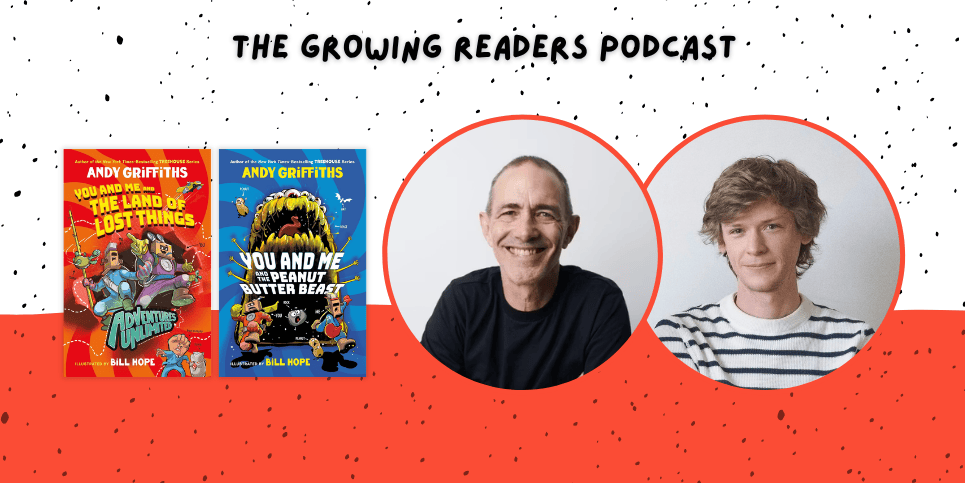
A podcast interview with John Tonai and Jolene Gutiérrez discussing Unbreakable on The Growing Readers Podcast, a production of The Children’s Book Review.
Hey You. Yes, You! Andy Griffiths and Bill Hope Are Here
What if you were the main character in a book? In the You and Me series, you are. New York Times bestselling author Andy Griffiths and illustrator Bill Hope stop by the Growing Readers Podcast to talk peanut butter beasts, lost things, cardboard box helmets, and the creative partnership behind two of the most joyfully unhinged books in children’s literature right now.
Press play. This one’s for you!
Subscribe to The Growing Readers Podcast to ensure you never miss an episode celebrating the creators shaping young readers’ lives.
Listen to the Episode
The Show Notes
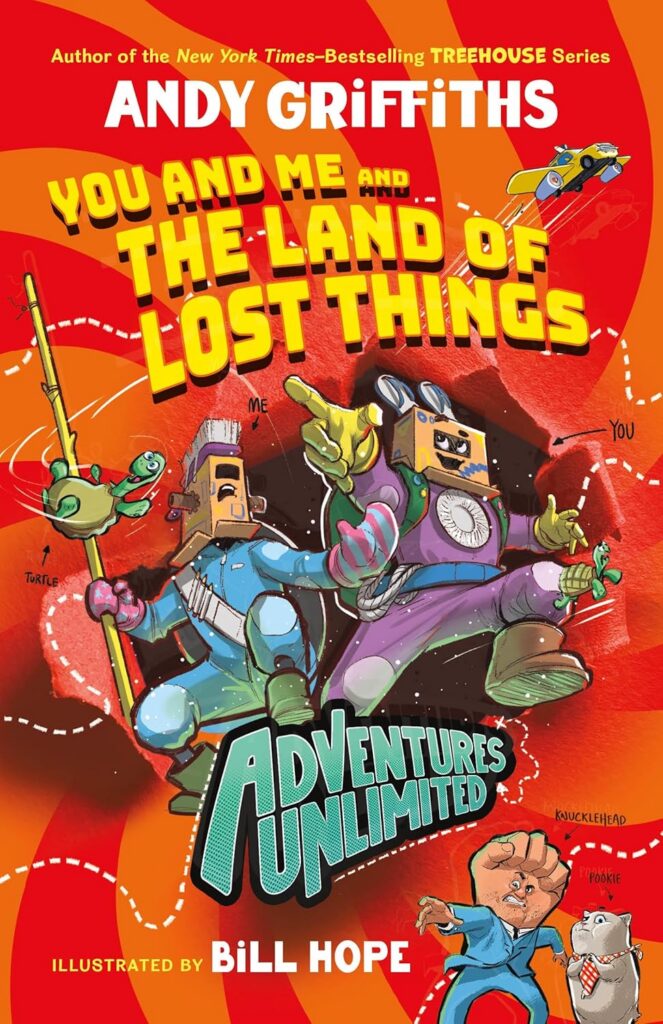
You and Me and… The Land of Lost Things
Written by Andy Griffiths
Illustrated by Bill Hope
Ages: 6+ | 320 Pages
Publisher: Feiwel & Friends (2025) | ISBN-13: 9781250367358
Publisher’s Book Synopsis: Come along with New York Times-bestselling author Andy Griffiths (The 13-Story Treehouse) on a brand-new adventure that plunks the reader right into the middle of all the wacky action and laughs with its unique storytelling style.
Hey, you and me sure have had a lot of amazing adventures together, haven’t we?
Remember the time we flew to the moon without a rocket? And remember the time we went to the bottom of the ocean and fought a high-voltage giant octopus? And how about the time we got lost in The Land of Lost Things?
What? You don’t remember? Really? Well, let me refresh your memory. It all started like this…
Buy the Book
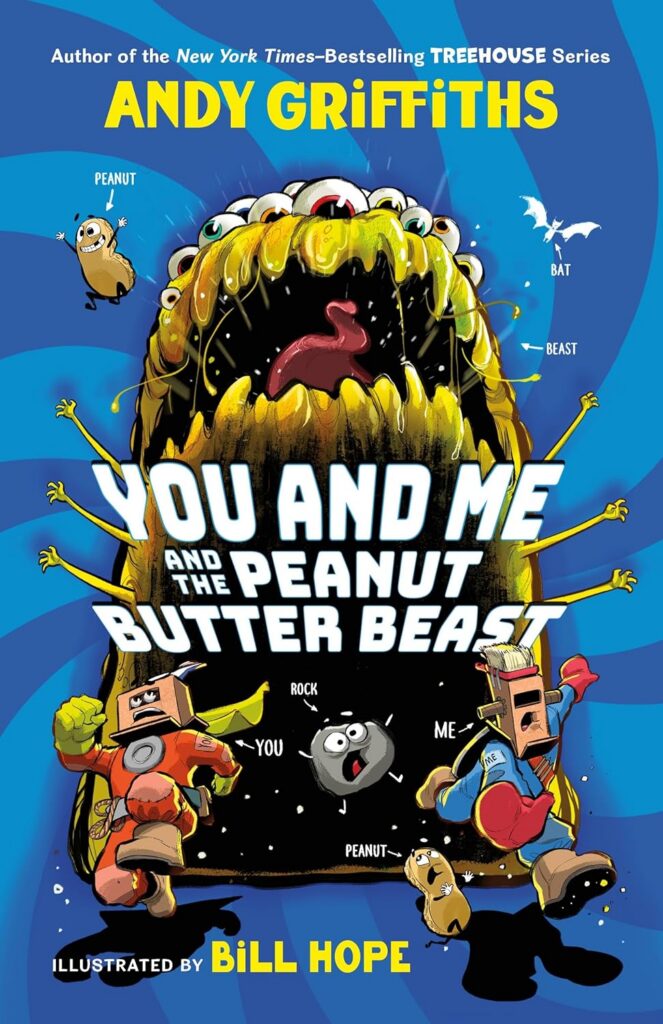
You and Me and… And the Peanut Butter Beast
Written by Andy Griffiths
Illustrated by Bill Hope
Ages: 6+ | 288 Pages
Publisher: Feiwel & Friends (2026) | ISBN-13: 9781250367358
Publisher’s Book Synopsis: Come along with New York Times-bestselling author Andy Griffiths (The 13-Story Treehouse) on a brand-new adventure that plunks the reader right into the middle of all the wacky action and laughs with its unique storytelling style.
Come along with New York Times-bestselling author Andy Griffiths (The 13-Story Treehouse) on a brand-new adventure that plunks the reader right into the middle of all the wacky action and laughs with peanut butter monsters and its unique storytelling style―perfect for fans of Dog Man and InvestiGators!
Hey, you―yes, you!
Remember when we found that really deep hole and you jumped in and I had to jump in to rescue you and at the bottom of the hole we found the cave of the legendary Peanut Butter Beast?
That was one of our deepest―and most dangerous―adventures ever!
What? You don’t remember?
Well, have I got a story for you!
Let me remind you how it all went down … and down … and down … and down …
Buy the Book
About the Creators
Andy Griffiths is the New York Times bestselling author of The Day My Butt Went Psycho!, Zombie Butts from Uranus!, and Butt Wars! The Final Conflict, as well as the Treehouse Series and Killer Koalas from Outer Space. In 2007, he became the first Australian author to win six children’s choice awards in one year for Just Shocking! He is passionate about inspiring a love of books in his young readers and works as an ambassador for the Indigenous Literacy Project, which provides books and literacy resources to remote indigenous communities around Australia. Andy is a big fan of Dr. Seuss and of cauliflower. He lives in Melbourne, Australia, and is Australia’s most popular children’s writer.
For more information, visit andygriffiths.com.au
Bill Hope is an artist and illustrator living in the Blue Mountains just outside of Sydney. He has published multiple illustrated books and has ongoing representation through the Lost Bear Fine Art Gallery. His graphic novel An Interior Life won the Golden Ledger award for Australian Comics.
For more information, visit billhope.com.au
Credits:
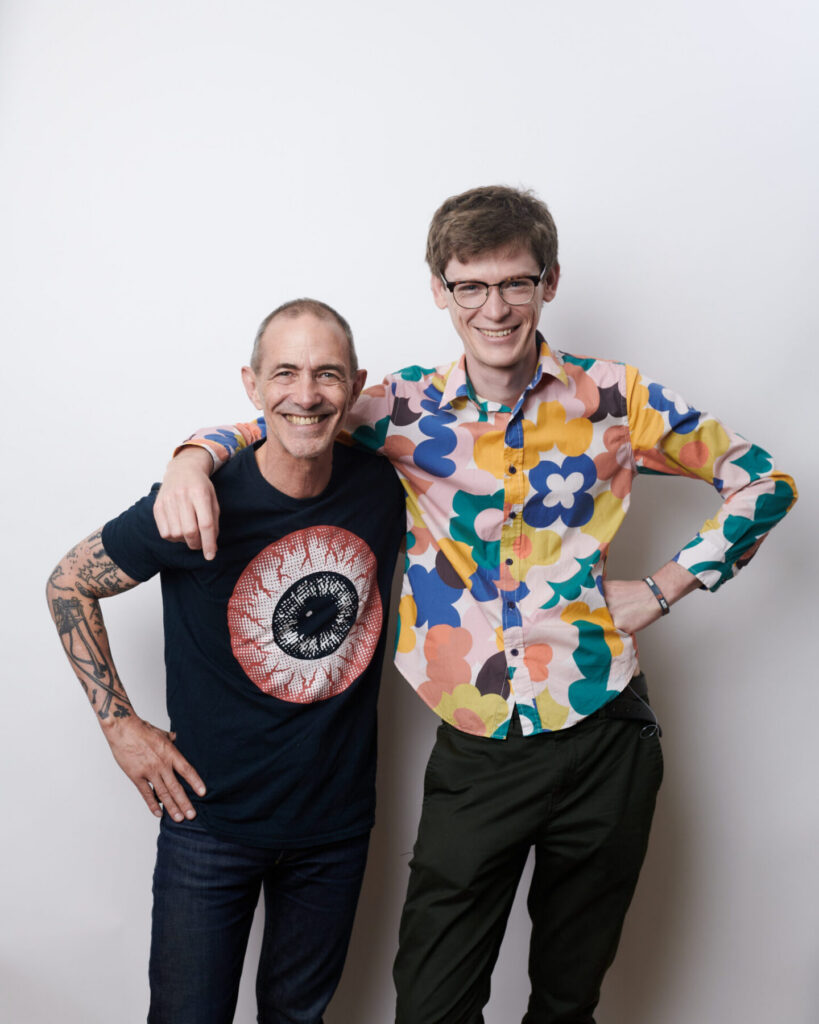
Host: Bianca Schulze | Guests: Andy Griffiths and Bill Hope | Producer: Bianca Schulze
Read the Transcript
Bianca Schulze:
Hi, Andy — welcome back to the Growing Readers Podcast.
Andy Griffiths:
Great to be here. Thanks very much for having me back again.
Bianca Schulze:
And you have brought a wonderful new friend today — joining us for the first time on the podcast: Bill Hope. Welcome, Bill!
Bill Hope:
Thank you so much. I’m thrilled to be here.
Bianca Schulze:
I hope you don’t mind, but I would just love to start with some silly, fun rapid-fire questions to get the conversation going. Andy, why don’t you answer first, and then Bill, you answer second. Sound good? Okay — crunchy or smooth peanut butter?
Andy Griffiths:
Crunchy.
Bill Hope:
100% crunchy. Yes.
Bianca Schulze:
All right, then — peanut butter or Vegemite?
Andy Griffiths:
Vegemite.
Bill Hope:
I will stick with peanut butter.
Bianca Schulze:
All right — would you rather explore the Land of Lost Things or the cave of the Peanut Butter Beast?
Andy Griffiths:
The Land of Lost Things, 100%.
Bill Hope:
Yeah, it’s going to be the Land of Lost Things. It’s certainly going to be a lot more fun and less disgusting than the cave of the Peanut Butter Beast. It’s also very dark in the cave of the Peanut Butter Beast. It’s just a beast, and you’ll get eaten — and then that’s that.
Andy Griffiths:
Yeah, there’s nothing to see.
Bianca Schulze:
Nothing to see! Well, if you were lost in the Land of Lost Things, what’s the one object you’d hope to find there?
Andy Griffiths:
There was this beautiful coat — well, a beautiful new coat — that I got in England a few years ago during a really freezing cold snap. It was like this magical coat that kept me warm, made me look great, and I lost it a few years ago in Australia and have never seen it again. My life has never been the same since.
Bill Hope:
He’s never quite recovered, and we can all tell. He’s a diminished Andy. I’d have to say I went traveling in Europe many, many years ago and I took a sketchbook with me. I drew lots of pictures in it, and then I lost the sketchbook. There’s something about not having any of those pictures anymore that makes me sad. So I’d want to get my sketchbook back.
Andy Griffiths:
So you’re going to spend the rest of your life trying to draw those pictures again, in the hope of recreating them.
Bill Hope:
Yeah, it’s a tragic tale.
Bianca Schulze:
Maybe the sketchbook will show up wrapped inside Andy’s jacket somewhere someday. All right, last one — what do you consider more dangerous: a high-voltage giant octopus or a Peanut Butter Beast?
Andy Griffiths:
Peanut Butter Beast, for sure. You can’t reason with a beast.
Bill Hope:
I’m going to disagree with Andy here. I think you can reason with the beast if you have some peanut butter on you. Whereas a high-voltage octopus — you’re in the water with it already. The show’s over before it started. There’s no maneuverability whatsoever. So I’m going to say the octopus is more dangerous.
Andy Griffiths:
Yeah, but you’re wrong — because you’re not reasoning with the beast, you’re bribing it. That’s not the same thing.
Bill Hope:
Yeah, but what are you going to bribe a giant electric octopus with? More electricity? It’s made of it.
Bianca Schulze:
I’m definitely not a scientist here, but maybe there’s some kind of suit that doesn’t conduct electricity and you’d be just fine.
Bill Hope:
To be fair, in the book we are in our adventure diving suits and we appear fine, so we’re probably protected.
Bianca Schulze:
All right, Andy — since we last spoke, you’ve been named the Australian Children’s Book Laureate. Congratulations! That is such big news. Can you tell us what that honor means to you, and what you’re hoping to champion during your time in that role?
Andy Griffiths:
Thank you. Well, it’s pretty much a continuation of what I’ve been doing right from the start — encouraging kids and showing them through the books how much fun, and how much adventure — imaginary adventure, but it still feels real — you can have in a book. These books are not a chore; they’re a pleasure, and they have all these incredible benefits that are, you know, just a bonus — beyond the fun of wondering where we’re going to go next when we turn that page. So this is an opportunity for me to have a national stage in Australia: to visit every state and territory and talk to kids and their parents and teachers and all the gatekeepers, just to remind them that at its heart, reading is fun.
Bianca Schulze:
Well, you’re one of my favorite authors globally. And as an Australian, I was so happy when I heard you’d been picked. Congratulations again.
Andy Griffiths:
Thank you. It gives me a little extra air of legitimacy, because I’ve always regarded my position in the literary ecosystem as the clown, the idiot — and I say that in the best possible sense of the word — as someone no one’s going to take too seriously. So I’ve had the license to do whatever I want. I like the fact that the Laureate title means people take me a little bit more seriously now. But I’ll fix that, don’t worry.
Bill Hope:
I keep trying to correct Andy’s spelling sometimes, and he says, ‘Do you know that I’m the Australian Children’s Book Laureate?’ And I have to say, ‘Okay, fair enough — it’s correct the way you did it.’
Andy Griffiths:
Yeah, you have to do whatever I say, Bill.
Bianca Schulze:
Well, Bill, I love to ask our first-time guests about the moment they fell in love with their craft. Was there a pivotal book, an image, or a piece of art that first sparked your passion for illustration — a moment where you thought, this is what I want to do?
Bill Hope:
I think the moment that sticks out to me is when I was about ten and was given a how-to-draw book written by Quentin Blake, who illustrated all the Roald Dahl books. I worked my way through it and really loved his drawings and the way he talked about teaching drawing and his whole philosophy behind it. It was one of those times when I was really getting into the idea of being someone who liked drawing. At the end of the book, there was an invitation to draw a monster and send it to the company that had produced the book — an American company called Klutz. I sent off my monster drawing, and then a few months later I got this big package of goodies that they’d sent me from America. At that age, to get free stuff in the mail because you’d done a drawing was so exciting. I think it was that combination — really falling in love with this kind of drawing, but also getting something in return — that was so exciting. And that’s sort of the itch I’ve been trying to scratch ever since.
Bianca Schulze:
I do love the Klutz books — they make so many great things, even knot-tying books and all sorts. But I love that story. I’m such a Roald Dahl fan. So I have to ask — do you have a favorite Roald Dahl book?
Bill Hope:
Do I have a favorite Roald Dahl book? I think it’s probably The BFG. I like The BFG best.
Bianca Schulze:
Andy, I don’t know if I’ve ever asked you that question. Are you a Roald Dahl fan, and do you have a favorite?
Andy Griffiths:
I would go for Charlie and the Chocolate Factory, but I didn’t really grow up with him. I went straight from children’s reading into his macabre short stories, which were my bridge into the adult world. I’ve since gone back and retro-admired what Dahl achieved — it’s a very similar child-centered approach. We are telling a story to the child, not for any other message-driven purpose. It’s just: what can we think up? And I like that in You and Me and the Land of Lost Things we have a little visual tribute to James and the Giant Peach, because we’re being pulled along in a flying bathtub pulled by flying socks. When we were making this, I said to Bill, make it look like the giant peach being towed along by all those birds — there are very similar fantastical elements in both books.
Bianca Schulze:
Well, the You and Me series shares the same wacky, highly illustrated energy as the Treehouse books — but with a fun twist: the reader is actually one of the main characters. Andy, can you explain the You and Me concept and where the idea of putting the reader inside the story came from?
Bill’s cinematic realism makes the most ridiculous idea seem perfectly reasonable — so the reader is just pulled into that world of nonsensical fantasy without even knowing it.
Andy Griffiths
Andy Griffiths:
Well, it came from the readers — because I read my mail from the kids very diligently and seriously. And many of them were saying, ‘Can you put me in the next book? Can I be a character in the Treehouse? Can you put my dog in, and my best friend?’ They’d include their names. So I was thinking there is something to do after the Treehouse that I haven’t done yet. The Treehouse ran for 13 books over 13 years. Terry retired, and I thought: what else is there to do? And I thought — I could put the reader in the book. That’s when I met Bill; our publisher introduced us. I said to Bill, I want to do this thing, but all readers are different. They’re different sizes, different genders, different nationalities, different ages. How do we represent that? And Bill came up with the idea that we would put a cardboard box on our heads to conceal our identities, so that any reader could identify with the character we say is ‘you.’ And then I thought, okay — you and I, the reader, have been on a lot of adventures. You’ve forgotten most of them. So in each book, I remind you in great detail about this incredible adventure we had. That was the engine that started it. And working with Bill, I quickly realized he has this ability to create vast, cinematic perspectives from all different angles. That was really exciting, because we can make up the most ridiculous idea, and Bill’s cinematic realism makes it seem perfectly reasonable — so the reader is just pulled into that world of nonsensical fantasy without even knowing it.
Bianca Schulze:
Bill, what’s your take from the other side of that — when the publishers wanted to connect you with Andy? What was that like for you, and is there anything to add to what Andy just shared?
Bill Hope:
Just on what Andy was saying — having ‘you and me’ as the two main characters is quite a big conceptual swing, and it is a little difficult to explain to people sometimes. But once people start reading it, they get it immediately. One of the most satisfying things for us has been messages from parents saying, ‘If I’m reading this book to my child, I’m ‘me’ and the child is ‘you.” It creates this really lovely dialogue in a reader-and-listener relationship with the book. Those two main characters completely work on that level, which is a really lovely thing. I’ll also add that there was a plan for a while to do the entire book without ever seeing the main two characters — and as an illustrator, this was a total nightmare. We were going to do everything from a first-person perspective, or just see their shadows, or just catch part of a foot going out a door. It was going to be very tricky, so I’m very glad we came up with the adventure suits to protect their identities. There are some pretty basic things, like you need to be able to see the characters’ expressions and their reactions. Getting that first call from the publisher was very exciting — it was quite secretive. I was just invited to a meeting and they wouldn’t tell me what it was about, and then throughout the meeting they revealed that Andy was looking for a new illustrator. It was tremendously exciting, because it was exactly the kind of book I wanted to do. I’d read Andy’s books when I was in primary school, so there was this incredible full-circle feeling to the whole thing. It was exciting, but also intimidating. You’re going for a really big job, and you want it to go well. With everything involving Andy, it’s fun and there’s a lightness of touch — so you’re managing this balance. It’s high-pressure play, if you know what I mean. I was making sample illustrations to send to the publisher with a lot riding on them — a real career-move kind of thing — but you want it to be fun and light. I feel like we’re great now, but for that first little while, yeah, I was just playing it cool.
Andy Griffiths:
I actually had that feeling after my first book, Just Tricking, back in 1997. I’d put ten years of work into it and had created this character who plays practical jokes that always backfire. Terry had done all the stream-of-consciousness doodles around the edges of the book. It came out and was an instant bestseller — and then they said, ‘Right, what’s next?’ And I said, well, it could be annoying. So I’ll write Just Annoying. But then I thought: my goodness, how did I do that? Now there are all these expectations. So I realized the only way I can do it is to forget all of that and revert back to the ten-year-old I was — and always am when I try to write — with that devil-may-care attitude. Just: this is funny, this is silly, I’m having a good time. That’s my security. If I’m all tight and tense and worrying about the outcome before I’ve even got anything on the page, that’s going to constrict the creativity. I’ve learned to relax under pressure. And that’s a good definition of an artist, I think — someone who can play when they have to; someone who is careless, but full of care.
Bianca Schulze:
Everything you just said — for anyone listening who has read your books — it all comes across. It’s so playful, but obviously really intentional. Andy, your work with Terry Denton on the Treehouse books was almost impossible to separate — where one person’s contribution ends and the other begins. And the reading experience of the You and Me series with Bill feels so similar. How does it feel switching creative partners after so long?
A good definition of an artist is someone who can play when they have to — someone who is careless, but full of care.
Andy Griffiths
Andy Griffiths:
I didn’t think I would find another Terry — someone I could boss around so totally. No — Terry and I probably worked together across around 24 to 30 books. The first half of that career, we were working separately, and I gradually realized how great he was and how much his illustrations could add to the storytelling, if I could just get out of his way and we could work together. There were about half a dozen experimental books before we hit on the Treehouse concept. Once we brought my wife Jill in as the editor of all my books, it became a three-way improvisation where none of us could really tell who had come up with what. Treehouse over 13 books really cemented that process. So when Bill came along, we just slotted him into the same way of working — gave him a few paragraphs to test him out. And he not only delivered exactly what was needed, he did it in an extraordinary way. Just from this paragraph of you and me walking in a forest and falling down a hole, he added a whole extra story to it. I thought: that’s incredible — I hardly have to do any work at all here. I just guide the process. I could see Bill was so into it, and that makes mine and Jill’s job so much more pleasurable. So over a year, the books get rewritten, and sequences get thrown out. The difficult thing for Bill was that we would throw out entire chapters he had drawn really beautifully. We told him not to get too attached, but he did anyway. I think he learned that everything’s provisional until we’ve decided it’s final.
Bill Hope:
It is, but it’s a way of working that I’ve really come to appreciate. There is a philosophy that Andy and I have of: we’re going to make a lot of stuff, and then we’re just going to choose the best bits — the bits that service the story. That’s a lot of work, because you need to produce a huge amount of material, but it does lower the stakes. You can come into it thinking there are no wrong answers, no jokes that are too silly. You put a lot of stuff out there, and you know that Andy and Jill have a personal standard of quality they want the books to reach. So you know there’s going to be this big refining process of arriving at something beautiful, but you get to have all that looseness and fun first. I really enjoy that process now — there’s a long period of me just pitching dumb stuff at Andy and seeing what sticks.
It’s not that Jill and I have high quality standards — it’s that we have a low boredom threshold.
Andy Griffiths
Andy Griffiths:
And some of those random things you give me — the ones you don’t even see as an important idea — that’s where I go, ‘My goodness, that would be great.’ A lot of randomness gets used. And it’s not that Jill and I have high quality standards — it’s that we have a low boredom threshold. When we’ve read the same chapter ten times, we look at each other and go, ‘Are you a bit bored?’ ‘Yeah, I’m bored.’ That’s when we go in and say: we need to cut that. They’re talking too much; or there are wonderful drawings here, but they’re not servicing the story — you’re not feeling like you’re moving forward. So yeah, we’re very discerning readers.
Bill Hope:
Andy is a wise grown-up man, but he can embody a bored nine-year-old extremely well. I can see him sometimes just totally tuning out — like, ‘No, this is not working for me.’
When I write, it’s that nine-year-old part of me that really takes control of the pen. The nine-year-old is like: this is my chance. Let’s go.
Andy Griffiths
Andy Griffiths:
It’s quite embarrassing if I’m on a panel or in public. But when I write, it’s that nine-year-old part of me that really takes control of the pen. I tried hard to be a serious adult writer — but it’s no use. The nine-year-old is like, ‘This is my chance. Let’s go.’ So my adult part is devoted to helping that nine-year-old — well, Jill helps him spell the words correctly. But it’s just about channeling that pure joy of being nine, when everything’s funny and wonderful and there are so many possibilities. That’s the energy I want.
Bill Hope:
On a similar note — I did a fine art degree at university, and we’d have these long life-drawing lectures studying anatomy, spending hours on these careful drawings of the perfect figure and pose. I couldn’t help myself. I’d always be sticking a bird in the background, or a snake, or something that wasn’t supposed to be there. It would drive my lecturers crazy: ‘Bill, can you just take this seriously? Can you just do the drawing?’ But yeah — you can’t help yourself sometimes.
Andy Griffiths:
Terry had the same thing. He was incapable of doing anything without his playfulness coming out in the drawing. He often used to think he should be doing proper oil paintings, proper serious work. But I said: ‘No, you’re a clown. That’s what comes out of you. You play — and that’s what people love about you.’ Humor and play, if not the most important things in life, are two of the most important things — because they add the juice and the joy of being alive. So I’m happy to serve that role.
Bianca Schulze:
That playfulness — it’s like every drawing you’ve already done is never wasted, because every piece of work is always leading you to the next great idea. On the note of playfulness, Bill — your illustrations are full of details that go beyond what the text says, little jokes living in plain sight for readers to discover. It sounds like you have a lot of creative freedom and you’re just riffing on your own. Is that fair to say?
Bill Hope:
Every once in a while Andy will have a specific idea of what a drawing should look like, or a reference — something we should bring in. But no, it’s a very fine balance of working very collaboratively while also going off and doing things independently. I’ve got so much freedom in terms of doing exactly what I want with the drawings, and Andy and Jill are wonderful about being receptive to all of that. When we started working on this book, I was almost slightly nervous about the amount of input they were keen for me to put in — how much I could contribute conceptually. I’d come up with one silly character, and they would run with it, and suddenly that character became very significant. That’s been one of the best things about this whole process for me: feeling that sense of creative input in the writing process — coming up with concepts and characters — as opposed to just executing the drawings. So it’s a lot of fun.
Andy Griffiths:
The only time we’ll rein you in, Bill, is if the drawings are somehow contradicting the narrative. I’m very sensitive to the narrative voice being consistent with the pictures, because the pictures are part of the narrative. So Bill might have a brilliant joke, and I’ll go: no, it’s working against me. It’s going to send the reader off on the wrong track — or it’s breaking the spell that this is actually happening, and not just created by two adults in Australia. I never want the reader to feel that.
Bill Hope:
It’s a very fine balance — how much is the drawing continuing the sense of momentum in the story, how much are you following the action, and how much are the little jokes flourishes on the existing action versus speed bumps that stop the narrative flow? It’s trying to get that balance of: what’s too much, what’s an interruption?
Andy Griffiths:
Most of the time the background jokes aren’t interfering with the narrative — they add re-readability. Kids read the books over and over again, and when you keep discovering little things you didn’t notice on your first rush through, or your second — I think that’s what I want from a book. Endless rediscovery.
Bianca Schulze:
Your books are the type that kids read over and over again, and I love that idea that there’s going to be something they didn’t pick up on the first read. My son, the first time he reads a book, just whizzes right through it — that’s his way of deciding whether he actually likes it. And then he goes back and reads it slower and more intentionally, taking in all the pictures. I love the humor in these books, because it really is layered. It’s often ironic and super silly. For example, there’s a double-page spread in which a cheesehead alien wearing a cowboy hat is pointing at you and me in a flying car and saying, ‘Well, that’s weird.’ So ironic and so silly. And Andy, is there something specific that Bill put in that you weren’t expecting — a moment you’d consider a favorite?
Andy Griffiths:
That would be true of both books — and there’s a third book we’ve almost finished. Bill will give me what I want, but not in a way I’m expecting. And that’s creatively very exciting. There are so many moments. That cheesehead alien is a good early one — there’s no explanation for that character being there. And yet you suddenly see the action through the eyes of someone else, which dimensionalizes it. If it’s weird to this weird character, then it must be truly strange. Speaking of the characters — what we noticed early on was that Bill was populating the town they live in with very strange little creatures: nuts and bolts and bits of fruit. There’s no way of describing them, and we loved that. Jill and I thought back to the books we loved, and they were full of animals and very few adults. One of my pet peeves about books written for kids is if there’s too much adult action. So we said: let’s get rid of the humans altogether — apart from you and me, who are presumably human. Although I was thinking the other day: what if they took their helmets off and revealed tentacles?
Bill Hope:
At the end of the series, yeah — they were just a slab of cheese the whole time.
Andy Griffiths:
I think there’s something in that I really want to explore. But so far we’ve banned all humans and adults from the books — mostly so the kid reader can just immerse themselves in a world of fantasy. The Peanut Butter Beast performing on a stage in a little Dickensian theatre — it’s dark and awful and the audience are all there for the spectacle and it’s kind of terrifying. It’s based on an illustration from Pinocchio, which is one of my very favourite touchstone books. I keep thinking we could do a whole story about this town of strange things. There are always spin-offs going off in my head.
Bill Hope:
And it’s become my personal challenge to try and weasel an actual human being into the books. I’m trying to get a ghostly pirate into the next one. But we’ll see — probably not. He’s only half a human. He’s just a little wispy ghost at the bottom of a page.
Andy Griffiths:
That’s all right, but he won’t be a normal pirate. And the early breakthrough was Johnny Knucklehead. I said: I’ve got this guy, Johnny Knucklehead — can you draw me what that looks like to you? And Bill gave me five figures. Four were kind of droopy, knuckle-headed humans. And then this fifth one was a guy with an actual knucklehead. I just went: that’s him. I can already see his personality — a double-dealing gangster type. He’ll be the perfect villain and foil for you and me.
Bianca Schulze:
Can you share a little more about the Knucklehead characters — what they bring to the story?
Andy Griffiths:
They are our frenemies. We’ve been on many adventures together. They help us to a certain point — we might find the treasure together — but Johnny will always double-cross us, over and over again. Even when he says, ‘I promise I won’t double-cross you this time.’ ‘Do you promise?’ ‘Yes.’ ‘Okay, we’ll trust you this time.’ And then he double-crosses us again. It’s a beautiful moment.
Bill Hope:
Johnny was meant to be a side character in the first book and then quickly started dominating it. He’s a major character in the second, and an even more major character in the third. I think we enjoy writing and drawing Jimmy and Johnny — the Knucklehead twins — almost too much. They’re like the ghost in the machine that drives a big chunk of the story: the agents of chaos. And it’s almost like you and me sometimes have to play straight men to Jimmy and Johnny — though ‘you and me’ are definitely wacky in their own way.
Andy Griffiths:
I think they’re like Batman and Robin to the Joker or the Riddler. That 1960s Batman television series was really influential on me. I loved the way they played it straight and yet it was completely ridiculous. That’s a big part of my humor — I’m not trying to be funny. I’m actually trying to solve the problem for the characters, and that just happens to be a ridiculous problem in a ridiculous world. That’s where the humor comes from.
Bianca Schulze:
And I love that the Knuckleheads help young readers feel intelligent — they can see that you and me are being a little naive in trusting them so much. Those moments really empower the reader.
Bianca Schulze:
Both books carry a quiet life lesson tucked inside the adventure, there for anyone willing to receive it. We talk a lot about the humor and the absurdity, but book one offers insights on learning to tame your temper, and book two touches on the idea that we’re all more complicated on the inside than we appear on the outside. Did those themes come first, or did they emerge as the story developed?
Andy Griffiths:
They just emerge, I think, as the story develops. With the Peanut Butter Beast, we just wanted to get inside its brain and drive it around like a hot rod. And then Bill’s beautiful drawing of the inside of its brain and body is so much more complicated and complex than I ever imagined — so one of the characters comments: ‘Gee, we’re so much more complicated on the inside.’ Those things have to emerge from the fun. And to me, it’s more amusing when a character has a spontaneous realization, rather than when a character announces: ‘Here is the lesson I am learning.’ That to me is the more interesting approach.
Bianca Schulze:
We’ve talked about how you and me are presumably humans, but Bill came up with the idea of covering them in these boxes. I feel like most children at some point make some kind of costume, whether it’s out of a big brown grocery bag or a cardboard box. But the Make Your Own Adventure helmet in book one involves a pair of flip-flops — which made me smile, because in Australia you would call flip-flops something completely different that wouldn’t fly over here in the United States. It actually made me wonder about the editing process when your books get translated between Australian English and American English. Are there many differences? Do the American editors ask you to change things?
Bill Hope:
There are little things that come up, but nothing too significant. Because there’s so much text in the artwork itself, it is a real process for people translating the books into, say, Polish. I love getting the international copies and seeing these tiny little jokes I’ve scribbled onto the side of something being interpreted into a different language — someone having to come up with a new joke that fits into the same space. It’s an incredibly complicated process, and the people who do it are amazingly talented. But Andy, you’d know more about the history of translating your kind of work.
Andy Griffiths:
These days the US editions are pretty much unchanged. In fact, it was almost the other way around. The original title of Peanut Butter Beast went through a lot of versions — it was going to be You and Me in the Very Deep Hole to begin with. Then it was going to be You and Me and the Peanut Butter and Jelly Sandwich Beast. I liked ‘peanut butter and jelly,’ and the comment was: ‘Oh, that’s so American — no one outside the US will know what that is.’ I was like, that’s all right, ‘jelly’ is funny! But we dropped it because the shorter title is quicker to say and still works. There are hardly any changes for other countries, particularly for the Treehouse series. Sometimes you might mention a celebrity in the book who means something to US, UK, and Australian audiences but nothing in, say, Holland — and a good translator will substitute the appropriate equivalent. So they have some freedom to make it work for their audience, and I’m completely fine with that. Whatever works.
Bianca Schulze:
It is so funny — peanut butter and jelly is so American. And as you know, my Australian birthright was asserting itself as I read it. I really wanted Vegemite to get a mention somewhere, and sure enough, it got a little shoutout at the end of book two. So I just wanted to thank you for putting it in, because I would pick Vegemite over peanut butter.
Bill Hope:
Is this after the peanuts have saved them? So it’s the backup spread? Right — good call.
Andy Griffiths:
We’ll eat Vegemite instead. Yeah — we can’t eat peanut butter anymore, because the peanuts are such little heroes.
Bianca Schulze:
Exactly! Well, Andy, in our last conversation, you talked about writing for three audiences at once — a concept from Australian-born writer Tim Winton, that writing for kids is a triangle. At one point is you, writing for yourself. Another point is the child. And the third point of that triangle is the gatekeepers — the buyers of books: parents, librarians, and teachers. How do the You and Me books speak to each corner of that triangle?
Andy Griffiths:
Well, I’m not just an adult — I’m also a parent and a former teacher, so I know what that angle is. And I’ve been a nine-year-old kid; I’ve got a good handle on that. And I’m obviously me, along with Jill and Bill — we’ve got to be delighted in what we’re doing in its own right. I think that’s really important. You’re not just writing down to the kid, thinking: kids like this, so I’ll write that. We are impressed by our own genius, and we know that if we are, we’ve got a pretty good chance of impressing someone else. One of the things I think a lot about is the bedtime read. How is this going to work if you’re an adult reading it to a child at bedtime? What do I need to give you to make sure that even if the child can’t see the picture, they’ll know what’s going on? The pictures certainly help tell the story, and they help emerging readers make sense of the words because they’ve done a lot of the descriptive work already. If we’re looking after all of that, you’ve got a book that’s going to entertain all ages — a bit like a fairy tale. Hansel and Gretel, for instance — you can access it at any level, child or adult, and you’re getting a good story. That’s my secret touchstone.
Bianca Schulze:
Bill, do you want to add anything there? When you’re creating, how much are you thinking about pure enjoyment versus thinking about the child reader and then the gatekeepers who are going to be the ones putting this in the school library?
Bill Hope:
Yeah, most of the time I’m focused on whether I’m enjoying it — with the hope that if I’m having fun, the kids are going to be having fun as well. And I think for the most part that’s true. I want it to work on multiple levels — some jokes a bit more advanced, some that parents might enjoy — but I’m largely focused on the kids. The other thing I’d add is that when I was reading a lot of comics as a kid — like the Asterix books — the nerdy drawing part of me was already noticing things: the line weights, the brushwork. There was something in the technique of the drawing that I really appreciated even then. I know that’s a very small section of the audience, but I really care about that too. I want the drawings to be as good as possible, with the understanding that there will be some kids who are like me — who are really picking up on those things.
Andy Griffiths:
And I want the child reader who has storytelling or writing inclinations to be inspired by the book. So they finish it and go: ‘Now I’m going to write my own.’ That’s a really lovely effect. I’ve passed on what I got from the books I loved — the ones that made me want to do my own versions. Passing that on to the next generation, knowing that some of them are going to pass it on too.
Bill Hope:
There’s also an interesting lesson embedded in here, and I don’t know if it gets through, but there’s a quasi-philosophical thing I like passing on through these books: some of the concepts are really, really dumb — but we’ve worked very, very hard on them. I hope the kids are picking up a little bit of that. These two adults worked super hard on making this really silly thing come to life. I’m not quite sure what the lesson is exactly, but I think there’s something there.
Bianca Schulze:
Andy, you’ve previously spoken so passionately about your work with the Indigenous Literacy Project and giving kids the raw material to tell their own stories. Did those experiences of sitting with kids — especially kids in rural places who may not have as much access to books — find their way into a series like this one?
Kurt Vonnegut had a phrase: ‘pity the reader.’ He did everything he could to make the books work for the reader. Because a page of words — asking a reader, adult or child, to work through a page of words is a big ask.
Andy Griffiths
Andy Griffiths:
It definitely influenced the development of my books — from the Just series, which were about 80% words and 20% scribbles in the margin, to the Treehouse series, which was 50 to 60% illustration with the fewest words I could get away with. I noticed a lot of kids didn’t have the reading level to fully access the Just series — they were getting it read to them by teachers. So I thought: how do I get the pictures to do a lot of the descriptive work? I can save a couple of hundred words a page by getting Bill or Terry to draw the scene we’re talking about. And then what Jill and I try to do is tell a fairly complex story in as few words as possible. Because often when you ‘dumb down’ a story for beginning readers, you take out all the interesting bits. So yes, they can read it — but at the end they think: why would I bother reading when I can play a video game and get a lot more excitement? That’s the art. The development has come from being in close contact with kids. Reading is hard work, and if you want kids to read, you need to do everything you can to make it a pleasurable experience. Kurt Vonnegut is one of my all-time favorite writers, and he had a phrase: ‘pity the reader.’ He did everything he could to make the books work for the reader. Because a page of words — asking a reader, adult or child, to work through a page of words is a big ask. What can you do to make it easy?
Bianca Schulze:
Your books are perfect for that. They’re such great bridging books for those kids who look at a novel and think it’s too big, too scary. And after holding one of your books — whether it’s the You and Me books or the Magic Faraway Tree — a kid gets to the end and knows they can read a book that’s a bit thicker. Eventually they’ll feel confident to go on and read a novel that’s more text than art.
Andy Griffiths:
Well, I hope so. I was talking about this with Sally Rippin, who was the previous Children’s Laureate, and a lot of kids who read voraciously through their primary school years will see that reading drop off in their teenage years. I’ve had a number of parents say: ‘What can I do?’ And I say: there’s really nothing you need to do. Those kids have literacy — they can read, and they will be reading things that may not even conform to your idea of what a book is. But they have the power of being able to read, and I think that’s the most important thing. Some of us will go off and read as a hobby for the rest of our lives and go deeper and deeper into it. Others won’t. I walked past a monster truck rally the other day — well, I didn’t actually go, but it was outside the stadium — and I thought: I know nothing about the monster truck world. I’m completely illiterate in how all that works. And I’m okay with that too. Everyone will go off into their own places. But a base level of literacy is an enormous advantage in your life.
Bianca Schulze:
Your books help with that so much — thank you. Now we have to ask: what should we expect from book three? Can you give us any teases?
Bill Hope:
I don’t know, but it’ll be good, Andy.
Andy Griffiths:
Well, I just wrote a new blurb for it yesterday. I wanted to get into giants, and Bill mentioned that The BFG was one of his favorite books.
Bill Hope:
I’ve always loved drawings where scale is out — anything too small or too big thrills me. And this book is all about scale being off. As an illustrator, that’s so much fun to work with. It’s a real challenge, because everything is about comparison — this is the big thing, this is the small thing. But we’re going to the Land of the Giants. Did you find the blurb, Andy?
Andy Griffiths:
I did find it. Here we go: ‘Hey, you — yes, you! Remember when we accidentally became gigantic and got banished to the Land of Giants, where we discovered that we were actually quite tiny — especially compared to the most gigantically gigantic, knuckleheaded giant of them all? That was definitely one of our biggest adventures ever. What? You don’t remember? Well, have I got a story for you…’ The idea was giants — I thought Bill would do giants in perspective really well. But we also wanted the fun of being tiny compared to a giant, like in The Borrowers. And then no — we also wanted the fun of being giants ourselves. So we’ve got our cake and eaten it too in this book, which I’m thrilled about. I think Bill’s drawings have gone to a whole other level. And I love Jack and the Beanstalk — I’ve often referenced that story in my other books. So, yeah.
Bill Hope:
And can we talk about Johnny Knucklehead’s role in the new book, Andy? One of the most fun things is that Johnny Knucklehead becomes a giant — and becomes a sort of tyrant king. Having Johnny Knucklehead controlling a country is as chaotic as you can imagine. We just had a lot of fun playing around with him as this ridiculous king figure. It was great.
Andy Griffiths:
Yeah, Johnny wins again.
Bianca Schulze:
I cannot wait to read it. For young readers listening who dream of being illustrators someday — Bill, what’s one thing you wish someone had told you earlier in your creative career?
Don’t worry about doing the best drawing today. Just do a drawing today, and the next day, and the next day. Eventually it will turn into something wonderful.
Bill Hope
Bill Hope:
I wish they’d told me earlier — though I started pretty early, so I’m not sure someone should have been giving me the hard word when I was three. But I think the thing that came to me naturally, which I was very lucky in, is that I don’t think I’ve ever had the most natural facility for drawing. It didn’t come to me as naturally as I could see it coming to other people. But I just loved doing it all the time. It’s been a consistency thing — I’ve just been drawing almost every day for the past thirty years or so. If you can enjoy it, you’ll do it all the time. If you do it all the time, it will develop at its own pace — very, very slowly, but it does get there. For any kids who are interested in being illustrators, I would just say: don’t worry about doing the best drawing today. Just do a drawing today, and the next day, and the next day. Eventually it will turn into something wonderful.
Bianca Schulze:
Yes. And Andy, if listeners take away just one thing from our conversation today, what would you want it to be?
Reading is an adventure — and it’s as real as an actual adventure, because your brain is completely involved. So it’s not something you do when there’s nothing else to do. It can be your first choice.
Andy Griffiths
Andy Griffiths:
Reading is an adventure — and it’s as real as an actual adventure, because your brain is completely involved. So it’s not something you do when there’s nothing else to do. It can be your first choice. You can live your everyday life, but you can also have this second, imaginary life running alongside it — and that makes living so much more fun.
Bianca Schulze:
I love that — reading can be your first choice. Yes to that! Well, Andy and Bill, this has been such a joy for me. The You and Me series is exactly the kind of book that reminds me why I fell in love with reading in the first place. It’s funny, it’s clever, it’s full of heart, and it makes the reader feel like the most important character in the room — which, of course, they are. Thank you for creating something so genuinely fun for kids and for the grown-ups lucky enough to read alongside them. I can’t wait to see this next adventure — and I’ll be first in line when it arrives. Thank you both for being here today and for sharing a little bit of the magic behind these books with our Growing Readers community.
Andy Griffiths:
Thank you, Bianca — and thank you for all the work you do bringing great books to people’s attention, reminding them of the wonderful books being written now and the classics of the past. 101 Books to Read Before You Grow Up — I love that book. I can go back and read your very concise summaries and be immersed in the book all over again.
Bianca Schulze:
Oh, Andy — thank you. That means the world.
Bill Hope:
Thank you very much, Bianca. It’s been a really lovely conversation. Thank you so much for keeping us on the rails.
Bianca Schulze:
Thank you, Andy, and thank you, Bill. It was my pleasure.
