

The Children’s Book Review | July 26, 2016
Denise Mealy: What inspired you to write A THOUSAND NIGHTS? Do you have a background in Middle Eastern Studies or archeology? If so, can you tell us about it, and how it relates to the novel?
E.K. Johnston: My undergraduate degree is in Near Eastern Archaeology, and I have spent six summers excavating in the country of Jordan, on an Iron Age town site we think was predominantly occupied with textile production. So I know more than usual about Iron Age weaving, I guess, and that directly influenced a lot of NIGHTS. I wanted to do a fairy tale retelling, and my first two books had been very, very white, so I was eager to get away from that. I picked The Thousand And One Nights because I love Scheherazade herself (and she never gets to the be the story’s focus!), and I picked the historical period because of my educational background. Which makes it sound all very technical and deliberate, which is was…kind of. I ended up in the Late Middle Bronze Age (archaeologists love to subdivide things), with a girl who wasn’t quite Scheherazade, but who could be, once she became a legend. And then I was off to the races.
Besides the beautiful writing and story, the most talked-about aspect of your book seems to be the unnamed protagonist. Is this a feminist stance? A folktale tradition? There are quite a few theories, and we would love to hear the real reason!
This always makes me smile because I thought I was being PAINFULLY obvious, and yet there are so many interpretations of it, which is delightful. There are no names at all in the book for two reasons: 1. We don’t know that much about Bronze Age naming conventions, and 2. In a fairy story, your name is your most powerful weapon. The King, for example, has only two names (“the king” and “my son”), because no one loves him. My narrator has about six, because she makes all kinds of human connections. For once it has nothing to do with my feminism, except that I “translated” all but four of the names into English (Lo-Melkhiin is fake proto-Arabic for “the king”, and everyone else’s names are literally the English translation) because they didn’t get used very often.
The magic in your book is fascinating and applied with a light hand. Can you tell us a bit about what inspired the protagonist’s unique gifts?
The reason magic is so light in the book is that my narrator is inventing it as she goes along, and therefore has no one to teach her. Human magic doesn’t exist yet, until the very end of the book when she essentially wills it into existence. This happened for a very particular reason: I needed to write the magical creatures I was going to need for SPINDLE. NIGHTS is very much giving me a place to stand, but it turned out way better than I could have possibly hoped for, and I am very proud of that.
In your mind, does the protagonist live happily ever after with her prince? Does her sister live happily with her new husband?
I’ll start with the sister. After her marriage to the Pale Man, my narrator’s sister is happy, but also a little restless. She loves her husband, and she loves her sister, but she knows how big the world is now, and she is eager to see it. And, um, that’s where the rest of the world-building for SPINDLE comes in, so you’ll have to wait until December!
My narrator does not love her husband, nor does he love her. He is very traumatized, so he needs her to be a Queen, and she is very good at it. Also, she likes it a lot. They are both aware that they will need an heir eventually, and they come to respect each other a great deal, but theirs is entirely a marriage of duty. She is happy, though, because she’s far too intelligent to be unhappy. And the king gets peace, which is about as much as he thinks he deserves.
Can you tell us why you chose to use small gods? Did you stick close to the traditional telling of small gods, or did you take some liberties?
I picked the smallgods because I liked the word. I had no idea they were in Pratchett when I started. I was aiming for a quiet, homey sort of ancestor worship, the sort of “household gods” we read about with Rachel, or like the ones the Romans used. So yes: I took a lot of liberties! But I like the idea of giving something (or someone!) power intentionally, and the idea that two girls can tap into something world-changing.
From the oily taste of the olives to the way the protagonist weaves her magical cloth, the locations and descriptions in your story are lush and full of life—no detail is too small. How did you capture the essence of this life that was so long ago?
I cribbed my own travel diaries, in a few cases! NIGHTS is very much an ode to how much I love the desert and Jordan and my studies. A lot of the places in the novel are based on places I have actually been, and then filled with period appropriate artefacts and technology, based on my textbooks. Dr. Daviau, to whom the book the dedicated, always taught us to imagine ourselves in the past when we were looking at archaeological reports, pictures, and objects…and I guess it worked out really well for me!
Your writing style is beautiful and evocative of sitting around a campfire in an Arabian desert. Does this style come naturally? Do you only use it in this book because of the subject matter, or in all of your books?
It came quite naturally. Most of my books are “read-a-loud”s, in theory (or conceit!). I like to imagine them being told. This book is a little more poetic for me, because I wanted to evoke an old style. Arabic is a beautiful language, and the Quran is full of poetry, and I wanted to try to capture some of that, even though I had to use English to do it.
What was your journey to becoming an author? I have read that you were a fan-fiction writer, how has that influenced your writing and style today?
I started with fanfic in 2002, and wrote my first manuscript in 2009. I think it made me a collaborative writer, who knew how to write for fun, but also to take it very seriously and do the research. Also, during this time I got my BA and my MSc, both of which required a lot of academic writing, often with a very strict deadline. So I learned to get things done.
Can you tell us about your writing method? Are you a Plotter or pants-ter?
Pants-er! I usually know the first line, the last line, a major explosion towards the end, and the title before I start, and that’s it. For NIGHTS, I remember getting to the part where my narrator’s father and brothers show up, and then being all “…”. I went for a drive and sent a few panicked texts, and then realized what I needed was a wedding, and then went back to work. But almost none of it was planned.
How long does it take for you to write a novel? Do you have a critique group or writing partners who review it?
Once I am actually drafting, I write very fast. NIGHTS was written in about 20 days, all told (with 50K or so written in 6 days), but from my first scratching at it to “the end” was almost two years. I think and think and think about a book, and then I sit down and write the whole draft very quickly. I have critique partners who read as I write, and a couple others who read the draft when I’m done.
What does a typical writing day look like for you?
Wake up, make coffee, write. As I said above, I write very quickly, so when I’m drafting, I’m not doing anything else (including, for example, laundry!). I used to sit at Starbucks, but I had a back injury three years ago that prevents me from sitting in a chair for hours at a time. More often now, I got to my brother’s cottage (which has the bonus of not having internet), and write with no disturbances at all.
Your latest book is contemporary Young Adult. Can you tell us about how you switched gears to such a different genre? Is that hard to do? What is the same between the two (very different) stories?
I wrote Exit, Pursued By A Bear back in 2012, before I started NIGHTS, and it never really seemed strange to me to switch gears. I think that’s where the fandom/academic training I had comes in very handy: I can turn on a dime. I consider both stories to be quite similar, in that it’s a pair of girls who REALLY want you know something, but the chief difference is that Hermione is actively trying not to be a legend, whereas at some point, my narrator fully embraces it.
Who are some of your favorite authors?
Jo Graham, Elizabeth Wein, Tessa Gratton, Kiersten White, Madeleine L’Engle, JRR Tolkien, David Eddings, and CS Lewis.
What advice can you give aspiring writers?
Try anything, but discard it if it’s not going well. Writing advice is the worst, because so much of it isn’t helpful to your own individual needs or style. The key is to ignore most of the advice (particularly if it doesn’t work for you), and be as flexible with your own habits as you can be (example: once I thought I could ONLY write in Starbucks. I adapted. I read somewhere that GRRM only writes at home! And we all know how that’s going!).
***
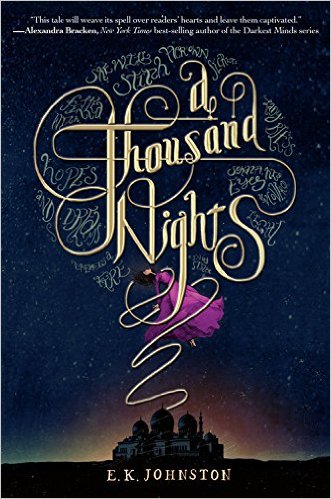 A Thousand Nights
Written by E.K. Johnston
Publisher’s Synopsis: Lo-Melkhiin killed three hundred girls before he came to her village, looking for a wife. When she sees the dust cloud on the horizon, she knows he has arrived. She knows he will want the loveliest girl: her sister. She vows she will not let her be next.
And so she is taken in her sister’s place, and she believes death will soon follow.
Ages 14-18 | Publisher: Hyperion | 2015 | ISBN-13: 978-1-4847-2227-4
Add this book to your collection: A Thousand Nights
Available Here:

Praise:
“Johnston is a true master of storytelling. Readers will feel like they’re sitting by the fire, eating fragrant olives under a starry night sky.”—The Children’s Book Review
About E. K. Johnston
E. K. Johnston is a forensic archaeologist by training, a book seller and author by trade, and a grammarian by nature. She spends a great deal of time on the Internet because it is less expensive than going to Scotland. She can probably tell you, to the instant, when she fell in love with any particular song; but don’t ask her, because then it will be stuck in both of your heads.
This discussion with E.K. Johnston about A Thousand Nights was conducted by Denise Mealy. Discover more books like A Thousand Nights by following along with our reviews and articles tagged with E.K. Johnston, Fantasy, Magic, Middle East, Myths & Legends, and Young Adult Fiction.
