

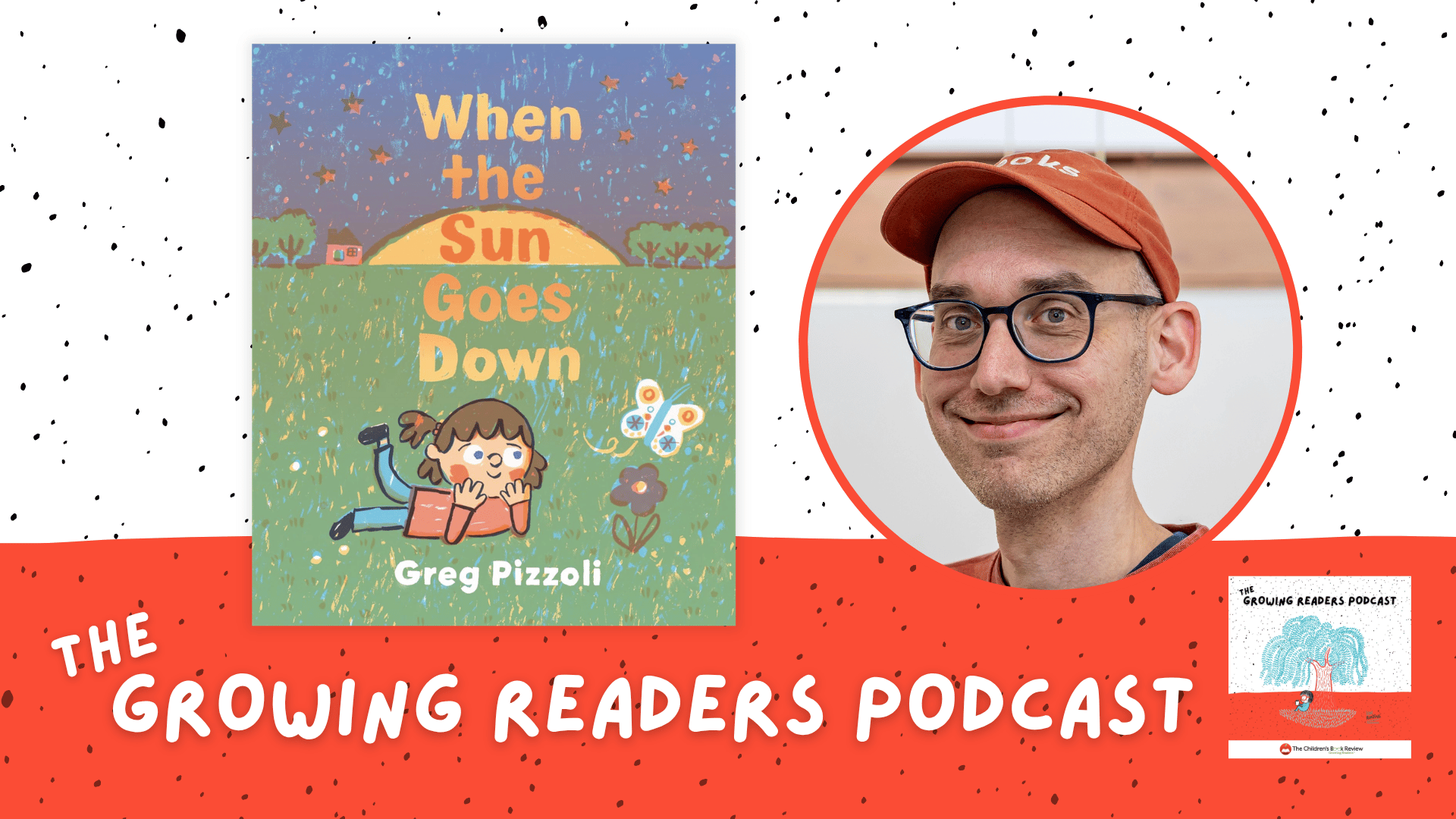
A podcast interview with Greg Pizzoli discussing When the Sun Goes Down on The Growing Readers Podcast, a production of The Children’s Book Review.
Greg Pizzoli trades big laughs for quiet bedtime moments in his new picture book, When the Sun Goes Down.
What if a bedtime classic started on the back of a receipt? Listen in as award-winning author-illustrator Greg Pizzoli shares how a sleepless night with his infant daughter sparked When the Sun Goes Down. From the cut critter that sent him back to the drawing table to the five-layer printmaking process behind the book’s cozy art, Greg reveals the craft behind this quiet, starred-review favorite and why bedtime books can become part of a family’s shared language.
Subscribe to The Growing Readers Podcast to ensure you never miss an episode celebrating the creators shaping young readers’ lives.
Listen to the Episode
The Show Notes
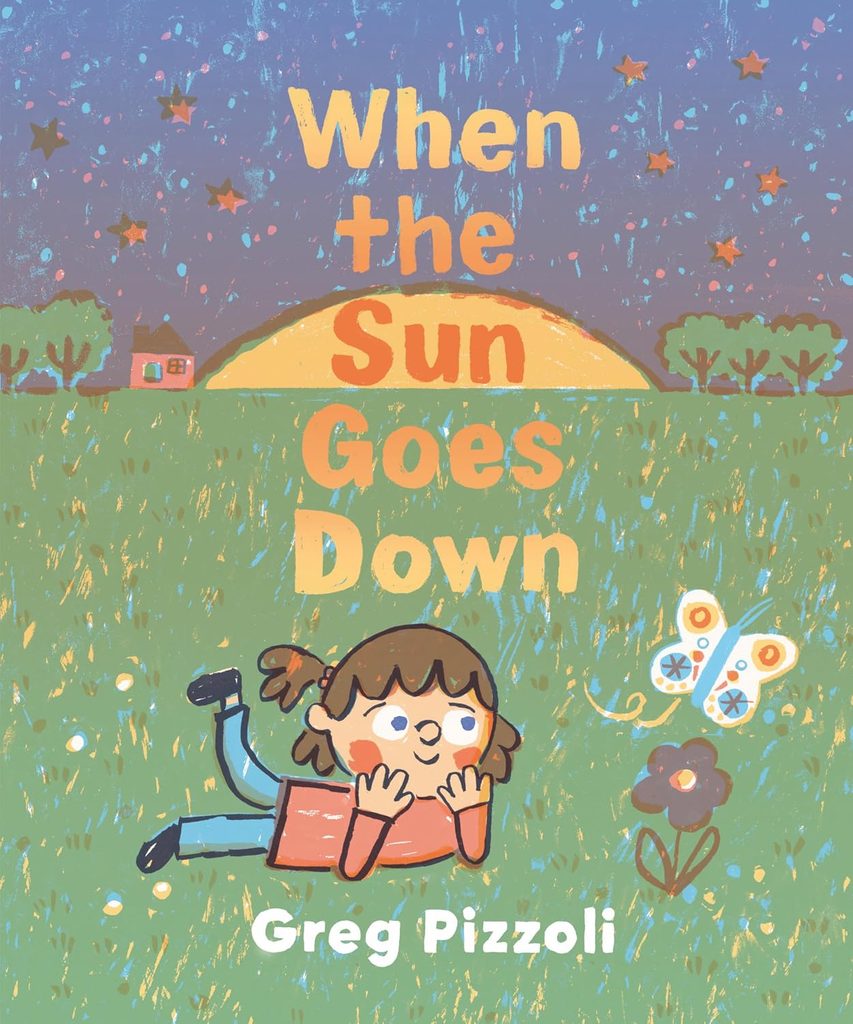
When the Sun Goes Down: A Bedtime Book
Written and Illustrated by Greg Pizzoli
Ages: 2-5 | 40 Pages
Publisher: Knopf Books for Young Readers (2026) | ISBN-13: 978-0593649800
Publisher’s Summary: Butterfly
Butterfly
Where do you go?
Where do you go
when the sun goes down?
I go under a leaf.
I find a good leaf,
and crawl underneath.
The sun is going down and creatures outside and inside the house are ready for sleep. But where do they go? Come along as a young girl spends her evening learning just where butterflies and kittens go to get their rest. Through soothing and interactive dialogue, the creatures answer the question “where do you go when the sun goes down?” until the girl finally makes her way safe and sound to bed.
Perfect for curious children and restless readers who need one more story before bed, this engaging picture book gives readers a peek into the nighttime habits of some of their favorite creatures. Award-winning author Greg Pizzoli’s gentle rhythmic text and snug illustrations make this the perfect last read before turning out the light.
Buy the Book
Borrow the Book
About the Creator
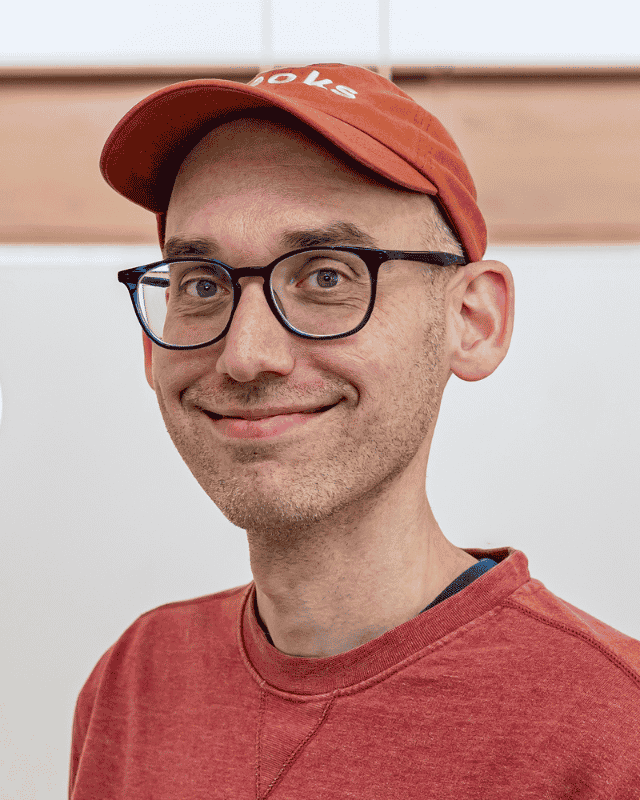
Greg Pizzoli is the author and illustrator of the Theodor Seuss Geisel Award books The Watermelon Seed, Good Night Owl, The Book Hog, and Earl and Worm: The Big Mess and other stories. He is also the creator of the Baloney and Friends graphic novel series. He lives in Philadelphia.
For more information, visit www.gregpizzoli.com or check out his substack at gregpizzoli.substack.com.
Credits:
Host: Bianca Schulze
Guest: Greg Pizzoli
Sound Editor: Kelly Rink
Producer: Bianca Schulze
Read the Transcript
Bianca Schulze
Hi, Greg. Welcome to the Growing Readers Podcast.
Greg Pizzoli
Hi, Bianca. Thank you so much. Thank you for having me.
Bianca Schulze
Absolute pleasure. I’m really lucky. Most of the time I meet people on this podcast, I actually haven’t met them in person, but I was really lucky to get to go to a dinner with you at the NCTE conference last year. Random House was putting together this amazing meal for the educators to meet you, and I was lucky to tag along with a librarian friend, Suzanne Costner, and it was just so great to get to meet somebody in person before they come on the podcast, and it was such a fun evening.
Greg Pizzoli
Yeah, that was a super fun evening. Yeah, we hosted a little dinner and we drew together, you and I. We got to draw together. That was fun. And I promise I didn’t realize that. I didn’t cheat. I wasn’t like, “I’m gonna pick her so I can get on the podcast.”
Bianca Schulze
Yes, exactly. And you know what? You made complete fun of how I draw a circle. I’m not very good at drawing a very round circle. So I mean, you actually could have written yourself off being a guest on the podcast.
Greg Pizzoli
Well, I don’t recall making fun of how you draw a circle. I’m sorry about that.
Bianca Schulze
All right. Well, I want to warm up with some rapid-fire questions. Are you good with that?
Greg Pizzoli
Mm-hmm. Sounds good.
Bianca Schulze
Okay, good. Night owl or early bird?
Greg Pizzoli
I am an early bird.
Bianca Schulze
Sunset or sunrise?
Greg Pizzoli
Sunset. Counterintuitive to my first question.
Bianca Schulze
Was there a bedtime book that you’d request over and over as a kid? And if so, which one?
Greg Pizzoli
One that I remember really well was The Little Mouse, the Red Ripe Strawberry, and the Big Hungry Bear, by Don and Audrey Wood. And I read that to my own children many, many times as well.
Bianca Schulze
Yeah, me too. I love The Big Hungry Bear and the sniff, sniff, sniff moment.
Greg Pizzoli
Yeah, yeah. Exactly.
Bianca Schulze
What’s the best place you’ve ever fallen asleep that wasn’t a bed?
Greg Pizzoli
Oh my gosh. The best? I don’t know that I’ve ever fallen asleep. Anyway, I’m a notoriously bad sleeper, and I have trouble without my white noise machine and my glass of water. I think maybe a train in Thailand. I remember a particularly long journey that I took one time when I was just so exhausted that I was surprised I fell asleep on a train. That was fun. Yeah.
Bianca Schulze
That’s awesome. Well, you probably had the white noise sound from the train going over the train tracks.
Greg Pizzoli
The click-clack, click-clack. Yeah, exactly.
Bianca Schulze
Yeah. If you were a critter in your book, When the Sun Goes Down, which critter would you choose to be, and where would you go when the sun goes down?
Greg Pizzoli
Hmm. I think all of the animals—so in the book there’s a butterfly, a bird, a fish, a cat, and an ant. I think they all have pros and cons. I probably would be a house cat, though. That seems like the most comfortable and most closely resembling my own life as a human. I was tempted to say bird because of the flying, but I think house cat’s probably more comfortable. Yeah.
Bianca Schulze
Yeah. Well, let’s get into some longer answers. So they say that to be a writer, you need to be a reader first. So was there a pivotal moment when you first considered yourself a reader?
Greg Pizzoli
Yeah, I can think of a few. I mean, I didn’t immediately connect with books, with reading. We did visit the library a lot. I was raised by my mom, and we hit the library a ton. I would say the first book that really connected with me, or I connected with, was Arnold Lobel’s Owl at Home.
I love Frog and Toad. I think Frog and Toad are as close to perfection as anything can get. But my favorite book when I was a kid was Owl at Home. And there’s a story called “Strange Bumps” in that book. I’ve talked about it a bunch on my Substack and stuff. I talk about it when I visit schools. This story, what he’s—you know, Lobel is such a genius at doing was he would make you as a reader feel smarter than the main character.
There’s the story “Strange Bumps” where the owl sees these two strange bumps at the foot of the bed. And right from the jump, every kid knows those are his feet, but he imagines that there are these horrible things that are going to grow in the middle of the night and crush him in his sleep, and he ends up destroying his bed. And I think that for me was a falling-in-love-with-reading moment for sure.
Bianca Schulze
Yeah, that’s awesome. Well, what would you say it is that guides you and drives you to create books specifically for kids?
Greg Pizzoli
I think kids are really the ideal audience, honestly. I think they’re very, very open-minded. I think that you can go places in a story with a kid’s book where your audience will accept, okay, we’re going here now. You know, as an example, I have a daughter who’s turning four today, and I went into her school and read a book as part of her birthday celebration. And the book she chose was The Amazing Bone by William Steig, which is one of my favorite books, and it’s become one of her top five for sure. And it’s about a bone that talks and sort of saves a young pig’s life from—spoiler—from a fox who’s trying to eat her. And no one in the little class of like 15 preschoolers that I read to questioned that, well, why is the bone talking, or how does that happen? They’re just into it immediately. And I don’t think that means necessarily that you can do anything, you know. Each book has its own logic, and you have to sort of convince your readers of the world you’re building. But for me, I think kids have allowed me to make books about what I’m interested in. And they’ve sort of let me keep going. You know, they’ve sort of followed me with my interests.
I’ve never felt as though I have to make a book for this reason or to say this thing that somebody else and some external thing wants me to say. I’ve been able to make the books that I wanna make, and kids have been there for it. And so I just keep going because I’m still interested in doing it, you know.
Bianca Schulze
Yeah. Well, first of all, happy birthday to your daughter. That’s so exciting.
Greg Pizzoli
Thank you. Yeah.
Bianca Schulze
Four is such a great age. I also love that she just didn’t default to one of her dad’s books, right? Because your books are awesome, but she defaulted to something else. And I just think that’s really cool. What does she think about your books?
Greg Pizzoli
It is really. She’s very cool. She’s very, very cool. She does not care what anybody thinks. And I think that makes her effortlessly cool. My almost-six-year-old, who’s also very cool and very sweet, has started kindergarten, and she has had library once a week and has brought home one of my books like every time. And I think it’s so sweet. It’s like, but honey, we have these books. You don’t have to get these. Last time she brought home a Narwhal and Jelly, so I think she’s gotten the hang of it now. She understands.
Bianca Schulze
Yeah, I love that. I love that. Okay. Well, what’s one thing that you do in your day-to-day creative practice that listeners might find surprising or even just relatable?
Greg Pizzoli
Well, I think, like a lot of creative people, I have, you know, the same anxieties and insecurities that come with being a self-employed artist in the world that we live in right now. And so I’m a big list maker. I don’t know if you relate to that, but I’m very much an every-morning-over-coffee—I sort of—my good friend Bob Shea started this Substack about time management, and he calls it time blobbing, where you take everything you have to do and you put blobs of time you associate with it. And I’ve been doing that probably for six months to a year, and it’s really helped me sort of stay on top of my tasks day-to-day. In terms of creative play in my studio, it’s maybe surprising that I have a dedicated Lego space in my studio. Part of that is having two kids, a four-year-old now and an almost-six-year-old. So when they come here, they have something to do. But also it’s like a sort of unwinding, turn-off-my-brain-a-little-bit, fun thing for me to do too. So, I don’t know if—
Bianca Schulze
Yeah. I definitely make lists. So when you ask me if I find that relatable, I do. But if I get really, really busy, it’s just my calendar. I mean, I would be nothing without my calendar. And in a way, that’s my list where everything is listed out. And if I don’t get to it, it just gets dragged and dropped to the next day, and I know that I have to get it done.
Greg Pizzoli
Yes, right, it’s just—yes.
Bianca Schulze
So in a way, I guess I’m making my list every day, just doing it in a different way. Yeah.
Greg Pizzoli
Yeah, I mean, I think especially the family calendar with, that’s when swim practice is, or that’s when Girl Scouts is starting, or whatever. That’s very, very important. But I find it really helpful for me to start each day and just sort of break down, you know—my wife and I swap childcare days. So, you know, do I have five hours of the studio, or do I have seven hours of the studio? And how much time is each of those tasks approximately going to take? And I’ve gotten better at predicting how long things will take. At first maybe I thought answering all my emails would take 15 minutes, and it takes two hours. So you have to sort of learn as you go. But it’s become an integral part of my studio day for sure.
Bianca Schulze
Yeah. The email situation can be very real. I mean, I think that time blobbing for that is definitely—I think that’s an important thing because, like you said, it can suddenly suck up a good part of your day and nothing’s done.
Greg Pizzoli
Yeah. Well, and the thing with the time blobbing thing that I found helpful too, something you just said rang a bell, is that it gives you permission then to be done with it. If you’re like, all right, I’m gonna do that for 90 minutes today, if you’re doing a Pomodoro thing or something, and you say, okay, I’m doing it for half an hour, and then when that half hour’s done, you say, okay, well, I did that. I did the thing, and now I don’t have to—or if you’re on a roll, you can keep going and maybe eat time from something else. But I think breaking things down into smaller, quote-unquote, bite-sized tasks gives you that feeling of accomplishment. It’s kind of like the chapters in an early reader. You know, you break the story down, and so the young reader feels as though they’re gaining momentum. Not to bring it back to books, but that’s—
Bianca Schulze
I know. I loved that you brought it back to books. I was like, touché, that was amazing.
Because on that note, we should dig into When the Sun Goes Down. And so it’s a picture book. It could also work like an early reader. And it could also be an incredible board book. I mean, I just think it’s kind of genre-crossing, format-crossing in that way.
But I just want to start by saying congratulations first, because it’s earned three starred reviews from Kirkus, The Horn Book, and Publishers Weekly. And Kirkus even said it has all the markings of a contemporary bedtime classic.
Greg Pizzoli
I did see that. Thank you.
Bianca Schulze
Yeah, you’re welcome. So knowing how hard those final stages of finishing a book can be, how does it feel to have this quiet little book make such a big splash?
Greg Pizzoli
Well, it feels great. You never know if you’re really on to something. You know, you’re listening to your internal voice, and maybe you have a literary agent like I do, or you have an editor that you’re sort of working with and bouncing these things off of. I think this was one of the few times in my career where I felt like the reviews really got it.
They were really picking up what I was hoping they would. Sometimes I read reviews, and I’m like, it’s perplexing as to why they interpreted it the way they did. I don’t relate to their understanding of it. But this was one of the few times where I felt like—and it’s not just because of the stars, even the reviews where I didn’t get stars—I felt like they sort of understood what I was trying to do. And that felt significant to me.
And I do think that this is an early reader in a way. I mean, it’s the first time I’ve tried to make a quote-unquote bedtime book. And I do think it will translate to board book well. That’s something that my publisher and I have talked about, for sure. And a lot of my books are picture books but have been sort of designated early readers. The Watermelon Seed was a picture book. The Book Hog, Good Night Owl, those really—Earl and Worm was my first, like, hey, this looks and feels in the format of an early reader. But I think this book, I could see it feeling that way because it has the same sort of repetitive language, you know, using the same words over to create that rhythm, and it’s relatively short. I don’t know off the top of my head how many words it is, but I would imagine it’s like 200 words long at the most, something like that. So I found it very fulfilling to be able to go into kindergartens and preschools and be able to read this book to them after reading The Watermelon Seed, when everyone’s sort of amped up and they’re all clapping along with the crocodile, to then be able to take a smaller, quieter, more contemplative text and hold their attention in the same way. I don’t know if you can hear, but I think there’s a plane flying right over my studio. It’s probably pretty loud.
Bianca Schulze
I can’t hear it.
Greg Pizzoli
You can’t? Okay. It sounds like it’s five feet above my roof.
Bianca Schulze
Ha ha. Well, where did the seed of the idea for this book begin? Did it start with that refrain, “Where do you go when the sun goes down?” Was that what came first for you, or was it an illustration, or maybe a real bedtime moment with your kids?
Greg Pizzoli
Yeah, it was the latter. I remember it very clearly. It was 2021, and my oldest daughter was less than a year old, and we were sleep training, which anyone who’s ever been through sleep training with kids before knows is a very, very trying time, because basically, if you haven’t done it before, the theory is that they need to learn to sleep without you in their own bed. So you have to put them down in their crib and let them cry it out, basically. And so my routine and my wife’s routine in the evenings was, after dinner and everything, after bath time, rocking her to sleep and basically just trying to get her to fall asleep so that we could gently put her down and then tiptoe backwards out of the room without waking her up.
And between bath time and that tiptoeing, I would rock her for, you know, at least maybe half an hour every night to try to lull her to sleep, after having read many, many great board books and picture books. The Very Hungry Caterpillar was a very popular one. Goodnight Moon was a popular one. She loved The Quiet Noisy Book by Margaret Wise Brown. She loved that text. So do I.
It’s incredible. And my book, When the Sun Goes Down, directly references that book, The Quiet Noisy Book, in the way that the refrain of “no, no, no, no, no”—that’s basically from that book, you know. And I was rocking her in a dark room, pacing back and forth, singing songs. I had like three songs that I always sang to her, and this line, “Butterfly, butterfly, where do you go? Where do you go when the sun goes down?” fluttered across my brain. And I had a receipt in my pocket and a pen. And I remember holding her and trying to write it down as best I could on the back of the receipt. And I think it probably took a few months after that before I figured out, this is the rhythm, this is how I could—but there was an immediate connection to just the sound of those words for me, and I knew that I wanted to make it a book that was for that time in a family’s life. Most of my books before that were either graphic novels or they were picture books that were meant to be read aloud in big rooms. A librarian doing a story time with 50 kids on the floor, or me at a school visit with 500 kids on the floor. The books were big and somewhat bombastic, and I think because this was my first experience having children and reading to them at night, it was the first book that I wanted to make, or that I made, that sort of wanted to speak to that specific time in a day.
Bianca Schulze
Yeah. Oh, everything you just said was so relatable. I’m a mom of three kids: one who was a terrible sleeper, one who was an amazing sleeper and tricked us into having a third kiddo. And then the second the third kiddo was born, she stopped sleeping. But it’s exactly the reason I wrote my first picture book, which is Don’t Wake the Dragon. And it’s all of those moments where you would finally get your kid to sleep and then somebody would make some obnoxious sound. We lived in an apartment building. Anyway, so yes, I mean, so relatable.
Greg Pizzoli
I was just telling—I have a parenting tip for anyone who has got a newborn. Check your microwaves. Look up your microwave online. You might be able to hold down the number eight for a long time, and it will turn your microwave beep off. Because I just remember putting some coffee in the microwave and then forgetting that I put it in there, and it would beep. And I was—ahhh, I would freak out because it was so loud. And I figured out how to turn it off, and it’s changed my relationship with my microwave.
Bianca Schulze
Oh my god, that’s hilarious. And when you were talking about holding your daughter, singing those three songs, that moment where you finally rest them down in their crib and you’re sneaking out, we had a floorboard that you had to avoid. And if you hit it and it went creak, then you knew that you were back to the start again. Yeah.
Greg Pizzoli
Mm-hmm. I know the steps in my house with my eyes closed, where to step so that I don’t make a creaking sound, for sure. Yep.
Bianca Schulze
Yeah, so funny. All right. Well, how did you choose which creatures would make the cut for this book, and were there any critters that you loved that didn’t make the final book?
Greg Pizzoli
I think I wanted to go with very sort of basic animals that city kids and rural and suburban kids would all experience. My kids are city kids. You know, I’ve lived in Center City, Philadelphia, for like twenty years. So they see a squirrel and it’s very, very interesting to them. And so I didn’t necessarily want to do barnyard animals.
One I can remember that didn’t make the cut was—the first couple of dummies included a worm instead of an ant. And then I realized, I don’t know, I was reading about worms for something else, and I was like, they’re nocturnal. They don’t go to sleep at night. They come out of the ground at night, so this is not gonna make sense anymore. And I did a book years ago called Good Night Owl that was about an owl who went to bed at night, and I got a fair number of emails and inquiries through my fan mail thing, with kids saying, like, why does this owl go to sleep at night? And so I’ve had to explain that he’s a burrowing owl from Florida, which they are diurnal, so that’s why he’s sleeping at night.
Bianca Schulze
Ha ha ha. Kids are so smart.
Greg Pizzoli
They are. They’re so fun. And they see things that you don’t see. But I changed it to an ant because I thought, well, it’s a similar scale, and I felt like I could make a cool illustration of him burrowing through a tunnel or something, and it’s conceivable that it would be sleeping at night.
Bianca Schulze
Yeah. Well, Publishers Weekly compared the build of this book to Brown Bear, Brown Bear, What Do You See? by Bill Martin Jr., and that’s exactly what was going through my mind as I read it, because that was a book that I read on repeat with my kids, along with the—my brain just—yes, yes, Big Hungry Bear. Thank you. Everything in my brain just erased. So I’m wondering, for you, is that call-and-response pattern something that lives in you from all of your reading as well, and that was kind of the natural flow of it, or it just came out that way?
Greg Pizzoli
It’s okay. I think a few reviews compared it to Brown Bear, Brown Bear, and we do own that book, and I definitely have read it with my kids. It’s interesting because I think we have two copies of it, one of which asks the kids, like, do you see a mother at the end? And one of them says, do you see—I see a teacher? So it changed at some point.
I don’t know which came first, to be honest. But I really wasn’t thinking about that book when I made this. And I think it’s a fair comparison. But for me, I was really building to that call and response, or the question and answer of, you know, do you sleep under a leaf? No. Do you sleep underground? No.
And that really, as I said before, came from The Quiet Noisy Book by Margaret Wise Brown. And I just think that something has evolved in my work. I’m lucky enough that I’ve made several picture books, and I can sort of see what’s happened over the last five years or so. And I’ve noticed in my writing that I’m asking a lot more questions of my readers and trying to make the text a little more interactive, because especially when you’re reading one-on-one or one-on-two, when you’re reading with children in your lap, there are so many moments of interactivity that are not in the text. You know, you’re pointing out pictures, or I’ve seen people read my books where they change the words and they sort of make little jokes and things, and I’m okay with that. I guess I try to—lately I’ve felt like I’ve been giving more room for those conversations to happen. Right. So it’s kind of a silly thing to ask a kid, like, do you sleep under a leaf? And they say, no. But I’ve noticed in general, in my pizza book and I have a book coming out next year, The History of Ice Cream, I just have been asking more questions. And I think that this book was just part of that same process.
Bianca Schulze
Yeah, yeah. I mean, the “no, no, no” part—I loved that moment in the book. A lot of people send me their books for review on The Children’s Book Review, and I don’t turn down self-published books. A lot of people do, just because—I really believe that everybody has a story to tell. But a lot of people try to do this sort of repetitive call and response and make their books interactive. And I write interactive books, I love interactive books. But a lot of people don’t know how to make it exciting, you know, or to change up the beat and the tone of the book. And I was wondering where you were going to go with the sort of repetitive call and response. And when you got to this moment, I absolutely loved it. And kids love the opportunity to say no, because often when they’re toddlers, you know, their parents and everybody around them want them to say yes to everything, right? And here they get to just be “no.” So I really loved that moment.
Greg Pizzoli
Thank you. Yeah. I think the book has a definite shift. You know, the first part of the book is asking the animals the questions, and then there’s a spread where—yeah, it’s already asked a bunch of animals where they go at night. The child in the book has asked them where they go, and they’ve given their slanty-rhyme answers. And then the book says, “And what about you?” And it’s asking the kid in the book, but it’s also asking the kid who’s reading the book, where do you go when the sun goes down? And when I’ve read it with kids, my own kids and kids at school visits and stuff, usually when I say, “Do you sleep under a leaf?” they say, “No.” And by the time I ask them the fifth question, “Do you sleep on a chair?” they’re yelling at me. They’re yelling, “No!” Although, if I say, “Do you sleep on a chair?” there’s always one kid who says, “Sometimes,” you know, which is fair enough.
Bianca Schulze
Yeah, yeah.
Greg Pizzoli
And I think building towards a payoff is—if you don’t do that with a book, as you were saying, it can start to feel just like a list. You’re just reading a list of things. And so I agree with what you’re saying. You need to have something that switches it so that it feels like it was building to a payoff and not just, okay, we have all this information. I don’t know what to do with this energy now, you know.
Bianca Schulze
Yeah. Exactly. I’m wondering, do you read it aloud to yourself and even to your family members or, you know, to your own kids, now that they can give you feedback, right? Do you read it aloud? And how much revising does it take you to get that rhythm just right, to get that crescendo, that part of the book that we’re leading to for that payoff? How many times do you have to go through a draft to get that right?
Greg Pizzoli
It depends on the book, depends on the draft. I do read to my own kids. I read them stories that I’m working on. They are very familiar with characters now that probably won’t be in books till like 2030, you know. Assuming they get made into books, so hopefully so. I think When the Sun Goes Down, because it’s a relatively short poem, the text didn’t change a ton from the early drafts. I think the thing that I spent a lot of time on was getting the dummy in shape and figuring out, how am I gonna fit five questions and answers on one spread, and how am I gonna turn a page and make each page turn feel really consequential, you know?
That stuff took a lot of time. For other books, I will just kind of write something, and then—each of my kids gets to pick one book every night. So we read two books every night at least, or sometimes two chapters of something. And I won’t make them sacrifice their own picks for mine, but I will slip in one of my own sort of working drafts every once in a while. And it’s not necessarily about asking them whether or not they like it, because they like me and they’re gonna tell me that they like it. It’s more that reading it aloud is very, very important. That’s the number one tip for every writer of picture books: You need to read your work aloud. But when you read it aloud over and over again to yourself, the familiarity of the sound will start to sound correct. It will just inevitably sound right, even if it’s not actually the way that it should be written. And so I think when you read it to fresh ears, you can pick up on little cues, or you’ll hear something different yourself that can tell you a lot about whether or not a text is ready or whether it’s working or not.
I often visit schools. I travel all over. I was just in Wyoming last week visiting schools. It was great. And I will very often read them, in school visits, something—if it’s far along enough that I have sketches, that I can show them some pictures too on the projector—I will read to them something that I’m working on. And I’ll just say, okay, we have five more minutes. I just want to show you guys something. And I can sort of tell during the presentation if in that five minutes there’s a moment where I’m like, boy, this is dragging, or if I just find myself skipping a page, like, we don’t need to do this part. That’s very telling.
Bianca Schulze
Ha ha ha.
Greg Pizzoli
And you really only get that from performing it. You know, I have come to think of my books, even my graphic novels, which I often perform on school visits as reader’s theater with kids from the school, I think of them as performances. Now they’re not plays. That’s a different art form. But this is something that is not meant to be read by the intended audience. It’s meant to be read to them. And so someone is going to be interpreting your work and performing it. And to not try to get that experience yourself and read it aloud as much as you can in front of people seems wild to me, that you would not do that. So I do that as much as I can.
Bianca Schulze
Yeah, yeah. So great. Well, let’s talk about how you approach the art, because I think you did such a great job of keeping things pared down, and it’s just such your style, but it’s also got this really cozy feeling. And I love the way it moves from that flower-filled backyard to the sort of snug indoors as night settles in, and colors start to change from beginning all the way to the end. So talk about how you create the art and your use of color. We’d just love to hear about it.
Greg Pizzoli
Sure. Well, thank you. Yeah, I made this book very differently than all of my other books. I made it using pen and ink. I used a pen called a Pentel Pocket Brush Pen, and I used just regular Canson mixed media paper that you can get at any Dick Blick or any art store. And what I did was, each image in the book is made of five different drawings that were then sort of smooshed together. So I drew all of the blue stuff on one piece of paper. And then I drew all of the yellow stuff on one piece of paper. And when those pieces of paper overlap, they create a green where they touch. Some of it stays yellow and some of it stays blue. But if there’s blue and yellow in the same place, they create green, right? I drew them all in black, scanned them all, and then in Photoshop made them those different colors. But I am a printmaker. I taught silkscreen at University of the Arts in Philadelphia for I think like seven years. I got my MFA there in printmaking, and so my brain thinks like a screen printer. I think in layers. If I need purple and I need red, well, I might as well just print red and blue, and then I’ll get purple as a bonus color. You know? And so each of the drawings is made up of five black-and-white ink drawings that were then scanned and then layered together by the printer to create this kind of effect. And I know this is an audio podcast, but there’s this chatter that happens where maybe the blue and yellow didn’t overlap totally, so you see one or the other peeking through. And for me, it was like trying to keep the images really, really simple, trying to make them almost like kid art, but making it complicated enough and interesting enough for me to still be really interested in it. And so I actually have this process post that I’ve been meaning to do for my Substack, where I explain how I did it, because I love that stuff. I love reading about process stuff. But yeah, you can see maybe, when you look through the images, all that little overlap, that purple is made from where the blue and the—so what I did was I made a pencil drawing, and then on a light box made each of the individual drawings. And I just sort of work intuitively from making screen prints for the last 25 years. I have a screen printing studio here in my art studio. And sometimes I would mess it up and it wouldn’t look good. And it was kind of easy enough to just draw another one, and I would do it again. And I really, really enjoyed the process of making it. I don’t know if you relate to this, but I almost feel restless as a creator. I feel like I get bored with whatever I just did. So I made this book on the heels of making three Earl and Worm books. And I love my Earl and Worm books, but they were all drawn digitally. And I just wanted to get off the computer and do as little as possible on the computer. And so I have a computer table, and then I have this other table that’s just my drawing table where there’s nothing electronic over there. And I would lug my light box over and just draw there all day. And it was like a balm, as an artist who was burnt out—as much as I love those books, I just needed a change. I was feeling really restless. And then after I finished that book, I was like, I want to do a book with dip pen now. So that’s just kind of how it seems that I work. It just seems to be that I will never really feel super confident in anything that I’m doing, because I’m always interested in, ooh, well, how would that work? And it means that I always feel somewhat like an amateur at whatever I’m doing. I feel like, though, I like—
Bianca Schulze
Yeah. I feel like, though, to create everything you just described, that’s the process of it, right? Because if it was very formulaic and you knew, oh, we do this and we do this and we do this, everything begins to look the same. AI art, right? So I love hearing about the process and the restlessness and knowing when you’re getting bored. And when you change that up, that’s what makes it exciting for the people who appreciate your art. Like, what’s Greg gonna do next? What color palette are we gonna see? Right. And even if they’re not necessarily thinking it so articulately, subconsciously, the readers, the librarians, the educators, you know, they get their favorite authors and their favorite artists. And, you know, we love it when we see something just a little different, a little unexpected. And yeah.
Greg Pizzoli
Yeah, I think that there’s a lot—and I’m not putting anyone down specifically, but I do think that there is something very cynical about contemporary publishing in the way that, the sort of sequel machine aspect of it, where it just seems like, well, we have this thing and it worked, so let’s put a Christmas hat on it and it’ll work again. And, you know, I say that as someone whose last two books that I made are sequels. Both of them will come out next year. It was very interesting to me, just sort of intellectually, to make a sequel. The last book that I finished illustrating was the sequel to The Watermelon Seed. It’s called Night Night Crocodile, and it will come out June of 2027. And it was so almost surreal to work with a character that I had made the book for 14 years ago. And my hand has changed in 14 years. The way that I hold a pen has changed. The way that I approach things. But I was like, well, I wanted to reference this book and feel like a sequel to that book, but I can’t draw the way that I drew then. It just is not gonna happen. And maybe I don’t even want to, you know? And I think my editor very kindly called it style drift. And, you know, it was just like, well, this is who I am. This is how I draw now, and I like it now. And I don’t know where I’m going with that. It’s to say that I would find myself—and I’m lucky. I recognize I’m lucky to be able to take those risks. And not everyone gets a chance to illustrate a book by Margaret Wise Brown with rubber stamps like I did. And I just feel like it’s really what keeps me super interested. And every book, you start from scratch, you know, even if it’s a sequel. I think you should find a way to make it interesting for you and obviously for your readers too.
Bianca Schulze
Well, The Horn Book praised the way the book celebrates the small rituals shared across living beings. So why do you think bedtime rituals, and bedtime books in particular, matter so much to kids and the grown-ups reading with them?
Greg Pizzoli
I think it’s just such a big part of the day for so many families. For our family, it is. We have rituals that—I don’t think I was always so routine-oriented. I’ve always been someone who’s spent a lot of time in the studio. I’ve always been someone who puts off doing laundry until I absolutely have to because I want to be in the studio. But I think particularly with young kids, you know, bedtime is somewhat sacred. You need to hit that bedtime, or you’re gonna pay for it the next day. And so, at least in our house, we have dinner time at basically the same time every night. And then after dinner time, we have a dance party. We pick three songs of varying quality and we dance to them, and it sort of gets all the wiggles out. And then we either do the dishes or do bath time, depending on who wants to do what. And then we have book time right before bedtime.
And it’s just part of that routine. And so it’s also sacred. That is a threat in our house. If someone is really acting out or really not doing bath time the way that they need to be doing it, maybe a secondary threat is, like, you’re gonna lose your book. You’re not gonna get your book pick. And then that sort of gets everybody in line pretty quickly. And I think it’s just one of those moments too where, especially now that my older daughter’s in kindergarten and she’s sort of entered the conveyor belt of education, she’s in a system now, you know, where I’m not as big a part of her day as I was even a few months ago. It’s that shared time every night where we’re gonna come together, we’re all going to focus on this one thing. We’re gonna feel the same rhythm, and it becomes part of the shared language too. Both of my kids will reference things that happen in books, or something will need to be explained, and it’ll be like, well, it’s kind of—do you remember that book where—it just becomes part of our vernacular. Even going back to William Steig’s The Amazing Bone. My now, as of today, four-year-old, for the last year, she’s been three. She’s the only three-year-old that I know that would call someone an odiferous wretch, because that’s an insult from that book. And it just became a joke in our house. You scoundrel, you worm, you odiferous wretch. You know, it just becomes part of your language. And I think that parents are tired and kids are sort of screened out, and there’s all sorts of reasons that you might not have the time, or feel like you don’t have the time, to take those five minutes to read a picture book. But I think it has become such an important part of our family’s sort of what we share day to day that we always make time for it, you know.
Bianca Schulze
Yeah. That’s so beautiful. I heard so many different things in there, in the sense of it creates safety, comfort, togetherness, connection to similar things. And I love that point you made about those inside jokes, right, that reading gives you. You know, there’s something so fun where you can connect with one another in that way. And then there’s just so much evidence out there that shows that families that do what you do, Greg, that read with their kids from the time they’re babies every single night, they just do so much better at school, because it’s that fundamental skill behind every other kind of learning, to be able to read the words and understand what you’re reading.
Greg Pizzoli
Maybe I had that, maybe within her kids.
Bianca Schulze
So anyway, I love that. I am so curious now, what do you hope that this book becomes for the families who read it?
Greg Pizzoli
I hope that it connects them in some way, that it creates that moment. I’d like to think that it would be somewhat soothing, calming—not necessarily fall asleep while you read it, but, you know, sort of, this is quiet time now. We’re sort of winding down. And I think that those moments that we were just talking about are super special, and sometimes they call for a funny joke or a funny book, and sometimes they call for a more sort of serious topic that might need to be dealt with. But for me, this was really about that connection between a caregiver and a child, which you see in the book. You see the mom holding the baby. And yeah, I just hope that it becomes part of that routine. Just to—Marylin Hafner in my house is like a celebrity. Good Night, Gorilla or Officer Buckle and Gloria, they’re big names in our house. And it’s, you know—I meant Peggy Rathmann. I said Marylin Hafner. I’m sorry, I meant Peggy Rathmann.
Bianca Schulze
Yeah. I was gonna let you go, and then I was gonna say, it’s Peggy Rathmann. And I swear we must have the same books on our bookshelf, because all the books you’re reading to your kids are the same ones I read to mine.
Greg Pizzoli
I love Marylin Hafner so much, that’s why I said Marylin Hafner, but Peggy Rathmann—they’re so—I love Peggy Rathmann. And I love Marylin Hafner too. I mean, there’s a book that she did about these two cats, Rollo and Juliet, that is incredible. It’s one of my favorite books ever. But just to become part of that for me, it would be, you know, just an honor to be on the shelf, you know, to be part of your routine or part of your shared vernacular. I don’t know that William Steig ever thought odiferous wretch would become an insult that kids are slinging around at each other, but it would probably be fun to know, you know.
Bianca Schulze
Well, Greg, of everything that we talked about today, if our listeners just took away one thing, what would you hope that it is?
Greg Pizzoli
Read to your kids. Support local independent bookstores if you can. And if you’re writing, read your work aloud as much as you possibly can.
Bianca Schulze
Yeah. Well, Greg, it’s been such a joy to hear how When the Sun Goes Down came to be. And you’ve created a book that slows everything down in the best possible way. And I think so many families will enjoy making it part of their nightly ritual. So thank you too for being so open about your journey, you know, just as a creator, and for the care you put into making good, honest books for kids with your human hands. And we’ll all be watching for the return of The Watermelon Seed next year. So thank you again, Greg. It’s just been such a pleasure.
Greg Pizzoli
Thank you so much. It was so nice talking to you. Bye.
