

By Caitlin Kittredge, for The Children’s Book Review
Published: April 29, 2011
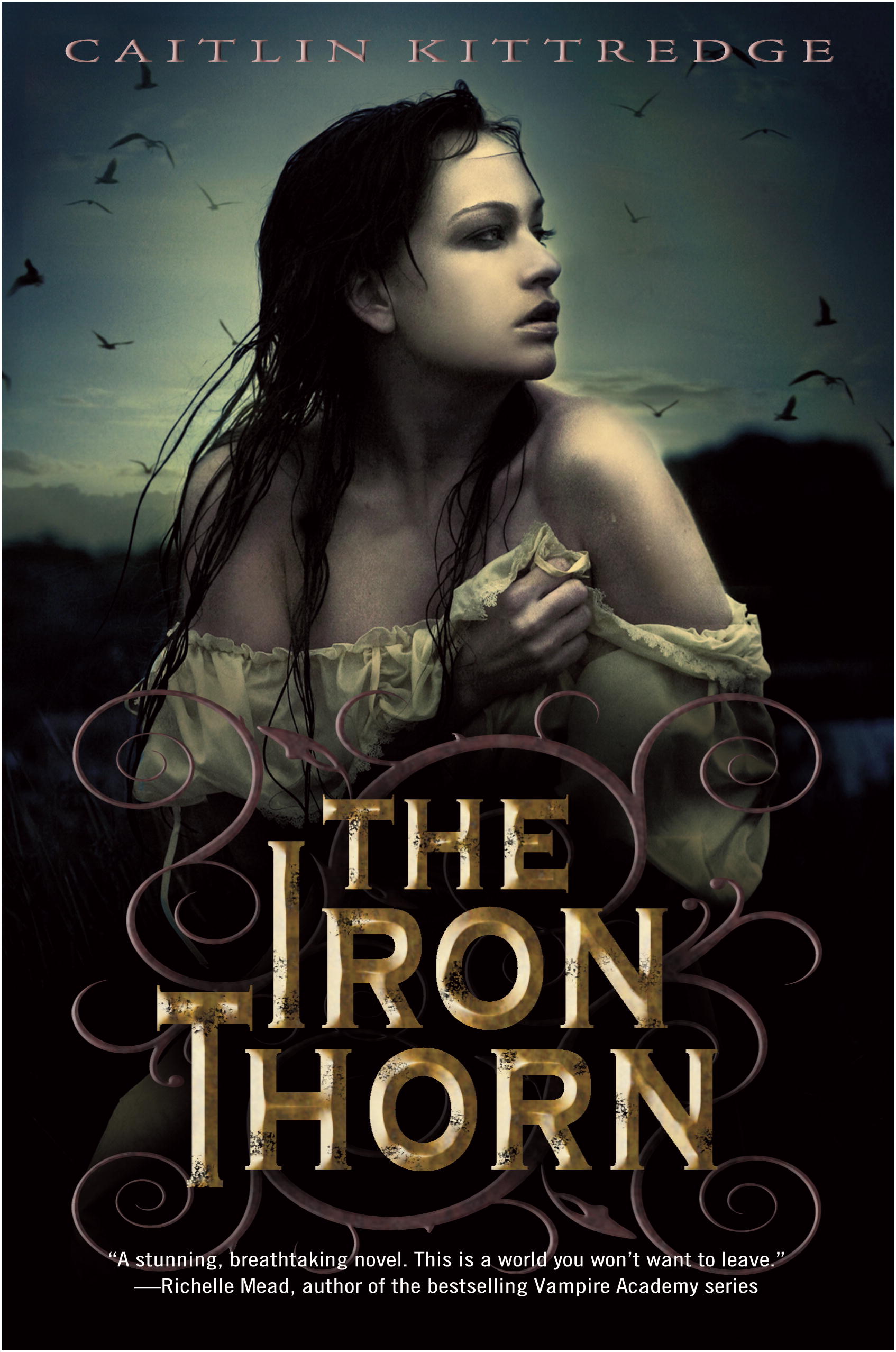
 I knew when I set out to write The Iron Thorn that it was an alternate history novel (albeit one set in the 1950s) and that I’d run into language barriers. Not the type you’re thinking of—but slang, etymology and yes, even swearing.
Somebody asked me recently what I thought of swearing in YA, and my answer was the same as it is for adult fiction—don’t be gratuitous, but when it’s situationally appropriate, then hell yes. Swear. Sidestepping so-called “bad words” lessens the impact. You run into a roadblock though, writing about teenagers in the 1950s. Pop culture at the time liked to pretend that teenagers didn’t swear (or, except in a few rare cases, smoke, drink or even let the possibility of sex cross their minds.) I turned to my mother, who was a teenager in the late 1960s, as a primary source, and from there I extrapolated some real language, supplemented by books on 50’s pop culture for slang and references. That was the easy part.
Writing alternate history, or any fantasy, really, you run into what speculative fiction writers called the moss troll problem—author Marissa Lingen, who coined the term, describes it thusly: “The advantage of writing urban fantasy or world-crossing fantasy is that when the sea serpent has eyes the color of NyQuil, you can say so rather than spending time trying to come up with settlement-era Icelandic-ish equivalent having something to do with moss-troll ichor. Because then you’re stuck with moss-trolls, and also they have ichor, and you can pretty well guarantee that’s going to come back and bite you in the butt in another book or two: you didn’t have to deal with moss-trolls *before*, and now you do, and it’s a lot of bother just for a color analogy.”
There’s a ripple effect in alternate history, much as there is in second-world fantasy, like the one she describes—change one thing, such as the purpose of the Manhattan Project—and there’s a massive ripple. NyQuil definitely won’t exist. Entire lexicons appear or disappear. Sometimes, I’d look at my manuscript and be sure I was overwhelming readers with unfamiliar words. But it is alternate history, and I tried to keep a few familiar, iconic bits of the 1950s intact. Joseph McCarthy is still a prominent politician—in fact, he’s the president. Howard Hughes and Juan Trippe are still waging their war over TWA versus Pan Am—their fleets just consist of dirigibles rather than airplanes. Kids still go to school, congregate at diners and listen to Elvis, but they do it in the shadow of steam power and fascism rather than atomic energy and a burgeoning civil rights movement. And every bit of that impacts their language, their lexicon, the voice of the world that they live in. An author must be ever-vigilant in this alternate history, to avoid a ripple that will have the same effect as a butterfly flapping its wings to form a typhoon—eagle-eyed readers will rip your world to shreds, all because of a misplaced analogy or two.
If this all sounds like an enormous amount of work for very little reward, I’d encourage anyone thinking about alternate history to dive in. Yes, there’s more research and more thought during the drafting process (when every word might change from the norm, it becomes almost like learning a new language) but it is such a rewarding prospect to see a book, based in a world that you wholly created, in finished form.
Finding the language of an alternate history is a huge undertaking, and a very tiring one compared to writing a paranormal fantasy set in the modern day, or even in a non-altered historic setting (also known as a “secret history”, where nothing is altered but fictional events are woven into the historical narrative) but I think writing The Iron Thorn made me a better storyteller, more aware of those ripples even in my more realistic fiction. I won’t get taken unawares by the moss trolls again, that’s for sure.
CAITLIN KITTREDGE is a history and horror movie enthusiast who writes novels wherein bad things usually happen to perfectly nice characters. She is the author of the Nocturne City series, the upcoming Black London adventures for St. Martin’s Press, as well as the Icarus Project superhero saga for Bantam Spectra (with Jackie Kessler) (all adult projects). She lives and writes in Massachusetts. You can visit her at CaitlinKittredge.com.
