


An article by Kristen Witte for The Children’s Book Review.
Since the mid-15th century, tarot cards have been used as a tool for connection and entertainment. This article explores the way you can use these witchy cards to encourage creative and honest conversations with kids and adults alike.
The History of Tarot Cards
While you might be used to seeing tarot cards promoted in store windows of strip mall psychics or making cameos on your favorite TV show during spooky season, if you had lived in the 15th century, you would’ve had a much different relationship with the ornate cards.
Italian families in the 1400s used the deck of cards the same way we’d pick up a bicycle deck—to play card games together. Similar to the 52-card deck you’re familiar with today, the tarot deck has four different suits: cups, pentacles, swords, and wands. Each suit contains the cards Ace through Ten, and then four court cards, the Page, the Knight, the Queen, and the King (one extra than the three-piece court you know!)
Things get a little fancier when you add in the Major Arcana cards, which were in the deck as trump or “tarocci” cards. This 21-card portion of the tarot deck follows the Fool’s journey through life, experiencing cards like Justice, Death, and The Sun, before culminating in The World.
Over time, this 78-card deck drew interest from artists and spiritual practitioners alike, with different creatives creating their own interpretations of the tarot deck. Nowadays, you’ll see a huge variety in the beautiful decks that are available to practice with, fitting niches all the way from Cat Tarot to the traditional Smith-Rider-Waite tarot deck.
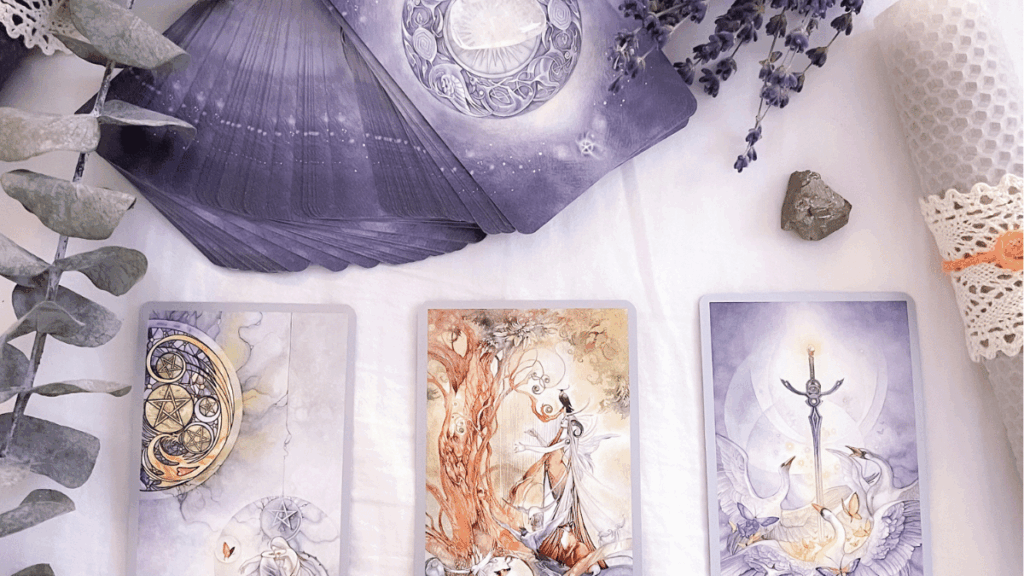
The Tarot Basics
Once tarot took on new life as a spiritual practice, the cards themselves each took on their own meanings as well. The minor arcana, the four suits and their corresponding Ace to King cards all represent an element and area of life, Cups, the suit of water and emotions, Pentacles, the suit of earth and the body/physical, Swords, the suit of air and intellect, and Wands, the suit of fire and passion/creativity.
Together with the major arcana, these cards reach across almost all elements of life, making them excellent for storytelling, consulting one’s life path, or even providing thought-provoking prompts for conversation.
Tarot for Kids
While lore maintains that one should be 13 to have a tarot deck of one’s own, the artistic and storytelling nature of tarot makes it naturally attractive to audiences of all ages. Because each card has its own meaning and lesson, it’s a fantastic tool to introduce to the children in your life to help spark discussion and reflection for all the different ups and downs of life.
How to Use Your Tarot Deck With Children
Start by explaining the backstory of tarot to inspire respect and appreciation for the practice. Next, find a guidebook to reference as you start to get used to the different cards and their meanings. The Inner Tarot by Kate Van Horn is a fantastic tool for deeper learning, and The Children’s Illustrated Book of Tarot by Kristen Witte is a great option to use with kids.

Next, cleanse your deck and add any pre-deck rituals to help set the scene. Some readers knock on their deck or blow on it to shake off the old energy. Do what feels right to you to help you and the child both get into the right headspace.
Fan the cards out face down across a table and ask the child to hover their left hand over the cards until one feels a little different. Sometimes an area might feel hotter or colder, or you might even experience a buzzing feeling as you shift your hand across the cards. Once they’ve decided on their card, turn it over to see what they picked.
Reading the Tarot Card
Once you’ve selected the card, ask the child to talk about what they see in the artistry. Is there a person on the card? Do they look happy or sad? What colors do you see that stand out to you? What do you think is happening in the card?
Prompting with questions like these can help the child understand the card and its meaning before needing to open up the guidebook. Instead of trying to memorize meanings, look to the cards and their artwork to be your first clues.
Once you have a basic idea of the meaning, flip open to your guidebook to see what else the card might mean and try to come up with a question that the card might want to ask of you. For example, The Fool card, the first in the Major Arcana, represents jumping excitedly into the unknown and starting an adventure. If this is the card the child has selected, try asking a question like, “Did you go on any adventures today?” or “What’s something you’re excited about right now?”
The cards can act as natural conversation starters to move you and the children in your life away from the tired and often dismissed question of “How was your day?”
With help from the cards, you’ll spark deeper and more meaningful conversations with the children in your life, and likely get to know things about them and their thoughts you hadn’t known before!
You can do this routine as frequently as you want, but it works best as a daily practice of reflection. Add it into your morning routine before school to set the tone, or wind down with a card and conversation to recap the day before bedtime.
Tarot has been used for connection and communication for centuries. The children in your life will enjoy honoring that tradition and connecting with you over a fun, exciting, new way to view the world.
About the Author
Kristen Witte is a former elementary school teacher and current Tarot enthusiast. Always on the lookout for social-emotional learning tools for both herself and others, she stumbled upon a deck of Tarot cards and hasn’t looked back. She believes the tool can help create an ongoing discourse between children and their caretakers about mental health, processing emotions, and approaching each day as a learning opportunity.
Kristen leads community relations for tech companies by day, and dreams up more book ideas by night. She lives in Austin, TX.

Learn more about Kristen’s latest book here:
The Children’s Illustrated Book of Tarot: An Adventure Through the Major Arcana
Written by Kristen Witte
Illustrated by Margarita Kukhtina
Ages: 5-8 | 56 Pages
Publisher: Odd Dot (2025) | ISBN: 978-1250370136
Publisher’s Book Summary: Open the door to a world of wonder and self-discovery! The Children’s Illustrated Book of Tarot: An Adventure Through the Major Arcana invites young readers (ages 5+) and their grown-ups on a captivating journey through the timeless wisdom of the Tarot. This beautifully illustrated picture book brings the 22 archetype characters and symbols of the Major Arcana to life, helping children understand universal values like courage, empathy, and resilience.
Embark on an enchanting adventure! Follow The Fool, the Tarot’s main character, as they navigate life’s ups and downs, teaching children that they are the protagonist of their own unique story. Each vibrant, four-color illustration reveals a new character, from the brave Fool taking a leap into the unknown to the nurturing love of the Empress. Perfect as a read-aloud or a “read-together” experience, this book encourages young minds to explore their inner world.
Buy the Book
This article, How Tarot Cards Can Enrich Your Adult-Child Relationships, was written by Kristen Witte.
