

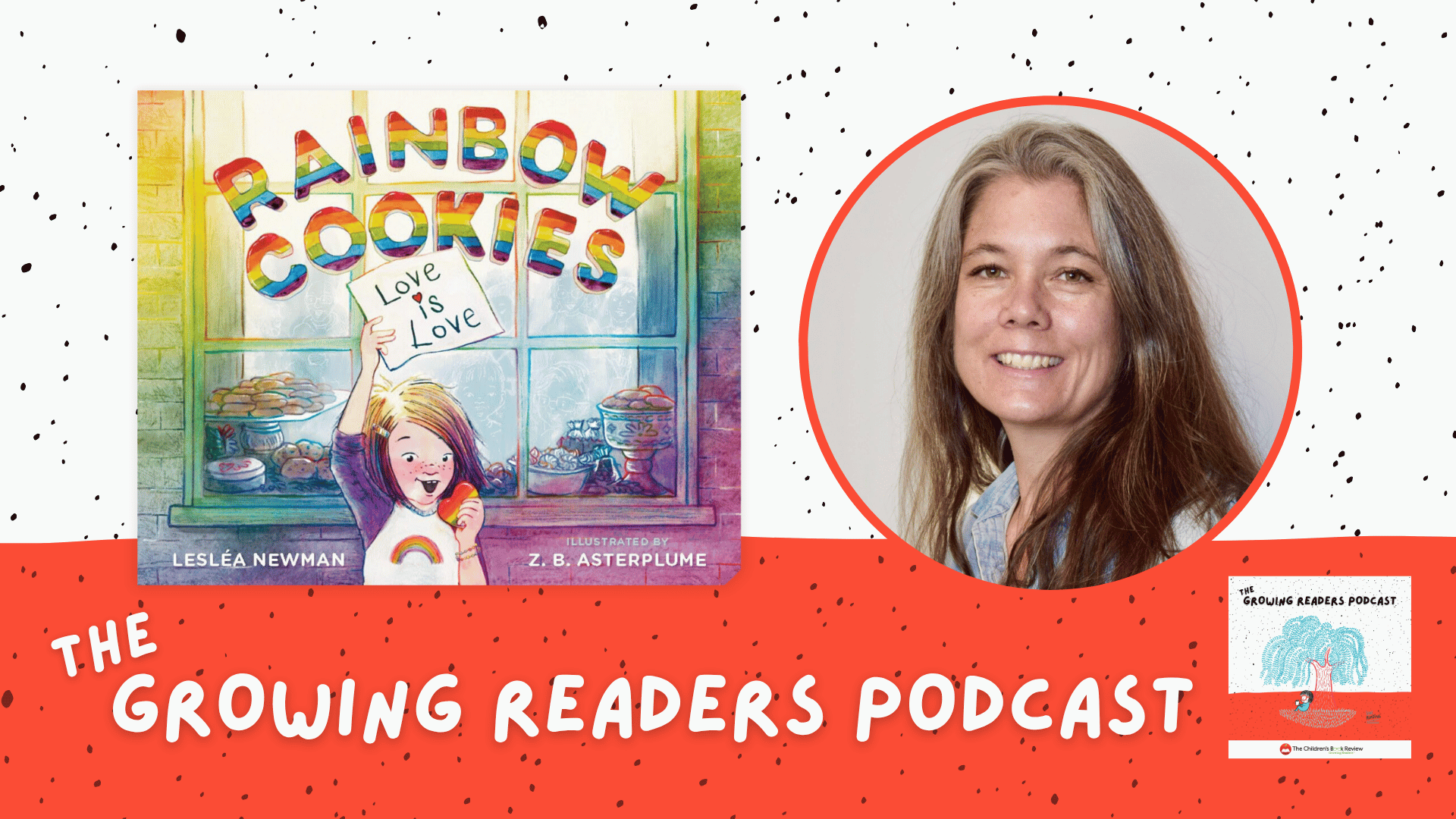
A podcast interview with Z. B. Asterplume discussing Rainbow Cookies on The Growing Readers Podcast, a production of The Children’s Book Review.
Join us for a conversation with Z. B. Asterplume about illustrating Lesléa Newman’s Rainbow Cookies, a story of Pride, community, courage, and one unforgettable cookie.
Every month, Ms. Madeleine creates a new cookie for her bakery, and every month, her loyal customer Cookie is first in line to try it. But when a rainbow-striped Pride cookie sparks backlash in the community, Cookie rallies friends and neighbors to stand up for kindness, love, and celebration.
In this episode, illustrator Z. B. Asterplume joins us to talk about bringing the warmth, joy, and emotion of Rainbow Cookies to life through illustration. We discuss visual storytelling, capturing community and connection on the page, and the role picture books can play in helping young readers see love, courage, and belonging reflected in the stories they read.
Subscribe to The Growing Readers Podcast to ensure you never miss an episode celebrating the creators shaping young readers’ lives.
Listen to the Episode
The Show Notes
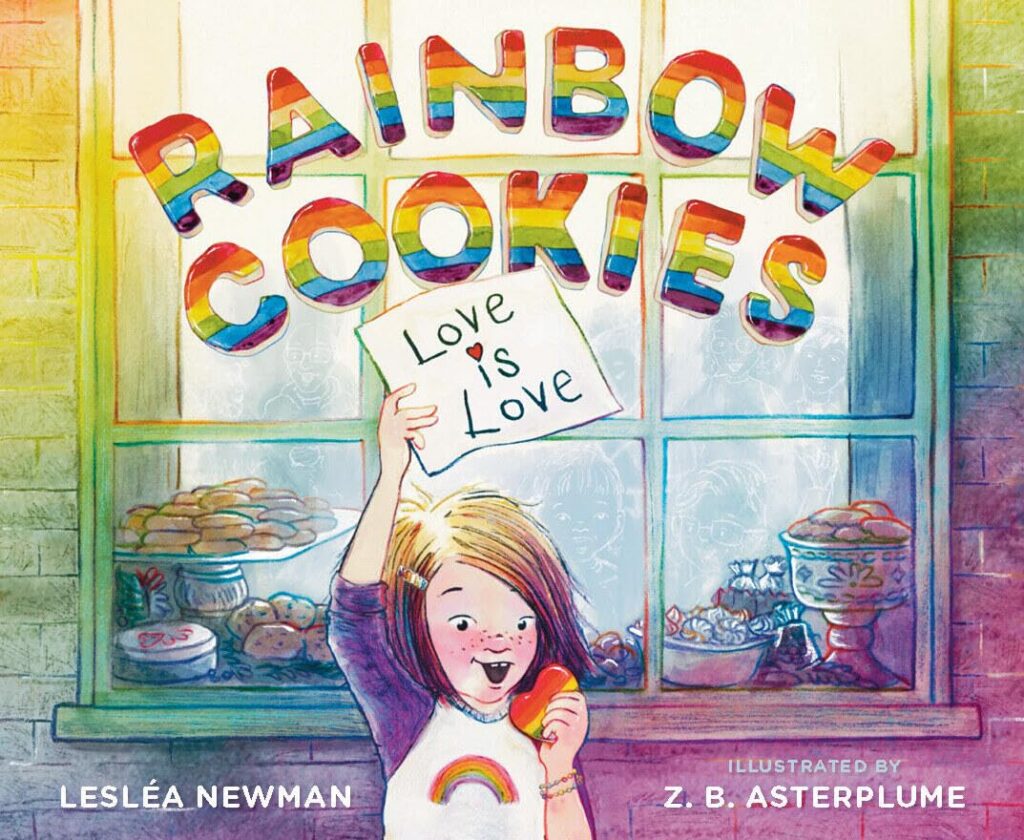
Rainbow Cookies
Written by Lesléa Newman
Illustrated by Z.B. Asterplume
Ages: 4-8 | 40 Pages
Publisher: Levine Querido (2026) | ISBN-13: 978-1646146314
Publisher’s Summary: All This Fuss Over a Cookie?!
Every month, Ms. Madeleine creates a special cookie of the month for her bakery. And her best customer, a little girl named Cookie, is always the first to try it. Ms. Madeleine’s sweet treats never disappoint.
When June arrives, Cookie and her two moms stop in and taste the best cookie yet: a heart-shaped, rainbow-striped, crunchy, frosted confection that Ms. Madeleine baked especially for Pride.
But Rainbow Cookies make some people in the neighborhood angry. They write harsh notes. They cancel orders. Ms. Madeleine is afraid her Rainbow Cookie might be her last.
But Cookie is not about to let that happen. With great determination and a fabulous idea, she gathers friends and neighbors to support Ms. Madeleine. Together, they show the whole town how colorful and fun and celebratory and delicious the combination of love, Pride, and cookies can be!
Buy the Book
Borrow the Book
About the Illustrator
Z.B. Asterplume began her illustration artistic career as a scenic artist for the Denver Center Theater Company, and has worked as a paraprofessional for special needs students in many elementary schools. She now works as a Direct Support Professional for adults with intellectual and developmental disabilities as well as writing and illustrating picture books. She lives in Westminster, Colorado with her family. Sometimes, a Tiger is her picture book debut.
For more information, visit: https://asterplume.com

Credits:
Host: Bianca Schulze
Guest: Z.B. Asterplume
Producer: Bianca Schulze
Read the Transcript
Bianca Schulze: Welcome to The Growing Readers Podcast. I’m so thrilled to have you here, Z.B.
Z.B. Asterplume: I’m so excited to be here and that all our tech is working.
Bianca Schulze: I know, right? The tech is always the hardest part. And once you get past that, it’s like the best conversations ever. Let’s warm up the conversation by playing a quick rapid-fire round of questions. Just the first thought that comes into your mind — no overthinking. Are you ready? Sweet or salty?
Z.B. Asterplume: Both at the same time.
Bianca Schulze: I love it. Cheater. Favorite cookie of all time?
Z.B. Asterplume: I’m going to say snickerdoodle, which is what it says in the book, but there are a lot of close seconds.
Bianca Schulze: And if you were having a chocolate chip cookie, would it be crunchy or chewy?
Z.B. Asterplume: Chewy. That was the easiest one.
Bianca Schulze: All right, pick a color from the rainbow — which one are you today?
Z.B. Asterplume: Purple.
Bianca Schulze: Bakery, library, or bookstore — pick one to spend the afternoon in.
Z.B. Asterplume: You know my answer because I put it on here. There are a lot of wonderful bookstores that have bakeries in them, so I’d probably hang out there. But still — shout out to beautiful libraries.
Bianca Schulze: Mornings, afternoons, or late nights — when does your best creative work happen?
Z.B. Asterplume: Morning, one hundred percent.
Bianca Schulze: A picture book that changed you. First one that comes to mind. You can change your mind later.
Z.B. Asterplume: It’s Freya Blackwood’s The Boy and the Elephant. Do you want the because, or is that the quick answer?
Bianca Schulze: Give me the because. I want the because.
Z.B. Asterplume: In my recent journey as a picture book maker, it gave me — not that I needed it — but it gave me permission to do things I wasn’t seeing in picture books until I saw that one. I thought, yes, that’s how I want to make them. I didn’t think you could do it like that and have that scope of imagination feel so natural. That book gave me that.
Bianca Schulze: I’m going to break my own rapid-fire rules here because I’m curious — was it a specific technique that she used? Something you felt like you weren’t doing before that she gave you permission to do?
Z.B. Asterplume: I definitely was doing it before — I just wasn’t sure it was going to be okay. That book is wordless, and yet it feels like it isn’t. The level and scope of imagination you have to accept in it is pretty big, and yet it feels very natural. My first book, Sometimes a Tiger, had that same scope. You have to bring a pretty wide imagination, and hoping that would feel natural was, in a way, inspired — though we actually did those books kind of simultaneously. It was just lovely to see that there were other folks out there putting that out as well.
Bianca Schulze: I’m a fan of Freya Blackwood as well. And she’s Australian — I feel like she is, anyway. Well, for the final rapid-fire question — and I realize it’s a bit of a hard one — but we’re going to be spending a lot of time talking about Rainbow Cookies, so let’s start us off. One word to describe the book.
Z.B. Asterplume: Inclusive, I guess, would be my word. And we can go deeper on that later.
Bianca Schulze: I love it. I feel like sometimes when you say ‘just one word to describe a book,’ it’s almost impossible — but I love that answer. Now, Lesléa wrote this book, but you are also a writer as well as an illustrator. I find your reading journey really refreshing because you didn’t consider yourself a reader until you were an adult, and even now you prefer books with pictures. I think there are people out there who need to hear that from you. Can you talk about your own path to reading and what role pictures play in that for you?
Z.B. Asterplume: I did read some as a kid — I do have favorite picture books from my childhood. My brother was a big reader, so we had a lot of books around. My parents were readers. But once the idea of reading became books that were just words and no pictures, I kind of fell off the path as I got older. I think I came back to it by making little picture books for my kids when they were small, and seeing how much they loved reading. We read together every night until they were in junior high — seriously, late into middle school we were still reading novels together. And then they went off and read their own things, and I had to learn to read my own. I do now, as an adult, read books without pictures, but I still very much love ones with them.
Bianca Schulze: I love that. You and I have traveled in similar circles but only recently really met each other, which is kind of surprising when you look back — you were working at the elementary school my kids go to. We’ve been members of the SCBWI Rocky Mountain chapter for a while too, and it’s a sizable chapter. But we’ve been really lucky to have some tea together lately. Something that really stays with me from our conversations is this idea that what drives you is creating something a child can hug and be comforted by — something that doesn’t change. I love that idea of a book as a constant in a child’s life. Can you talk about where that motivation comes from and how it shows up in the work you make?
Z.B. Asterplume: I hope it shows up! I’ve been sent pictures of kids hugging a tiger — my first book — and hopefully they’ll hug Rainbow Cookies, or at least eat a cookie while enjoying it. I think for a lot of children, the world shifts under their feet. It certainly does for adults, too. I grew up in a family where two parents went in two different directions, so that idea of what is stable can really shift. But if you have a favorite book — the words in that book don’t change. They might change meaning for you as you shift. I’m not saying they don’t. Some of the best books really do. But the book itself doesn’t say, ‘I didn’t say that.’ It’s not a moving target the way so much of the rest of the world can be. Toys evolve — a doll that was right for you at one age isn’t right at another. But a picture book a child truly loves is always going to be that for them. I’ve never met someone who couldn’t name a favorite childhood book and tell you exactly why. And I think if they came across it at a yard sale, even if they no longer owned it, they’d pick it up and think, ‘These words are still the same. I remember these pictures. I remember what it smelled like, where I was when I read it.’ That constantness — I find that comforting for myself, and I want to give that comfort to someone else.
Bianca Schulze: So beautiful. The wonderful Claudia Mills, who has written over sixty-five books for children, recently said that even now as an older adult she returns to her favorite childhood books as a source of comfort — when the things around her feel wild. That is the beauty of a book that can stay with you your entire life. It is a constant.
Z.B. Asterplume: Yeah. Thank you.
Bianca Schulze: I want to ask you about something I find fascinating. You regularly cull your sketchbooks — and I think a lot of people would assume artists hold on to everything. So tell me about that practice. What gets kept, what gets let go, and why is that part of how you work?
Z.B. Asterplume: It is not a popular practice among any of the artists I know, my husband included — he’s also an artist. A month ago there were twenty sketchbooks on the shelf behind me. I’m moving right now, so this is almost all that’s left in my studio. The process is pretty pragmatic: I go through and rip out the three or four drawings that were really impactful — either to a book or to me personally. And I stick them into one book. So I have a single sketchbook that’s just ripped-out pages from thirty or forty sketchbooks over the years. I rip out the things I love and let the rest go. It’s important to have the history and to see the evolution, but not an entire book of it. And honestly, I’d lose the good ones if they were buried in twenty volumes. Now I have those impactful moments all in one place, and the rest is recycled.
Bianca Schulze: One of my favorite children’s book creators who has been on the podcast recently — Alan Barillaro — who is also an Oscar-winning animator, talked about how important it is not to be too precious. If we’re too precious over every little word we write or every little picture we create, we get caught up and we get stuck. All of that playing — filling up those sketchbooks — is where the evolution happens. And then you go back and pull out your special moments.
Z.B. Asterplume: After I saw your podcast episode with him, I purchased his book and I’m reading it right now.
Bianca Schulze: Amazing. Well, we’re here to talk about Rainbow Cookies. Will you set the scene and talk us through how it all began? What’s the kickoff?
Z.B. Asterplume: I certainly can’t speak for Lesléa, since she wrote the words — her history with this story is long and beautiful. But I can speak to where I come in. I had met Arthur Levine at an SCBWI conference. He was very kind about my debut and my portfolio, and we just had that connection. Then six to nine months later, I was invited to do the illustrations for the book. They sent me the manuscript, and I looked through it and thought, this is amazing and beautiful and needs to be in the world. So I said yes. Then we start setting dates for concept art — how should this character look, how would you lay out the pages? They let me lay out the sketches myself, which was a gift. And in that process a little give-and-take happens. As an illustrator, you’re reading the words on two levels — what can become pictures, and what now has room to carry more weight on the page. If I’m showing something in the art, sometimes that frees up the words, and then a beautiful, profound moment gets to land more fully. My art director would talk with Arthur, the editor, who would then have that conversation with Lesléa: ‘Look, this is in the art — should we let these words breathe more?’ That was a wonderful process to witness. And there were also times they came back to me and said she’d really love to see something specific drawn in the book, and I was happy to do that. It gave me confidence in her vision that I was helping to support it.
Bianca Schulze: Part of the story is that Cookie is the main character, and there’s a bakery in her neighborhood that does a Cookie of the Month. When June arrives, Ms. Madeleine bakes a heart-shaped, rainbow-striped, frosted Pride cookie — and that’s when the story turns, because some neighbors start writing harsh notes and canceling orders. Lesléa has spent her whole writing life working into that exact moment where love and joy bump up against intolerance. When you had her words and her beautiful story, how did you decide what to keep in and what to leave out — so that those conversations can still happen after the book closes?
Z.B. Asterplume: I just noticed your rainbow earrings, by the way. I have to find out where those came from.
Bianca Schulze: I make them.
Z.B. Asterplume: My initial heart pull when I first read the manuscript — what made me so happy and made me want to hug the future book it would become — is that she paid so little attention to the villain. The problem is that somebody, or some people, are deciding for the community that these cookies aren’t right in some way. But she pays almost no mind to that. Her focus is: okay, how do we fix this? How do we move forward? How do we put what we know in our hearts should be available to everyone into the forefront? We spend very little time highlighting the people writing the notes. I really connected with that — because this is her own-voice story, her conversation around having two mommies and all of those things. But for me, my own-voice thought was: inclusion in general, love is really love no matter what. I loved forwarding that idea. That’s why you see the ‘Love Is Love’ poster on so many pages. Whether it’s race, gender, or age, there are so many moments in the world where people try to say this love shouldn’t happen. I really strongly felt this was a beautiful book about that — all love is love — and to have this innocent little girl, Cookie, look at the situation with a kind of confused clarity, like, why don’t people get this? It seems pretty simple. She doesn’t flinch. She just decides: I’m going to fix this. She goes about finding ways to support her community, and it was such a joy to see it so normalized. All of her friends are as different as we could possibly make them, which was important to Arthur and to Lesléa as well. Amongst all those differences, love still reigns supreme. It is always still love.
Bianca Schulze: That’s such a phenomenal answer. I was thinking as you were speaking about how important art is — whether it’s words, poetry, illustrations, or music, we’re all humans trying to make sense of the world. And Cookie is who makes this story sing, because she doesn’t just feel sad. She takes action. She rallies friends and neighbors. As adults we can take so much from children. We try to protect and cocoon them, and I think that’s sometimes where the fear of not understanding who loves whom comes from. But maybe we don’t need to protect our children — we need to learn from them. Do you want to add anything there?
Z.B. Asterplume: My favorite illustration in the book is actually the brief moment where Cookie allows herself to feel sad. She allows herself this quick processing moment — ‘that’s sad’ — and then she goes, ‘but it doesn’t have to be.’ She lets the sadness sit. We see a moment where her moms are able to support her in that sadness, and then she says, ‘Well, I have an idea.’ And her first idea doesn’t quite work — she goes, ‘Okay, we’ll buy all the cookies.’ It kind of does need fixing with money, because that’s the real problem: the shop will go under if nobody buys cookies. But you don’t just throw money at it. You ask where the systemic problem is. The neighborhood doesn’t know that this shop is suffering because a few voices have risen up. Let’s see if there are other voices out there with a different thought. She figures it out through trial and error, and then even she is surprised at the end by the amount of support and the way that love can travel along so many different lines to find the people who say, ‘Yeah, I think that too.’ There are many voices saying that. And she finds them. That’s just the brilliance of Lesléa’s writing — she really allowed that process. It isn’t just a snap decision.
Bianca Schulze: When you first read Lesléa’s manuscript, what was the visual world that immediately came to mind? And I’m especially curious about Ms. Madeleine’s bakery — there’s such a real visual language to a bakery the moment you walk into one.
Z.B. Asterplume: I’ll take you there — we live close enough that I will actually take you. It’s a bit of a compilation. I did have to visit bakeries to research the book. There’s one in Louisville and one in Lafayette, and then one near Five Points in downtown Denver that I had already photographed for the Sometimes a Tiger book. The visual language obviously always had to be every color of the rainbow. A lot of times when you start working on a book you ask, what’s my palette? But this one was obvious: candy, juicy, every color of the rainbow. That said, I do tend to step back from just straight Crayola colors. So the first thing I did was take my thirty-year-old watercolor set that I’ve been painting with since college, clean it out, and put in new half-pans of the most rainbow colors I could find that I still loved — closest to true rainbow but with my sensibility. The visual language was: there has to be a lot of color, but the rainbow needs to show up in impactful ways. Every page can’t be wild. Our eyes need to rest on some pages too. And then I took clues from the writing. Lesléa wrote that Cookie is ‘hungry as a dinosaur,’ so I knew she was a girl who wears baseball shirts and has dinosaurs on her clothes — she’s a little like me. Cookie could wear a tutu or jeans or overalls. I really understood her right out of the gate. I tend to have very messy hair and did as a child, so her hair was a little wild. The only note I got was that on the last day — the big day — could she have a barrette? It cracked me up. I’m sure it was like my grandmother and mother saying, ‘Could you just comb your hair? Just for today.’ And I loved that note, because they were thinking visually as much as I was. I thought, yes — she’s going to put the biggest, gaudiest, jeweled rainbow barrette she can find in her hair. She would absolutely do that. It felt very authentic to the character, and I’m glad it felt authentic to them as well.
Z.B. Asterplume: The barrette on the cover is actually digital — I had already painted everything.
Bianca Schulze: That’s so funny. It actually doesn’t look digital at all.
Z.B. Asterplume: I had to add it digitally because we’d already locked off the cover, but I was still doing the art for the rest of the book. It was easy to add it to the interior pages, but we realized the cover was from that same big day, and I’d already painted it. There was no way to go back and paint a barrette in — well, I suppose I could have scraped it. But digital was the answer.
Bianca Schulze: I love it. As you were describing all of those bright rainbow colors in the candy-pop zone, I think what’s really incredible about your style is that it’s generally softer and more muted — cozy and warming, the kind you snuggle up with. And you really did balance that. All of that softness still has a vibrancy, but when the rainbows need to pop, they pop.
Z.B. Asterplume: Thank you. And think Procreate. I did do it all in watercolor, but there were moments where I thought, I wish that would pop a little more. That’s where a little digital nudge comes in handy — you can just say, let’s pop it here.
Bianca Schulze: Let’s enhance! Well, let’s talk about your favorite spread in the book. Without giving too much away — can you walk listeners through your favorite moment, what’s happening on the page, and why it landed for you the way it did?
Z.B. Asterplume: There is a double-page spread that is everyone else’s favorite — and of course I love it, and it’s going to be a beautiful piece forever. But it isn’t actually my personal favorite illustration in the book. I do think it is the most impactful, though, and that’s the spread where everyone is lined up for the cookie shop. Cookie has finally said, ‘Let’s go — let’s get all our friends to come.’ And they’ve told their friends, who’ve told their friends, and the text says the line went around the block. In the original manuscript, Lesléa had actually written some of what those people were wearing — she said Jojo is wearing a clown suit. That was in the text. I would never have thought to put a clown going to a bakery, but that gave me permission. From that one detail, and a couple of others — rainbow sneakers, a specific outfit — I thought: if someone can be in a clown suit, I can have someone in a sequined gown. I can have someone in a rainbow baseball jersey. It gave me permission to really ask, who might have shown up at that bakery that day? I love that there’s a baseball team. There’s a child walking out with a box of cookies, and his dad or coach handing a cookie to a person in a full sequined gown — who has a beard and a tiara — and they’re just very casually saying, ‘Oh my gosh, you have to taste these cookies, they’re amazing.’ Every interaction on that page is a little vignette of a whole story. There’s a family taking selfies who are probably allies — not necessarily part of that community, but they’re there to support with cookies. There are people who are very definitely part of the community the book is shining light on. There are other families who are just there for cookies because that’s what they’re doing. There’s a big brother stealing his little brother’s hat. All of these moments show the different people who could show up in their community around an idea they might be strongly part of, adjacent to, or might just think — yeah, that’s how it should be, and I want to support it.
Bianca Schulze: Yeah. Well, let’s talk about collaboration. I have a feeling that for you, collaboration is a golden thread that runs through all of your work. What does true collaboration mean to you, and why does it matter so much in your artistic process?
Z.B. Asterplume: I might be jumping ahead, but I want to sneak this in here because it connects directly to my pen name. ZB Asterplume is not my legal name. My real name is Amber Owen. My pen name is ZB Asterplume because Amber cannot make these books. ZB Asterplume is Amber plus the critique group I belong to, the years of people helping me learn to be an artist, my children, my husband who has had to endure version upon version of things, my parents for setting me up to succeed as a writer and an artist over my lifetime, my art directors, my editors, my agent Deborah — just all of these people really live inside every book that goes into the world with that name on it. That’s who ZB Asterplume is. It is all of those people who came together at any moment in my lifetime and allowed me to funnel all of that into a product called a book. Collaboration is baked into every book, even the ones I wrote and illustrated myself. Amber still couldn’t do that. Z.B. does that. And it’s all of these wonderful people, experiences, and yes — my cat. I have two, but only one of them supports me. Collaboration is something you could not remove in any way from how I respond to and produce art and writing.
Bianca Schulze: Magical. I think it would be fair to say that your hope for this book is that it inspires inclusion and community action — going back to that rapid-fire word you gave us: inclusive. So when a child closes Rainbow Cookies, what would you most love for them to be feeling, doing, or saying?
Z.B. Asterplume: I would say agency. I think they’re going to be thinking about cookies first, and that’s okay — because who doesn’t want a cookie? But my hope is that they can see themselves, whatever their situation is, whatever their challenges in their life or community, and think: I have strength. I have a voice. I can have this conversation now because I have some context. And that’s my hope not only for children, but for anyone who reads this book — that it opens the conversation. Because when we shut down conversation and say, ‘I don’t like this idea, so we’re going to tuck it away,’ it doesn’t go away. It probably festers. Maybe it’s better to just have the conversation — whether a child is now able to have it with their parents, their peers, or with themselves, giving themselves some quiet strength because maybe that conversation isn’t allowed around them. That would make me happy. That makes me want to hug the book right now. And I think Lesléa just made it so — cozy and accessible and not heavy-handed. It just says: hey, it’s really kind of this simple. Let’s have the conversation. And I loved that about it. And about her writing in general.
Bianca Schulze: And simply put — who doesn’t love a rainbow decorated cookie? I mean, come on. I feel like we could have ended our conversation right there. But I know you have another book coming up this year. Tell us what’s next and what our listeners should be watching for.
Z.B. Asterplume: I haven’t done an event for Rainbow Cookies yet, so if there are Colorado listeners — I’m going to try to get something going in June, because that feels like exactly the right time. I’ve been in the middle of moving, so I didn’t quite pull it together for the book launch, but events are coming, and Lesléa is having events on her end back east in Massachusetts. My next book is right here — let me grab it. It’s called To Knit a Ghost, illustrated by Heather Brockman Lee. This is a case of collaboration again. I have done writing and illustrating myself, I’ve illustrated someone else’s words, and in this case I wrote it but did not illustrate it. I loved having had all three experiences. And this one was especially wonderful because I actually know the illustrator — in fact, it was her illustration that inspired the book in the first place. She posted a picture on Instagram of a little witch knitting a ghost. She had actually knit one and digitally compiled it. The second I saw it, I thought: that needs to be a book. I basically texted her the next day and asked if she’d written it yet. She said no, and I said, ‘Can I?’ She said yes. We both have the same agent, Deborah Warren at East West Literary, so we sent it to her together as a package — here’s the book, here’s the illustrator. The wonderful Maria Correa at Penguin Random House fell in love with it too. It comes out July 20th. It has a bit of a Halloween feel — witches, ghosts — but it’s really a year-round book. And the end papers actually teach you how to hold knitting needles and cast on, so you can knit your own little ghost. Yeah.
Bianca Schulze: Before we close, is there anything else you wanted to share — about Rainbow Cookies, your writing, your illustrating, anything I didn’t ask about?
Z.B. Asterplume: If I’m talking directly to anyone who is looking to be part of this endeavor — and I almost hate to call it a business — I just want to give you hope and inspiration. It is worth it. There are days when it doesn’t feel like it. It takes years and years, and you think: this is never going to happen for me. But it doesn’t matter if it’s been five, ten, or twenty years. I think of some of my peers who worked for twenty years before things caught fire for them, and now they are making so many wonderful projects. Do it for love. Don’t do it for the end game, because when the end game comes, it doesn’t matter how many years it took. You are holding a beautiful book in your hand. Those twenty years just disappear. You’re twenty years older and grayer and you’re holding this book, but you enjoy the process. Stay in it for the process. The process is the good stuff. Keep drawing. Keep writing. I have to remind myself of that too — just get up in the morning and draw, and enjoy it. It may become a book, it might not become a book, and that’s okay. In the moment, that process is a great thing to be doing. And when it does become a book, it won’t matter that it took twenty years. All of that melts away. So don’t focus on the end game or how long it took. Just focus on what you’re doing right now. It’s great and it’s fun. That’s it.
Bianca Schulze: Enjoy the process. Play, play, play. Z.B., this has been such a great conversation. Thank you for spending time with me and with the Growing Readers listeners. There’s a lot I’ll be carrying with me from today, including how you and Lesléa have worked into one of life’s hard moments with such care for young readers. Not heavy-handed — just so beautifully done. And this beautiful idea of a book as something a child can hug, something that doesn’t change in a world where so much else does. I love that. Rainbow Cookies is a beautiful, brave, and deeply joyful book, and the world is so much better for having it in it. Thank you for creating the artwork for this book, thank you to Lesléa for writing the words, and Z.B.— thank you for being here today.
Z.B. Asterplume: Thank you so much. And the last note is: now we have to meet in person again so we can have some tea and a cookie. We need to celebrate together with a cookie at a bakery with some tea.
Bianca Schulze: Yes, and a rainbow cookie.
