

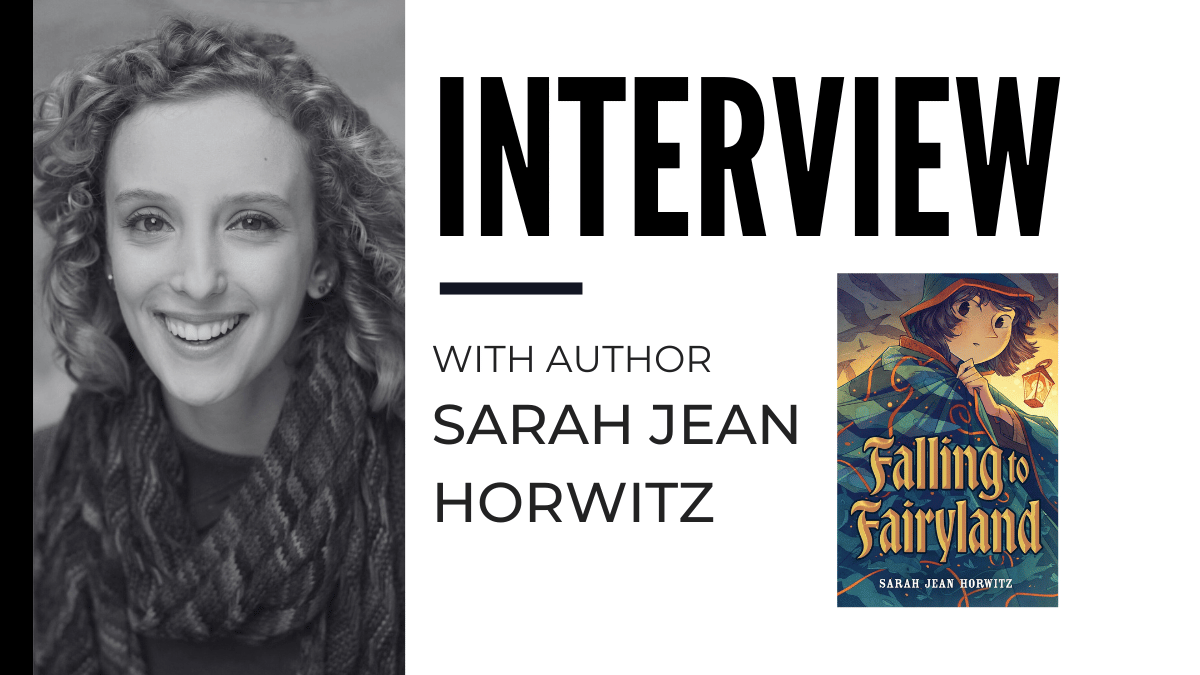
An interview about Falling to Fairyland by Sarah Jean Horwitz, presented by The Children’s Book Review.
We’re delighted to welcome Falling to Fairyland author Sarah Jean Horwitz for a behind-the-scenes look at building a Grimm-inspired world filled with magic, identity, and unforgettable characters.
From a cloaked boy named Cricket to a Fairyland filled with hidden truths, Sarah Jean Horwitz invites readers into a story where nothing is quite as it seems. In this interview, she shares the imaginative spark behind Falling to Fairyland, from the origins of Cricket’s name to the layered fairy tale traditions that shaped his world. She explores the emotionally complex relationship between Cricket and the Fairy Witch, the surprising evolution of the story’s mischievous narrator, and the journey toward self-discovery at the heart of it all.
Along the way, Horwitz reveals how themes of identity, belonging, and transformation emerged through the writing process, creating a richly imagined tale that reclaims classic fairy tale elements for a more modern, inclusive story.
Cricket is such a distinctive name for a changeling boy living in a fairy witch’s tower. How did you land on him as your protagonist, and what does his name say about who he is at the start of his journey?
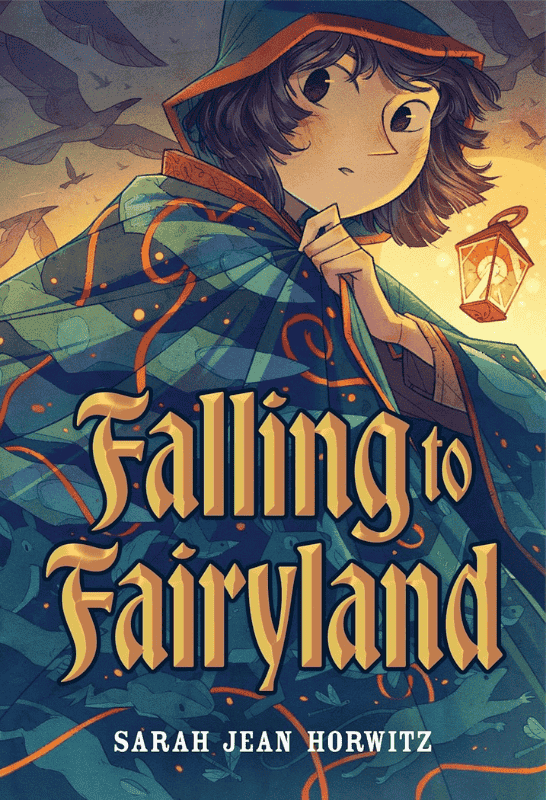
Sarah Jean Horwitz (SJH): Back in 2019, I was goofing around on GChat with a writer friend who jokingly suggested that since I was having some medical problems with my hands, I should procure “a ward” to do my typing for me and that he should “wear a lil cloak.” I remember nothing about my thought process but my response was simply, “the little ward’s name is cricket.” I even added some details about living in a tower with a giant spiral staircase and wearing a cloak made of the night sky…and I have absolutely no idea where I came up with these things. Imagination can be like that sometimes! Cricket lived in my head for years before I thought of giving him his own story.
I initially liked the name Cricket because it suggested smallness and sprightliness, both of which seemed like qualities a little changeling boy in Fairyland might have. Crickets are also a symbol of good luck in some cultures – hence the Fairy Witch, Cricket’s guardian, often saying that she keeps him for good luck. It’s sort of sweet, but also indicative of the way she exerts ownership and control over him. Lastly, Cricket is a diminutive form for another name that becomes important late in the book, and I loved the way that tied up the ends of the story. (I’m embarrassed to say that this last point didn’t occur to me until one of my trusty beta readers pointed it out, so I need to give credit where credit is due!)
The book has been described as a “Grimm-inspired Fairyland,” and reviewers have also drawn comparisons to the whimsy of Dianne Wynne Jones. When you were building this world, which fairy tale traditions were you most drawn to — and were there any you deliberately pushed back against?
SJH: I was heavily inspired by the Hans Christian Andersen fairy tale “The Snow Queen,” the Oz series by L. Frank Baum, and the Scottish folk ballad of Tam Lin. I loved all the winter imagery in “The Snow Queen,” the protagonist’s journey through uncharted lands, and of course, the quest to save a friend from a cursed pointy object. Return to Oz, the 1985 film adaptation of some of the later Oz books, was a childhood favorite of mine. The scene of Dorothy trying to steal one of Princess Mombi’s heads has lived rent-free in my brain since I was old enough to see the movie on VHS, and I thought it only fair I pass on that terror to the next generation of readers! Tam Lin is one of the more famous fairy folktales that involves shapeshifting. And of course, there are nods to other fairy tales all through the book, from Rapunzel’s hair to Sleeping Beauty’s spinning wheel.
In terms of any traditions I was trying to push back against, it’s pretty clear that Falling to Fairyland is much queerer than any of those older stories. (Although in fairness, the Oz books have much more gender play than you’d think.) I wanted to use the traditional trappings of the fairy tale journey to tell a more modern story of self-discovery and young queer identity.
Cricket’s relationship with the Fairy Witch is one of the most compelling parts of the story — she’s cold, possibly evil, and yet she raised him as her own. What drew you to that morally murky dynamic between a child and a caregiver who doesn’t fit neatly into the role of villain or guardian?
SJH: I’m so glad you found that relationship compelling, because I struggled to get that balance exactly right. I didn’t want to make the Fairy Witch too obviously evil, because then the reader might not be sympathetic to Cricket’s desire to stay with her and earn her approval. But I also wanted to make it very clear that this was an unhealthy relationship from the get-go. I was inspired by the relationship between Mother Gothel and Rapunzel in the Disney film Tangled. Mother Gothel and the Fairy Witch do care about their respective charges – they’re not completely heartless – but that care has limits, and it’s not real love.
I always find myself drawn to writing about characters who learn to cast off relationships or societal expectations that are no longer serving them or are keeping them from being themselves. This can be part of the queer experience, but it’s also just the experience of growing up, of learning that you can push past the boundaries of the world that the authority figures in your life have set for you.
The mischievous narrator is one of the most distinctive elements of the book. How did that voice develop, and did it change the way the story unfolded as you wrote it?
SJH: Would you believe that I had no idea who the narrator was until I was more than halfway through the book? I simply needed another party to the story who was more detached from the action than Cricket and Isaac (the other major point-of-view character). This person needed to be a little older and wiser; they needed to tell the reader things that Cricket and Isaac didn’t or couldn’t know. But they also needed a plausible reason to be removed from much of the story and not get in the way of Cricket and Isaac’s adventure. It wasn’t until I was plotting out one of the climactic sequences in the novel that I realized exactly who would have such intimate knowledge not only about Fairyland, but about both Cricket and the Fairy Witch’s secrets. Then I went back and reworked the narration to be truer to that character.
Cricket is a human in Fairyland, a changeling with rare and dangerous magic, a boy on the edge of his thirteenth Change Day — someone defined in almost every way by not quite belonging. How did you approach writing a character carrying that much otherness without it feeling like a burden on every page?
SJH: Cricket’s struggles with his secret power and his identity are certainly burdensome, but they’re also not the only things that make him Cricket. He’s still capable of having moments of joy and love and normality and boredom and everything in between. It also helps that his burden begins to slowly lighten the moment he sets out on his journey, even if he doesn’t realize it yet. Giving Cricket challenges and opportunities to use his gifts throughout the story makes his powers an asset, not a liability. It’s harder to be ashamed of your powers when you’re saving the day with them! Cricket also meets several folks along his journey who reflect parts of himself and show him that he’s not as alone as he thinks he is.
Was the book’s message of self-love and identity always the thematic core you were writing toward, or did Cricket lead you there?
SJH: Cricket definitely led me there. One of the unfortunate things about the writing process is that, at least for me, only a handful of elements spring spontaneously forth from that mysterious well known as “inspiration.” The rest is hard work. For me, that’s mostly in the form of asking lots of questions and then answering them. I knew from the start that Cricket would have some sort of power and that the Fairy Witch wanted that power. But what power was that, and why did the Fairy Witch need it so badly? I knew that Cricket wanted a cloak made of the night sky, but why? And what would be the thematic glue that tied the whole thing together? Once I decided on Cricket’s shapeshifting powers, the broader themes immediately became clear. Going on this journey with Cricket even led me to think deeply about my own gender identity and expression, so I have a lot to thank him for.
You grew up next door to a cemetery and down the street from an abandoned fairy-tale theme park. How much does your own childhood landscape make its way into the worlds you build — and did any of it find its way into Fairyland specifically?
SJH: I can’t say that it was a direct influence on my stories, but think it would be hard to drive by a medieval castle and two-story giant shoe every day and not have some of that rub off on my imagination! I also think it’s interesting that I never saw Fairy Tale Forest (the theme park) in its full glory. It was fairly dilapidated by the time I was old enough to appreciate it – and maybe that’s where some of my love of poking at fairy tales comes from. Once you’ve seen the rotten floorboards of the witch’s tower and the metallic paint chipping off the storybook knight’s armor, it makes you more inclined to tell stories about what’s behind that curtain. I also blame my irreverent attitude toward fairy tales on my mother, who regularly changed the ending of “Sleeping Beauty” by joking about how badly everyone had to pee after being asleep for a hundred years.
Anything else you think we should know?
SJH: Thank you so much for these thoughtful questions. They were truly a joy to answer!
About the Book
Falling to Fairyland
Written by Sarah Jean Horwitz
Ages: 8-12 | 336 Pages
Publisher: Little, Brown Books for Young Readers (2026) | ISBN: 978-1643752808
Publisher’s Book Summary: In this sinister and whimsical adventure, a changeling boy embarks on a magic quest of self-discovery through a Grimm-inspired Fairyland, perfect for fans of Kelly Barnhill and Aubrey Hartman.
Cricket has lived with the Fairy Witch for as long as he can remember. She may be moody and cold, and sure, maybe even a little bit evil, but she raised him as her own—even though he’s a human changeling with a rare and dangerous magic. But as his thirteenth Change Day approaches, Cricket worries she may kick him out of her tower if he can’t prove his worth soon.
When a knight from the human world falls (literally) into Fairyland, Cricket sees his chance. He knows the knight can lead him to a coveted missing piece of the Night Sky sure to impress Cricket’s fickle guardian. But after chasing him out of the tower, Cricket learns the knight has been cursed and will die soon without help. Embarking now on a quest to break the curse and steal the piece of the Night Sky, the two are thrust into a Fairyland wider, weirder, and more beautiful than they expected. As they encounter delightful characters, eerie magic, and a mischievous narrator, Cricket and the knight may discover more than they bargained for—about who they are, who they can be, and who really has their best interests at heart.
In this wildly imaginative, episodic fairy tale for the modern reader, acclaimed author Sarah Jean Horwitz delivers a powerful message of identity, independence, and self-love.
Buy the Book
About the Author
Sarah Jean Horwitz grew up next door to a cemetery and down the street from an abandoned fairy-tale theme park, which probably explains a lot. Her love of storytelling came from listening to her mother’s original “fractured” fairy tales, a childhood spent in community theater, and far too many rereads of her favorite fantasy books. She now lives with her spouse near Boston, Massachusetts, in a neighborhood sadly lacking in witches’ towers.
Find Sarah Jean online at sarahjeanhorwitz.com.

This interview—Interview with Sarah Jean Horwitz, Author of ‘Falling to Fairyland’—was conducted between Sarah Jean Horwitz and Bianca Schulze.
