

An article by author and librarian Mary R. Lanni, MLIS, on choosing appropriate nursery rhymes for The Children’s Book Review.
If you’re like me, you probably have a list of popular songs on your favorite streaming platform that are carefully curated to both be fun for you and your child(ren) while avoiding strong language and adult themes. This is to be expected in a world where nearly any media one could desire to consume is available at the touch of a button, and we want to ensure that the music we share is appropriate for the listening audience.
But when was the last time you thought about the appropriateness of the cheerful nursery rhymes and songs classified as children’s music and presented by kid-friendly performers?
From songs like “Ten Little Monkeys” and “Ten Little Indians,” whose racist undertones are strong, to songs like “Mary Mary Quite Contrary” and “Three Blind Mice,” whose sinister meanings are less overt, there is a plethora of songs that are frequently viewed as acceptable to share with children simply because they have been passed down for generations.
But does tradition supersede any other reflection on appropriateness?
Who Decides What’s Appropriate (and How)?
This is a question that has been floating around the library community a great deal in recent years, especially as storytellers endeavor to ensure the songs they share in their weekly Storytimes continue to be relevant and appropriate for contemporary audiences. After all, it is these songs that are likely to be repeated ad nauseam at home after Storytime is over.
Most parents are not early literacy experts, and even as a parent and a librarian myself, I do not always have the right answers at hand. So, when I was asked to put together a presentation about nursery rhymes for my library colleagues a couple of years ago, I was excited to learn everything I could about this topic.
Except for one problem: despite extensive searching, I was able to compile very few results.
Without a guideline as to which songs are most appropriate for children, how are parents, librarians, and educators, whose available time is extremely limited, able to determine the appropriateness of songs for themselves and the children they serve?
Early Literacy Tips Worth Knowing
Luckily, librarians have a very helpful set of tools that can guide Storytime creation, known as Every Child Ready to Read, which focuses on the early literacy tips that are easily woven into Storytimes and are so powerful when shared with new parents.
Some of my favorite early literacy tips are:
- Singing slows down the sounds in the words that we say, allowing children to better understand and replicate the sounds that make up words.
- Repetition and rhyme anchor critical neural pathways that form the foundation of pre-reading abilities.
- Children don’t care whether or not you’re a good singer: singing together (no matter your skill level) builds strong bonds while supporting early literacy development.
I used these ideals as a foundation when conducting research about nursery rhymes, especially as I was not entirely sure what my research would reveal. Since many classic nursery rhymes stem from folk tradition hundreds of years ago, very little is known about the actual origins of these songs. While some historians and folklorists have speculated about the potential meanings behind well-known nursery rhymes and songs, it is impossible to know if these theories are, in fact, true.
The Stories Behind the Songs We Sing
Let me ask you this: what nursery rhyme histories do you know already?
You probably are under the assumption that “Ring Around the Rosie” is about the bubonic plague that killed so many in Europe. But did you know that the timeline of the song’s existence doesn’t necessarily align with this historical event, nor do the symptoms described by the lyrics match those inherent to the disease?
Perhaps you occasionally use the rhyme “Eenie, meenie, miney, mo” in order to take the pressure off of yourself as you make decisions. But did you know that instead of the word “tiger,” the original rhyme used a racial slur?
Did you know that many of the rhymes shared with children today originated hundreds of years ago and have changed very little since that time?
Sharing songs through the generations can be a powerful and nostalgic way to connect grandparents and grandchildren across the expanse of time, but when the songs being shared are deleterious–especially to marginalized populations–this tradition can create a self-perpetuating loop that embeds racism, ageism, sexism, and more into the fabric of popular culture.
One particularly strong memory I have is from when my own child came home from school, chanting “Eenie, meenie, miney, mo” as they were making selections in their environment. After having a better understanding of the origins of this song, I immediately marked this as a teaching moment, but I could already tell that the rhyme was embedded within my child’s brain.
While I recognized the fact that the rhyme was not taught to my child with a nefarious purpose, I also knew that allowing them to continue reciting it without any context could be detrimental. So, after distilling the idea that the rhyme was originally used in a way that hurt some of our friends, I recommended that my child choose another rhyme instead.
By loosely explaining why the rhyme is less than ideal and offering my child the opportunity to come up with other options, I was modeling how to think critically about the things we are taught and unquestioningly accept as truth. Especially in a world so deeply complicated by the strength of AI-generated images and messages, this skill is more important now than ever before.
How to Choose Children’s Songs with Care
So, what can you, as a parent, librarian, or educator, do in your own life to ensure that the next generation of leaders, public safety officers, medical professionals, and general humans begin life with strong pre-literacy skills without inadvertently continuing to strengthen divides within the population?
- Do your research. Especially if you are a librarian or an educator, make sure you know the history of the songs you plan to share (inasmuch as that information is available) because parents look to you as the expert and will repeat your songs in their home environments. When in doubt, choose something else.
- Consider the goals of the songs you sing: what do you hope to inspire/instill in the children in your care? As you consider the songs that will serve this purpose, ensure that those songs are relevant and uplifting.
- Support and educate when appropriate. Many adults (and as a result, many children) do not recognize the challenges that can arise within popular children’s music, so when there is an opportunity to course correct an adult or a child, gently offer guidance and alternatives to promote positive musical selections going forward.
Unfortunately, there is no clear-cut answer to the question of “what nursery rhymes should I share with my child?” While there are some standout options that appear safe (like The Itsy Bitsy Spider), the reality is that many of the histories of these songs are nebulous.
You are an awesome parent/librarian/educator already, especially since you’re reading articles like this to enhance your understanding of the complex world of early childhood education. In the words of Maya Angelou: “Do the best you can until you know better. Then when you know better, do better.” Each step you take toward this goal helps to better the world for generations to come.
If you are strapped for time and are interested in learning more about nursery rhymes, please feel free to check out my YouTube channel for a selection of 40 songs that are probably safe for Storytime.
If you want to dive deeper, please consider reading my new book, Using Nursery Rhymes with Today’s Kids: Their Legacy and Evolution.
Another great resource is Storytime Solidarity: https://storytimesolidarity.ca/.
About the Author
Mary R. Lanni, MLIS, is a professional librarian in Denver, Colorado, USA. She is co-author of Early Learning Through Play: Library Programming for Diverse Communities (Libraries Unlimited, 2019). Lanni’s career has focused on early literacy, and she has served as a member of the steering committee of the Colorado Libraries for Early Literacy. She has presented at several state-level conferences. Find her video reviews on YouTube.
For more information, visit www.maryrlanni.com.

Find out more about Mary’s book, Early Learning Through Play: Library Programming for Diverse Communities:
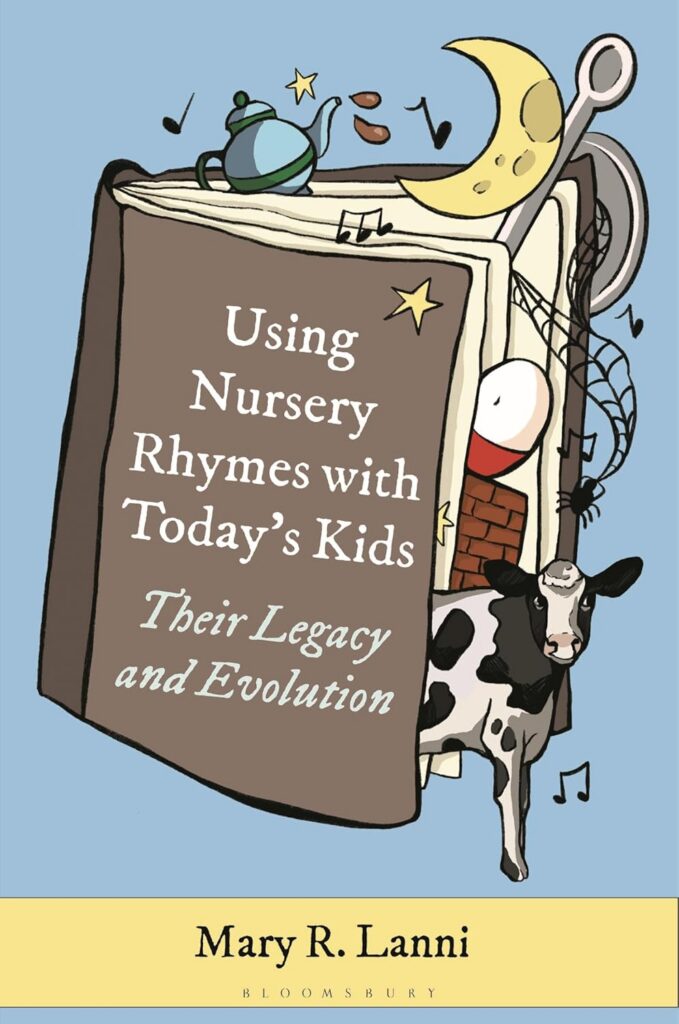
Using Nursery Rhymes with Today’s Kids: Their Legacy and Evolution
Written by Mary Lanni
Ages: 16+| 160 Pages
Publisher: Bloomsbury Libraries Unlimited (2026) | ISBN: 979-8216188698
Publisher’s Book Summary: Nursery rhymes are easy to remember, recite, and pass on to future generations, but are these transmitters of popular culture still relevant and appropriate?
In an increasingly multicultural world, it’s critical to examine the lessons children are learning-both directly and indirectly-to ensure a positive collective future for everyone.
Readers are introduced to nursery rhymes from a historical and international perspective, where common themes and original intents are explored. The book highlights the importance of oral storytelling in cultures around the world and details the ways in which nursery rhymes provide young children with the tools to become strong readers. This guide also explores how popular modern children’s songs borrow from older tunes to be accessible to a contemporary audience.
An examination of the more nuanced elements of nursery rhymes highlights cultural changes that can affect the meaning of these older songs, questioning whether using the tune of a song with a problematic history is appropriate and whether altering only the offending words/phrases is sufficient to justify continued use. On-the-ground examples illustrate the ways in which songs can affect participants in different ways. Finally, the book helps readers make educated choices about how best to use nursery rhymes to support diversity, equity, inclusion, and accessibility.
Buy the Book
Rethinking Storytime: How to Choose the Best Nursery Rhymes was written by Mary Lanni.
