

By Nina Schuyler, The Children’s Book Review
Published: October 24, 2013
All Things Japanese
Japanese can be daunting to learn. There are three alphabets—Kanji, Hiragana and Katakana, none of which resemble the English alphabet with its Latin script. Japanese syntax locates the verb at the end of the sentence, and the verb changes, depending upon whom you are speaking to. So how can your four-year-old kid possibly learn?
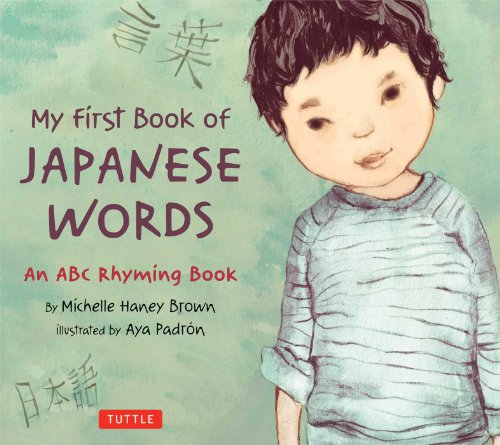
 My First Book of Japanese Words: An ABC Rhyming Book
Age Range: 3-6
Hardcover: 32 pages
Publisher: Tuttle Publishing (October 8, 2013)
ISBN-13: 978-4805312018
My First Book of Japanese Words: An ABC Rhyming Book, by Michelle Haney Brown, is written for preschoolers, and starts as all parents do when teaching their child how to speak English—with simple nouns. Brown uses an ABC rhyming structure, with cultural and linguistic notes sprinkled throughout. She’s also kind enough to include a pronunciation chart for parents who are non Japanese speakers, so you know the “a” in Japanese is said like “ah” as in “father,” and the “I” is pronounced like “ee” as in “meet.”
“D is for densha—a train in Japan—goes choo choo down the track as fast as it can.”
“H is for hashi. Chopsticks are nice for picking up goodies like veggies and rice.”
Occasionally Brown throws in common Japanese expressions:
“W is for Waa! Which is how we say “Wow!” (Maybe you’ll say it now that you know how.)” “Y is for yatta “I did it!” “Yay!” This is a word I like to say.”
You’ll learn Japanese may not have the “x” sound, but it still has xylophones, which are called “mokkin” and are usually made of wood. It’s a fun way to learn a handful of basic Japanese words, and perhaps inspire an interest in learning more.
My Awesome Japan Adventure: A Diary about the Best 4 Months Ever!
By Rebecca Otowa
Age Range: 9-12
Hardcover: 48 pages
Publisher: Tuttle Publishing (November 5, 2013)
ISBN-13: 978-4805312162
For the fifth grader interested in Japan, there’s a wonderful new book, My Awesome Japan Adventure: A Diary about the Best 4 Months Ever!, by Rebecca Otowa. Dan, an American boy, spends four months with a Japanese family as an exchange student. Dan keeps a journal, noting everything he sees and learns, and here is the format of Otowa’s book. On the first day, his pages fill up quickly: “Everyone in the family uses the same bath water, which is why they have to get very clean before the relaxing soak,” in the tub. No shoes in the house, only slippers. And no slippers on the straw mats. You need different slippers in the kitchen and restroom. For breakfast, miso soup, along with fish and pickles! “Salad is a recent addition to the Japanese breakfast. Traditionally, they mainly eat cooked vegetables.”
Daisuke teaches Dan (and you) how to make an origami flower; Mari, his sister, shows Dan how to make onigiri, balls of salted sticky rice, filled with umeboshi, (picked, salted plums) or tarako, (salty fish roe.) Grandfather shows up at school on September 19, “Respect Aged Day,” and talks about old Japan. Dan goes to a tea ceremony, a Ninja village, a shodo (writing) class, and a shinto shrine. “Ninjas were not warriors but spies, information carriers, and assassins. Their specialties were concealment, quick strikes and escapes.” As for the village itself, “It was super fun, with authentic old thatched houses, a museum, and tons of great activities like a shuriken target range, wall climbing with ropes, and a pontoon water crossing. The kids at home will be green jealous when they hear how much I know about real Japanese ninja!”
Written and illustrated by Otowa, who has spent thirty years in Shiga, Japan, My Awesome Japan Adventure is lush with specific, intriguing details about the Japanese culture and the lives of Japanese children and families. It’s the voice, though, that will win kids over. Otowa smartly chose to write about Japanese culture, using the point of view of Dan, who, at the end of the book, vows to come back to Japan.
Nina Schulyer’s new novel, The Translator, has received starred reviews from Booklist and Shelf Awareness. Her fist novel, The Painting, was nominated for the Northern California Book Award and was named a ‘Best Book’ by the San Francisco Chronicle. She’s fiction editor for www.ablemuse.com and teaches creative writing at the University of San Francisco. For more information, visit her at www.ninaschuyler.com.
