

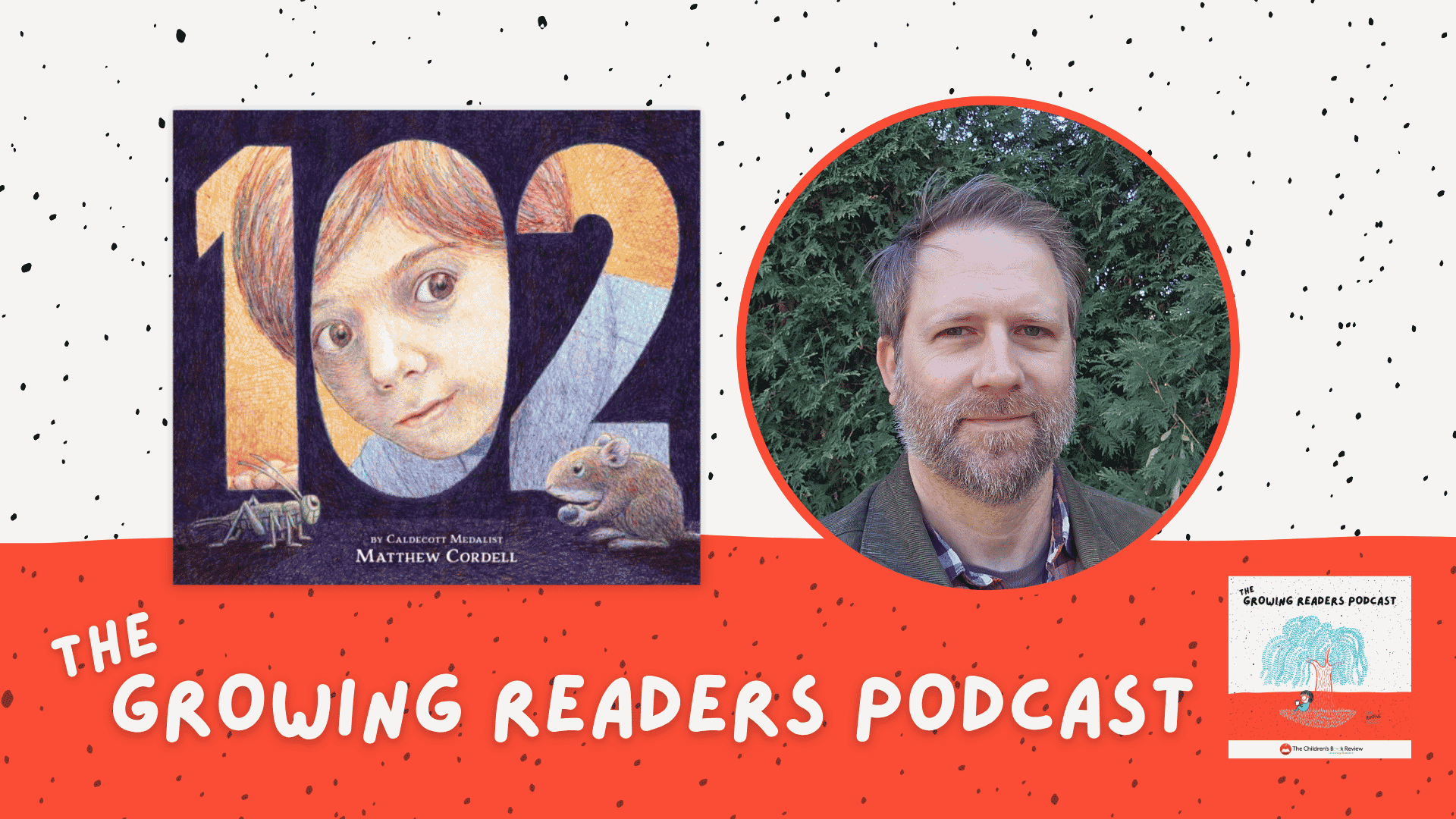
A podcast interview with Matthew Cordell discussing his picture book, 102 (Little, Brown Books for Young Readers), on The Growing Readers Podcast, a production of The Children’s Book Review.
One scented, multi-colored pen. One whole book.
In this episode of The Growing Readers Podcast, Matthew Cordell talks about 102, his newest picture book—a tender nighttime adventure about a sick child, a cricket, and a bowl of 102-bean soup. Matthew shares how a scented ballpoint pen from his kids’ art stash became his only tool for the entire book, why a swooping owl spread means so much to him as an avid birder, and why he believes staying curious is one of the most important things we can do for each other.
Subscribe to The Growing Readers Podcast to ensure you never miss an episode celebrating the creators shaping young readers’ lives.
Listen to the Episode
The Show Notes
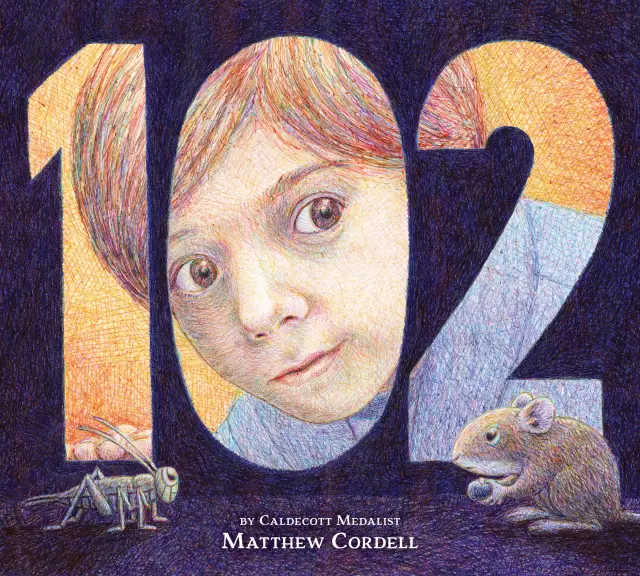
102
Written and Illustrated by Matthew Cordell
Ages: 6+ | 48 Pages
Publisher: Little, Brown Books for Young Readers (2026) | ISBN-13: 9780316580953
Publisher’s Book Summary: From Caldecott Medalist Matthew Cordell comes a cozy, magical nighttime adventure, where a child discovers the mysterious, miniature world beyond his bedroom walls.
Sent home from school earlier in the day with a fever, George awakens in the middle of the night to discover a cricket beckoning him on an adventure and soon finds himself shrunken down in size. He follows the insect guide through a crack in his bedroom wall, through the moonlit yard, and into the home of a family of mice at the base of an oak tree. There, in a tiny, cozy kitchen, George discovers the meaning of his quest: he must help the Mama mouse complete her special 102-bean soup for her sick young son.
Delightfully sweet as it is fantastic, 102 seamlessly explores the values of curiosity, kindness, and generosity. The simple yet profound conclusion shares a clever wink with readers, encouraging them to believe the unbelievable.
Buy the Book
Borrow the Book
About the Author-Illustrator
Matthew Cordell is the Caldecott Medal-winning author and illustrator of Wolf in the Snow, Evergreen, Cornbread & Poppy, Wish, and Hello, Neighbor!: The Kind and Caring World of Mister Rogers. He is also the illustrator of highly acclaimed children’s books such as Every Dog in the Neighborhood (by Philip C. Stead), Bob, Not Bob! (by Audrey Vernick and Liz Garton Scanlon), and Leeva at Last (by Sara Pennypacker). His books have been best-of-the-year selections by The New York Times, The Boston Globe, NPR, and Amazon.com, and have been translated into numerous languages around the world. Matthew lives in suburban Chicago with his wife, author Julie Halpern, and their two children.
To learn more, visit www.matthewcordell.com
Credits:
Host: Bianca Schulze
Guest: Matthew Cordell
Producer: Bianca Schulze
Read the Transcript
Bianca Schulze: Hi, Matt. Welcome back to the Growing Readers Podcast.
Matthew Cordell: Hi, Bianca. Thanks for having me.
Bianca Schulze: An absolute pleasure. So, I’m hoping we can start off with some fun rapid-fire questions. Are you good with that? All right — first answer that pops into your mind: what’s the last book you read that wasn’t your own?
Matthew Cordell: Sounds fun. It’s a very long title, by my friend Philip Stead — actually, let me give you a different one. The one I’m currently reading, for the first time, is Watership Down. I’ve never read that novel, and I’ve been curious about it for a long time, so that’s what I’m reading right now.
Bianca Schulze: Wow. That’s definitely one I watched — I feel like I saw an animated movie version of it when I was a kid. Are you enjoying it?
Matthew Cordell: Yeah, I never saw that. I grew up around the time it came out, and somebody was talking about it with me recently, so I thought I should finally read it. It’s really good.
Bianca Schulze: All right — a living children’s book creator whose work you greatly admire?
Matthew Cordell: Quentin Blake.
Bianca Schulze: Soup or sandwich? What’s your go-to when you’re sick?
Matthew Cordell: Soup.
Bianca Schulze: If you shrank down to mouse size right now, what’s the first place in your house you’d want to explore?
Matthew Cordell: That’s a good question. Probably inside the walls, maybe near the kitchen. I feel like there might be some cool stuff back there, or under the appliances. That would be interesting to find.
Bianca Schulze: I’m picturing lots of cobwebs. Is there anything you’ve recently found yourself feeling curious about that you want to learn more about?
Matthew Cordell: Yeah — I’m always very curious about the outside world, the natural world. I’m really into birds, so there are always different birds I want to find out more about. I’m especially obsessed with owls. I’d love to explore some different states and see species of owls we don’t have here.
Bianca Schulze: I know this is rapid-fire, but I’m breaking my own rule here. I recently had to help my mom move out of an apartment she’d lived in for a really long time, and going through the things she’d saved for me was fun. I came across a photograph I’d forgotten about — I was on a back porch in Australia with a group of friends. Somebody was playing guitar, we were all sitting around, and a tawny frogmouth owl literally flew up to us and sat on us. I have the photograph as evidence. I’ve never — it’s just bizarre. I wonder if it was sick or something, but when does an owl ever just fly up to a group of people and sit on them?
Matthew Cordell: That bird could have been a young one — younger birds have fewer inhibitions and are more curious about everything. Young owls will sometimes fly right over my head or perch a little closer just to check me out. Their heads move around like this — it’s pretty wild. I’d love to see that picture if you have it handy — you could email it to me after this.
Bianca Schulze: I will — I’ll dig it out of the box I carried all the way back from Australia and send it to you. All right, last rapid-fire question: pen, pencil, or paintbrush — your grab-and-go tool if you had sixty seconds to draw something right now?
Matthew Cordell: That one’s easy. Definitely pen. I love drawing with it.
Bianca Schulze: Awesome. All right, Matt — last time we talked, you told me you’re mostly self-taught in pen and ink and watercolor, no formal training, just trial and error. So when you found a scented, multicolored ballpoint pen in your kids’ art stash, was that same “let’s see what happens” instinct at work, or did it become an accident that turned into a dare — to create this whole book, 102, using just that ballpoint pen?
Matthew Cordell: I think I was just playing with it in my sketchbook at first. Because it has ten colors in one pen — and I usually just draw in black ink and then color with watercolor, that’s been my process for years — but because this pen has so many colors, I didn’t need anything else. I could do a full-color drawing with just this one pen.
At first, I was probably drawing things in individual colors — for instance, I’d draw an apple in red ink, or the grass outside in green. Then I started overlaying lines with this pen, and it became a very different effect. You can actually blend colors just by overlapping the lines — if you overlap interlaced yellow lines and then draw blue on top, you suddenly have green on the paper.
I draw a lot of birds, as I mentioned — I’m a birder, so I sketch birds a lot, just for relaxation. I started drawing owls with this pen, using yellow, blue, green, orange, all these different colors overlapping. By the time you’re done, you have a fully realized, fully colored picture. But because it’s all lines overlapping, it has this weird, electric effect — it looks kind of surreal. I really enjoyed drawing with it, and I loved how the pictures looked. They had this strange quality.
I was sharing these pictures on social media, and some of the comments were along the lines of, “Are you going to draw a book like this?” Normally I share pen-and-ink-and-watercolor drawings — that’s what I’ve done for almost my whole career — so sharing these ballpoint pen drawings was different. A couple of people asked if it was for my next book. And it just so happened that the next book I was going to start, 102, had this surreal, fantastical, strange quality to the story. I thought, if I ever wanted to try this, this would be the perfect time.
Since I’d never done a book in that style, I had to draw a bunch of the characters and some scenes in the style and show my publisher — and ask if they’d be okay with me changing things up for this book. It worked out, though they were a little hesitant at first about how realistic some of the critters looked — the bugs and the mice. They were drawn very realistically, and that realism can put some people off, since mice and bugs in your house aren’t always welcome. So I ended up stylizing them.
There’s still realistic fur, and the legs of the bugs are realistic, but I softened their faces — made them a little more stylized, almost slightly cartoonish — so they’re not as off-putting to people who might have an aversion to pests in their house.
Bianca Schulze: That’s so interesting to me, because to me they read as really realistic. But now that you’re explaining it, I can actually see those subtle differences — though when I was first reading it, they felt completely realistic. Now I want to go look and see if you posted any of the original sketches where they looked more off-putting, because that’s fascinating — how those minor touches can make such a difference in a picture book.
Matthew Cordell: One of the things that changed things easily is that we humans have whites in our eyes, but mice and crickets just have solid dark eyes. So one way I softened — almost humanized — these animal characters was giving them eyes like ours. It changed things quickly, because you can see the pupil moving left or right, and it changes their expressions. If you look at the mice in 102, you’ll see they look a little more people-like, just from that one simple change to the eyes. It really helps make them softer and more relatable.
Bianca Schulze: All right, well — now we have to know: how many pens did it take to finish the whole book?
Matthew Cordell: That’s a good question. I wasn’t counting at first — I was just tossing them in the bin as they ran out. But then someone, maybe my editor or my art director, started asking how many pens I was using, thinking it might be worth noting, or a question people would ask. So I started counting. I don’t have a perfectly accurate number, but it’s somewhere around twenty. We actually put a little note in the book — in the art notes, I think — that says sixteen or seventeen. I rounded down a bit, but it was probably closer to twenty, if not more. I mostly used one type of pen, with a few different ones for specific colors, but the main brand came in a pack of three for about five dollars — a really affordable art tool.
Bianca Schulze: Which color ink ended up getting used up first?
Matthew Cordell: Definitely the dark blue, because this book takes place at night, and the backgrounds have a lot of that dark, navy-blue color. The scenes that look like complete darkness — if you’re just flipping through the book, you’d probably think it’s black, but it’s actually layers of multiple colors. Even on the cover, that dark background starts out light blue, then purple, then pink, and ends in a very dark navy blue. Sometimes, if I really wanted it rich and dark, I’d add black in the very last layer. But that dark blue needed a lot of coverage — it had the most surface area — so it got used up the most.
Bianca Schulze: I have to ask — I’m a doodler. If I’m on a call, I’ll run my pen back and forth in the same spot, and sometimes it pokes a hole through the page. Did anything like that happen with you — the pen pushing through the paper, or leaving an indentation?
Matthew Cordell: I never drew through the paper — I draw on heavier paper. If I’d used regular printer paper, it probably would have torn through from the friction. But it definitely digs in. By the time I’m done, you can see a lot of texture, especially from drawing over the same area again and again. If you look at these drawings up close, they have a lot of texture — it’s a cool thing you’d never notice just from looking at the book, but it really changes the surface of the paper.
And these pens — the brand I chose — actually have scented ink. They’re really made for a younger audience, not necessarily a fifty-year-old man like me, but the inks smell like candy, which I can appreciate. The light blue smells like cotton candy, the pink smells like strawberry candy, the black smells like black licorice, the brown smells like chocolate, and so on. As I was drawing, you don’t really smell it much if you’re just writing your name on paper — but because I was covering so much of the page, there was a lot of scent coming up as I drew, which added to the strangeness of the whole experience. The sad part is that the scent only lasts about a day before it’s gone. But while I was drawing it, it was this whole sensory experience — creating the drawing, seeing it, and smelling it. It was very different for me.
Bianca Schulze: When I was reading it, I had visions of Brian Selznick’s The Invention of Hugo Cabret, and through the story arc, I also got Maurice Sendak’s Where the Wild Things Are vibes — and people might throw rocks at me, but I don’t think I’ve ever read Tuesday by David Wiesner. These are all Caldecott-winning books, and those titles kept popping into my mind as I was reading 102. Nobody ever knows what the future holds or what’s going to be a Caldecott pick, but I have to imagine — given how unique this process was, and the fact that I have visions of those titles while reading it — that at the very least, it’s going to be on people’s mock Caldecott lists. So my wish for you is that, if it’s as successful as I think it will be, when they do a reprint, maybe they’ll make a special edition with a scratch-and-sniff element — some kind of celebration copy that lets readers scratch and sniff the pen’s scent.
Matthew Cordell: I appreciate that. That would be awesome if they had the technology to add that. Now that you mention it, it would have been a fun marketing idea too — handing out stickers with art from the book that had scratchable smells. I’m sure I was channeling all these greats — a lot of the artists you mentioned use a similar cross-hatching technique, and they’re all very surreal. Wiesner, Selznick, Sendak, even Chris Van Allsburg — all those strange stories, like Polar Express, told with a lot of dramatic lighting in their art. There had to be parts of me channeling those great illustrators once I zoned in on that style.
I had an earlier version of the book where I was drawing it the way I’ve done a lot of my other books — pen and ink and watercolor. But as soon as I started drawing with this cross-hatching style, I thought, I should really think about what I can do with light, since this story takes place at night and there’s a lot of drama in it. I wanted really dark scenes with extreme lighting. I don’t know if you’re familiar with the Italian painter Caravaggio — his paintings are incredibly dramatic, with almost black backgrounds and light beaming in on battle scenes or graphic, sometimes gory moments. It made the experience of looking at his paintings eerie and strange. So yes, I was definitely channeling a lot of different influences while working on this book — it was so much fun to do lots of different things.
Bianca Schulze: I’m always fascinated by artists who can make things feel like they’re glowing. I’ve talked about this with — I think it’s David Litchfield, am I saying that right? Yeah, David Litchfield. I think it’s such a special talent to pull that off. As I was reading 102, I noticed you managed to do that with just a pen — more by pulling back in certain areas, not using any pen at all, and letting the white space do the work. I found that really clever, and I wanted you to know I noticed. Were there challenges with that — how did you make sure you left enough space for that glow?
Matthew Cordell: I think it’s just years and years of drawing — after a while, it becomes intuitive. It’s the same with color, since I’m blending in real time. Anyone can learn this — it just takes time studying things. Color theory is really about knowing what colors mix to make other colors. Some of it’s simple, but it gets more complicated with things like browns, which need three or four colors layered to build up. It’s the same with shading and light — years and years of drawing, and at this point I don’t think about it too much. I just know how much pressure to use to make something darker, how lightly to draw to keep things light, and how leaving the paper blank is what creates the light — the white of the paper. It’s just part of my process at this point.
But it was interesting, too, because when I was making this book, I discovered something. With pen and ink, drawing in one color is simple — I do school visits and art workshops with kids, little drawing demos where we all draw in one color, pen or pencil, simple line drawings. But I started wondering about this multicolor pen process — could I do this with kids? Would they be able to figure it out? I wasn’t planning to try it, but an art teacher at a school I visited asked me to try it with her fourth graders. I said, okay, we can try — I wasn’t sure they’d be able to pick it up.
We started with something simple — an apple. An apple is almost one color, but it has some yellow and green in it too. We put it on a projector so everyone could see the same thing, and we drew it together. I explained how I start with the lightest color and build up, getting darker and darker. By the time the session was over, I was walking around looking at their drawings, and I was blown away by how beautiful they were — how quickly they picked up the technique. Kids, even when they haven’t tried something before, are often very brave about trying new things — not every kid, every kid is different, but they’re curious, and they want to try. These fourth graders picked it up immediately and made beautiful drawings using the same technique I used for this book. It was such a pleasant surprise — kids are always surprising me that way. That’s part of why I love that children are my audience. Being around them is such a breath of fresh air. When that happened, I was so happy to be proven wrong — happy that this was something they could do.
Bianca Schulze: I love that. And thank you for making time to visit schools — it makes such a difference for kids to have someone they can look up to and be inspired by. I’m sure you’ve had moments leaving a school visit, walking past a line of kids, and one of them stops and tells you, “I’m going to be an illustrator,” or “I’m going to be an author.” That must feel so electrifying — knowing you helped create that energy for a kid. So thank you for showing up for them.
Matthew Cordell: Of course — it’s one of my favorite things.
Bianca Schulze: You’ve talked before about wanting every book to have a surprise and a callback at the end — a phrase or moment from early on that returns and means something different by the last page. “102” is a recurring number throughout the book — in the date, October 2nd, which we see on the clock — well, I don’t want to give any spoilers, but talk to me about that callback, and whatever you’re willing to share about what that number means by the last page.
Matthew Cordell: The story started as just a little nugget of an idea — I wanted to make an animal rescue story, where an animal gets into the house and someone in the family helps rescue or save an injured or trapped animal. It started like that, but in my mind it wasn’t quite enough to build a whole book. It’s a simple story about kindness and helping someone, but I needed to build on it. I started thinking, maybe it’s a mouse, and there’s something wrong with the mouse. Then I thought, maybe the child who’s saving it has something wrong too — maybe he could be sick. I wanted him to be sick, but still able to do things, because if you’re really sick, you’re in bed all day.
I started thinking in terms of numbers — maybe his fever is a hundred degrees, or a hundred and one. I got up to a hundred and three and thought that felt too high — as a parent, that’s scary territory when your kid runs a really high temperature. So I thought maybe we’d start at 102. That number felt interesting because it’s distinct — 101 felt a little too “not sick,” and 103 felt too sick. 102 was right in the middle.
From there, I realized this number could help me move from one point in the story to the next, because numbers have so many different meanings — they can measure time, date, quantity, temperature, age. I could keep bringing that number back to build the story, and it also made things stranger, because as a reader you start asking yourself, why does this number keep showing up? It’s never really explained, and I don’t think it needs to be — there are coincidences in life. But it keeps appearing throughout the story, almost like chapters, and it became this device for building the story while also hiding things in it. Kids really enjoy looking for hidden details, hidden messages, little Easter eggs throughout the pictures and text, so I hid the number in the background in different ways. It became this playful device, and by the end, there’s a twist where the number is used one more time — something I don’t think anyone will see coming on a first read. I thought it was a fun way to tie everything off.
Bianca Schulze: I thought it was very clever. And there’s even a 102-bean soup, which is such a specific, almost absurdly detailed thing for a recipe in a picture book — these characters trying to make a 102-bean soup. I love the bean endpapers, and while I didn’t count every single bean pictured and labeled, I have to imagine there are exactly 102, right?
Matthew Cordell: Yeah — there are 51 on the front endpapers and 51 on the back. There are probably only ten or fifteen actual bean varieties in the world, so I looked it up and realized I’d have to make some up. I had a lot of fun with it — I named some beans after family members, some after artistic heroes of mine, some after characters from books and movies I like. My editor got a bean, my art director got a bean, my literary agent got a bean. I went a little wild with it, since I had so many opportunities to come up with names. It was a lot of fun.
Bianca Schulze: I love it. As you mentioned earlier, children are often so open to being curious, and because of that curiosity, there’s such great potential for creativity. I think, like you said, they’re the best and most inspiring audience there is. George in 102 is driven into this whole adventure purely by curiosity — he follows a cricket through a crack in the wall in the middle of the night. Did you think of George as a stand-in for that kind of pure, uncomplicated curiosity you love in kids? What were your thoughts on George?
Matthew Cordell: Yeah — I think that’s one of the beautiful things about kids: they’re seekers. They’re so curious that there’s almost a fearlessness to it — when you’re that curious, you just want to see, you want answers, and you’ll take more risks to get there. I think that’s one of the things we lose as we get older — some of that curiosity peels away. I try to encourage curiosity wherever I go, whoever I’m speaking to — even in schools, where kids are already bursting with it. I try to impress upon them that there’s a time in life when you think you know all the answers. As adults, we can get into this mode where we think we know everything, and we stop seeking, we stop learning. It’s really a shame, because there’s so much — we’ll die having known so little, if you think about the vastness of the world. I try to impress upon kids to stay curious, to hold onto that for their entire life, because even as you get older, there’s still so much left to discover about people, cultures, places, and nature. The world is full of possibilities, and I find myself, even as an adult, constantly finding new things to obsess over. That’s part of why I love writing and drawing stories about kids — they’re living in that powerful time of life where they just want to discover things, and it changes them as they do it.
George is one of those characters — these strange things start happening to him, and it just makes him want to know more. It starts with a little cricket on his chest, and one thing leads to another until he’s shrunk down to mouse-size. That doesn’t stop him. If we were adults, we’d be panicking, thinking, how am I going to get back to normal? But he just moves on to the next thing. That’s the beauty of telling stories with children as the main characters — they keep going. They want to know why things are happening rather than getting paralyzed by the moment. At least, that’s how it works in my stories.
Bianca Schulze: As much as you love the work you do, I know your favorite thing in the world is being a dad — going to your kids’ concerts, plays, and school programs, exploring the world together. Your kids are seventeen and thirteen now, and any parent knows how fast kids grow up. Does that make its way into a book like 102, or any of your books? I feel like the story is as much about George as it is about a parent, or a parent figure — there’s Mom at the beginning, and, no spoilers from me, but showing up for a child in a small, specific way. Do you think some of your thoughts as a parent, combined with what you just shared about curiosity, show up in your art and stories?
Matthew Cordell: Yeah — I think a lot of my books have family-centered themes in different ways. I did a book called King Alice, about a dad and daughter stuck inside on a snowy day, making a book together — they draw and write a story together, and it carries them through the whole day. By the end, they have a finished book and read it together. It’s full of crazy hijinks, a humorous story, based loosely on the dynamics of creating things with my own kids — exhausting, but also validating and inspiring. A lot of my books are really about how I feel as a dad, as a parent, and how rich that’s made my life, and about the incredible, funny, unusual things kids do and say.
We have a seventeen-year-old now — a senior in high school, about to head off to college. It’s hard for my wife and me to think about. It’s bittersweet — exciting to see them start a new chapter, but also a kind of separation. Before this, I wrote a book called Dream, a more emotional book, really more for families, or maybe parents, to read — it’s about watching a child grow up. The characters are gorillas; the young one thrives, faces some challenges, and eventually goes off on their own. It’s about the full experience of parenthood — watching a child evolve and become an adult in their own right.
Family is such a big part of my life — there’s no one closer to me than my wife and kids. We’re a very close-knit group, and it’s been a huge inspiration for me as a creator. Picture books are the perfect place to express those big feelings about family and children.
Bianca Schulze: So beautiful. Since you mentioned birding — that has to be a really patient activity, and you have to be very observational, watching and waiting for something wild to reveal itself on its own terms. I can’t help but see the parallel to being a creator, developing a story. Do you think that same kind of attention shows up in how you build a page, or a story?
Matthew Cordell: I think so, yeah. There are certain things I can be really patient about — overall, I’m a fairly patient person. I like the slow process of birding, because when you do have a success — whether it’s a drawing you’ve worked on for days, or a bird you’ve been searching for over a couple of hours and finally spot — it’s a patient process, and that success feels all the more powerful because of it. It’s more potent than an immediate success. I think that’s part of my wiring — it helps me be patient in those ways, because I know that long-sought success is going to feel good in the end.
But there are things I can be really impatient about — stressful things, like losing your car keys and having no idea where they are in the house. I get almost paralyzed with frustration and impatience — I just don’t want to look for it. It’s funny, because I love searching for a bird in the forest that takes forever to find, but I hate looking for a lost item in my house that I need to get to the next thing. Generally speaking, though, I enjoy things that take time — it builds an experience around them, instead of something that happens instantly, with instant validation, which doesn’t feel quite as special. I think it’s made me a more patient person.
Bianca Schulze: I had a book title pop into my head for Cornbread and Poppy — Cornbread and Poppy and the Lost Thing — because I’d love to see how they’d each approach trying to find something lost, given how differently they’d handle it. So there’s some food for thought for you. I couldn’t help but notice — your gorgeous book Evergreen was a quest to deliver soup to Granny Oak, and 102 is a quest to help make a 102-bean soup for a sick mouse. Two soup quests. Is that coincidence, or an unconscious theme? Is there something about delivering soup that keeps pulling you back?
Matthew Cordell: I don’t have a soup obsession, but I do like a good soup. I think soup is such a natural companion to feeling unwell — it’s not a miracle remedy, just something we naturally want when we’re sick. So it started with the ailment — that was the common thread in both stories. Then I started thinking about numbers, how you can buy a can of soup at the grocery store labeled something like “thirty-two bean soup.” I thought, maybe I could do a hundred-and-two-bean soup. There was some hesitancy at first — did I really want another big soup moment in another book? But I figured it would be fun, and I’d use it differently. It ended up being more about the beans than the soup itself — the specific number and detail of it. I think it became this thing where there are parallels between Evergreen and 102, but sometimes that’s okay. Maybe my next book will be —
Bianca Schulze: Totally different stories, but both warm the heart, like a good bowl of soup.
Matthew Cordell: Right — and I think they’re both cozy stories. Soup just has a natural cozy quality to it, so it reappeared for those reasons.
Bianca Schulze: We can’t not mention your other new book, Starman, a picture book biography of David Bowie. I’d love to know, in a nutshell, what drew you to Bowie as a subject?
Matthew Cordell: For most of my career, I’ve written and illustrated fiction. Then I was inspired to write a picture book biography about one of my personal and artistic heroes, Mr. Rogers, who created children’s programming. I enjoyed that process so much that I wanted to do another biography, about another artistic hero. David Bowie came to mind almost immediately — there are so many things I admire about him. I love how often he changed his style — his sound shifted constantly throughout his career, from rock to soul to jazz. That kind of range has always inspired me — artists who, instead of working continuously in the same style for their whole life’s work, pause and try something completely different. I love his music, of course, and he was such an interesting person, with real highs and lows in his life. He had this intergalactic quality about him too — a lot of his lyrics touched on space travel, themes that made him seem almost alien. His story is so fascinating, and his presence was so big, that I knew right away I wanted him to be the subject of my next biography.
I had a lot of fun playing with this one, and because Bowie himself was so unorthodox, the story isn’t told as a straight biography — it’s more of an artistic biography. It frames him as a space traveler, moving from planet to planet, and as he goes, he’s inspired by different things happening on each one, which changes the way he makes his art. Then he moves on to find something else, and the next planet brings something new. It was such a fun departure — I started out writing it as a typical biography, but it evolved into this kind of alien biography, where he’s exploring the universe, which is really what he did. Everything he sought out and found made its way into his music, his art, his sound. Each planet is a different section of the book, and the art style changes with each part — one section is collage, one is colored pencil, one is watercolor. It was so much fun to make, and it’ll be out this fall, in September — right around the corner.
Bianca Schulze: I kind of love that you’ve gone from this pen-only book to another book with such a variety of art in it. You probably needed that after spending so much time with the scented pens.
Matthew Cordell: Right — yeah, it’s fun to jump around at this point. I feel like I’ve discovered different ways of making things, and it’s refreshing to do something one way, then go back to an older way, then try something else entirely. Sometimes there’s crossover — in the Bowie book, there’s a lot of pen-and-ink line drawing, but I actually found ways to use that same scented, colored pen in some of the space backgrounds, which made them feel more electric — the darkness of space, with a lot of those colored cross-hatched lines overlapping. Life feels like a constant reveal to me, a constant exploration — why should we limit ourselves to one way of creating, or one way of understanding something, when our minds could keep opening up bigger and bigger? So it’s refreshing to work that way too.
Bianca Schulze: I feel like we could end right there — that was so perfect. But we’re going to go full circle and finish up with some rapid-fire questions. Are you ready?
Matthew Cordell: Yeah.
Bianca Schulze: If a kid closes 102 and keeps only one feeling from it — not a plot point, just a feeling — what do you hope that is?
Matthew Cordell: That’s a hard rapid-fire question. I’d say — not to keep repeating myself, but — I want them to keep exploring, to keep finding things out.
Bianca Schulze: Yep, curiosity. And for the grown-ups listening, on that topic of curiosity — and the incuriosity that can come with being an adult — is there something you’d want a tired, distracted adult reading this book aloud at bedtime to notice, that they might otherwise read right past?
Matthew Cordell: That’s a good question. I’d probably say — there are things hidden in the endpapers, where the different beans are illustrated, at the beginning and end of the book. If a grown-up, especially an artistically inclined one, looked closely, they’d see lots of names of things they might recognize. So I’d say — linger there if you can, no matter how tired you are.
Bianca Schulze: Is there a moment from making this book — not from the story itself, just from the actual days of making it — that you think you’ll still remember five years from now, after everyone’s stopped talking about the pen?
Matthew Cordell: Yeah — I’ll always remember the experience of creating George, because George is modeled after my son, Dean, when he was about that age. It was a very father-son shared experience — I took a lot of pictures of Dean, and he became the basis for George. Dean was a little too old by the time I actually started drawing the final pictures — the story takes so long to bring into existence — but I still had all those photos of him, and I just kind of shrank him down onto the page.
I’ll always remember the time we spent together taking those pictures. It wasn’t always a pleasant experience, honestly — trying to get my son to focus. He enjoyed knowing he was going to be the visual subject of the book, but he also wanted to do other things, so I actually ended up paying him — he was my paid model. But it was such a fun thing, turning Dean into George, and I think he’s proud of it too. Early on, it was a little hard for him — he’d get annoyed and ask, “Why isn’t he named Dean?” I told him that felt a little too on the nose — I wanted to keep it a bit ambiguous. But I’ll always remember that time we spent together.
Bianca Schulze: It’s so beautiful. All right — absolute final question. Of everything we talked about today, if there’s just one thing you want our listeners to take away, what would it be?
Matthew Cordell: I’d say — try something new. If you haven’t drawn in twenty years, sit down and make a drawing. If you haven’t been on a trail or in a forest preserve since you were a kid, go for a walk. Whenever I try something like that, sometimes the answer is, I don’t like this — that’s confirmation too. But sometimes I’m really surprised by how special it is. Trying something new — watching a movie I didn’t think I’d like, or picking up a book I didn’t think would be relatable to me — I think we fall into patterns where we just do the same things, know the same things, but there’s so much to understand, to broaden and expand ourselves by trying something new. It’s endless. So — try something new, today or tomorrow, whenever you’re listening to this. Just try one new thing and see where it takes you, because I think it can only lead to good things.
Bianca Schulze: Well, Matt, thank you so much for this conversation — for trusting a scented ballpoint pen to become a whole book. 102 is such a tender, strange, wonderful little book, and I’m so glad we got to talk about it. Congratulations on it, and on Starman — I can’t wait for listeners to get their hands on both. Thank you so much for being here.
Matthew Cordell: Thanks for having me, Bianca. It was a pleasure.
