

Cover Reveal of The Best Good Thing: Discovering Joy on a Very Bad, Smad Day by Anna Housley Juster and Andrea Onishi, presented in partnership with The Children’s Book Review.
We are so excited to share the cover for The Best Good Thing: Discovering Joy on a Very Bad, Smad Day, written by Anna Housley Juster and illustrated by Andrea Onishi!
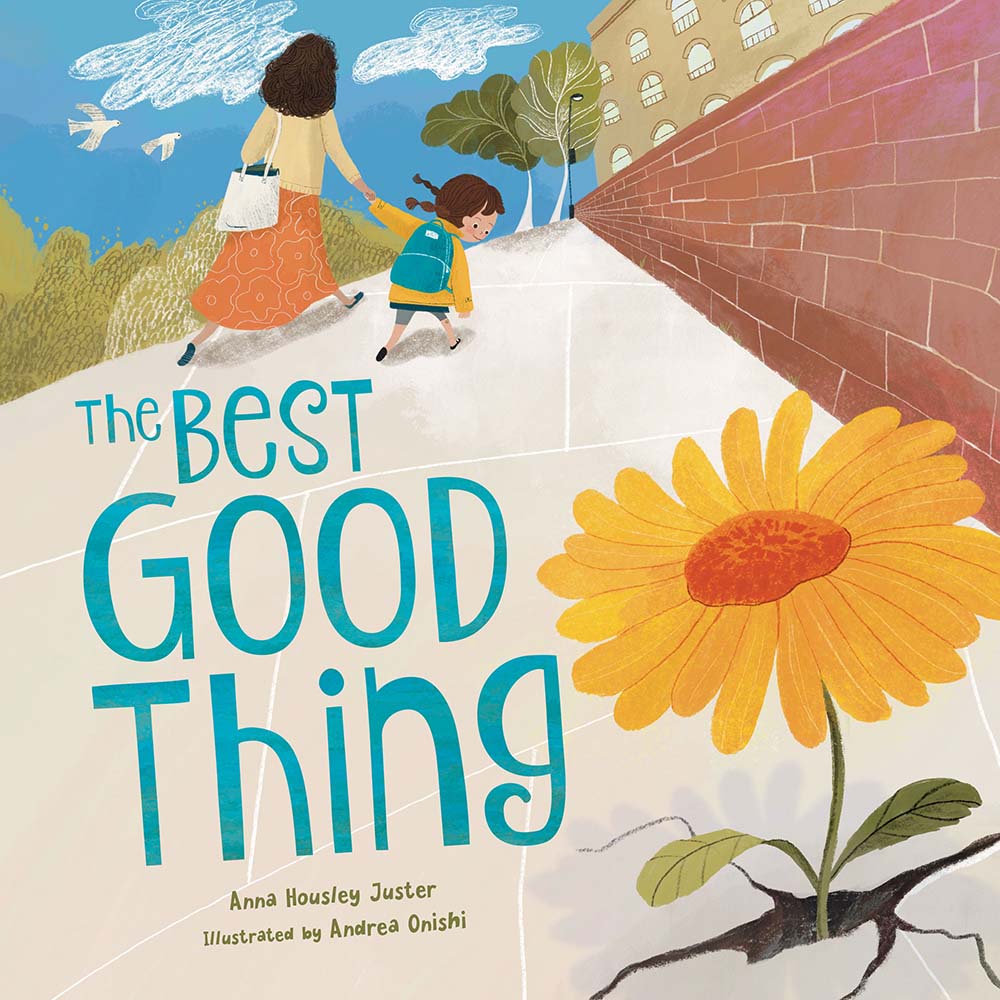
From the very first glance, Andrea Onishi’s warm, tender artwork sets exactly the right tone. A mother and daughter walk hand in hand past a single yellow flower pushing up through a cracked sidewalk—a quiet, hopeful image that captures the heart of this story before you’ve even opened the book. Take a look at the cover below, and then read on for a heartfelt interview with author Anna Housley Juster about smad feelings, noticing the good, and the love at the center of it all.
Cover Reveal
Author Interview
Bianca Schulze (BS): You’ve spent 25+ years working with children and families and you currently support children with anxiety, ADHD, and behavior challenges. Was there a specific moment in time that planted the seed for this story?
Anna Housely Juster (AHJ): Yes! Several years ago, I was working with a child who was consistently stuck in negative thoughts. His mom shared that every day after school he was sad and angry and could only remember what was hardest, but his teacher reported observing good moments as well. The child was caught in a certain story about himself, a very sticky thought pattern – all negative all the time.
One day, before he started telling me everything that was bad, I said: I want to hear everything you want to tell me, but first I’d like to try something a bit different. What is one good thing about today?
He paused, thoughtful, and said: I told a joke at recess and my friends laughed.
After that we continued to work through what was hard and we also made space for the good. He started bringing a range of memories to me and sharing about at least one good thing at home without being asked. He had created a new story about himself for himself, a new way of seeing his days. To be clear, it is not always this easy, but intentionally working on a new story and tuning into the good is an excellent strategy overall.
This “one good thing” practice became a staple in my work with him and lots of other kids and parents. This prompted me to think about how the idea could work as a picture book to reach many more children and families.
BS: Smad! Talk us through your choice to coin that word. What made you want kids to have language for feeling sad and mad at the same time, rather than picking one or the other?
AHJ: Sad + mad = smad is such a common combo. The word evolved naturally in conversations with kids as we worked together to label feelings.
Children tend to love the word “smad”! It is kind of fun to say and it gets right to the heart of the emotion they are trying to describe. The word is introduced directly by the main character in The Best Good Thing as she thinks about her very, very, VERY bad day and realizes that these two feelings can be mixed together as one.
Especially for children who are frequently mad and don’t understand why they are so angry it is helpful to know where the anger begins.The feeling we call “mad” is often tied to our threat response and can be thought of as a secondary emotion usually triggered by sadness, fear, shame, jealousy, etc.
This relates to my first picture book How to Train Your Amygdala. The process of going from hurt or threatened to mad can happen instantly. It is useful to get really specific about what is happening in kids’ bodies. What are we really feeling? How can we communicate about these feelings with others?
BS: There’s a strong focus on noticing the good things that are already there rather than manufacturing false positivity. How did you make sure the story didn’t tip into “just think happy thoughts” territory, which can actually feel dismissive to a kid having a hard day?
AHJ: My goal was always to highlight the simplest everyday good things so that young readers can bring this same practice into their own lives. It’s not about making major changes, it’s about learning to attend to the good things that are already there: a neighbor, a bowl of water for dogs, a single yellow flower growing through the sidewalk.
By actively attending to her daughter’s feelings and empathizing with her, the mom in the story models how to plant the seed of an idea. She doesn’t instruct her daughter to change how she feels or force her to look for something good. The child gradually makes this decision on her own. Their relationship is at the core of why the balance works: during our hardest times, it is connection and community that will get us through.
In the very first pages of the book the wording and the illustrations are designed to model emotional attunement and mirroring. The mother’s facial expressions match the child’s, reflecting, showing directly that she is not just expecting the girl to move on or “let it go”. They do not jump right to “happy thoughts”, rather the mother mirrors, validates, empathizes, and it is only then, as they move through their neighborhood that the mother plants the seed of an idea from her own perspective: even on days that are very, very, VERY bad if she tries she can find at least one good thing.
The Best Good Thing showcases an important fine line. Validation and acceptance are balanced with empowerment towards change and this balance is where true growth can occur within relationships.
BS: The backmatter explains that what we give our attention to grows. Why was it important to you that both kids and the adults reading to them absorb that idea—not just the child?
AHJ: This idea that what we attend to grows is at the core of The Best Good Thing and I highlight this concept for children and adult readers at the back of the book because it is such a critical message. We adults set the tone through our actions and kids learn by watching us!
Humans have what we call “confirmation bias” meaning that once we have decided something our brains create easy categories to make sense of our experiences and we actively seek out information to prove we are correct! This is a good thing if we have decided we are proud of ourselves and feeling good about our friends. This is a good thing if we believe we are good enough and can then take steps to be kind to others and lift them up.
This is a challenge, for example, if we have had hard experiences making friends, and convince ourselves: I am just not good at making friends or I will never make friends. If we have gotten in trouble at school we might think: I am just bad. Nobody likes me. Then, tragically, we might look for data to prove that this is correct and others might treat us as if this story is true.
This is why it is critical for everyone – children and adults – to do the intentional work of paying attention to our biases and remembering: What I give attention to grows – both in myself and in others.
BS: The mother in the book listens and sympathizes before she ever suggests looking for the good things. How much of that sequencing—validation first, strategy second—came directly from your clinical training or experience as a mom of two?
AHJ: We all know how bad it feels when our emotions are misunderstood or, worse, when no one is listening at all. Or when we share about something hard and someone jumps right to fixing the issue, or trying to fix us, when we just wanted to be heard and seen.
I hear from lots of parents and teachers that they often feel compelled to jump in and solve problems for kids right away and I have definitely felt that pull in my own life as Mom to two daughters. If I could just change this for the child or fix this particular issue then everything would be okay.
I believe our role as parents or professionals working with kids is to scaffold a “both/and” for children: it is both okay for us to feel the way we feel AND when we have a choice, perhaps we will choose to find ways to actively change our thoughts and feelings.
I recommend giving kids some time to be in their feelings, to ride the wave of an emotion, so they are granted necessary opportunities to learn how to cope. The goal in parenting, teaching, and in therapy is not to create a reality where a child will never feel worried, sad, disappointed, etc.
The goal is to validate and support skills so that when feelings arise (and they will) children develop the ability to move through those feelings as they learn and grow.
BS: You started your career as a Head Start teacher and later became director of content for Sesame Street. How did that early work shaping content for very young children influence the voice of this narrator?
AHJ: I am so grateful for my time teaching Head Start and for the several years I spent with the best colleagues in the world helping to create Sesame Street.
In the classroom, in children’s media, and even as a very young child obsessed with books, I have always found that stories can be both playful and educational, they can make us laugh even as they transform our understanding of the world. Stories can change lives.
As a classroom teacher, as director of content for Sesame Street, as a clinician, and as a mom, I have been committed to taking important concepts that might initially seem too hard for young children and making these ideas accessible in playful ways.
While writing The Best Good Thing and How to Train Your Amygdala I channeled my own inner child, my in- depth understanding of how young children naturally see the world, what they find engaging and funny. I then worked to create narratives that bring adults and children together.
I have heard from parents, teachers, and counselors that children request How to Train Your Amygdala, that they use the word “amygdala” when expressing what is happening in their brains and bodies and they use strategies from the book. I believe that The Best Good Thing can inspire children in similar ways.
My greatest hope is that readers find themselves in these two books and that they want to return to the stories again and again so that ideas are lifted off the page into everyday life.
BS: This is your second picture book after How to Train Your Amygdala. Do you see The Best Good Thing as a companion to that book, or as its own standalone tool—and how did what you learned from the first book’s reception shape this one?
AHJ: Each book can absolutely stand alone, but core concepts explored in The Best Good Thing also build on How to Train Your Amygdala: first children gain deeper understanding of how to calm their fight/flight/freeze response and and then they can access language to share about how they feel with a trusted adult and intentionally tune into the good to change how they feel.
How to Train Your Amygdala has received positive feedback globally and I have heard directly from readers that they appreciate the way the story takes a bit of complex neuroscience and effectively makes the content accessible for very young children.
Readers appreciate the humor and the empathy in the story and find the book comforting. I intentionally brought this warmth and understanding into The Best Good Thing and early reviews are highlighting this quality in this second book as well.
BS: Andrea Onishi’s illustrations carry so much of the emotional storytelling—the facial expressions especially. What are your thoughts on the artwork?
AHJ: I am beyond thrilled with Andrea’s illustrations. This is by definition a children’s picture book – the pictures are essential in translating the true energy and meaning of the words, and I cannot imagine how the artwork could be any better. The details in the illustrations bring the story to life in the curve of an eyebrow, the shape of a mouth, the way the girl’s muscles tighten around her neck and shoulders when she is initially stuck in her “smad”.
When I opened the shipment of my first early release hard copy from Free Spirit Publishing I was overwhelmed with gratitude for Andrea and astonished at how many new details I found on each page even though I’d seen the illustrations several times during the development process.
With a background in children’s media I am always seeing a story unfold visually as I am writing. There is no separation for me. While writers and illustrators don’t generally get the chance to connect directly during the editing and design process it seems as though Andrea and I were speaking the same language from the very beginning. She captured emotions so well on every page and this is essential to how The Best Good Thing unfolds.
As soon as the NetGalley and Goodreads advanced copy reviews started to come in I sent Andrea an email pulling from several 5 star reviews that highlight the rich detail in the art, the choice of warm colors, the way additional good things are built into the background of the vibrant community. Andrea truly brings the story to life!
I am also grateful to the design team who created the fantastic cover and designed the beautifully detailed endpapers.
BS: The story ends with the narrator discovering that love is “the best good thing of all.” Was that ending always the destination, or did it emerge as you were writing?
AHJ: The other possibility was hope. However, I believe that hope grows out of love. Love is the energy that keeps hope alive even when everything else seems lost.
Humans are wired to connect at birth because we need each other to survive. This understanding is crucial in my opinion and at the end of the book I share this message with adult readers: For humans there really is no I without we, no me without us.
The Best Good Thing highlights the love between a child and her mom and the hope that emerges from their connection, but ultimately the book is also about love for our neighbors, our larger community, for the planet we share.
Love and hope are intertwined for me and they are two of the very best good things of all.
BS: Is there anything else you’d like to share about the book, your writing, or yourself?
AHJ: I love to laugh and am generally a playful person, but I also have a busy brain and can tend towards over-thinking and self-judgment. This means I am continuously working on the same goals I highlight in The Best Good Thing.
As I sit at my desk responding to these questions I am honestly feeling pretty tired (it’s been a long week) and vulnerable (putting a book out into the world is a vulnerable thing to do!).
So, I am going to switch gears and practice exactly what I am writing about. I am acknowledging that these feelings make sense. It is okay to be tired and being vulnerable inherently builds strength. All of the feelings are all okay and I will look for one good thing.
I see my very sweet and very soft dog Sam (who is featured in the book!) curled up on the floor by my feet. I see the feeder outside my window where several cardinals and a pair of mourning doves are gathering, and I see the photo on my desk of my daughters, caught mid-laugh.
And all of these things bring me back to love, the best good thing of all.
About the Book
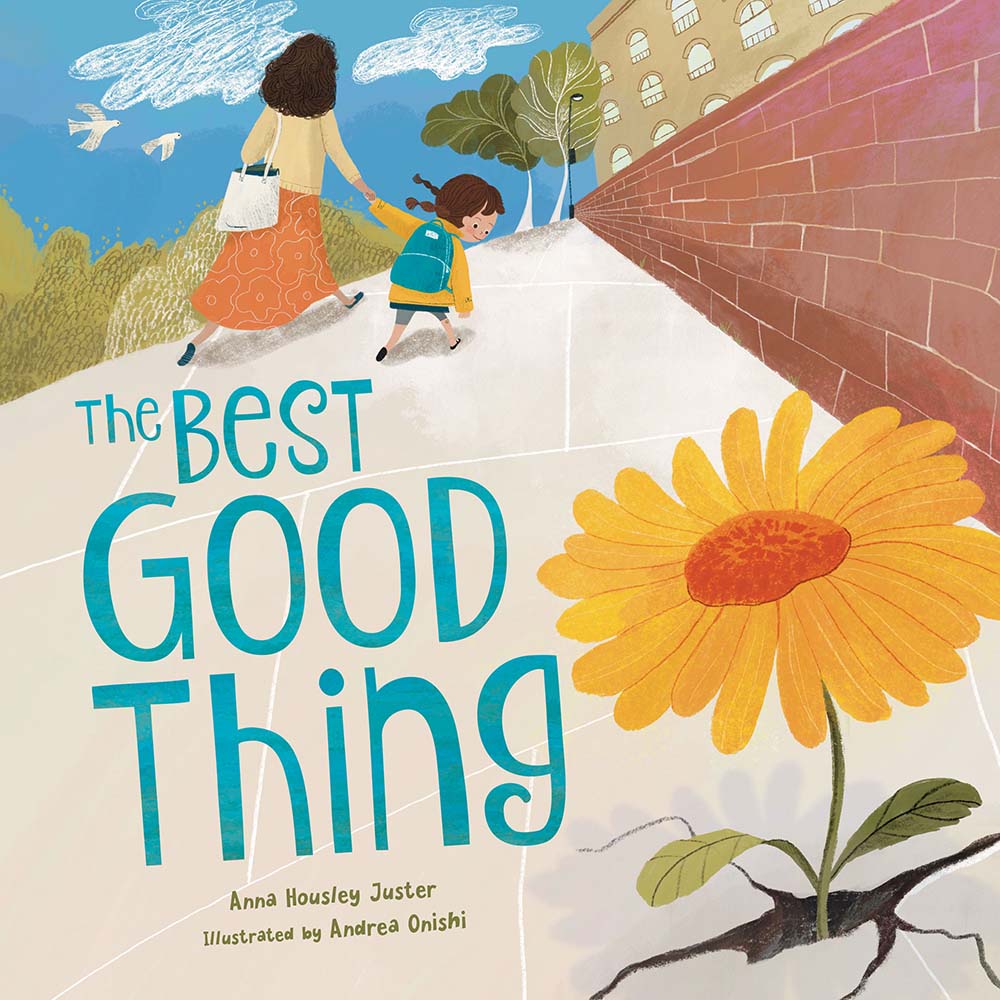
The Best Good Thing: Discovering Joy on a Very Bad, Smad Day
Written by Anna Housley Juster
Illustrated by Andrea Onishi
Ages: 4+ | Pages: 40
Publisher: Free Spirit Publishing (August 2026) | ISBN13: 9798885549653
Publisher’s Synopsis: Some days are all bad . . . or are they?
In The Best Good Thing, nothing is going well. The young narrator sharing about her day is feeling sad and mad. Smad! She knows there are no good things about the day. Her mother listens, sympathizes, and suggests intentionally looking for positives. The story becomes a relatable search for good things, which are all around. A flower, a kind neighbor, yummy bread. Ultimately, she discovers the best good thing of all: love.
Written by a child mental health clinician and grounded in child development, this book:
- Meets the need for story-based books with tools that support children’s well-being
- Teaches parents and young readers the therapeutic strategy of cognitive restructuring in an accessible and kid-friendly way
- Includes guidance and support for kids and adults at the back of the book
This engaging and beautifully illustrated story, told by a main character with a strong voice, will make a real difference in the lives of children and their caregivers.
Pre-Order the Book
Borrow the Book
About the Author
Anna Housley Juster, PhD, LICSW, is an award-winning author, child mental health clinician, education consultant, and mom. She began her career as a Head Start teacher, served as director of content for Sesame Street, and has over twenty-five years of experience supporting children and families. Anna currently treats children managing anxiety, ADHD, and behavior challenges with expertise in cognitive behavioral therapy, play therapy, trauma therapy, and parent guidance.
Her first picture book, How to Train Your Amygdala, is an NYC Big Book Award Distinguished Favorite and has been translated into French, licensed for translation, print, and distribution by the Ministry of Education for Indonesia, and was published as an English-Spanish bilingual edition, How to Train Your Amygdala/Cómo entrenar tu amígdala. Her second picture book The Best Good Thing follows a young girl who discovers joy on a very bad, smad day.
Anna grew up exploring in mud, sand, and snow, surrounded by stories, and is a firm believer in the power of play. She lives with her husband, two daughters, and one very soft dog near Boston, MA.
For more information, visit: www.annahousleyjuster.com


2 Comments
Awe! That cover is so cute! I hope to win this prize package for my neice
Yes, it’s beautiful! We’re so glad you think so, too.