

Anna C. Iacovetta, Ph.D. | The Children’s Book Review | July 16, 2017
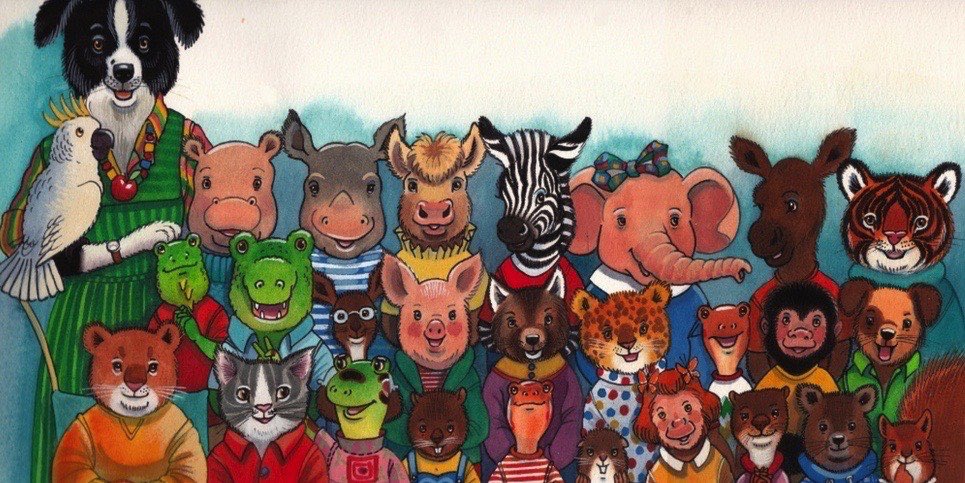
The Miss Bindergarten picture book series provides primary teachers with a wealth of activities to be used within the classroom walls based on the themes of the stories and the illustrations by Ashley Wolff. “In approaching picture books, pre-readers will often pay attention to the pictures without attending to the text as it is read to them” (Christensen). The books not only emphasize diversity, but the educational aspects that involve rhyming and learning the alphabet are just a few prime examples of why these books would make for a great addition in a classroom. Teachers could easily find ways to incorporate these books in their curriculum.
Animals
The animals are used to represent a diverse population in the kindergarten class. Primary teachers can use this as a springboard for students to study the different animals and their characteristics in a science class. Students can even create a comparison chart comparing a particular animal character and its interests to themselves.
For Social Studies, this can open up a conversation with the class about diversity and different cultures. Students can study their own backgrounds and do various projects such as a family tree or a family coat of arms. Teachers can take this a step further by having the students interview each other and accompany that with a hand-drawn portrait or to create a portrait of words – producing a portrait made up of words and phrases that describe that particular student.
Alphabet
Each of the names of the students begins with a different letter from the alphabet and the story begins with A and ends the last page with Z. For example, “A – Adam, B – Brenda, C – Christopher” (Slate). As a teacher reads the books aloud, the students can learn the alphabet and have it reinforced in other books. Students can write or cut out the letters of their names and proceed to decorate them to eventually create a mobile of sorts to be hung in the classroom. Likewise, the teacher can make a large banner where students can put their cut-out, decorated letters and put them in alphabetical order (Slate). Teachers can also use the alphabet characters as a sorting/matching game. Students can match up the name with the correct letter it begins with.
Rhyme
As the books are read aloud, teachers can emphasize the rhyming scheme that is associated with the character and with their action. “Noah connects the hose. Ophelia tries to take a drink and gets squirted in the nose” (Slate, 2005). Knowing the lines rhyme, students can guess what the next action may be after the teacher reads the first line. They can also create a rhyme that goes with their name to be added to a mobile or poster (TeachersPayTeachers, Slate).
Math
Miss Bindergarten Celebrates the 100th Day of Kindergarten can certainly be used as a counting book and in conjunction with a primary classroom who is also celebrating their 100th day of school. Teachers can create a wall display with “100” being the main theme. Children can trace their hands and create a wall of “100 hands or fingers”. Another wall can have “100 animals” and students can cut out various animals from magazines to contribute to the display. Using manipulatives such as pasta to create necklaces or other artwork encourages the children to count each piece out loud until they reach 100 (Slate, 1998).
Shapes
Miss Bindergarten Takes a Field Trip with Kindergarten focuses on the shapes of everyday objects. Students can participate in a scavenger hunt around the classroom searching for various shapes and explaining in their own words the possible reasoning of why that object is that particular shape.
Character Mapping
Because the illustrator, Ashley Wolff, does a fantastic job with personalizing each character, an activity where the child maps their various traits that are embodied within the story can be used. Furthermore, they can use their character maps to compare and contrast the animals with one another. The child can examine gender, age, clothing, and other characteristics that make up that character.
Reading Strategies
With any book, it is easy for teachers to create their own reading strategies that complement what they are learning. This includes differentiating between fact and opinion, summarizing/reporting on the story, oral retelling, cloze activities, and story mapping. These are just a few examples that teachers can use in conjunction with the major theme of the story as they discuss the story as a class. Additionally, various activities that students can do individually or in small groups can include: writing their own version of the story – changing the plot/ending, recreating illustrations, adding bios for each character, and writing up an imaginary interview with Miss Bindergarten.
Overall, these books can be used as early as preschool and into the primary years. Any activity used can easily be connected to the new Common Core standards within any subject – especially Reading. “In a carefully crafted picture book, both text and illustrations play an important role in perceiving the book’s full meaning” (Christensen). The Miss Bindergarten series does just this for young children.
References
Christensen, D. (N/A). Picture Books: Interplay of Text and Illustrations. Retrieved from http://www.public.asu.edu/~diann/Resources/Text%20Set/Text%20Set– Picture%20Books.pdf
Slate, J. (1998). Miss Bindergarten celebrates the 100th day of kindergarten. New York: Dutton Children’s Books.
Slate, J. (2005). Miss Bindergatren has a wild day in kindergarten. New York: Dutton Children’s Books.
Slate, J. (2005). Miss Bindergarten celebrates the last day of kindergarten. New York: Dutton Children’s Books
Slate, Joseph (N/A). The Miss Bindergarten kindergarten series. TeacherVision.com. Retrieved February 17, 2014, from https://www.teachervision.com/literature/activity/31133.html
TeachersPayTeachers (N/A). Teachers Pay Teachers: An Open Marketplace for Educators [Website]. Retrieved from http://www.teacherspayteachers.com/
The article Using the Miss Bindergarten Books in the Classroom was written by Anna Iacovetta. For similar articles, follow along with our content tagged with Educational Books, Kindergarten, Literacy Activities, and Reading Tips.
