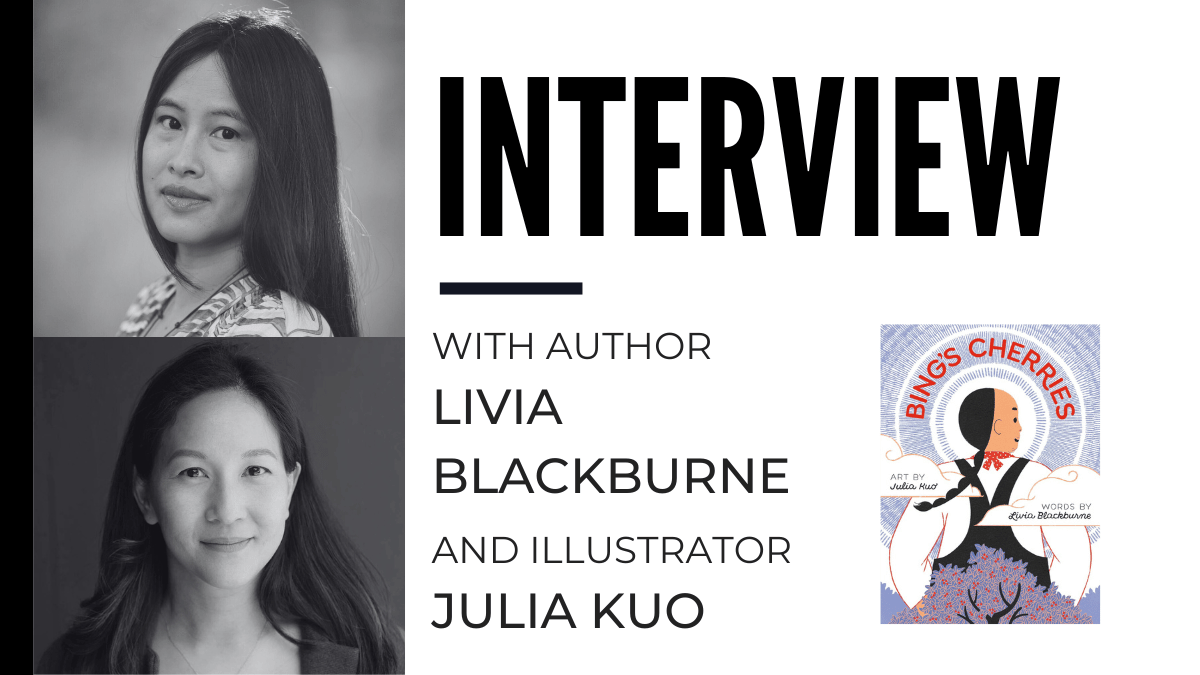
An interview about Bing’s Cherries by Livia Blackburne and Julia Kuo for The Children’s Book Review.
In this conversation, Livia Blackburne and Julia Kuo take us behind the scenes of Bing’s Cherries, a vibrant picture book inspired by the little-known story of Ah Bing, the Chinese immigrant behind the famous Bing cherry.
Rooted in the little-known history behind one of America’s most beloved fruits, Bing’s Cherries reimagines the story of Ah Bing—the Chinese immigrant whose name lives on in the famous Bing cherry. Author Livia Blackburne and illustrator Julia Kuo blend folklore, history, and artistic interpretation to celebrate a figure whose legacy has long gone unrecognized. Blackburne and Kuo reflect on the discoveries that shaped the book, the visual and narrative choices that brought Ah Bing to life, and their hopes that the story will inspire readers to see the beauty that emerges when cultures and communities come together.
What was your earliest connection to this story? What made you want to tell it or illustrate it?
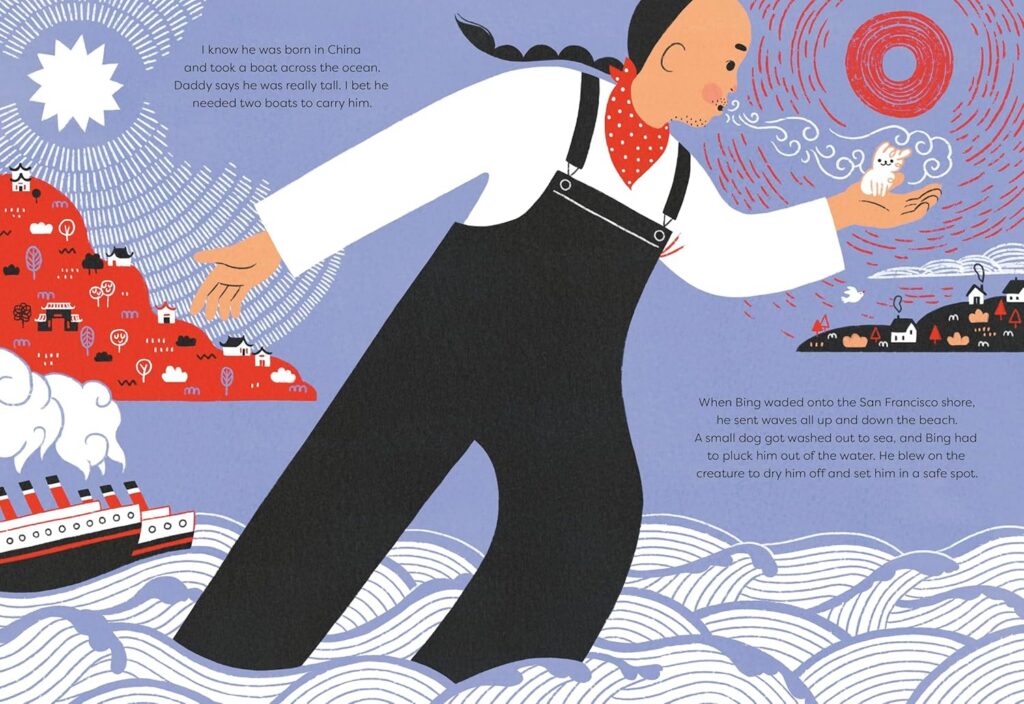
Julia Kuo (JK): I was reading Erika Lee’s The Making of Asian America, and she had a paragraph on Chinese people in agriculture. There was one line that stopped me in my tracks: “One was Ah Bing, who bred the famous Bing cherry in Oregon”. I could have never guessed that Bing cherries were developed by a Chinese immigrant. A quick search initially told me that he was 7 feet tall and sang a sad, mournful song. This colorful description was enough for me to picture Ah Bing joining the ranks of Johnny Appleseed and Paul Bunyan in American folklore!
How did you approach the historical and cultural details, and were there any discoveries that reshaped a scene or deepened your understanding of the story?
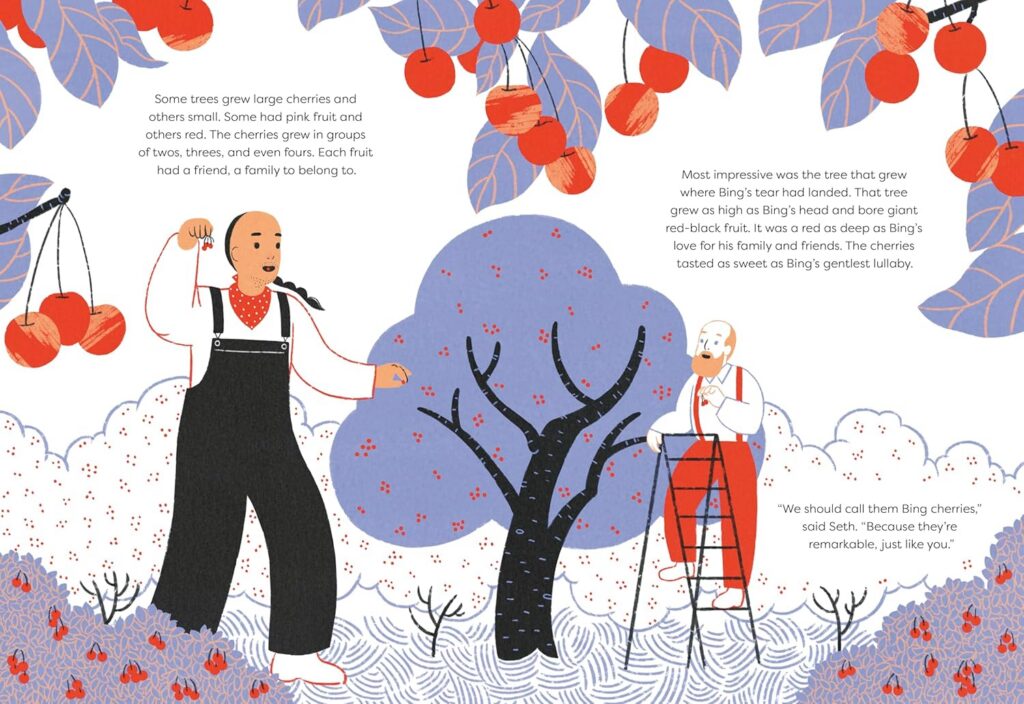
Livia Blackburne (LB): You can’t research Bing’s story without brushing up against the discrimination that Chinese Americans faced in that era. Bing lived at a time when there was a big push to keep Chinese Americans out of the country, and I couldn’t help but feel the contrast between that and the optimistic origin story of the Bing cherry itself. In some ways, this ugliness was unpleasant to behold, but in other ways, the presence of both happiness and conflict in the same story gave me more reason to hope. Even in the midst of all this strife, Bing and the orchard owner Seth were still able to come up with something beautiful. That in itself is a reason to be optimistic.
What part of creating this story felt the most challenging or the most meaningful to you?
JK: Growing up in the 90s, the folktales and myths that I read told tales of bearded white men in colonial America or Chinese gods and goddesses in ancient China. I was used to stories and people being either white or Asian, but never both, like I was, an Asian American. But here was a real-life Asian American folk hero waiting to be celebrated. I realized that as a picture book maker, I had the means to help share Ah Bing with today’s children!
I’ve written some picture books (in addition to illustrating them), but I’ve never tackled a narrative-heavy story before. I’m not sure this book would have been made if I had been set on writing it myself. Thankfully, Livia was up for helping to bring Ah Bing to life.
When you began illustrating Bing’s Cherries, how did you build its visual world—from palette to composition to character design? What guided your earliest visual choices?
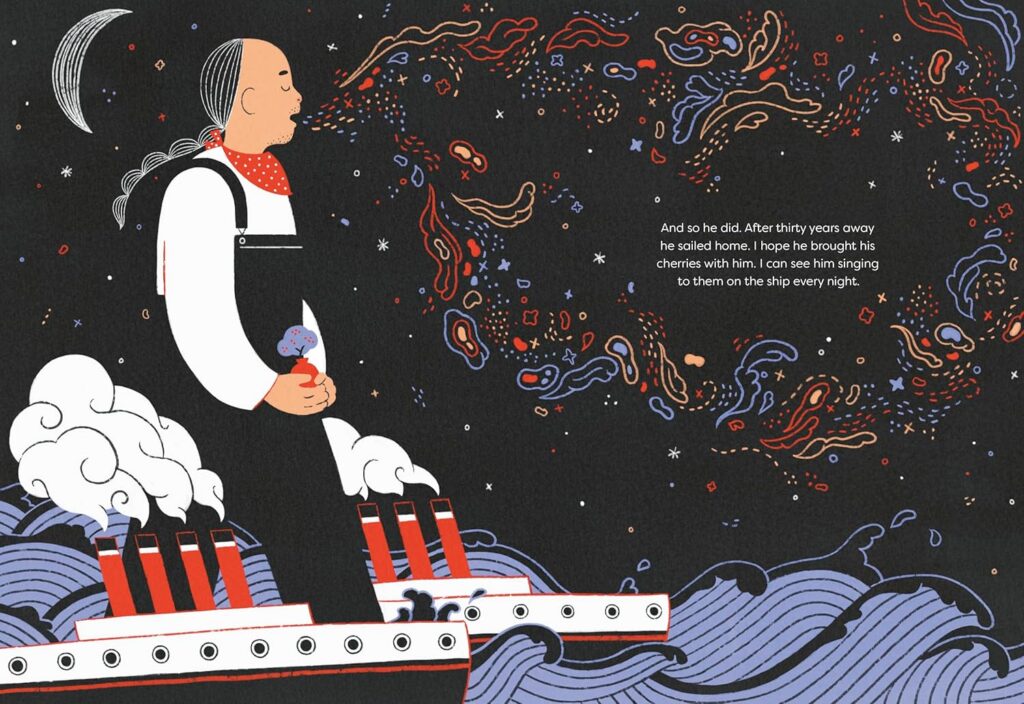
JK: My initial dummy for Bing’s Cherries looked much different! The style was more representational with a pastel palette, but I realized that I was missing an opportunity to illustrate this folktale in a more graphic, simple, and Asian American way. What makes a book look “Asian American” is extremely open to interpretation, but I realized that the work of anyone who has lived that identity and absorbed these bicultural influences all their lives should qualify. So it was refreshing to just draw the way I do naturally! Looking closely, I can see that my ocean waves are a bit Japanese, the clouds are more Chinese, and the way I use shapes and a restricted color palette is influenced by American mid-century illustration.
This story carries powerful themes of legacy and recognition. How did you balance honoring a real historical figure with crafting this story for young readers?
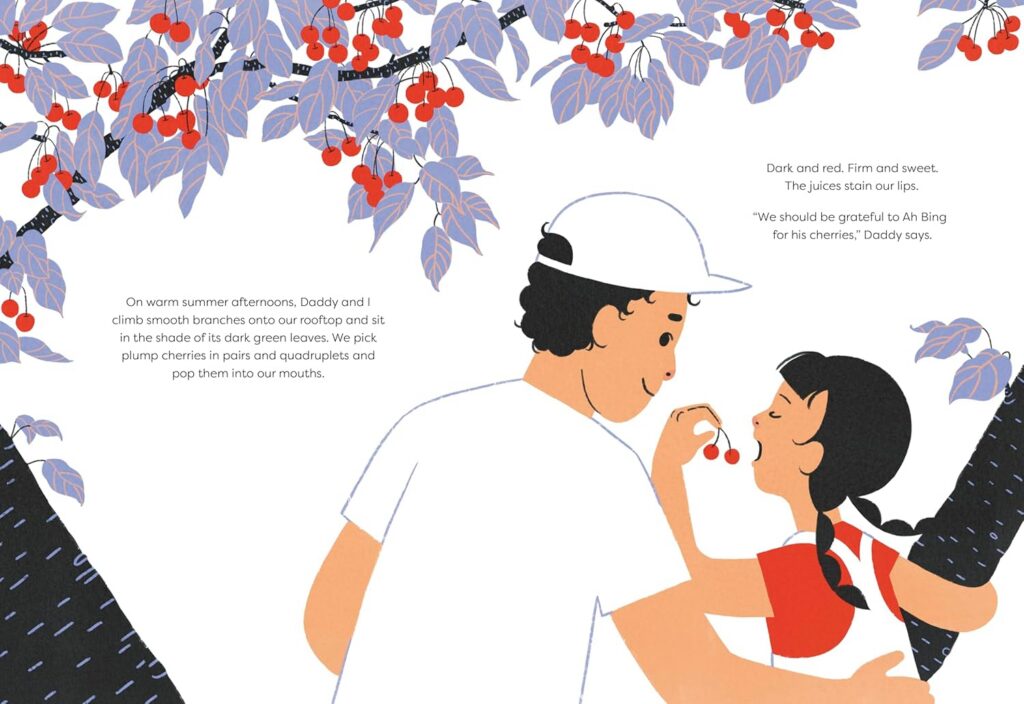
LB: I thought a lot about this as I was writing. While I loved the idea of a tall tale, I also wanted to be respectful of the real Ah Bing and not simply use him as a canvas on which to paint our artistic vision. In the end, I decided to frame the tall tale within a larger story about a modern-day Chinese American girl looking back on Bing and spinning her own story. This makes it more apparent that the tall tale is an imaginative exercise while simultaneously highlighting our hope that Asian Americans will continue to claim their unique heritage through art and whatever other mediums they choose.
Having collaborated before, how did your existing creative relationship shape the way you approached Bing’s Cherries? Did anything feel easier or more ambitious this time?
LB: This collaboration was very different from our previous one. I Dream of Popo was written exclusively by Livia. The two of us didn’t really even communicate except through the publisher until the book was almost launched, so we didn’t really get to know each other until the publicity phase. Bing’s Cherries, on the other hand, was a true collaboration. Julia came up with the initial idea and approached Livia, and then we spent a lot of time bouncing ideas back and forth. I really enjoyed having Julia’s input and creative vision. My books typically tend to be solo endeavors, and it was refreshing not to be the only brain responsible for shaping the book.
If readers take away one feeling from this book about history, belonging, or legacy. What do you hope it is?
LB: Our country is going through a time of strife regarding how immigrants are portrayed and treated. I hope Bing’s Cherries create an alternate vision for how we as a country might view immigrants and people in the margins. There is beauty when people of different backgrounds come together, and we all stand to benefit.
What surprised you most when you saw the finished book come together as a whole?
JK: I was surprised at how great it looked! Bing’s Cherries is my 11th picture book, so I’ve gotten pretty used to the process. Once I’ve finished the illustrations, it’s not hard to imagine what the book will look like. The team then makes choices about the font, thickness of the boards, jacket, etc., but usually it doesn’t move the needle one way or another. This book was different. It’s hard to explain, but the design and production choices—subtle as they may be—have made the physical, finished book much greater than the sum of its parts. I’m not sure how often the public sees that designers really improve everything they touch, but this is a great example!
What can readers expect from your next project? Whether together or solo.
LB: We are already hard at work on our next collaboration! Chrysanthemum’s Glow is another Asian American history-inspired folktale. We were drawn to the topic because chrysanthemums are originally from China, but they made their way across the ocean and have now become well integrated into American Thanksgiving traditions. In a way, the chrysanthemum has its own immigration story.
We can’t wait to see how Chrysanthemum’s Glow turns out—we can already imagine how beautiful it will be,
About the Book
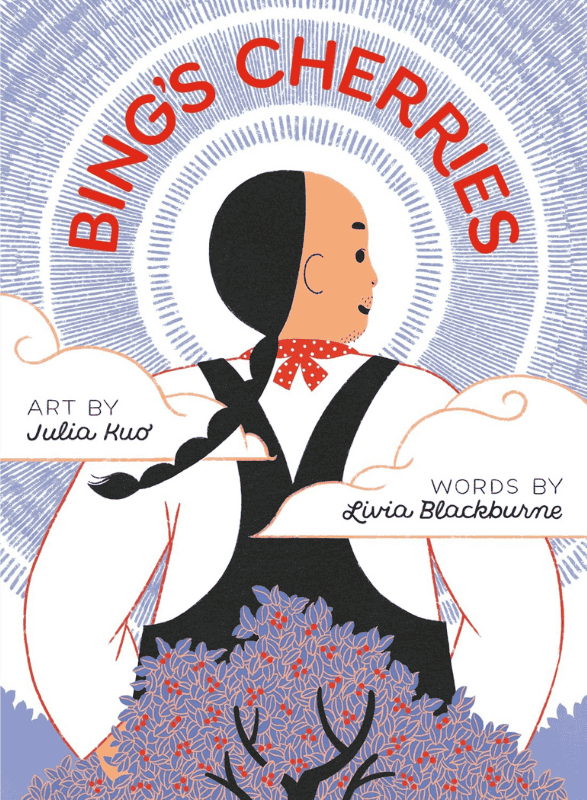
Bing’s Cherries
Written by Livia Blackburne
Illustrated by Julia Kuo
Ages: 4+ | 48 Pages
Publisher: Knopf Books for Young Readers (2026) | ISBN-13: 978-0593902813
Publisher’s Book Summary: A modern American tall tale woven by a girl and her father about Ah Bing, the Chinese immigrant behind the Pacific Northwest’s most delicious cherries.
You’ve heard of a Bing cherry, but did you know the story of the Chinese American immigrant for whom the dark, luscious cherry is named?
Long ago, Ah Bing was a father who travelled across the sea from China looking for work. It was in Oregon where he met a man who hired him to work in his orchards, where eventually, Bing cultivated the delicious cherries we know of today.
But what was it that made this man and the cherries he made so special? a young girl wonders as she sits together with her father, enjoying cherries from their backyard. Weaving together cultural memory, historical fact, and her own imagination, the young girl imagines a narrative of Ah Bing that is as larger than life and as sweet as his namesake.
Buy the Book
About the Author
Livia Blackburne is a New York Times bestselling author of novels and picture books. Her titles include I Dream of Popo, which received starred reviews from Publishers Weekly, Kirkus, and Booklist; Midnight Thief, an Indies Introduce New Voices selection; and Rosemarked, A YALSA Teens Top Ten nominee. Born in Taiwan and raised in Albuquerque, she now lives in Los Angeles with her husband and daughter.
About the Illustrator
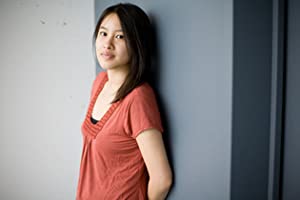
Julia Kuo is the author and illustrator of Let’s Do Everything and Nothing and Luminous: Living Things that Light Up the Night. She is the illustrator of several picture books, including I Dream of Popo by Livia Blackburne, I Am an American: The Wong Kim Ark Story by Martha Brockenbrough and Grace Lin, and New York Times bestselling Rise by Jeff Yang, Phil Yu, and Philip Wang. Julia has created editorial illustrations for publications such as The New York Times, The Wall Street Journal, and The Economist. She currently lives in Bellevue, WA.