

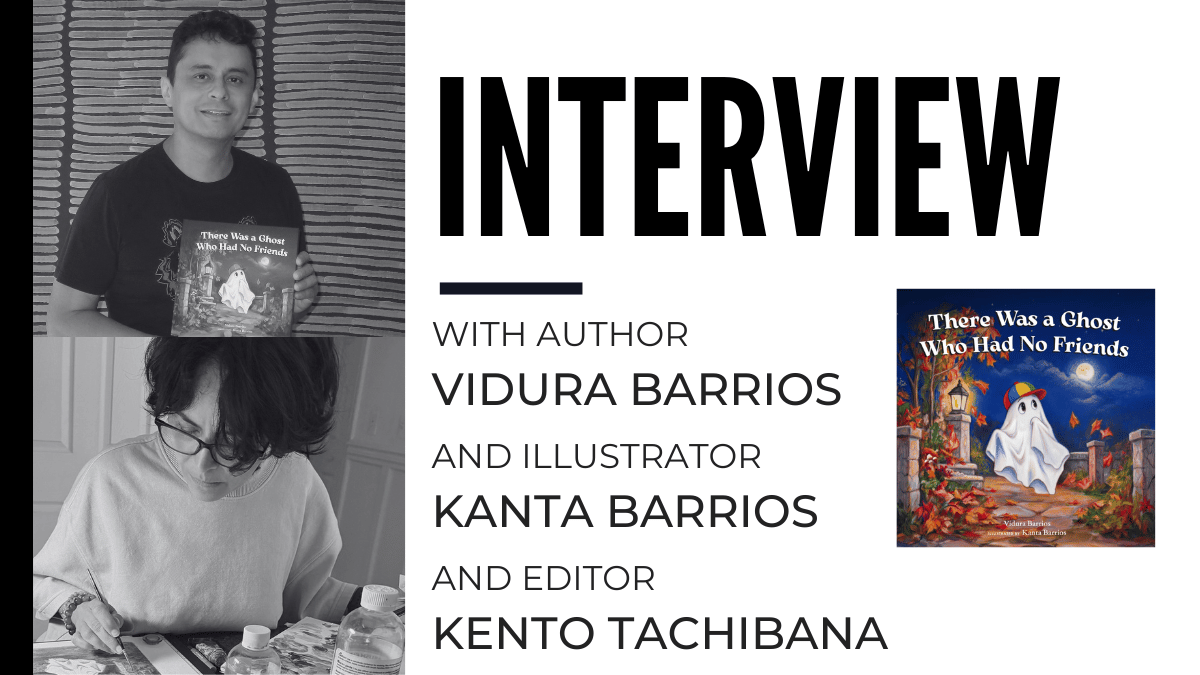
An interview with author Vidura Barrios, illustrator Kanta Barrios, and Kento Tachibana about There Was a Ghost Who Had No Friends, presented in partnership with The Children’s Book Review.
Join author Vidura Barrios, illustrator Kanta Barrios, and editor and layout designer Kento Tachibana as they share the inspiration behind their new picture book, There Was a Ghost Who Had No Friends.
For a child who longs to make friends but is too shy to say hello, even the smallest step toward friendship can feel like a big one. Drawing on his own childhood experiences with loneliness and bullying, author Vidura Barrios created a little ghost who knows that feeling all too well.
In this interview, Vidura, illustrator Kanta Barrios, and editor and layout designer Kento Tachibana share how a few lines of a song grew into a picture book, how their creative collaboration brought the little ghost to life, and why children don’t need to change who they are to be worthy of friendship and love.
For Vidura: Where did the little ghost come from? Was there a moment, a memory, or a child you know who sparked the idea of a ghost too shy to let anyone know he’s there?
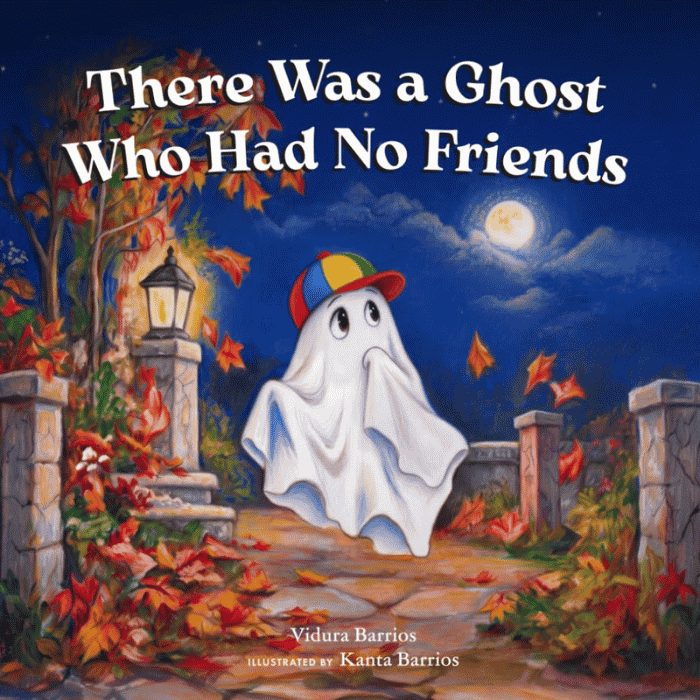
Vidura Barrios (VB): Well, the shy little ghost was ultimately based on some of my childhood experiences. I was that child who watched others play and have a wonderful time while I sat alone in a corner. The longing to have a real friend was something I experienced very deeply when I was young. I also went through a fair amount of bullying at school.
When I was 15, I began practicing meditation. One day, during meditation, the face of my main bully suddenly appeared in my mind, and I had a realization: he actually just wanted my attention. That experience changed my perspective. As I gradually became more confident and stopped worrying so much about what other people thought of me, something remarkable happened. The bullying stopped, and I began developing genuine connections.
I wish I had possessed those tools when I was younger. In a way, this book is my little contribution toward helping children discover that even a small effort to step outside our shell can make an enormous difference. Sometimes, a little courage is all it takes to open the door to a wonderful friendship.
For Vidura: Shy children are often told to “just go say hi,” which can feel huge to them. How did you decide what the ghost’s first brave step would look like, and why was it important that it be a small one?
VB: For me, one of the most pivotal moments in the book is when the little ghost begins doing small things to help Danny. I believe that shifting our attitude from “What can I get from others?” to “What can I offer others?” is one of the foundations of a genuine and lasting friendship.
It takes the ghost quite some time to gather enough courage to reveal himself and simply say hello. But his journey toward friendship begins much earlier, through small acts of kindness. By finding little ways to help Danny, he gradually creates a connection without having to overcome all his fears at once.
I think that’s an important message for shy children. You don’t have to make some enormous, courageous gesture to connect with someone. Sometimes, the smallest act of kindness can be the beginning of something beautiful.
For Kanta: Your training and exhibitions are in fine art. How did you approach illustrating a picture book differently from your gallery work? Was there anything you had to unlearn or rethink?
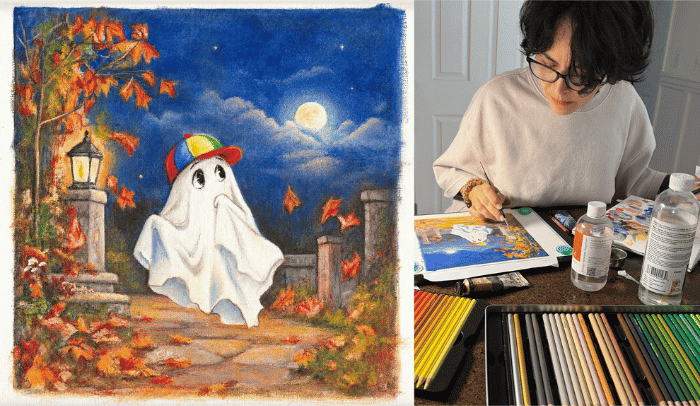
Kanta Barrios (KB): I usually work in oils, creating layered paintings that require considerable time to develop. For this project, I had to adjust my approach because we were working with a deadline, which meant I needed to work much faster and become more inventive with my materials.
That challenge actually opened up some exciting creative possibilities. I began experimenting with materials I don’t normally use, such as oil sticks, pastels, and oil pencils, which allowed me to work more quickly without waiting for layers of paint to dry. At the same time, these materials still gave me the freedom to explore color, depth, and movement in the characters.
In some ways, I had to return to the basics of drawing, which was a wonderful experience.
Another big adjustment was the color palette. Vidura had a very clear vision of bright, saturated colors for the book, which is quite different from the palette I typically use in my fine art. It was refreshing and fun to experiment with such vibrant colors and discover how they could bring the characters and their world to life.
For Kanta: A ghost is a tricky character to draw expressively, since he has no eyebrows, hands, or body language in the usual sense. How did you show his loneliness, hesitation, and eventual courage on the page?
KB: When I thought about illustrating a ghost, I approached him almost as the spirit of an emotion. Since he doesn’t have the usual physical features we rely on to express feelings, I focused primarily on his eyes.
For me, drawing is very much about entering the emotional world of what I’m trying to portray. Whether I’m expressing sadness, loneliness, happiness, or courage, I try to connect with that feeling inside myself first and then allow it to come through in the artwork.
With the little ghost, I wanted the reader to sense what he was experiencing, even without words. His eyes became the window into his emotional journey, from loneliness and hesitation to the joy of finally finding a friend.
For Vidura and Kanta: You’re siblings who have worked together before. What does collaborating with family make easier, and what does it make harder? Did you ever disagree about how a scene should look or read?
KB: Working with family certainly has both challenges and benefits! When disagreements arise, there are sometimes fewer boundaries in how openly we express ourselves. But at the end of the day, we’re family, and we genuinely want to support one another and create the best possible work. That shared commitment always outweighs any differences of opinion.
Interestingly, when Vidura first approached me about the project, I actually turned it down because I didn’t consider myself a children’s book illustrator. My background is in fine art, and this was something quite different from what I normally do.
But Vidura was so enthusiastic about the story and had such a clear vision of what he wanted to create that I eventually became excited about helping him bring it to life.
He had a very definite idea from the beginning of how the little ghost and Danny should look and feel. My role was to take that vision and translate it into illustrations that would bring the characters and their emotions to life.
In the end, I think our different perspectives complemented each other beautifully. And there’s something especially rewarding about creating something meaningful together as siblings.
VB: Yes, definitely! I absolutely loved collaborating with my sister. I actually considered several other artists for the project, but one thing that was very important to me was having illustrations created using traditional, physical art materials rather than digital techniques. I was surprised to discover how many children’s book illustrators today work primarily digitally.
I wanted the book to have that special quality that comes from original, hand-created artwork, where you can really feel the artist’s personal touch. Kanta brought exactly that to the project, along with her own artistic sensibility and creativity. I think she did a fantastic job, and I’m very happy that we were able to create something so special together.
For Kento: As both editor and layout designer, you shaped how the story unfolds page by page. How did you use page turns, white space, or pacing to mirror the ghost’s journey from hiding to reaching out?
Kento Tachibana (KT): It was really important to me, as we were going through the story, that there was a distinct rhythm in how the words on each page were spoken out loud. If that meant changing an entire section, or flipping the order to achieve that flow, we did it. As I was going through the book, I wanted to make sure it was divided up in a way that was easy to follow and clean. A lot of the visual layout side was just pure intuition.
For Kento and Vidura: You’re both musicians. Did a musical sensibility influence the rhythm of the text or the flow of the book? And how did the companion song come about? Did it start before, during, or after the book?
KT: It definitely did. Each page of the book has its own style and rhythm, with one flowing naturally into the next. We spent about a month perfecting this, going back and forth until we felt we had it just right.
As for the song, we always had it in mind to do both, and we started working on them more or less simultaneously. One of the differences is that, for the song, I wanted to keep things fun and light, leaving certain details out to give listeners more room to imagine the story for themselves.
VB: Yes! Although the text of the book was completed first, the whole idea actually began with a song. These first four lines became the inspiration for the story:
There was a ghost who had no friends
So shy and yet so keen
He watched the kids and longed to play
Afraid to be seen
We thought, wait a minute, this is such a sweet story. It could become a book, too!
Growing up, some of my fondest memories are of my mom telling me stories through song. So it felt completely natural to bring the two together.
For Vidura: You’ve built an enormous Halloween-loving community online. What have you learned from that audience about what draws people, kids and adults, alike, to friendly spooky characters?
VB: Part of the message of the book is that we shouldn’t be afraid of or alienate someone simply because we perceive them as different.
And I think that’s one of the beautiful things about Halloween. It’s a celebration where everyone is welcome, from the weird and wonderful to the spooky and mysterious! It’s that one night of the year when you can express yourself in whatever way you like, and it’s perfectly okay.
I think there’s something very liberating about that, and perhaps that’s why people of all ages are drawn to these characters. They remind us that being different isn’t necessarily something to fear. It can be something to celebrate.
That said, I want to emphasize that There Was a Ghost Who Had No Friends isn’t intended to be just a Halloween book. Its message is timeless, and the story is meant to be enjoyed all year round.
For All Three: Picture books are often read aloud by a parent, teacher, or librarian. What conversations do you hope the book sparks after the last page? Is there a question you’d love grown-ups to ask the children they’re reading with?
KT: I hope it sparks conversations about acceptance, both of ourselves and of others. I think the questions I’d love grown-ups to ask would center around how we can include children who may be shyer or less outgoing than others. Sometimes a simple invitation to join in can make all the difference.
KB: I think the book encourages children to be their authentic selves. The story is about finding the courage to be who you are, even when that feels difficult.
I would love for parents to reassure their children that they are loved and accepted just as they are, no matter how shy or different they may feel. Every child deserves to know that they don’t have to change who they are to be worthy of friendship and love.
VB: Absolutely! And for me, the core message of the book is generosity, especially being generous toward someone you don’t know yet.
I would love for parents and teachers to ask children something like, “Is there someone you know who might be feeling lonely or left out? What could you do to make them feel welcome?”
Sometimes the smallest gesture of kindness can mean the world to someone else.
For All Three: If you could send one message to a child who is watching from the edges of the playground right now, the way the little ghost does, what would you want them to know?
KT: You are loved and accepted for exactly who you are.
So many shy children feel invisible or unsure of themselves, and those feelings can bring a lot of insecurity. But when you begin to believe in yourself, you realize that you have something wonderful to offer and that your love and kindness will be felt by others.
That’s what the little ghost discovered. He realized he had something to give. He didn’t just wait for friendship to find him; he found the courage to reach out.
KB: It’s okay to be that shy kid. You won’t always feel that way, and even if you do, that’s okay, too.
Sometimes you just need a little time to observe what’s going on before joining in. And when you’re ready, go for it! Most people are a lot kinder than we sometimes imagine.
VB: I would want them to know that things do get better and to show kindness and love toward others, regardless of their differences.
Sometimes, when you’re young and feeling lonely, it’s hard to imagine that things could ever be different. But they can, and they will. There are wonderful friendships waiting to happen, and sometimes all it takes is one small moment of courage to begin.
About the Book
There Was a Ghost Who Had No Friends
Written by Vidura Barrios
Illustrated by Kanta Barrios
Edited by Kento Tachibana
Ages: 4-10 | 50 Pages
Publisher: Independently Published (2026) | ISBN: 979-8163572410
Publisher’s Book Summary: There was a ghost who had no friends.
He had so many stories to share,
There was so much fun to be had,
But unfortunately, he was terribly shy and scared.
And so begins the charming and uplifting journey of a little ghost who learns a thing or two about kindness, friendship, and finding his way out of his shell. Written by Vidura Barrios and featuring original drawings by Kanta Barrios, this heartwarming tale is a sweet reminder that sometimes all it takes is a little courage to start a great friendship.
Buy the Book
About the Author
Vidura Barrios is a writer, singer, recording artist, and founder of Inner Splendor Media. A lifelong lover of Halloween and all things spooky, he is also the co-author of SPOOKtacular Gluten-Free Halloween Desserts.
With There Was a Ghost Who Had No Friends, Vidura hopes to remind readers that they are never truly alone and that, with a little courage and effort, wonderful connections and lasting friendships can blossom.
Photo by Manasi Fragoso, used with permission
About the Illustrator
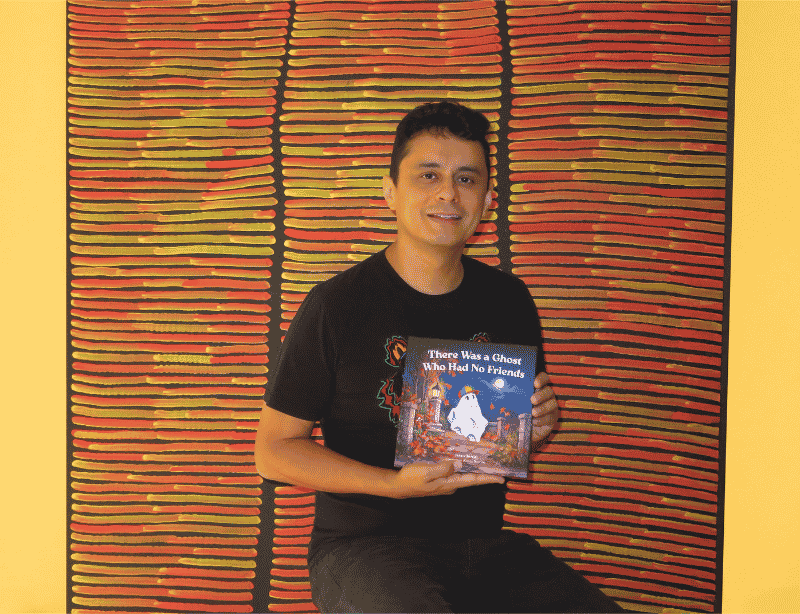
Kanta Barrios is an artist and illustrator who studied at the National College of Art and Design (NCAD) in Dublin, Ireland. Her artwork has been exhibited in Ireland, including at the Irish Museum of Modern Art (IMMA).
A lifelong lover of Halloween, ghosts, and all things spooky, Kanta is also the co-author of SPOOKtacular Gluten-Free Halloween Desserts. She created the original illustrations for There Was a Ghost Who Had No Friends, bringing the little ghost and his world to life through her artwork.
Check out the song that inspired it all:
This interview—Interview with the Creative Team behind ‘There Was a Ghost Who Had No Friends’—was conducted between Vidura Barrios, Kanta Barrios, Kento Tachibana, and Bianca Schulze
