

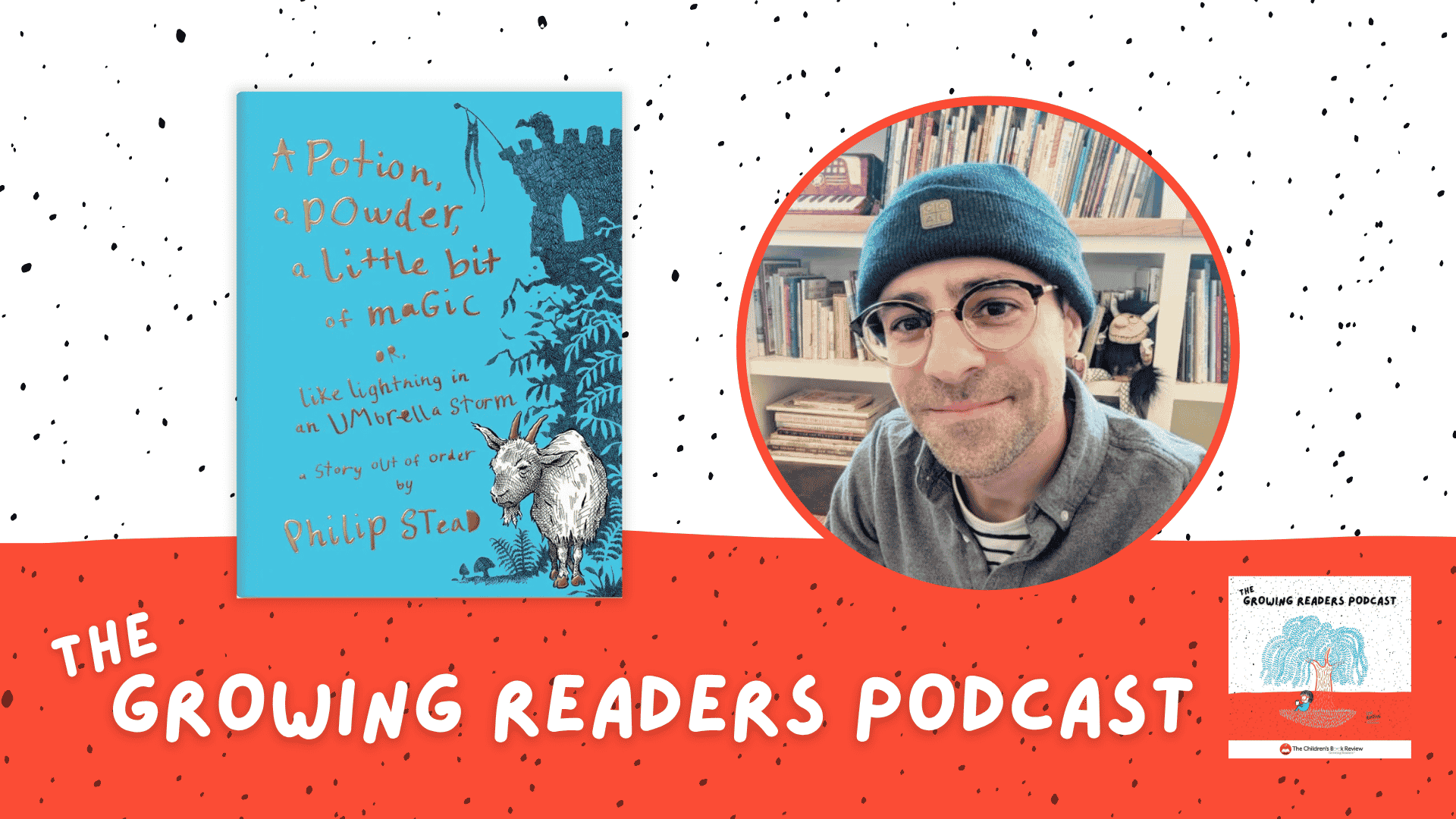
A podcast interview with Philip C. Stead discussing A Potion, a Powder, a Little Bit of Magic: Or, Like Lightning in an Umbrella Storm on The Growing Readers Podcast, a production of The Children’s Book Review.
In this episode, Philip C. Stead shares the inspirations behind A Potion, a Powder, a Little Bit of Magic, his leap into imaginative middle grade fiction.
Stories do not always move in straight lines, and neither does the creative process behind them. In A Potion, a Powder, a Little Bit of Magic: Or, Like Lightning in an Umbrella Storm, Philip C. Stead embraces the strange, the funny, and the deeply heartfelt, crafting a tale that unfolds out of order and lingers long after the final page. In this conversation, he reflects on the books that shaped him as a reader, why stories need heart more than cleverness, and how writing just 200 words a day over the course of years helped the novel slowly take shape.
Subscribe to The Growing Readers Podcast to ensure you never miss an episode celebrating the creators shaping young readers’ lives.
Listen to the Episode
The Show Notes
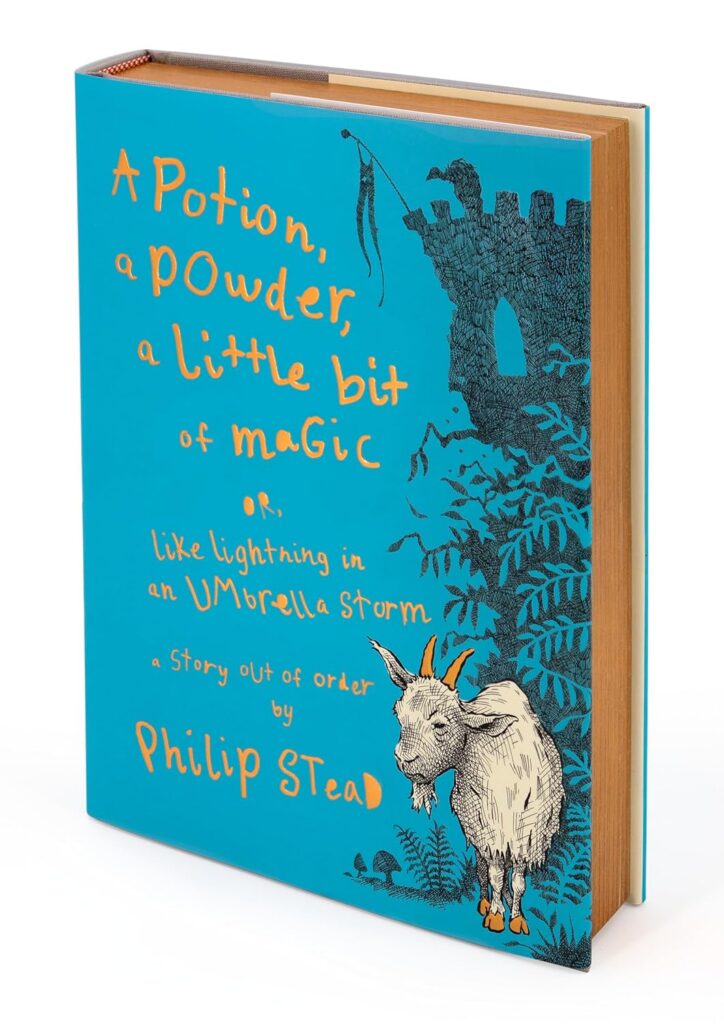
A Potion, a Powder, a Little Bit of Magic: Or, Like Lightning in an Umbrella Storm
Written and Illustrated by Philip C. Stead
Ages: 10-12 | 328 Pages
Publisher: Neal Porter Books (2026) | ISBN-13: 978-0823458097
Publisher’s Summary: A plucky young goatkeeper sets out on a misadventurous rescue mission in this uproarious debut novel with premium hardcover features, perfect for fans of Kate DiCamillo and Lemony Snicket.
In a kingdom ruled by a capricious king, the castle rests on the backs of twenty-four goats, and the welfare of those goats rests on the back of a girl called Bernadette. So when one goat escapes, it’s up to her—with the help of a very forgetful wizard and a Boat That Does Not Grant Wishes—to bring it back safely.
Her task may be straightforward, but this book is anything but. Like a swirling herd of restless goats, the chapters are all out of order. The ending may prove to have been the beginning all along. All the while, the author of Bernadette’s saga—a character himself—hurries to write her a resolution, with very mixed results. And if you’re feeling lost, don’t worry; the story has twenty-four morals, of varying advisability, to edify you along the way.
Award-winning picture book author and illustrator Philip Stead makes a confident debut as a novelist in this laugh-out-loud, one-of-a-kind illustrated tale, chock-full of running gags, broken fourth walls, and underdog triumph.
Gilded edges, a velvet-touch jacket with foil accents and embossing, a foil-stamped cloth case and printed endpapers make A Potion, a Powder, a Little Bit of Magic as thrilling to hold as it is to open, a perfect gift for any young reader.
Buy the Book
Borrow the Book
About the Author
Philip C. Stead is the author of the Caldecott Medal-winning book A Sick Day for Amos McGee, also named a New York Times Best Illustrated Book and a Publishers Weekly Best Children’s Book, illustrated by his wife and frequent collaborator, Erin Stead. He is the author and illustrator of The North Wind and the Sun, a Bank Street Best Children’s Book of the Year. He lives with Erin, their daughter, and their dog in a hundred-year-old barn in Ann Arbor, Michigan.
For more information, visit www.numberfivebus.com.
Credits:
Host: Bianca Schulze
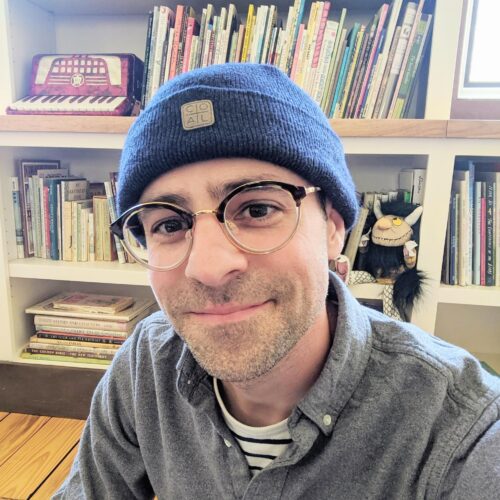
Guest: Philip C. Stead
Producer: Bianca Schulze
Read the Transcript
Bianca Schulze:
Hi, Philip — welcome to the Growing Readers Podcast.
Phil Stead:
Hi, thanks for having me.
Bianca Schulze:
An absolute pleasure. You’re probably best known to our listeners as the award-winning picture book creator behind the Amos McGee titles, which you create with your wonderful wife, Erin. But this is your debut novel. So how does it feel to be sitting in the novelist chair for the first time?
Phil Stead:
It’s a little strange for me. I do feel sometimes like a little bit of an imposter, which I think is a common experience for creative people in general — to try a new thing and feel like, man, do I belong here or not? But at the same time, it’s something I’ve really wanted to do for as long as I’ve been making books, and even longer than that. It was middle grade books that really formed my reading experience as a child. It actually wasn’t picture books. We didn’t have a lot of picture books in my home. It wasn’t until I was a really independent reader in third, fourth, and fifth grade that I really became a daily reader, and my world got so much bigger because of it. So part of me has always wanted to try middle grade, to take that step into middle grade. But because I’m an artist first, it’s a bigger leap than it is for some picture book writers.
Bianca Schulze:
Yeah. Well, I have this question that I like to ask all of my first-time guests, and I feel like you already answered it without me having to ask it. But they say to be a writer, you need to be a reader first. And I usually ask, was there a pivotal moment in your life when you truly considered yourself a reader? And it sounds like middle grade books were informing you for a long time. Is that fair to say? And if so, were there specific books that you think turned you into a reader?
Phil Stead:
Yeah, absolutely. So I didn’t have a ton of picture books, but I had a few that were really, really influential, probably around first and second grade. The two that come to mind right away are Sylvester and the Magic Pebble by William Steig, which is a very strange story and much darker than people give it credit for. When you go back to it as a grown-up, there’s something almost horrifying about the book for a lot of it. But that really imprinted on me as a way that a story could be told as a kid. The other book would be Swimmy by Leo Lionni, which again, when people remember that book, if they remember it at all, they remember this sort of triumphant image at the end where all of the little fish form a big school and chase away the big scary fish. But the most important thing to remember about Swimmy, in my opinion, comes on the second page of the book, when that big fish eats up every single fish except for Swimmy. So we have this mass killing of fish, and this is a book for really little kids. I go back to these books sometimes as a reminder that the littlest children can handle a bit of darkness as long as you balance it with a bit of light in books. So those are the picture books that really imprinted.
In third grade, though, I moved really heavily into middle grade and devoured all of the books by Roald Dahl. In particular, The BFG was my absolute favorite, along with Matilda, and probably The Twits as well to a certain extent. I do love The Twits. As a grown-up now, I love the length of The Twits. It’s something I’d love to play with later on — that 10,000-word sort of length. It’s middle grade and it’s a high-level reading experience, but it’s not a reading experience that takes 12 hours. It’s something you can get done in an hour and a half. So that’s pretty cool.
All the work of Roald Dahl, and then The Phantom Tollbooth by Norton Juster, was really critical for me as far as expanding my mind as to what a book can do. A book can be not just a story, but it can be almost like a game that you get to play with an author. And then related to that, but in a different way, my last one would be The Westing Game by Ellen Raskin, which I remember as just being a mind-blowing experience when I was eight years old. Like, my gosh, this book is so smart and so clever, and here I am at only eight years old, and I’m in on it. I get it and I’m along for the ride. So those types of reading experiences, where the author seems to be in sort of direct conversation with the reader — as though the book itself is a kind of game — is both what excited me when I was a kid, but also really informed the experience of writing this book too.
Bianca Schulze:
Yeah, I love that. And I didn’t mean to shout out about The Twits, but I feel like it’s one of the least — like, when people talk about Roald Dahl, you get mostly Matilda and, you know, Charlie and the Chocolate Factory, Fantastic Mr. Fox, BFG, James and the Giant Peach. And I feel like nobody ever says The Twits, and I loved The Twits.
Phil Stead:
Yeah, it’s one of my favorite ones to go back to actually as a grown-up. You know, Dahl is a complicated figure. You have to sometimes throw out some caveats before you reference him or try to put him up on a pedestal, because he was not perfect as a human being. And especially, there are some things in Charlie and the Chocolate Factory that can really make you cringe, especially if you have one of the original printings. That said, there’s something inherent in Dahl’s writing that I really respond to, which is that he gets talked about and remembered as this sort of master of wickedness and nastiness. But to me, Dahl’s writing is actually about sweetness and kindness — but it’s a bait and switch.
When you open up the book Matilda, the very first page, you get this — I mean, it’s my favorite single page of middle grade writing anywhere. It’s a short little description of how most parents imagine that their child is the most perfect little child, when in actuality it’s more likely that they’re a disgusting little blister. And so he sets you up with this: I’m going to be honest with you. I trust you. You’re eight years old, but I trust you with this piece of knowledge that nobody else is going to tell you, which is that the world is not always a perfect and safe place. That actually it is full of pitfalls and it is full of charlatans and it is full of people that want to take advantage of you. But there is another way to be — and Matilda is that other way to be, or Miss Honey is that other way to be, or Charlie Bucket is that other way to be. And he trusts the child reader to make the selection properly of who you want to be and who you don’t want to be, without ever necessarily saying this is the right answer. And that’s why I think those books have sold, at this point, who knows, like billions of copies, and why generation after generation of kids feel seen and heard when they read those books — because finally, a grown-up is telling them the truth.
Bianca Schulze:
Yeah, absolutely. Well, what is it that you say motivates you or drives you to write specifically for kids? Is there some underlying drive that says, yes, I need to write and create art for kids?
Phil Stead:
Yes. Some of it is sort of just hard baked into who we are as makers, I think. You kind of end up reverse engineering yourself when you get a question like that — like, what is it about me that led me here? Because it wasn’t really a conscious choice. As early as when I met my wife Erin in high school, and I was 15 years old, at that point I already knew I wanted to make work for kids. So it’s been with me for basically as long as I can remember.
But I think I can point to a few things about myself. One is — and I think this is true of almost all makers of things for kids — is that we really, really remember the reality of what it felt like to be a kid. I think most grown-ups, after they’ve exited childhood, they forget very quickly what childhood was actually like, and begin to remember it either very fondly, in a romanticized way, or very negatively, if they were unfortunate enough to have a difficult, truly difficult childhood. Most of us, though, don’t remember the sort of untidy balance of childhood, where every day you’re having to overcome something, every day is a new challenge, your body is changing every single day, you’re becoming this new person, and it’s beyond your control. There’s just a certain type of person that the truth of that experience stays with all the way through. And so you want to draw from those experiences when you make things. So I guess I’m just one of those people.
Bianca Schulze:
Yeah. Well, let’s dig into A Potion, a Powder, a Little Bit of Magic. They say write what you know. So I have to ask — did you begin this book simply by writing the very next thing that popped into your head? Because to me, it absolutely reads that way, in the best possible way, that you were just sitting there and just writing whatever popped into your head.
Phil Stead:
Yeah, so I guess I’ll start by describing to you how I actually write, the actual process for me, because I think it is a little bit unusual. I come from an art background, not a writing background. And when you’re making a picture, you just start by making a mark. And now you’ve made one mark, so the second mark has to respond to the first mark, and the third mark has to respond to the second mark, and so forth. It’s very, very difficult, when you’re starting with a blank white page, to really puzzle out every move you’re going to make in advance. And if you even try to think even just a few moves in advance, you end up being completely crippled at the page, which is honestly a really common feeling for any artist — to just feel like, my gosh, I can’t make a mark because what if that mark is wrong?
So because that’s how I have always approached any creative thing, it’s how I ended up approaching the writing of a long piece of fiction too, where I basically just put down a couple of words and then responded to those words, and then responded to those words, and responded to those words. And the way I formalized it is that every day I had a goal of 200 words, which is really not that much. It’s like a small paragraph. I figured, I’d never written anything of this length before, but if I wrote 200 words a day, five days a week for one year, I would have a book. And it was as simple as that.
But because I come from picture book writing, where every word has to be exactly right, that’s exactly how I treated each one of those 200-word segments. It was: I’m going to write 200 words, and every word is going to be in exactly the right place. And once it’s there, it’s there, as if it’s carved in stone. And then I’ll move on to the next 200, and the next 200, and the next 200. There were revisions to this book, but revisions were on the micro scale: is this sentence put together exactly right? Or maybe these two sentences just need to swap places, or something like that. But there’s probably not a single paragraph in the book that isn’t in pretty much the exact location at which I wrote it chronologically. Although even that’s a little bit of an untruth, because the other sort of quirk of this book, which readers will experience right away when they open up the book, is that the book is told out of order. So I probably ought to explain that a little bit too, and how that came about, if you don’t mind.
I began writing all the way back in 2018, so about eight years ago. And at the time, like what you were saying, how you guessed I was working, I didn’t really have a destination in mind for the writing. I just began. And I was writing and writing and writing, and I got to about 10,000 words in, and I was feeling like, okay, this is something now. I mean, it was the length of that Twits book basically. And I thought, I’ve almost got a book here and this is pretty cool. I sent the writing off to a trusted friend and asked for her opinion. She wrote back and she said, you know, I really like it. The language is fun and it’s engaging. But at the same time, you waited basically the whole way to even introduce your main character — which was true.
It had not occurred to me, as stupid as it sounds, that you shouldn’t wait 10,000 words to introduce the main character of your story. But this is the kind of thing that happens to you when you don’t know what you’re doing when you’re writing a long piece of fiction for the first time. Instead, what I’d been doing is I described the king and I described the world that they lived in, and the different people that populated the castle, and all these unsavory characters that sort of exist around my main character. And really, there wasn’t even much plot at that point. The other thing I sometimes admit to people but sometimes feel like I shouldn’t is that I’m just not interested in plot. I’m far more interested in just characters, and how they communicate with each other, and what they do when faced with injustice or something like that. Like, how do they process things internally? The internal is so much more important to me as a maker than the external.
So anyway, I get this bit of feedback from my friend and I feel immediately defeated by it, because I just spent who knows how much time and energy to get this far in the story. So I just put it away for a while. I’m not sure even how long, until eventually it struck me that, rather than starting over from scratch, I could just take absolutely everything I already had and just take whatever was at the end of what I had written and just put it at the beginning instead, and then just keep going. That little revelation I had completely unlocked a way of storytelling that I didn’t even know I had at my disposal, that allowed me to then go, as I described to you, just kind of in one big straight line, without even necessarily knowing where the final destination would be.
Bianca Schulze:
I don’t want to bring up the parallel of Pulp Fiction, because Pulp Fiction is an R-rated movie for adults, so this story is not Pulp Fiction, but I love that — that circular where you start with the end and then work your way back through. And I’ve always loved a story that does that. It’s really unique and it’s really clever. And it’s like what you said before, what Roald Dahl did, is to trust that the readers can handle it. And I love your voice in the way that you talk readers through this sudden change — that we’re not just a linear starting from chapter one until the finale, the end. You’ve done that so well, and I think kids are going to have a lot of fun experiencing a book like this that’s not just traditionally, like you said, from chapter one to the end.
So let’s talk a little bit about what’s happening in the story. I’m just going to kind of go brief here. There’s a castle that rests on the back of 24 goats. Bernadette, the main character, keeps the goats. And there’s a forgetful wizard — forgetful human being — involved. There’s a boat that does not grant wishes that appears. So how on earth did this particular world of such eccentric characters come about? Where did they come from? How did they come to you?
Phil Stead:
So nothing about this book was pre-planned in any way. Every sort of unusual element, every unusual character, every unusual scene, every unusual conversation that happens, is just something that happened in the context of what 200 words are happening today. Each thing just kind of answered a question from the day before, and so forth, until a story developed.
I think a lot of people, after reading this book — and maybe if they’ve heard me say something like this — will think that I’m being disingenuous. Like, there’s just no way, because there are so many puzzle pieces that had to fit together for this book to actually function, especially once you start telling it out of order. But it is true. And in fact, there’s 24 chapters in the book, and the very last chapter you read is chapter one. What was so fun about this experience is that I wrote the first 23 chapters, which is actually chapters two through 24, and I still didn’t know what chapter one was. But I knew that basically every single loose end in the book needed to be tied up and answered in some way by whatever does happen in chapter one. So it was that missing setup. I was able to use basically my entire book, or almost my entire book, as a writing prompt for chapter one, which was both the conclusion and the start of the story.
Bianca Schulze:
Yeah. Well, because of the characters you said — I mean, it is character-driven, almost. Something I always talk about, especially when I’m watching TV shows too, is I feel like a lot of books for kids tend to be plot-driven, and there’s one or two main characters with a couple of sub-characters. But I always, when I’m watching a show, you can really tell which shows are character-driven and which shows and movies are plot-driven. And I love something that is character-driven, because I love getting into the nitty-gritty of how different we all are. But usually we are all clambering for the same things — to belong, to love, to have friendship, to feel like we have a purpose. So I want you to just pick two of your favorite characters from this book — describe them, who they are, and why they’re integral to the story.
Phil Stead:
Okay, that’s funny. I haven’t been asked a question like that before. For context, for anybody listening, most of the characters in this book are negative characters. They’re unsavory in one way or the other. There’s Bernadette, the main character. She encounters a friendly but sort of bumbling magician who has a very poor memory. So those are positive characters. But then they encounter the tree who does not grant wishes, who eventually becomes a boat who does not grant wishes, and then the wheelbarrow who does not grant wishes. And that character we’re actually not so sure about. Everyone else is somebody who is either the king or one of the sort of sycophantic characters that lives in the castle and is sucking up to the king and wanting to be loved by the king in some way.
Although they were all very Dahlian in nature, and I had imagined that I was going to dispose of all these characters in a very Roald Dahlian way — like a Charlie and the Chocolate Factory kind of way, where we just find some sort of ruthless way to dispatch them — I found that as the story progressed, I was starting to have a lot of sympathy for even some of these really negative characters. The king was the only one — the king and his closest advisor, Ned — were the only ones that I had no sympathy for whatsoever. Everyone else, I wanted something good for them by the end of it.
So now, having given that long lead-up, my favorite character in the book is Reginald, the Royal Archer. He’s not an important character. There aren’t many characters in this book, but he doesn’t have a lot of lines, he doesn’t have a lot of scenes. But it was in the act of drawing him, when I had to make the first illustration of Reginald, that I suddenly became in love with this character. And I realized — he has this sort of slumped posture. He’s old. His armor doesn’t fit right. He just looks tired and worn out. When I saw him, I realized, he’s not a bad person. He’s not an evil character. He is just existing within this world where he’s lost hope. And so he has become cynical and lazy. And suddenly I could love him again, because it’s much easier to love someone who has been beaten down than somebody who is doing the beating down, like the king. So Reginald, for that reason.
And my other favorite character is probably Clarence. He’s an unusual character. He is the tollbooth operator, which is my own little tip of the cap to The Phantom Tollbooth. All Clarence wants is just a little luck in his life, and he’s had none. He’s had none his whole life. I saw him initially as a throwaway character, somebody that would just encounter Bernadette very briefly. But once I had written the character, I realized, no, I need him to come back. I need him to finally experience a bit of luck in his life, and maybe I can even tie that into a critical moment in the story that’s also really important for Bernadette.
Bianca Schulze:
Yeah, I think it’s such a great thing for kids to see and read too, because here’s Bernadette — she’s that main character walking through this life that has been given to her, and she’s figuring her way through. It’s a nice reminder that everybody that we encounter, kind or unkind, they all have their own story going on too. While we just get these little glimpses from these characters in this book, I think it’s a really lovely reminder that everybody else has their things going on, and the reason that they are where they are, there’s a whole story behind it. And I think your book shows that.
I want to read a line from page 130. I had an unfinished copy, so it’s possible that in the finished copy it’s not on page 130, but in my book copy, it was 130. I want to read it because I think it tells us something important about how you work, possibly. You said, “Often the smartest thing an author can do is put down the pen, go to bed, and try again tomorrow.” So is that genuine autobiographical advice, hard-won from this particular book?
Phil Stead:
Yeah, this book taught me a lot of lessons, both about good and bad practices for creative work, but also just lessons about myself that I don’t know that even years of therapy would have necessarily taught me. Another sort of peculiarity about the book is that there are 24 morals in the book, and each moral is flagged within the text. It happens naturally in the flow of the writing, but when a moral exists, that sentence or phrase will be sort of set apart by two little icons of goats, so that you know that that’s one of the 24 morals of the book.
My favorite of the 24 is just the very simple moral of “there’s always tomorrow,” which is kind of like a throwaway phrase that we use in life, but Adelbert, the magician, offers it to Bernadette at a really low moment. And it’s described by the narrator as the three kindest words you can give to somebody or say to somebody who is experiencing a bit of trouble in their life. A book takes a long time. It took me three years of daily work, but all the way back to 2018, if you’re going to include the entire process. In that time, I lived a lot of life, and some of that life was not necessarily that pleasant. We’re all — all of us grown-up authors — are getting to an age where things happen in your life. Parents get sick, whatever; you’ve got kids, things are happening. There’s just something so nice about, instead of fretting everything, just saying, you know what? Today wasn’t what I had hoped it would be, but there’s always tomorrow. With writing, it became like my daily mantra, because so many of those days I didn’t even get to the 200 words. I didn’t have 200 words in me. I maybe had 10 or 50 or none. And I just sat there, and then you walk out the door, and there’s always tomorrow.
Bianca Schulze:
Yeah. Before I even knew that I was going to be in this industry, that I would write kids’ books or, you know, be having this podcast, one of my favorite things to do was, when I found a line in a book that felt like an aha moment to me, was to write it down in this little journal that I still have. I think that’s why your book felt special to me. Like you said, the little goats on either side of one of these fabulous morals — I was like, this was just so me, because I’ve always loved a book that has those little tidbits. But also these nuggets of wisdom that aren’t just slapping you across the face. They’re integral to the storytelling and to the voice of your story. So I really love that feature.
Phil Stead:
All of the morals really did happen within the flow, and none of them were planned. It was more that I would be writing, and I realized, like, this is important for some reason. And sometimes it was important just for comedy. One of the morals is “never stand up in a rowboat.” It’s an important thing to know in your life, but it’s not a platitude that we put in a picture frame and put up on the wall — although maybe we should. But the idea was that I kind of knew that eventually there would be, in the flow of the writing, a single phrase that would sum it all up for me. And I wanted to prime people for the moment when that would happen. There actually ended up being a few. And I don’t want to really give them away, because I want people to experience them honestly through the reading. It could be that other ones that I don’t even realize are important will be exactly what people need.
Bianca Schulze:
Yeah, and parts of it I found that didn’t have goats around it felt like nuggets of wisdom too.
Phil Stead:
Well, the funny thing is that when I started, in the very first page of writing, I introduced this concept that this is going to happen. But at the time, I was like, I don’t know — am I really going to be able to come up with 24 different morals? For some reason, this number was important. There’s 24 goats that the castle sits on. There’s 24 chapters in the book. There were 24 morals. The reason I did the chapters and the morals in exactly 24 is in part because I’d never written anything this long, and I thought I better give myself some kind of rule, because I’m used to working in picture books. In picture books, you’ve got all of these restrictions that really are helpful. You have to write for what is usually exactly a 32-page book. You can fudge it sometimes and make it 40 or 48, but the restrictions are there. It just seemed like, if I don’t give myself some kind of boundary, then I might just write for the rest of my life. And so I gave myself this somewhat arbitrary boundary of 24 morals, 24 chapters, and I would know the story was done because I had gotten that far, basically. That’s what I told myself. It turned out I ended up having more than 24 to choose from for those morals, and it was really, really hard to cut some.
Bianca Schulze:
Yeah. Well, I want to read another passage aloud. It was page 51 in the copy that I had. Here it goes:
“There are a lot of different words that describe the part of a story that happens before the beginning. Preamble is one such word. Pre means before, and amble means walk. And as every author knows, all good stories begin by taking a walk to avoid the difficult work of putting one word in front of another, in front of another. The author lived all alone at Tapatore Mountain, overlooking a green valley. Each day, he took a stroll along the narrow rocky path that led from the front door of his little house down to the verdant fields below. Once there, he found his favorite spot in the shade of a small tree, sat down, and took out pen and paper. The author always carried with him pen and paper. He did not want to be caught unprepared if inspiration struck. Not that it ever had. The author was often struck, though, by the terrifying emptiness of the blank white page before him.”
To me, that section reads like a love letter to the terror of the blank page. So talk to me about that terror for you as a writer and an illustrator. You kind of touched on it before — one mark after another. Just talk us through that. What do you do? Do you go for that walk? Tell us how you get past it.
Phil Stead:
Yeah, writing and art making too is like 90% procrastination for me. It’s just putting off the inevitable tragedy of that first choice as long as you can. Because once you make that first choice, the second choice has to flow from the first choice. And most often, it doesn’t remain a state of terror. Like, as you work, it’s just something about that first decision, because it feels so final. When things are existing nebulously in your head, it can go in any direction. The second you make a choice, you’ve now narrowed your possibilities. One of the things that I think makes this book unique, if it is unique, is that I was able to fend off the narrowing of choice for so long. Just with the unusual structure of the book, it allowed me to keep possibility open.
I think it’s one of the things — of course there’s many different types of writers — but one of the things that probably plagues most of us is that narrowing of choice. Once your story begins to go in a certain direction, you have no choice but to follow it. Which is also one of the themes of this book — that the author or the creator of anything only has so much control over the thing they’re doing. They kind of set it off on a course, but then the story owns you at that point, and you have to go where it’s going to go. The fewer and fewer choices you have as you near completion, that’s when the stakes get really high for you, and you start to wonder more and more, have I made the right choices? Did I really want to be in this place that I am? You feel it really acutely when you make art — visual art — because you’re filling up more and more of that page, and you can’t go backwards. With writing, there’s always that delete key that I don’t have as an illustrator, especially because — I mean, maybe some illustrators do, because they’re working digitally. I work with traditional materials, so once the ink hits the page, that really is the choice. The only option you have is to throw the whole thing out. So yeah, I think there’s just something about — it’s the narrowing of choice that is the bane. It’s the reason so many things don’t get started at all, I think.
Bianca Schulze:
Yeah. Well, there’s another line in the book that I really loved that I had to write down, and it was, “A thing stored in the brain is never as important as a thing stored in the heart.” I felt like that’s a really great guiding principle to know. But what does that mean to you? “A thing stored in the brain is never as important as a thing stored in the heart.”
Phil Stead:
Well, I think that’s one of the harder to pin down morals that exists in this book. And it’s one that, when I wrote it, I wasn’t even 100% sure what I meant by it. It’s spoken by Adelbert, the forgetful magician, who is in that moment perfectly willing to sort of embark on this journey with Bernadette, even though he doesn’t really know where they’re going, and he isn’t sure why he’s really involved. But there’s like a natural enthusiasm to him — one foot in front of the other kind of personality.
I think, as I was writing this book, I thought, this book can get away from me if the only thing that’s special about it or unique about it is that it’s clever. And cleverness is not the first thing I look for when I’m looking for a book to read, or any sort of creative thing that I’m interacting with — a movie, a piece of artwork. Cleverness is fun, but cleverness belongs mostly to the maker, and really can’t belong much to the person experiencing the art. But heart really can. Heart is something that travels back and forth between the creator and the person who is experiencing the work of art. So as I was writing, I really felt like all of the cleverness that might exist in this book needs to be in service of heart, and it can’t be the other way around. If it is, then I think the book will feel cute but dead, and it won’t have a beating heart.
The best books, in my opinion, are the ones that you close them, you finish them, you put them on the shelf, and it’s as if they are continuing to glow. And that’s because of heart, not because of cleverness. Cleverness is something like, you know, it gives you a chuckle. Maybe you’ll share it with somebody, because you felt like you understood something smart, and that always makes you feel good about yourself for a second. But heart is just something else, and it’s hard to describe what gives a book heart.
Bianca Schulze:
Yeah. That was probably the hardest question of the whole conversation. I think you nailed the response there, because there wasn’t really an answer to that kind of question, but you gave one. So yeah, I love that. I love the idea, too — those books that, you know, like, I think the clever books, maybe those are the books that you pass along as well, like, “Here, this was really great and interesting. You should read this,” and you pass it along. And then those books that have the heart and they have a glow to them — those are the ones that stay on your bookshelf forever.
Phil Stead:
Yeah. Well, I don’t know if you have this experience, but I bet you do, and I bet a lot of your listeners do, where you finish a certain type of book and you don’t put it away. You leave it on your coffee table or your nightstand or your kitchen table or wherever you do your reading. And it just kind of sits there for like a month. I really think it’s mostly the books that have that heart, that have that soul, that end up being things you don’t want to put away, because now they’re like living, breathing entities. A clever book can go back on the shelf and you’ll remember it’s there. You’ll take it down when you need to. But there’s something special about certain books.
A lot of Dahl books were like that for me, because he was very, very clever. Very, very clever. But his best books — and honestly a lot of his books are his best books — have that heart. You feel for James, or you feel for Matilda or Sophie, or any of those wonderful child characters.
One thing that I think is really unique about certain children’s books in particular — this is something that I don’t think is as true in books for adults, but in middle grade books in particular — a lot of the characters that allow for the most heart are actually fairly thinly written. I’ll try to explain what I mean. You take a character like Sophie in BFG or Matilda — we’re just going to stick with what I’ve been talking about already. Those characters, they’re described, but there’s also a lot sort of left up to the reader to just kind of feel about the character. I think there’s something important that’s happening there with middle grade, where it allows for a space for the child to imprint themselves into that character and say, I am that character. So it’s not just a character you’re reading about — you’re living through the book through that character.
I was aware of that as I was writing my own book. I think Bernadette, although she’s on almost every page of the book, she’s actually the character I probably describe the least about. You kind of glean things by how she interacts with other people, or how she populates her living quarters, that sort of thing. But there’s not a ton of self-interrogation. There’s not a ton of self-dialogue with her. That was intentional. That was something I was doing intentionally to allow for that space for a child to become Bernadette within the book.
Bianca Schulze:
Yeah. Well, so I had this question that I was going to ask you, but I’m going to rephrase it here, because I feel like we’ve touched on this so much. But I did want you to know that I couldn’t help but think about Norton Juster’s The Phantom Tollbooth, but also like Kate DiCamillo’s recent books, The Puppets of Spelhorst. These were the things I was thinking about as I was reading — that those are the books that I would find, like, if somebody loves those books, then yes, this is the book for you. Do you feel like that’s fair company to you, to be shelved with books like Kate DiCamillo and Norton Juster? I mean, those are big names. And then, were there any other books that you were consciously holding in your heart when you were writing this one, besides the books that we’ve talked about?
Phil Stead:
Yeah, I don’t know about fair company, but definitely two really influential figures to me, with Norton and Kate DiCamillo. I think when my writing is successful, if it is ever successful, it ends up falling basically directly between those two writers. Because I don’t go all the way into the extreme wordplay of Norton Juster, but I do dabble with it. And I don’t go all the way into a certain kind of sentimental storytelling as Kate does, because that wouldn’t be honest for me either, at least in this — for middle grade work, it wouldn’t be. With picture book stuff, it certainly does. But somewhere right in between is my lane. So I love that you picked out those two.
With Norton, though — The Phantom Tollbooth was really important to me as a kid, but it’s actually a different Norton Juster book that has been the most important influence maybe of my entire career, and the book I most wanted to emulate with this book. It’s a much lesser-known Norton Juster book called Alberic the Wise, and Other Journeys. It was originally issued back in the 1960s in a picture book format — so a large format — but it’s three fairly long short stories, which already makes it sort of unique and not classifiable. Which is probably why people don’t know about it today, because where do you even put it on a bookshelf? Do you put it with picture books? Do you put it with middle grade? It kind of belongs nowhere and everywhere at the same time.
But I discovered it when I was 19 years old, and I was studying illustration and design at the University of Michigan. And I used to spend basically all of my free time at this little used bookstore in Ann Arbor that specialized in out-of-print children’s books. Every week I would go in, and the owner there would hand me a stack of books that he thought I would enjoy. One of the very first ones he ever gave me was this copy of Alberic the Wise. I think anybody that tracks this book down and reads it will immediately see the influence it had on me, both in this book and in other books too.
And one other book I’d like to shout out, because it’s one that a lot of people don’t necessarily know that I think they ought to know, is a book called A Barrel of Laughs, A Vale of Tears, which was written and illustrated by the illustrator of The Phantom Tollbooth, Jules Feiffer. And it is much like my book. It’s playful. It’s not told out of order, but there is sort of like a “who’s in charge here?” kind of feel — like, is the author really in control of what’s going on? And it’s also in sort of a medieval setting, but it doesn’t take itself so seriously as, you know, like a Lord of the Rings kind of thing or anything like that. It’s just kind of like dabbling in it the way that Monty Python might dabble with a medieval setting. And it’s one of, I think, the absolute best middle grade read-alouds I’ve ever experienced. I would love it if my book was considered a read-aloud. I mean, you don’t care how people read the book — you’re excited if they do. But because I’m a picture book person first, it’s all about rhythm and musicality to me, and how it sounds coming out of your mouth. So the highest honor for me would be if this book were read in classrooms, and over the course of several days, kids got to experience this story.
Bianca Schulze:
Yeah, amazing. Well, we have to talk about the gilded edges. There’s a velvet-touch jacket with foil accents and embossing, a foil-stamped cloth case, and it also has printed endpapers, and just looks stunning. So will you talk about the illustration process, but also the art direction for this book? Because between your artwork and what the team has put together for the finished book, it’s just magnificent. A beautiful gift book — and just to even hold it, or, like you said, hopefully it becomes that book for people that it glows, and they just need to leave it on the table or their nightstand, and it will look beautiful doing so. So just talk about that for us.
Phil Stead:
Yeah. Well, first with the illustration process — again, referencing Alberic the Wise — Alberic the Wise was not illustrated by Jules Feiffer. It was illustrated by an Italian illustrator named Domenico Gnoli, who did these absolutely gorgeous, intricate, cross-hatched, black and white, pen and ink illustrations that, you know, for 20 years I’ve wanted to make a book that looks like that. And this was my attempt to do it. And like everything that any creative person attempts to do, it both came up short and ended up looking not anything like quite I imagined. But at the same time, you can see the original inspiration, I think, if you were to find a copy of Alberic.
We originally thought there would be — I think I proposed 10 to 12 illustrations, because that’s what I thought I could handle while also writing the entire book. But as soon as I got going, I just thought, there just needs to be so much more. In part because, when I was a kid, I was a good reader, but even as a good reader, it was so much of a relief to be able to turn ahead a few pages and see, I’ve got an island to get to. That island is an illustration. And I don’t have to make it that far before I can just take a minute and not do the hard work of reading, but just do the much easier work of looking.
I realized as I was making it that the more I could do that, the kinder I would be to the potential reader, who I’m already asking to do a pretty heavy load with the reading. Because while I think the reading is fun, I am doing some tricky stuff with chronology, and some of the language is — you know, it’s not impossible to read, but there’s some slightly difficult vocabulary and sentence structures, that sort of thing. I really felt like, if we just put art everywhere — or as much as I can possibly manage to get done under the deadline — that’s going to make it feel so much less intimidating. We extended that to the design process as well, figuring out the right type size and the right line spacing.
I always like to talk about how middle grade books ought to have proper space on both your left and your right margin for the children that are going to stick their thumbs there while they’re reading. Most children, when they’re reading a hardcover book, hold it with two hands, because they have small hands and they’re small people, and their thumbs need to have space so that they’re not covering the type. This is something I learned from Ellen Raskin, one of my favorite writers. She was a designer and an illustrator first, like me, and she took special attention in the first editions of all of her books that children had ample margins. So all these little things kind of went into the design process.
When it came to the final production — the cloth case and the foil stamping and the gilded edge — I was really proud of what we were able to do here on a relatively small budget. Because that’s always the tricky part with a children’s book: a children’s book has all this art and color, but we don’t get to sell the book for the same price that an adult book gets to sell. An adult hardcover is going to sell from between $30 and $45, but it’s all going to be printed in black and white and is quite cheap to print. It’s often printed on very thin paper. With a children’s book, we can’t do that. We can’t even do the thin paper, because if we’re putting artwork in the book, you don’t want the artwork showing through the page. So it’s more expensive to make a children’s book, and we sell it for less. So the margins are really, really tough. We tried to just be really careful about what we chose to do. And none of the things we chose, with the exception maybe of the real cloth case, which I was so pleased we were able to get — that’s probably the one thing where we really had to fork out a little bit for it. But to me, it was worth it. And I think when people hold it in their hands, they’ll hopefully think it was worth it too.
Bianca Schulze:
Yeah, and I love that business side that you just kind of went into too, only because I think it’s evidence of why I think kidlit people are the best people, because we do this because we love it. You know, like you said, there’s slimmer margins. People in this industry work so hard in the kidlit space, and I think they do it because of the heart, like we talked about before. So it’s funny how even talking about the business aspect with you, we can still bring it back to heart and meaning and drive and why we choose to create for kids.
Phil Stead:
One other thing I like to point out to people, especially when I’m talking to people that make work for grown-ups, is that — so I make this book here, and my target audience is, in a narrow window, 8 to 10; in a broad window, 7 to 12. So we’ve got generously five years of life where my book is really, really appropriate for you. How many adult authors wouldn’t even bother writing if their window was only people between the ages of 40 and 45? I mean, imagine how difficult it would be to make a career off of that. And like you said, that’s how you know the people working in children’s literature that are really committed to working just in children’s literature are doing it because they love it. They love the audience, and the work is meaningful to them. Because while you can have a book that is successful, and you can have books that pay your bills, it is a much trickier proposition.
Bianca Schulze:
Yeah. Well, what do you hope a child carries with them after reading about Bernadette and her misadventurous quest?
Phil Stead:
I think what I would hope — it’s kind of a very general, broad thing — but I would hope that any kid that reads this book feels like it was written for them. Because the books that were the most special to me as a kid, and honestly the books that are most special to me even now, are books where right from the first page, first sentence sometimes, you feel like, this person is writing this for me. Like, finally somebody gets me. A lot of the people that really understood me the most in my childhood were people that I never met. There are the hidden people behind the books that I read. So I hope that that’s the experience that kids have with my book too.
Bianca Schulze:
Yeah, I love it. Well, let’s just have a little fun to close out our conversation. I’m going to ask you a few rapid-fire questions, and just whatever your first instinct is to respond with is perfect. So — potion, powder, or a little bit of magic? Which one would you actually want in your studio on a difficult writing day?
Phil Stead:
Hmm. I think a little bit of magic. I can’t really give away what the little bit of magic is in this book, but it’s a very useful item for almost anybody to have.
Bianca Schulze:
Your character Adelbert forgets everything. What’s one thing from your creative life you’d actually like to forget so you could experience it fresh again?
Phil Stead:
Oh, fresh again. So you spun it positive. I thought you were going to spin it negative. The experience of being with Erin when she won the Caldecott Medal for A Sick Day for Amos McGee is a really special memory for me. And it is one that is uniformly positive. So that would be a fun one to have again. Things I’d like to forget, though, include the typo on page 82 of A Potion, a Powder, a Little Bit of Magic.
Bianca Schulze:
Now we’re all going to go look. If you had a tree or a boat or a wheelbarrow that granted wishes, what’s the first thing you’d wish for?
Phil Stead:
Well, let’s see. First of all, there’s the tree who does not grant wishes, there’s the boat, there’s the wheelbarrow, but there’s also a fourth thing that I don’t want to give away here. And it’s the fourth thing that I would wish both for and from.
Bianca Schulze:
Okay, you have to give yourself a goat name in the tradition of this book. What’s your goat name?
Phil Stead:
I just met a goat named Biscuit, which I thought was pretty great. But I don’t think Biscuit suits me. I don’t know. It was really hard to come up with 24 goat names — now you’re going to make me come up with a whole new one.
Bianca Schulze:
Yeah. Well, maybe it’s just Phil.
Phil Stead:
Yeah, yeah, maybe. Some of the goats are actually named after friends of mine or the children of friends of mine, family members. But then there are also some that I left out — like, there really needs to be a Jack. So maybe I should be Jack the goat.
Bianca Schulze:
And should we expect any more novels from you?
Phil Stead:
Nothing on the horizon of this length and scope, but I do have a three-book mystery series for middle grade coming out that will be illustrated by my very good friend and frequent collaborator Matthew Cordell. So I’m excited about that. It’s genre fiction. One of my favorite things to read is mystery. And it really never occurred to me that this thing that I’ve loved reading even since I was a little kid would maybe be a thing that I ought to try. I just had so much fun trying it. And completely different writing and reading experience than Potion, though.
Bianca Schulze:
Awesome. Well, I’m looking forward to that. So, of everything we talked about today, if we were to leave listeners with just one nugget of wisdom or one thought, what would you want it to be?
Phil Stead:
I think I would say, if you’re a writer and you’re listening to this, just figure out how you write and how you do it. How do you put one word in front of another, in front of another? And whatever that answer is, that’s the right way to do it.
Bianca Schulze:
Well, Philip, this book is such a joy. It’s funny and wise and wonderfully strange, and it trusts young readers in a way that I find really moving. And Bernadette’s the kind of character kids are going to carry with them, and the kind of book that makes a child feel like reading is an adventure worth showing up for. So thank you for writing it. Thank you for being so generous with your time and your creative heart today. It’s been a real pleasure. More and more people that I talk to in this industry — you know, like, you have some great credits to your name and to the books that you’ve created, and it’s so lovely to encounter people as humble as you. And I said upfront, I was lucky to join a virtual meeting with Macmillan with you and your wife, Erin, and so it’d be so lovely to have you both on the show in the future. Thank you for both being incredible humans, and thank you for this book, and thank you for being you.
Phil Stead:
Well, thank you. This was great. I really enjoyed this.
