


Book Review of The Last Apple Tree
Sponsored* | All opinions are our own
The Children’s Book Review

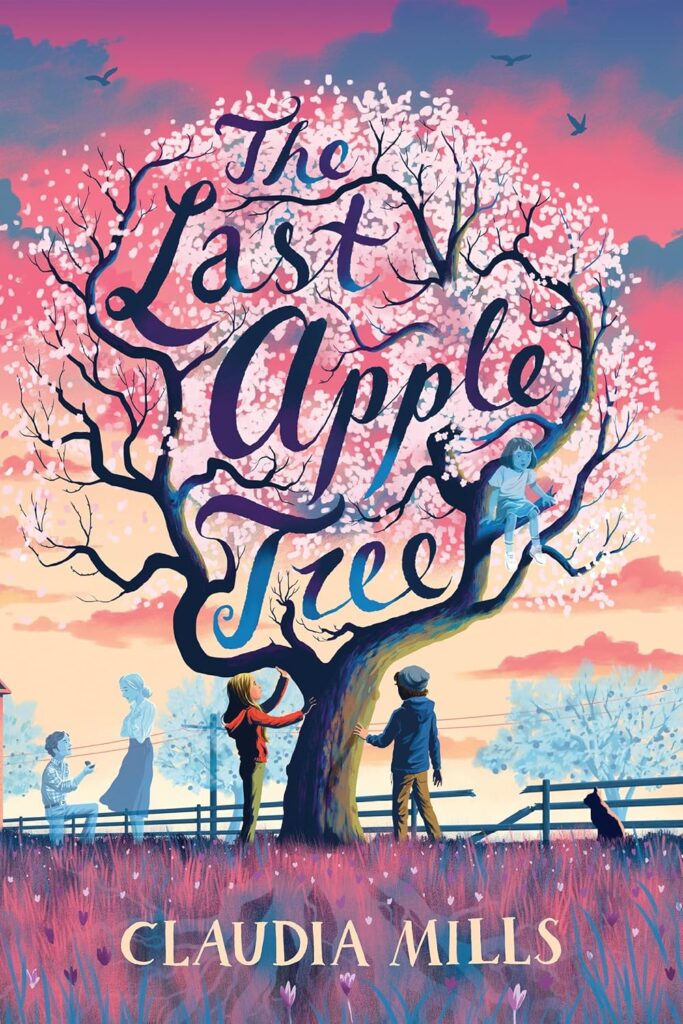
The Last Apple Tree
Written by Claudia Mills
Ages: 9-12 | 264 Pages
Publisher: Holiday House (2025) | ISBN: 978-0823461882
What to Expect: Contemporary fiction, family dynamics, intergenerational relationships, environmental themes, and the complexities of memory and forgiveness.
Contemporary, yet with the classic appeal of novels like the 1978 Newbery Medal-winning Bridge to Terabithia, this gentle exploration of loss, environmental awareness, and the delicate balance between remembering past events and moving forward demonstrates why Claudia Mills is a master of emotionally intelligent storytelling that respects the capacity of young readers for taking on complex themes.
After her grandmother’s death, twelve-year-old Sonnet moves across the country to live with her grandfather, whose once-thriving apple orchard has been reduced to a single heirloom tree amid new housing development. When her neighbor Zeke chooses her grandfather for a school oral history project, Sonnet resents his probing questions that reveal painful memories she’d rather avoid. Their conflict escalates when Sonnet invites Zeke’s activist father to speak at the school’s Arbor Day assembly, creating the exact family exposure Zeke desperately wanted to prevent. However, as the interviews reveal a past family tragedy and an emergency forces them to work together, both children must confront some difficult truths—rather than avoiding them.
Utilizing a dual-perspective structure that alternates between Sonnet and her initially antagonistic neighbor, Zeke, adds an intriguing depth and authenticity to the story. Rather than presenting conflicts with easy resolutions, Mills allows both characters to be flawed and realistic. This nuanced characterization elevates what could have been a simple friendship story into something more substantial as they navigate interviewing her grandpa for the school oral history assignment. The narrative feels both intimate and universally relevant, while the ecological subplot, from the symbolic apple tree to the school’s Green Club and the Arbor Day assembly, feels both plot-relevant and thematically resonant.
A particular strength of Mills is her portrayal of intergenerational relationships—the dynamic between Sonnet and her grandfather captures the tender complexity of watching a loved one age, while the oral history project becomes a meaningful vehicle for exploring how families process trauma and memory. Perhaps what is most impressive is how Mills handles the story’s emotional weight—her background in philosophy thoughtfully enriches the story without overwhelming the accessible narrative voice. When the broader themes of family secrets arise, they are treated with the gravity they deserve, while still maintaining hope and the possibility of healing.
The overarching journey of Sonnet’s character growth provides a mature message delivered with age-appropriate wisdom as she goes from wanting “everything to be okay” to accepting that remembering past events can be more complicated than simply trying to forget—acknowledging that some wounds don’t fully heal, but relationships can deepen through shared understanding.
Mills has crafted a story that honors both the pain of loss and the resilience of young people facing change, making The Last Apple Tree a worthy addition to the contemporary middle-grade canon.
Buy the Book
About the Author
Claudia Mills is the author of over 60 books for young readers, including most recently the verse novel The Lost Language and the middle-grade novel The Last Apple Tree, as well as two chapter-book series: Franklin School Friends and After-School Superstars. Her books have been named Notable Books of the Year by the American Library Association and Best Books of the Year by the Bank Street College of Education; they have been translated into half a dozen languages. Claudia is also a professor emerita of philosophy at the University of Colorado and a faculty member in the graduate programs in children’s literature at Hollins University. She has written all her books in her faithful hour-a-day system while drinking Swiss Miss hot chocolate.
For more information, check out claudiamillsauthor.com.

Dedicated Reviews allow authors and illustrators to gain prompt visibility for their work. This is a sponsored*, non-biased review of The Last Apple Tree. Learn more about getting a book review …
