

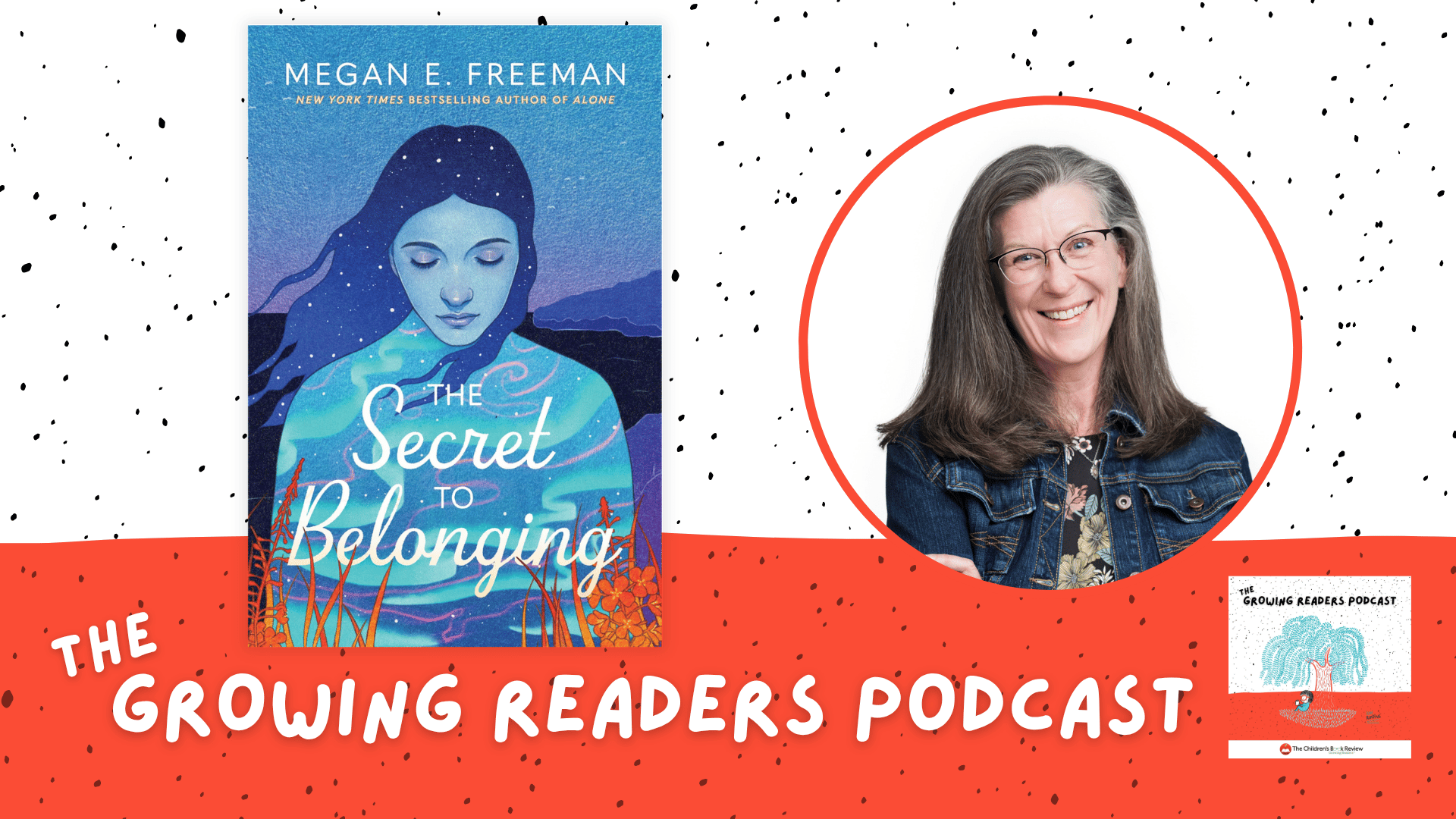
A podcast interview with Megan E. Freeman discussing The Secret to Belonging on The Growing Readers Podcast, a production of The Children’s Book Review.
Join us for a heartfelt conversation with Megan E. Freeman about The Secret to Belonging, her YA debut about family, resilience, and discovering what it means to belong.
In this episode of The Growing Readers Podcast, New York Times bestselling author Megan E. Freeman returns to talk about The Secret to Belonging, a coming-of-age novel in verse that takes readers from a painful home life to a remote corner of Norway. Megan discusses stepping into YA after Alone and Away, writing about the ripple effects of addiction on families, and exploring how an unexpected fresh start can give a young person the space to imagine a future of her own.
At the heart of the conversation is a powerful message about finding joy after despair, making room for your own dreams, and learning to belong to yourself.
Subscribe to The Growing Readers Podcast to ensure you never miss an episode celebrating the creators shaping young readers’ lives.
Listen to the Episode
The Show Notes
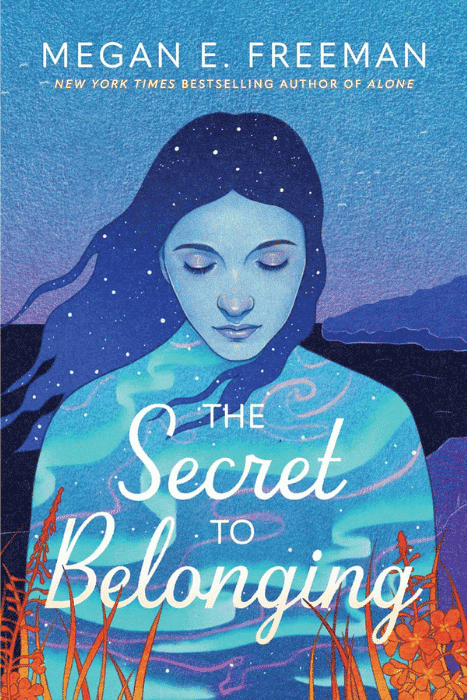
The Secret to Belonging
Written by Megan E. Freeman
Ages: 12+ | 352 Pages
Publisher: Atheneum Books for Young Readers (2026) | ISBN-13: 978-1665988407
Publisher’s Summary: A neglected teen travels to Norway for a fresh start in this “lush…aching” (Publishers Weekly, starred review) coming-of-age novel in verse about longing, love, and the courage to create joy from the ashes of despair by award-winning and New York Times bestselling author Megan E. Freeman.
You are invisible in your own family. Your parents spend all their care and attention on your brother, who is addicted to drugs. Your dreams don’t matter to anyone but you.
Your only ticket out is a college fund left by your grandfather—until your parents use it to pay for your brother’s drug rehab.
Just when your future seems about to collapse, you are offered a lifeline: a scholarship to become an exchange student in a remote part of Norway. It’s an invitation to begin a new life in a new place with new people…a place where you might finally feel like you belong.
Buy the Book
About the Author
Megan E. Freeman attended an elementary school where poets visited her classroom every week to teach poetry, and she has been a writer ever since. Her New York Times bestselling novel in verse, ALONE, won the Colorado Book Award, the Massachusetts, Maine, and Vermont Children’s Book Awards, the High Plains Book Award, is an NCTE Notable Verse Novel, and is included on over two dozen “best of” and state reading lists.
Megan is also a Pushcart Prize-nominated poet and the author of the poetry chapbook Lessons on Sleeping Alone. An award-winning teacher with decades of classroom experience, Megan is nationally recognized for her work leading workshops and speaking to audiences across the country. Megan used to live in northeast Los Angeles, central Ohio, northern Norway, and on Caribbean cruise ships. Now she divides her time between northern Colorado and the Texas Gulf Coast.
For more information, visit https://www.meganefreeman.com/
Credits:
Host: Bianca Schulze
Guest: Megan E. Freeman
Editor: Kelly Rink
Producer: Bianca Schulze
Read the Transcript
Bianca Schulze Hi, Megan. Welcome back to The Growing Readers Podcast.
Megan E. Freeman Thank you so much. I’m so delighted to be here.
Bianca Schulze It’s really fun to see your smiling face. You’re one of my favorite local authors here, so I’m glad you’re back. I’m hoping we can just start with some fun, silly, rapid-fire questions. All right: coffee, tea, or hot chocolate on a snowy Norwegian morning?
Megan E. Freeman Thank you. Likewise. Oh my gosh, hot chocolate.
Bianca Schulze One word to describe what it felt like to write in the second person for an entire novel.
Megan E. Freeman Challenging. Okay.
Bianca Schulze We’re going to get into that later. If you had to pick one Norwegian word you learned while living there that English doesn’t have a good equivalent for, what would it be?
Megan E. Freeman It would be the word dere, which is the plural “you.” The closest we have is “y’all,” and different parts of the country have different variations on “y’all,” but it is so helpful to be able to be very clear about when you’re using a singular “you” or a plural “you.” I didn’t fully appreciate that until I came home from having learned Norwegian and missed it terribly.
Bianca Schulze Yes. And, tangent: when I’m talking to my kids and I mean the universal “you,” and I say “you,” and then they feel like I’m coming at them, I’m like, “But no, no, I meant the universal you.” Verse or prose? I think I know the answer to this one. If you could only ever write in one again, which one wins?
Megan E. Freeman Yes. Yes. Exactly. Lots of potential for confusion. Verse.
Bianca Schulze What’s the very last book you read that made you cry?
Megan E. Freeman Crystal D. Giles’ middle grade novel Listen to the Girls. It’s so good.
Bianca Schulze I’m going to have to check it out. All right, longer answers now. The Secret to Belonging feels like a real departure in subject matter from Alone and Away. Alone and Away are your middle grade reads. We’ve got [title unclear] coming out in 2027. Exciting. But The Secret to Belonging is YA, and even though the verse novel DNA is unmistakably yours in this, when did you first know that this was the story you needed to write next? You were in this middle grade world for a while. So when did you decide to depart from that and write this one?
Megan E. Freeman It’s such a good question. And the truth is that the publication record and the writing record are not the same. I actually started writing The Secret to Belonging after Alone came out. I was working on a bunch of different projects. I wrote another middle grade. I wrote part of another novel in verse. I got about halfway through The Secret to Belonging and decided to focus again on middle grade. So then I ended up writing Away. And we’re talking over three years here, so it wasn’t quick. I ended up writing Away and then going back and picking up The Secret to Belonging again. So it sat fallow for probably 18 months, 24 months, something like that, in between projects. It feels like a big departure, but in fact, before I wrote Alone, I had written a YA novel that has yet to find a home. So I’ve been writing in both categories all along, but the publishing history has been middle grade up to this point.
Bianca Schulze I love doing that. Well, I hope the other YA also finds a home.
Megan E. Freeman We’ll have to go back and see. I need to look at it again. It may not be worthy of a home. It may need some tinkering.
Bianca Schulze I love it. All right. Well, this book, The Secret to Belonging, puts a spotlight on something a lot of families live with, but they usually live with it quietly: a child who becomes invisible because a sibling’s addiction consumes all the household’s attention and care. So what was it that drew you to tell that particular story, the story of the kid standing just outside the crisis and not in the middle of it?
Megan E. Freeman It’s a role I’m intimately familiar with. Like most people, my life has been touched pretty impactfully by addiction in a variety of different relationships and different dynamics. So it was not anything that… I was asked a question earlier, “What research did you have to do?” And I thought, gosh, I just had to wake up in the morning. I just had to live in my house, which is unfortunate, but it’s hardly unique. Addiction is such an infuriating disease because of the collateral damage that it creates and causes. It’s bad enough for the person who’s directly impacted and who’s struggling against it, and it is so deadly and so destructive, but the ripple effects and the collateral damage are enormous and hard to contain. That’s something I’ve been familiar with and working with for a very long time, so it wasn’t hard to tap into that. Now, I want to say really clearly, The Secret to Belonging is fiction. Very little in it happened to me in terms of the plot or anything like that, but the context and the emotional reality are something I’m really familiar with.
Bianca Schulze Yeah. Well, writing a parent who is, by necessity of the story, failing one child while trying to save another, that’s morally complicated terrain. So how did you go about approaching the parents?
Megan E. Freeman You know, that’s such an interesting question. And the truth is that I did not concern myself with anyone but the main character. My only goal was for her to be fearless on the page and for her to use the story to tell her unvarnished truth. She speaks to the reader in ways she doesn’t speak to anyone else, even her most intimate bosom friends. She doesn’t reveal the depth of what she’s experiencing at any point to anyone entirely, except for the reader. The reader is her true and only confidant. And playing with that was liberating in a lot of ways, right? Because you can say to the reader what you would never say to your sibling or to your parent, because you don’t want to hurt them, or because it’s only going to make the situation worse, or instead of de-escalating, it’s going to throw gasoline on the fire, whatever the situation is, whatever the dynamic is, whatever the dysfunction is. But to be able to truly speak the truth without any fear of repercussion is pretty radical, and that’s what I was really interested in exploring. We’re going to tell the whole truth of this person’s reality and experience. And of course, there are as many other points of view and truths as there are people in the dynamic, but for this particular project, I was only concerned with her. So how the sibling and the parents fall out, I didn’t make that my business. If that makes sense. I don’t even know if that makes sense. Okay.
Bianca Schulze Yeah. It makes complete sense. I love that. I love that. And obviously, you know, every reader comes to a book with their own life. So I’m always trying to read it as how would the kid perceive it, or a young adult perceive it, but it’s impossible not to read it as you are. And I’m a parent. So I was looking at these parents and I was like, “Wow, this is really good food for thought.”
Megan E. Freeman Yeah. It’s interesting hearing different people who have read advance copies. Some people have responded to the main character, and some people have responded to the parents, right? These challenges are so universal, and they’re so impossible, and they’re just so enormous. I think there’s a lot for anyone to potentially connect to.
Bianca Schulze Yeah. Well, that’s a very specific and devastating detail in the premise: that the protagonist… well, there’s a couple, but we’re not going to do spoilers unless you decide to offer up pieces. But this is a good plot point. The protagonist’s college fund, left by her grandfather, gets spent on her brother’s rehab, and that’s not an abstract loss. It’s a door closing on a very real future for the main character. So can you talk about landing on that particular wound as the inciting incident?
Megan E. Freeman Yeah. From just a strictly storytelling perspective, I actually love that, because when we first meet her, we learn really quickly that college is the light at the end of her tunnel, right? She is surviving in her family despite its dysfunctions. She’s getting through every day, but she’s literally counting down the days on the back of her closet door until she can go to college and start fresh and start on her own, on her own terms, free from the burdens of her family. To have that be, literally, this shining light at the end of this dark tunnel that she lives in, and then to take that away so suddenly is devastating. I think it’s devastating, especially when it’s sacrificed to the thing that is causing her to want to leave in the first place, right? There’s something deeply painful about the fact that the very thing that’s driving her away is also the thing that’s going to prevent her from going. There’s something sort of dramatically beautiful about that loss and that tension. And that sets up so nicely the opportunity that she gets to become an exchange student. She gets a scholarship. She and her best friend each get scholarships to become exchange students, and she ends up leaving a year earlier than she had planned, because she goes for her senior year in high school instead of staying until graduation. So, strictly from a craft perspective, I really loved throwing her off that cliff. And then, this is such a bad cliché, the parachute opens after you jump. This opportunity presents itself that she never would have even considered.
Bianca Schulze Yeah. Did you do any extra research into what it’s like to be the sibling of someone with addiction, that forgotten family member, beyond what you have witnessed personally? Were there resources, other memoirs, or conversations with other people that maybe you’ve lamented with that helped shape how you wrote the experience? Or is it just what you said before, where it’s purely drawing off your instinct of storytelling and life experiences?
Megan E. Freeman Certainly, over the years, I’ve met many friends and we have swapped stories. And of course, I love reading memoirs, and I’ve read a lot of memoirs. You can’t read much memoir without encountering the kinds of family dysfunctions that we’re talking about and the impacts of addiction and substance abuse disorder. But I didn’t do anything explicit for this book. It’s just been an accumulation over years. I’ve also spent a number of hours doing the kind of work that we find in twelve-step programs and recovery, and I’ve had some really great therapy and counseling over the years. All of that has informed my understanding of it and my relationship to it, and all of that informed the story.
Bianca Schulze Yeah. Well, I think you made a bold structural choice writing the entire novel in second person, addressing the reader as “you.” That’s rare. So walk me through the moment that you, Megan, decided that “you” was the only way to tell this particular story. What do you think the second person let you do emotionally that first person couldn’t have?
Megan E. Freeman Yeah. I played with both, and I would literally write a section using first and then go back and write it using second and just compare and contrast. And this is just a little tangent, but in the copyediting process, there was one spot where I found that I had fallen into first person. In one couplet, it was in first person. And I emailed my editor and I said, “My god, it says ‘I.’ It should say ‘you.'” None of us had noticed it. So it is a very subtle shift when you make the shift from one to the other. I had read a couple of adult books, one novel and one memoir, that were both in second-person voice, and I had really been intrigued by that and sort of admired it. Part of it was that I had written in first, I had written in third, and I wanted to try something new. With every book I’ve written, I’ve tried something new, either in the formatting or in the voice. I personally want to try new things and see if I can make them work. So that was part of it, but I also really felt, and this goes back to this notion of courage, right, and being free to truly tell the unvarnished truth, that if you are the person, then you already know the story. You already know the truth. It creates an intimacy for the reader, I think, that creates an empathy that maybe isn’t there if you’re reading in first person and the speaker is the “I,” instead of the reader being the “you,” or the reader being the “I,” right? It’s like, okay, if you were five and you sat on your dad’s lap, you already know this. You were there, right? So it creates a weird psychological dynamic that I really liked and that I thought lent itself to that kind of empathy and intimacy. And I’ll be really interested to know, I’m guessing there will be people who read it and don’t realize that it’s in second person, because I do think it’s so close to first psychologically that, for some people, it will be invisible.
Bianca Schulze Yeah, you’re probably right. So I know that you actually lived in northern Norway yourself, which is a really wonderful thing to bring to a novel about an exchange student starting over there. How much of your own experience of arriving somewhere as an outsider found its way into your protagonist’s first weeks in such a remote country?
Megan E. Freeman Yeah, no, all of that was from my own experience. I lived above the Arctic Circle; she lives above the Arctic Circle. I lived with a family. The family in the book is completely fictionalized. The family I lived with did not have that shape and did not have that demographic. But the character in the book does go to summer school in Norway with all the other international exchange students, and we did that in the program that I was part of. So all of that was very much my experience of it, and the tumultuous nature of being a linguistically fluent person in one language and really totally inept in another language, and not being able to use the one, you know that feeling of “I’m having all these sophisticated thoughts, but I can’t articulate a single one. I can barely ask for a glass of water,” right? That was such a head trip. I remember having so much empathy for toddlers, because I felt like a toddler. I know what I’m trying to communicate, and I can’t communicate it. You see that in toddlers who have no language acquisition yet or who are in that developmental phase. So her experience in the book is all from my own experience, and much of what she does as an exchange student was also my experience. I was an art student; I went to an art school. I studied weaving. I gave her all of that because I could draw so completely on those memories and those opportunities that I had as well.
Bianca Schulze Yeah, I love that. And I just love the way that, as she picked up the language, it mirrored how she was also growing inside. It was such a great parallel to watch and experience as the reader. So you’ve received some wonderful starred reviews, and I love how vividly the setting comes through, like the cold, the snow, and just that blanketed quietness that anybody who has just walked through a completely snowy area… You really captured it. So what is it about that specific Norwegian landscape that felt right for a story about someone learning to take up space in her own life, right? She’s been the outsider, and all the focus has been on her brother, and yet you drop her in this space where the land is just so vast around her, you know.
Megan E. Freeman Yeah. So I grew up in Southern California, and when I moved to Norway, I was fifteen. I spent my junior year in high school abroad, and it was so startlingly wonderful, because I was not used to seasons at all. In California, the temperature varies 20 degrees, but for the most part, it’s pretty static, right? The weather and the climate. So to be in a climate that had such dramatic shifts, not to mention above the Arctic Circle, where it’s light half the year and dark half the year, right? That’s a whole other thing, let alone winter and fall and spring. It was so novel for me. I felt like I’d been dropped in this sort of magical wonderland. And I don’t think it’s a coincidence that I ended up choosing Colorado as my home, because Colorado feels very much like Norway in terms of the climate and the weather and all of that. A lot less dramatic, but you still get to have all of that. So for me to make that choice for the story, it felt like a no-brainer, because I knew I had such a wealth of memories and sensory details and the wonder of discovering something that is Mother Nature and just makes you stop and drop your jaw in awe. It’s so fabulous. And if you’ve never seen it before, it’s even more extraordinary.
Bianca Schulze Yeah. Well, one of the tender threads in this book is first love, and it becomes part of how she starts to understand her worth separate from her family’s chaos. So how did you want that relationship to function in the story without letting it become the thing that fixes her? Because I think we, as adults now, can look back and think about relationships and how they can make us and whatnot, but really we need to be our own people first, which your character shows. So what went into that? Because I really loved this relationship. It’s got the perfect amount of health, but it’s also not depicted as a perfect wonderland first love. So anyway, I’m rambling. You talk.
Megan E. Freeman Yeah, no, it’s such a nice question, and I’m so glad you thought so, because I just adore them as a couple. I absolutely did not want this to be any kind of Cinderella story, where she’s rescued in a heteronormative dynamic or anything like that. I wanted this to be another wonderful thing that she discovers in the world, right, among many wonderful things that she discovers in the world, which includes relationships with other people that are not romantic, and all those different dynamics. I wanted her to get out from under the shadow of her family and the burden of her family and discover that there are all kinds of ways to be in healthy relationships with other humans, and that other humans can be trustworthy and can bring value to a dynamic. It’s not always a diminished return. I wanted her to experience that and, frankly, learn to trust, because when she arrives, she’s not trusting. Everything looks great, but she knows better than to believe the surface of things, right? So it was all part of that experience of discovering that the world doesn’t have to be dangerous, that the world doesn’t have to be full of pitfalls, that relationships don’t have to destroy you from the inside out. But also for her to discover that she kind of likes who she is in relationship with these other people, right? There’s that great… I don’t know if everybody has this experience, but the first time you meet somebody, a friend or a lover or whatever, and you think, “I really like myself when I’m with that person.” Because there are other people where you think, “I don’t like who I become when I’m in that dynamic,” right? That’s such an amazing experience, and that’s what makes us want to find more people like that and people our lives with the people we love to be with, because we like who we are when we’re with them. So I wanted all of those things to be true for her in platonic dynamics, in sexual dynamics, in romantic dynamics, in family dynamics, with all of it. I wanted her to see there’s another way to be, and you have the agency to manifest that for yourself, that what you’ve inherited from your family doesn’t have to be a legacy that you choose to carry.
Bianca Schulze Yeah. I just love talking to you, Megan. I just do. That’s so great. So, as I said before, and I’ve said it in so many episodes, the reader gets to decide what the book is to them. To me, my overall meditation at the end was recognizing that the weight of someone else’s choices isn’t something one should have to shoulder, right? I think that’s a really hard realization, and not just for teenagers; I think for adults too. So was that insight that I took away something you set out to write toward? Or is that just something that revealed itself to her, or revealed itself to you as the writer as you followed her? Or maybe that’s just a theme that revealed itself to me because of my own life experiences?
Megan E. Freeman Sure. It’s probably all of the above, honestly. I definitely wanted her liberation to be the ending of the book. I didn’t plot this book; I just wrote. But because I had had the experience of living a year abroad, I had a structure in my mind of that experience. I didn’t necessarily know how it was going to end when I started it, other than to know that she would be transformed in a way that would be positive and empowering, and that she would be rewarded for having the courage to tell her truth and to live in integrity with that truth. Because I think a lot of times we know what we should be doing, or we know what’s best for us, or we know what we would like, but we don’t necessarily align our choices or our actions with that desire or that knowing. And I don’t know if that’s even more true for women than for men, because I think so many of us are programmed to please others or to caretake others. But I know it can be incredibly challenging, and the rewards are huge when we’re willing to put ourselves first in a healthy way and set boundaries that protect us from unhealthy dynamics.
Bianca Schulze Yeah. Well, the title itself, The Secret to Belonging, is also doing a lot of work. It promises a secret. So, without giving it away, what do you want readers to understand about belonging by the time they close this book that they might not have understood going in?
Megan E. Freeman You know, that’s a hard question, because I don’t necessarily have an agenda for the book, if that makes sense. As you said a minute ago, different readers may come away with very different insights into themselves or into the book, and it’s going to be what it’s going to be. I will say belonging means so many different things, right? Whether it means belonging to a place, or belonging to a family, or belonging in a space, or owning a belonging that you can hold or that you can purchase or sell or make or give away. So all of the nuance that goes into that notion, or “I belong to someone,” right? Or “they belong to me.” I think that’s all up for grabs. And I think, just like we get to set boundaries that serve us and that are good for our overall health and well-being, and I mean that in a mental way and in a physical way and everything, when we can be healthy and productive, we can be better members of our families and of our societies and of our civilizations. And when we can remember that we have that agency, then we can create the lives of our dreams. And I don’t mean that in a Pollyannaish way. I know there are huge obstacles and challenges that everyone faces, and everyone’s are different and everyone’s are similar. But to find that sense of belonging, I mean, isn’t that Maslow? Isn’t that the base of Maslow’s pyramid? We need to feel like we belong.
Bianca Schulze It’s like safety and security, right? And then I think it’s shelter, and then, yeah.
Megan E. Freeman Right, right. Yeah, maybe it’s the top of the pyramid, but it’s in there, right? Exactly. Exactly. Exactly. Exactly. And if we’re always looking outside ourselves to have that be true and we don’t recognize that we are actually empowered to create the real reality that we want to live in, it can be pretty frustrating. So I don’t know if I even answered your question, but those are all the different things that I think about when I think about belonging.
Bianca Schulze Yeah, because you become self-actualized when you get up there. Is that when you belong? Yeah.
Bianca Schulze Yeah. Well, and this question’s sort of similar in this vein, but you’ve said to me before that your deepest hope for any book is that it helps kids feel loved, seen, known, heard. So, given how specific and personal this subject matter is for some, addiction, neglect, invisibility within your own family, for a teen reader who recognizes themselves in your protagonist’s family, who’s living in the margins the way she was, what do you hope that specific reader takes away, practically or emotionally, from watching your character walk toward her own life?
Megan E. Freeman Well, certainly I hope they feel recognized, or maybe less alone than they might have, right? To see yourself in a book can be a pretty comforting thing. But I also think it’s worth noting that the character, her best friend’s family sort of took her in when her family wasn’t paying attention. And she has a counselor at school who is really advocating for her next steps. There are people in the world who are ready to be those things for us, but you have to be willing to share, right? You have to be willing to say, “Can I come over? Can I spend the night at your house?” or whatever. To let somebody know that you need that, and to seek that out. I remember that from when I was a teacher. There were certain kids who would come into my classroom and hang out on their spare period, or bring their lunch and eat with us. Those kids need something they’re not getting elsewhere, and it’s pretty easy to offer that and to be that source of comfort. I worked with a counselor once, a child counselor, and she talked about how she wants every kid to have a five-pointed star around them. In a perfect situation, two of the points on the star are going to be parents, and then three points come from somewhere else: a neighbor, a family member, a teacher, a coach, whatever. We know that’s not always the case for every kid, but she likes the idea of this five-pointed star around every child, because then there’s always someone they can go to or someone who is a person of trust for them. At the school where I taught, we actually interviewed kids and said, “Who of the adults at this school is somebody you would trust to go to in the event that you needed something or something was wrong?” And we loved it when they named the custodian, named the lunch lady, named the front office lady or the attendant, right? It’s everyone in the school who can be that. So I think about that when I’m in the life of a child: Can I be one of those five points for them? But also, thinking about every child, I want them to have those five points, and sometimes they may have those five points and not realize it. So again, I’m totally wandering from your question, but I would love for a reader who is suffering in their family to be inspired to reach out and find the support that they need beyond the obvious and immediate people in their…
Bianca Schulze Yeah. And you’re always entitled to wonder, because that was really meaningful. I think what you had to say was really meaningful. And I was thinking to myself how I would have loved to have been in your class as a student, because I think you would have been one of the points of my star. I mean that genuinely. I am wondering, do you have a copy of the book close by? And would you be willing to read us a short passage?
Megan E. Freeman That’s nice. Sure. Yeah. Do you have a section you want to hear?
Bianca Schulze No, go to a spot that feels right to you.
Megan E. Freeman Let me swap these. I’ve been reading from two different sections, so I’ll give you the choice. There’s a section from before she leaves, when she’s still in her home, and we’re getting to know her. And then there’s a section from when she first gets to Norway, where she’s in summer school and is being thrown into the deep end. So I’d be happy to read either one of those if you have a preference. Okay. Okay.
Bianca Schulze I want the “before she leaves.”
Megan E. Freeman Sometimes when the phone rings late at night in your parents’ room and you hear the fear in your mother’s voice, you close your eyes and imagine the sound of your future college roommate breathing in the dark. And the light from the dorm hallway under the crack between the door and the floor, and the mini fridge you’ll share, and the hot pot where you’ll cook ramen and add an egg to the water for protein, and listen to music and make mixtapes for each other, and pull all-nighters before midterms, and drink coffee black. You’ll learn to like coffee. And you cannot wait to graduate. In the epicenter of the earthquake that is your brother’s life, you become prematurely independent. While your parents are running around wedging cupboard doors closed and trying to bolt the house to the foundation, you’re on your own. Such is life in a disaster zone. You can hide under the table if you want to, but the house still falls in on itself. When you live with someone who lies constantly and tells the truth badly, you have a choice between calling them out after every sentence or never saying anything, because whatever you say will be challenged, and you’ll be told to lower your voice and accused of causing a scene. And at some point, the price of truth becomes less important than the need to survive. And eventually, it just isn’t worth it, so you keep your mouth shut and become invisible.
A koan: If you design the set for the seventh grade play but no one in your family comes to see it, did it actually happen? If you advance to state playing varsity singles but no one in your family is cheering in the stands, did you actually win? Between the calls from the jail and the drives to the emergency room and the long, tense conversations about refinancing the house again to pay for rehab again, no one pays attention to the invisible child. The problem child has to come first, has to. Life or death and all that. Invisibility has its pros and cons. Pro number one: expectations are very low. Pro number two: everyone leaves you alone. Pro number three: you can do whatever you want. Con number one: expectations are very low. Con number two: everyone leaves you alone. Con number three: you can do whatever you want. There is only so much money, time, energy, love to go around. We’re exhausted. They love you. We do. They’re sorry. We are. Your brother needs them, needs us more. They’re so proud of you. Thank you for meeting our low expectations. They love you. Thank you for not needing us. There is a cupboard in your chest. Behind your breasts, between your ribs, your heart is bruised from knocking against it. The doors are warped, the hinges rusty. The latch stays bolted.
Bianca Schulze Hmm. So good. So when you read that, what goes through your mind afterward? When you read your own words that you put together, and you know they’re going to enter the homes of many others, what goes through your mind?
Megan E. Freeman That is such an interesting question, Bianca, because I actually just recorded the audiobook for this, and it is such a surreal experience. It’s one thing to read it on a podcast or in a bookstore. That’s even better, because it’s totally extemporaneous. Nobody’s recording anything. It’s very surreal to think about other people hearing it. On the other hand, I love audiobooks. I love being read to. I love the moment in a classroom where someone reads their work and everybody leans in. There is something so magical and primal and human about storytelling that I get very excited about it. At the same time, there is some nervousness about wanting to deliver a story people are going to want to listen to, but there’s also excitement at the thought of creating that connection between a listener and a storyteller.
Bianca Schulze Yeah. And with the recording of the audiobook, I saw your picture on Instagram. It was very cool. I feel like it’s any writer’s… maybe no, I shouldn’t say it’s any writer’s dream. It’s not any, but it’s a lot of writers’ dreams to be able to record their own audio for one of the novels that they’ve written. So did you put your name in the hat for that? You said, “I’d love the opportunity.” How did it all come about? And then just tell us about the process a little.
Megan E. Freeman It’s so interesting. It’s a great question, because with my other two books, there was no part of me that wanted… I mean, I love reading them out loud. I love reading to students and all of that, but I didn’t aspire to do the audiobooks. I didn’t feel the need to do that at all. I had thought about it a little bit with this one, and then I was listening to Jason Reynolds. He actually does the audiobook for Long Way Down, and I had read Long Way Down as a “book book,” and then I discovered that he was the narrator. So I thought, “I want to hear him read it.” And I heard him read it, and afterward he talks about it on the audiobook, about why he really wanted to do that particular book, because of the nature of the poetry and the rhythm and the poetic devices. He knew it so intimately that he wanted to do it himself. And I thought, “Yep.” I had also just listened to Amber McBride read Me (Moth), which is a gorgeous recording as well. And I thought, “Yep, this book. If I don’t do it, I’m going to really have to help the narrator, first of all, with all the Norwegian.” I knew they were going to ask me to make a whole recording of all the pronunciation of all the Norwegian phrases and words and things. So there was a part of me that thought, “Or I could maybe just throw it out there that maybe I could do it myself.” But also, because so much of this book is inspired by my own emotional experiences of these kinds of situations, it just felt like maybe this is one where I should offer. So I asked my agent, “What do you think?” She said, “Yep, I think that could be cool. You need to make an audition tape, do a demo, and send it in and just see. And I’m not going to get attached to any outcomes. I know this is a long shot.” My editor was very supportive, but she also said, “I don’t have anything to do with this.” And nine times out of ten, they say no, and they don’t want authors reading their own book. So I kind of threw it out there and figured they’ll either invite me to do it or they’ll get someone great, and I’ll help them with whatever they need, and it’ll be what it’ll be. So then when they came back and invited me to do it, I was really delighted. I was also really scared. Careful what you wish for. But it was a great experience, and I really enjoyed the whole process. I don’t know that I need to ever do it again, because this book is sort of unique, but I did enjoy it a lot.
Bianca Schulze How long did it take to record it?
Megan E. Freeman We did it in one session, in one day. But with verse, there’s not a lot of words. It’s not a long book.
Bianca Schulze Yeah. True. But I think about needing a break, and also those moments where you trip up on a word and you have to go back and redo it, or…
Megan E. Freeman Yeah. Well, and it was crazy, because we were in a recording studio here in Colorado, and the director was Zooming in from her home in New York. So I was in the booth, and there’s an engineer, and he can see me and I can see him, and he’s reading along with me, and she’s in the headsets. They could hear everything. Every once in a while, the engineer would stop and say, “I’m sorry to interrupt, but I just heard your stomach growl.” Or if I touched my clothes, I had to wear really soft clothing that wouldn’t make any noise, but I just put my hands on my legs, and he’s like, “I just heard the fabric.” Or I moved my feet on the carpet: “I heard your…” It was such a sensitive microphone. I became very self-conscious of my breathing. And one of the tricks: he had a glass of apple juice for me, and he said apple juice really helps keep your mouth sort of lubricated and makes you less likely to dry out. So, interesting. Yeah, it was very interesting.
Bianca Schulze Yeah. Awesome. Well, I definitely want to listen to the audio when it’s available, so I’m excited for that. All right. I want to make sure that every listener knows that, as much as this book is about some tough topics, and there are certainly some teen readers it’s going to be written for, it’s a book for anyone who loves a novel in verse. It’s a book for anyone who loves realistic fiction. It’s a book for people who like romance, but even if you don’t like romance, it’s just the right amount of romance. So I just feel like there’s something in this book for so many people. On that note, if a reader closes this book and for the first time feels like someone finally put words to what they’ve been carrying, what do you hope those people do next? Do they put the book down and call someone? Do they write something down, or just breathe a little easier? What does that moment look like for you in your mind? A reader has just read it, closed the book. What do you think they do next?
Megan E. Freeman Well, I mean, every author hopes they’ll hand the book to somebody else and say, “You’ve got to read this,” right? That would be the dream, which is kind of what happened with Alone. Alone, my first book, had such a slow, long tail, but I think it was that beautiful word of mouth. So I would love for somebody to feel connected enough to it that they want to share that experience with somebody else by having them read it. I would also love for them to just have a sense of well-being: whatever the situation is, it’s temporary, and it doesn’t have to be this way. I actually have a say in my own life. I have a choice here. Depending on the circumstance, those choices are different, but I do have agency in this situation.
Bianca Schulze Before we go: at the time that we’re recording this, the book has not officially released, but when everybody’s listening, okay, you’re listening now, you can go and get the book. It’s available. But I know that you’ve been doing some discussions ahead of the launch. Is there anything about the book, the story, your process of creating it, that nobody has asked you yet that you wish somebody would just ask you?
Megan E. Freeman Hmm. I don’t think so. In fact, I’ve been asked questions that I was really delighted and surprised by. As I’ve been doing some of the writing, some of the off-the-book pieces, and having some of these conversations, I’m gaining insights into it that I didn’t have myself. It’s always very interesting when other people pose the questions, because they see things that I don’t necessarily have. I was really delighted that several of the reviewers, several of the booksellers who were asked to read it and blurb it, said things like, “Now I really want to go to Norway.” It never occurred to me that Norway could see a little boost in tourism or something, right? I just think that’s so fabulous, because there’s no better destination, no matter what time of year, right? Go in the winter and see the northern lights. Go in the summer and celebrate midsummer. So that’s been kind of delightful, to think that maybe Norway gets a glow-up based on the response to this book. But no, I don’t think there are questions out there.
Bianca Schulze Yeah. And of all the things that we spoke about today, if listeners take away just one thing, what would you want that to be?
Megan E. Freeman I think that the secret to belonging is in here. It’s in yourself. And it’s just a question of excavating that and figuring out what that secret is for you in your situation, in your life.
Bianca Schulze Amazing. Well, Megan, thank you for trusting us with a conversation like this and for writing a book that feels so beautifully and brutally honest. I feel like there’s a word there that sometimes people combine, beautiful and brutal together. I don’t know what it is. But The Secret to Belonging is the kind of story that I know will find readers exactly when they need it, young adults and adults alike. So thank you for giving us your time.
Megan E. Freeman Thank you. Thank you for having me.
Bianca Schulze Yep. You’re very, very welcome. And this beautiful book. Oh my god, the cover. Sorry, I know I said we were going, but we didn’t say how beautiful the cover is.
Megan E. Freeman Right. And credit to the artist, Natalie Foss, who is actually a Norwegian artist, which delights me no end. I believe she’s based in the UK, but when they showed us the different artists they were considering, we all loved her work, and so we were delighted that she was available. She has a gorgeous Instagram, and she posts some posts where you can see her process with her colored pencils and things. So I highly recommend following her, Natalie Foss.
Bianca Schulze Amazing. Say what her name is one more time.
Megan E. Freeman Natalie Foss, and it’s F as in Frank, O-S-S.
Bianca Schulze Awesome. I’m going to put that link to her Instagram in the show notes too. Oh wow, Megan. Thank you, thank you, thank you.
Megan E. Freeman Great, great. Thank you.
