

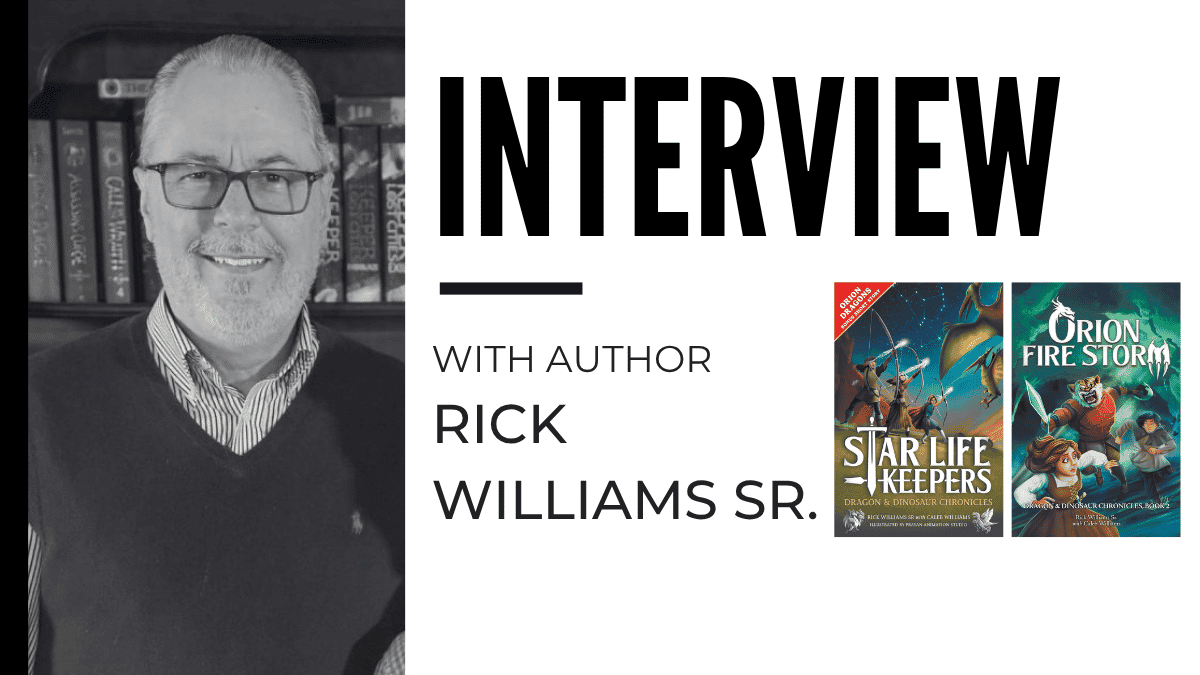
An interview about Dragon & Dinosaur Chronicles by Rick Williams Sr., presented in partnership with The Children’s Book Review.
Join us for a conversation with Rick Williams Sr. about the inspiration, imagination, and family collaboration behind the Dragon & Dinosaur Chronicles series.
What happens when a grandfather takes his grandsons’ wild idea about dragons and dinosaurs seriously? The result is the Dragon & Dinosaur Chronicles, a series that combines epic adventures, STEM-inspired imagination, and heartfelt themes of family, friendship, and perseverance. In this interview, Rick Williams Sr. shares how real-life experiences, childhood reading, and collaborative storymaking helped shape a world where young heroes learn that courage isn’t about being fearless. It’s about growing through challenges together.
The protagonists in your series are compelling because they aren’t perfect heroes and heroines—they have physical and character flaws that help them feel real. What was your process for developing a trio of characters that young people could easily relate to?
Rick Williams Sr. (RWS): One of the earliest decisions my grandsons and I made was that Jason, Amanda, and Elisa would never become flawless heroes. We wanted them to feel emotionally authentic—like ordinary middle-school kids suddenly thrust into extraordinary circumstances.
Jason struggles with grief, concerns about being a leader, and his hidden nanotechnology hearing aids. Amanda battles anxiety and self-doubt even while being courageous. Elisa is older and seemingly stronger, but, as the crown princess, she also carries emotional burdens and must withstand the Jurassican leaders’ psy ops.
Children dealt with incredible pressure during the COVID pandemic, and each day on social media can be challenging as peer influence has escalated. Many kids contend with constant adversity, such as uncertainty, grief, failure, and bullying. Media sensationalism and clickbait magnify fears about apocalyptic chaos.
Please tell our readers more about the concepts of “show, don’t tell” in writing science fiction-oriented fantasy books for children.
RWS: As parents know, preteens and teenagers begin to shy away from lectures. They don’t want someone to “tell” them how to stand strong, have courage, and be resilient. They usually need to see family-value principles effectively working in someone else’s life.
Fiction is one way to “show” children how to discern what is truth and what is deception, and who is a sincere ally and who is disloyal.
Many reviewers during The Children’s Book Review’s Virtual Awareness Tour picked up on this emotional core. Several mentioned that the cousins feel believable because they grow under pressure instead of always relying on their Star Life Keeper magic.
The three friends are given enviable amounts of power and authority over the course of the series, and something the books do really well is show how they struggle with the challenges that power brings. Why do you think it is important for children today to understand that with power comes responsibility and burdens?
RWS: In Dragon & Dinosaur Chronicles, Jason, Amanda, and Elisa face routine power struggles, both externally with the invading Jurassicans and Highlanders, and internally with conspirators and traitors within the Bukanian government. They discover that leadership isn’t easy. Every new responsibility creates more difficult choices, emotional burdens, sacrifices, and risks.
Star Messengers from the Orion Belt provide the second-generation Star Life Keepers with gifts to defeat the growing forces of evil. But the star-traveling cousins must also learn how to handle their astronomy magic, by themselves and while collaborating with their human, elf, and shape-shifting dragon friends.
Hopefully, young readers will realize that they, too, have their own magical gifts to use in life’s inevitable battles. They are entering a world shaped by artificial intelligence, advanced technologies, and an explosion of information. So, I wanted the books to contrast power dynamics and impersonal behavior with compassion, integrity, emotional discipline, and teamwork. My decade of working with China also taught me a lot about respect.
You’ve said that you dealt with significant interpersonal challenges as a 50-year entrepreneur and biotech executive. Did you integrate some of those experiences into Dragon & Dinosaur Chronicles?
RWS: Sadly, I encountered many power-hungry, unscrupulous people—business partners, scientific collaborators, investors, and employees—during my career. It’s possible that entrepreneurial fields may attract a higher percentage of egotistical people and traitorous behavior.
Based on the Myers-Briggs test, I have a high level of intuition and perceptiveness, which I continue to use in my business dealings. I also studied nonverbal communication and look for alignment between people’s motives and their actions.
I was fortunate to have a mentor, Dr. Richard Cox, who was a world-class psychologist. He taught me to identify sociopaths and crazymakers. (Julia Cameron discusses the latter term in The Artist’s Way.) We both learned to remain calm in high-pressure situations, like the eye of a hurricane. I share many of his lessons with young readers through the experiences of Jason, Amanda, and Elisa.
Doctor Cox was a psychologist, MD, theologian, artist, and author; he passed away last December at the age of 97. Despite being 90% deaf, he became a concert musician and composer. As lifelong learners, Dr. Cox and his wife, Betty, were avid readers and also experts in family counseling. He urged me to write uplifting books for preteens and teenagers, whom he felt needed encouragement during a volatile and confusing time in their lives. I depict his ongoing battle with hearing loss through Jason.
The Belacamber universe hark[end]s back to the medieval world. Why was this important for the development of the plot, and what research did you have to undertake to make it believable?
RWS: I grew up interested in civilizations, both ancient and modern, which helped with our worldbuilding. I spent decades studying medieval, American, Biblical, and ancient Chinese history as well as technological innovations and their effect on societies. I also wrote two scholarly works on American military history and extensively traveled around the world. All of these interests and experiences become part of my “Tolkien Stew” as I create Dragon & Dinosaur Chronicles.
Biographers have found numerous examples of Tolkien’s mash-up in The Lord of the Rings: his childhood communities outside Birmingham became the Shire; a youthful hike through the Aps influenced his development of Rivendell; and his dreadful WWI experiences showed up in Mordor.
The medieval-inspired world in the Belacamber parallel universe allows us to address today’s issues in a less true-to-life way—and allows the reader’s imagination to make comparisons to the real world. We follow the concepts of Tolkien and C. S. Lewis by developing creatures—such as our dinosaur-human hybrids—to serve as villains and enemies in warfare.
However, we are not creating traditional medieval fantasies since we add astronomy, biology, engineering, and ancient navigation to our Tolkien Stew.
One of my favorite things about this book is the fact that it blends tropes from both science fiction and fantasy to create something new and exciting. What inspired you to create a world in which both dragons and dinosaurs live with humans?
RWS: In April 2018, I gave Brady a tutorial on the history of writing instruments: quill pens, 19th-century steel dip pens, fountain pens, and inexpensive gel and ballpoint pens. He wrote with each pen in a blank journal like the ones I use for book projects. At the end of the discussion, I showed Brady my two American history books and made the point that words could be printed.
Two months later, Brady came into my office and proposed that we should write a book together about “dragons & dinosaurs” with Jason, his sister Amanda, and their older cousin Elisa as the protagonists. When I told him that dragons and dinosaurs don’t appear in the same books, movies, or TV shows, he looked at me and said, “Pappap, you’ll figure it out,” and then left.
When I confirmed that Brady was serious about this proposal, I spoke with his mother, Megan Williams, who gave me a bundle of Magic Tree House chapter books to read. I then went to the public library, where a kind woman gave me a tour of the shelves. She agreed that the Magic Tree House books would be a good prototype.
I expected to create a private publication, like the memorial book I developed for the family of Drs. Richard and Betty Cox in honor of their 70-year marriage—but Brady and our team of mid-grade reviewers had other ideas.
Besides your long career in the field of medical innovation, what else caused you to add science-related elements to your stories for middle school readers?
RWS: Many reviewers during the Virtual Awareness Tour mentioned that our STEM-like fusion has made Dragon & Dinosaur Chronicles feel distinctive and imaginative.
Early in the process, 8-year-old Brady and I visited the local Barnes & Noble store. I told the woman in charge of the children’s section about my situation, and she graciously gave Brady a guided tour. He opted to “write up” and create a fantasy more oriented to advanced elementary school readers and mid-grade students.
Over the years, I took three other grandchildren to the Barnes & Noble store, and the same woman gave each of them a tour of the children’s book section!
Around the same time, I took Brady, his younger brother Caleb, and Cousin Chen Pei on a “field trip” (with a written guide) to the Morehead Planetarium in Chapel Hill. We became fascinated with the celestial globe and armillary sphere used by 62 Apollo astronauts who trained there in the 1960s.
I had been serving as an advisor to the University of North Carolina and North Carolina State on an educational grant to adapt academic AI tools in support of families dealing with rare pediatric diseases (for which I had spent much of my career addressing). Thus, I combined AI and quantum computing with the planetarium’s celestial globe and armillary sphere to create the Star Globe for Jason, Amanda, and Elisa to time-travel.
I hired 6 kids from our church’s youth group to critique our initial manuscript. They loved what we were doing, suggested improvements, and recommended we make Star Life Keepers commercially available. That precipitated the creation of Legacy KidLit Press so my family and I could execute the multifaceted plan we had in mind for helping to enhance both childhood literacy and creativity.
One of the most important messages in the book is that when things get really tough, you are only as strong as the people around you. Was this a difficult message to craft in a way that wouldn’t make the story feel too didactic?
RWS: Young readers need to see that Jason, Amanda, and Elisa are developing inner strengths during their adventures in the Dragon & Dinosaur Chronicles series. But the star-traveling cousins also must derive strength from their families and Star Life Keeper friends.
Our books “show” kids the importance of interdependence. And that inner toughness comes from utilizing their own special strengths while relying on others.
When we helped to launch Genentech and the biotech industry, we were fortunate to work with the founders of what is now CliftonStrengths. I continued to use the find-your-strengths principles throughout my career as I helped emerging leaders to find their “unique fit.” I applied the same concepts in raising my kids.
Dr. Cox and I used CliftonStrengths for leadership development at the genomics company where I was the CEO. There, we got to see how an individual’s strengths complemented teammates and generated greater innovations and better overall results.
I try to be a story weaver, picking up “snippets of life” and incorporating them into our stories about how fictional characters deal with adversity. I especially pay close attention to my grandsons and granddaughters as they share their concerns about growing up.
We developed what we call the “circles of trust.” For us, the nuclear family and spirituality are in the middle. The next rings—relatives and close friends—extend out from there.
The emotional depth in our books often comes not just from my grandkids, but also from my experiences. For example, I’ve shared with them reflections on my own life and how I now realize many people I once regarded as friends were, in effect, only acquaintances—or on the outer rings in our circles of trust. I encourage my grandchildren to be trustworthy friends, find a few loyal friends in each grade level, and be wary of turncoats.
How do you envisage this story could be used in classrooms to help young people think more about their role as active members of their civic communities?
RWS: We see our books as being tools in the toolbox of parents, educators, and librarians. Students can enjoy our stories alone or in a school setting.
Through Dragon & Dinosaur Chronicles, educators and parents can explore themes such as:
- Leadership under pressure
- Ethical decision-making
- Teamwork and alliances
- Cultural diversity and cooperation
- Resilience and perseverance
- Scientific curiosity
- Problem-solving and executive functioning
The books also create natural gateways into STEM discussions as students learn about astronomy, paleontology, “fantasy biotech,” geography, mapmaking, and the adoption of new technologies.
During the Virtual Awareness Tour, it has been rewarding to see how our books’ themes—such as family, friendship, courage, perseverance, teamwork, and emotional growth—have resonated so well with reviewers.
My son and daughter-in-law, both former educators, have helped me to create a separate website called The Storymaking Hub. In its Creative Writing Lab, there are free roadmaps, curricula, and downloadable resources for educational enrichment at home, homeschooling, or in classrooms.
Through a blend of emotional authenticity and thrilling cinematic adventures, kids can have fun reading the Dragon & Dinosaur Chronicles while observing how Jason, Amanda, and Elisa learn and grow throughout the series.
Trust matters. Families matter. Teams matter.
So, you wrote this story [these stories] in collaboration with your grandson[s]. Can you tell us a little bit about what it was like to write with a younger family member, and how that helped create such a unique series? Is it something more children’s writers should try?
RWS: Writing with my grandsons, Brady and Caleb, transformed the creative process.
Children approach storytelling differently from adults. They are often less constrained by genre expectations and far more willing to expand their imagination in surprising ways. Collaborating with youthful rainmakers means I have to rush to capture the raindrops when they fall.
Brady helped inspire the original Star Life Keepers concept. Caleb worked with us on many of the early adventure elements such as the Hero’s and Heroine’s Journey. He later contributed additional worldbuilding ideas, creatures, and personal challenges for Orion Fire Storm.
We used a variety of creative strategies to develop our characters, creatures, and stories, e.g., blackboards, whiteboards, action figures, and sketching. My grandsons had one major request: that we have fun along the way. So, I took them hiking and biking, and taught them archery. I also purchased wooden replicas of medieval broadswords, and we learned how to fight with them.
Their involvement led to a process that synthesizes childlike imagination and adult story architecture.
One of the most meaningful aspects of this project has been the development of family-centered activities. In many ways, the books themselves reflect intergenerational storymaking.
What advice do you have for readers who are struggling with grief the way Elisa and Jason are in Book 1? Are there lessons they can draw from this series about surviving the trauma of unexpected loss?
RWS: Children react to tragedies in deep ways, but don’t know how to address their feelings. They often encounter emotional struggles before they have sufficient language to express what they’re going through.
Mary Kole from the Good Story Company was my write-for-kids coach. She helped me realize how young readers can better understand emotions like grief and mourning from a character’s perspective rather than being told about them. Mary also taught me her principles about interior monologue, which are now published in Writing Interiority.
Jess Redman’s Quintessence reinforced what I learned from Mary Kole. As a child psychologist, she features a middle-school protagonist who contends with panic attacks during a family relocation. I continue to use The Emotion Thesaurus handbook during my writing.
In Star Life Keepers, Jason, Amanda, and Elisa encounter the sudden loss of their fathers and their mothers’ despondency. Those heartbreaking incidents lead them to time-travel as a way to correct present-day problems. But, as the story progresses, the cousins discover that healing does not always mean changing the past. Sometimes healing means learning how to move forward despite the tragedy and pain:
- It’s okay to struggle emotionally
- Sadness and confusion are normal
- Courage does not mean the absence of fear
- You do not have to carry the burden of grief alone
- Healing often happens slowly
- Friendship and family matter more than ever
Many reviewers during The Children’s Book Review tour commented on (1) the emotional realism in our fantasy adventures and (2) how we use stories to offer hope to young readers.
My family and I make sure that parents don’t find unforeseen surprises in our mid-grade books. Many of them are weary of grimdark novels. We are committed to stay in sync with the family-oriented classic books that parents grew up with.
What are your favorite childhood quest stories that you would recommend to readers who have enjoyed reading the Dragon and Dinosaur Chronicles?
RWS: I grew up in a highly dysfunctional family. I now recognize that “deep reading” gave me examples of how to draw from my inner strength to thrive in the midst of adversity. My family had minimal discretionary income, so there were no books in our home. There was no library in our community.
A fourth-grade teacher (Mr. Bitler) introduced me to the Hardy Boys, Nancy Drew, and Tom Swift short novels. I especially loved the illustrations and have hired artists to make custom images and maps for our books.
In sixth grade, my teacher (Miss Mazziotti) let me leave class to borrow classic books—by Charles Dickens, Alexander Dumas, Victor Hugo, Jules Verne, Sir Walter Scott, et al.—from a bookmobile that came once a week to a nearby shopping center.
I began earning money by mowing lawns and shoveling snow to buy my own books. Unbeknownst to me, my sister “borrowed” my books. Looking back, we believe reading helped us to survive a bleak childhood and gave us hope for a better future.
A young boy recently had a similar experience in reading Star Life Keepers. He confided in his uncle that our book gave him hope in the midst of a contentious divorce.
As a young adult, I discovered The Lord of the Rings and became a lifelong fan of J. R. R. Tolkien. But I didn’t get immersed in fantasy until my “dragon & dinosaur moment” with Brady. To get started, I reviewed the first 16 years of Brandon Sanderson’s Writing Excuses podcasts and began studying his series, such as The Way of Kings, Mistborn, and Skyward.
One of Sanderson’s mid-grade fantasy books became an inspiration for my writing-with-kids adventure: on January 8, 2021, at 8:57 PM, Brady sent me a text saying, ‘I finished the 1st book of Evil Librarians!!! I am so happy ☺”
Did you read quest stories once you became an adult?
RWS: After becoming fascinated by international thrillers, I studied under bestselling authors for 7 years at the annual International ThrillerFest conferences in Manhattan. They showed how to embed high-stakes quests into stories about spies, assassinations, and saving nations.
My two scholarly American history books feature Civil War soldiers on quests, such as artillerists in the Chicago Mercantile Battery who received Medals of Honor after the war for their bravery at Vicksburg. I draw on elements from those little-known stories of battles and heroism in developing Dragon & Dinosaur Chronicles. For example, I based the Tunnelsburg Campaign (Star Life Keepers) and the Battle of Fort Champion (Orion Fire Storm) on General Ulysses S. Grant’s 1863 Vicksburg Campaign.
Ironically, I never thought about commingling science fiction and fantasy until Brady introduced me to his Dragons & Dinosaurs world. To get started, I read many of the classics, including C. S. Lewis’ The Chronicles of Narnia and his space trilogy, Tolkien’s The Hobbit, and Madeleine L’Engle’s A Wrinkle in Time. Brady and I studied movies such as The Lord of the Rings, Eragon, and Jurassic Park, while Caleb and I focused on action-adventure movies like James Bond and Mission: Impossible. I continue to read two kid-related fantasy books per month and have especially loved the Wings of Fire, Impossible Creatures, Keepers of the Lost Cities, Five Kingdoms, Unwanteds, and The Trials of Morrigan Crow series.
What’s next for the series–can we have a sneak peek?
RWS: I’m working on Book 3, Young Dragonriders, which continues the epic adventures of Jason, Amanda, Elisa, and their Star Life Keeper friends. Interestingly, we are using a Mission Impossible fight on a moving train to develop the front cover: Jason fights in a dragonback duel against the Silver Fox Assassin from Orion Fire Storm.
As Brandon Sanderson often says, “choose something familiar but make it different.”
I am also launching more short stories that either cover the origins of The Dragon & Dinosaur Wars or fill in gaps between novels.
In my computer, there is an almost-finished thriller—where the USA and China become partners—that I set aside when my grandson Brady proposed we co-write a book. I hope to turn that novel into an urban fantasy as our heroes travel forward in time via the Star Globe.
With my grandsons growing up, and waiting for other grandkids to be ready for co-writing, I now have children of our friends who serve as Story Advisors. They make sure my books remain relevant for young readers.
My family and I are grateful that The Children’s Book Review—with its focus on high-quality children’s books, credibility, and trust—has publicly launched our Dragon & Dinosaur Chronicles series. A dozen TCBR reviewers have taken the time to read our family-centered books, recommend them for mid-grade readers, and reaffirm their emphasis on childhood courage, resilience, and emotional learning.
Do you have any final thoughts on reading and storymaking?
RWS: I often say, “You need to make a great story before you can tell a great story.” In my biotech world, prospective investors don’t want to hear the scientists raving about their technology; they want to know how it can make a meaningful difference in people’s lives.
My family and I want to be a beacon of hope for others and are available to share lessons of what worked and what we could have done better in our own storymaking journey. My son’s observations as a former middle school principal summarize the wellspring—“it’s all about the kids”—in our engage-with-kids model.
“My father didn’t just pour wisdom into our boys. He listened to them. He took their ideas seriously. He let their voices shape the stories. That rare, intergenerational curiosity—an adult who genuinely builds alongside a child rather than directing them—is something we talk about endlessly in education but seldom put it into practice.
In our family, storymaking happened at kitchen tables and in playrooms, in backyards and public spaces around the community—over characters and worlds and questions like ‘what should happen next?’ I believe my sons’ collaboration with their grandfather has quietly shaped who they are becoming as young adults. I couldn’t be prouder!”
About the Books
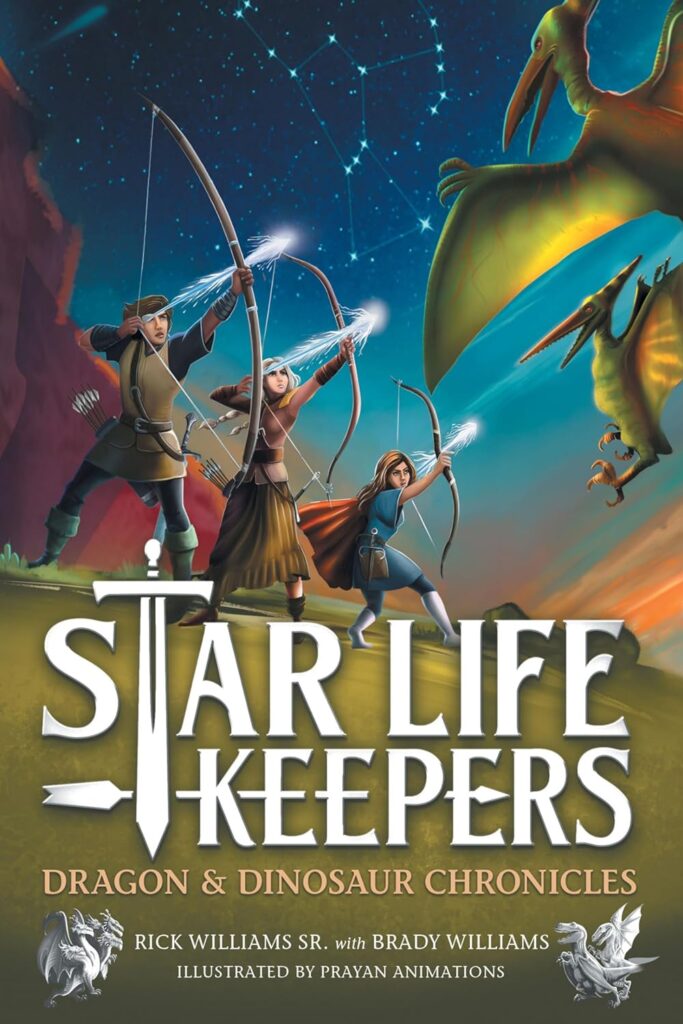
Star Life Keepers: Dragon and Dinosaur Chronicles
Written by Rick Williams Sr. and Brady Williams
Illustrated by Prayan Animations
Ages 10-14 | 388 Pages
Publisher: Legacy KidLit Press (2024) | ISBN-13: 9798987420010
Publisher’s Book Summary: With dragons and elves as allies, three cousins must save two worlds before time runs out.
Join cousins Jason, Amanda, and Elisa as their desperate wish to undo family tragedy launches them into the war-torn, mythical realm of Belacamber. In this beautifully illustrated, sci-fi/fantasy adventure, they stumble upon a cosmic portal hidden in Orion’s Belt and are thrust into a race against time that spans parallel universes.
Guided by the legendary Star Life Keepers—an extraordinary alliance of elves, shapeshifting dragons, and prehistoric predators—the trio faces relentless foes, including terrifying flying T. rexes and vicious ptero-raptors. The stakes climb higher when they must aid a warrior queen on the brink of losing her nation, all while battling to protect their own family back home.
In this fantastical, multicultural world, rich with dragons and dinosaurs, the cousins must rely on courage, loyalty, and an ancient starfire-forged sword to overcome the darkness. But will Jason’s dwindling hearing aids give out before he can deliver the final blow that will determine the fate of two worlds?
Star Life Keepers is a thrilling middle-grade epic that blends the magic of fantasy with the excitement of time travel, dinosaurs, and dragon-filled skies. Can the Star Life Keepers save both worlds before time runs out?
This is a perfect book to read as a family or classroom for ages 10-14.
Buy the Book
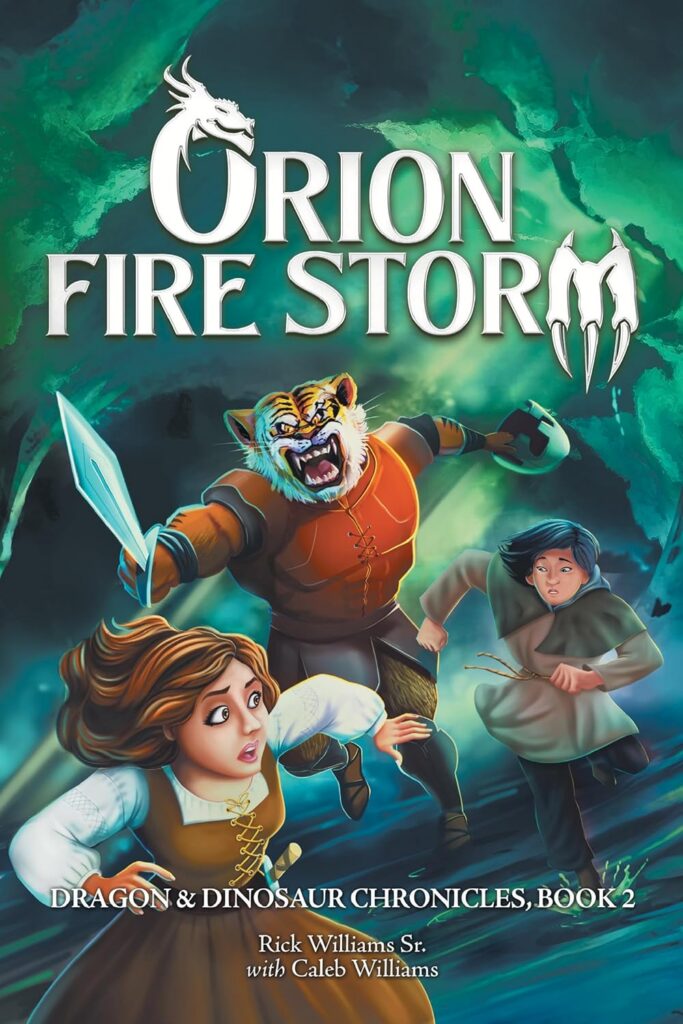
Orion Fire Storm
Written by Rick Williams Sr. with Caleb Williams
Illustrated by Prayan Animated Studio
Ages: 10+ | 417 Pages
Publisher: Legacy KidLit Press (2026) | ISBN: 979-8-9874200-7-2
Publisher’s Book Summary: During this time of renewed interest in space travel, Orion Fire Storm follows Jason, Amanda, and Elisa—modern-day teens who travel among the stars and into the past—as they join forces with elves and shapeshifting dragons to save their nations.
Continuing the adventures that began in Star Life Keepers, they face even deadlier trials in a medieval world of gryphon-riding wolf guards, roaming dire wolves, and flying raptors. Messengers from Orion’s Belt equip the cousins with magical gems to unlock the power beyond the universe.
Inspired by ancient and modern space exploration, the Dragon & Dinosaur Chronicles series is sparking a growing community of Story Apprentices—young readers who can create their own stories through The Storymaking Hub’s Creative Writing Lab.
Orion Fire Storm also features original illustrations, detailed maps, and an Encyclopedia of Creatures to deepen the reading experience.
Buy the Book
About the Author
Rick Williams Sr. is a former biotech executive who writes the Dragon & Dinosaur Chronicles series with his grandchildren and other Story Apprentices. Inspired by a visit to Chapel Hill’s Morehead Planetarium—where Apollo astronauts trained—the series features a Star Globe that transports young cousins into a parallel universe where they heroically use astronomy magic to save their nations.
His debut, Star Life Keepers, became a top Amazon children’s eBook in Space Exploration and Time Travel. The adventure continues in Orion Fire Storm and the upcoming Young Dragonriders. Companion short fiction—including the Orion Dragons’ Holiday Tale and Dragons & Betrayals—explores story origins and expanding worlds in the series.
Through the Creative Writing Lab at www.thestorymakinghub.com—featuring the Story Writing workbook—Rick provides roadmaps and free materials to equip a growing community of young creators who want to share their own voices.
For more information, visit: https://www.rickwilliamsbooks.com/.

This interview—Interview with Rick Williams Sr., Author of the ‘Dragon & Dinosaur Chronicles’ Series—was conducted between Rick Williams Sr. and Bianca Schulze.
